
 Menu
Menu Search
Is napping a sign of a deeper health problem?
Anna Lamb
Harvard Staff Writer
May 13, 2026 5 min read
New study finds link between certain sleep patterns and higher mortality in older adults
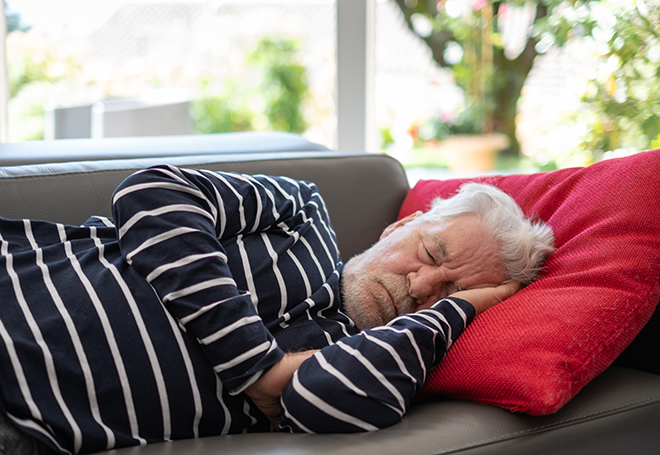
If Grandpa occasionally dozes off in front of the TV or squeezes in a power nap after lunch, it’s probably no big deal. But if he can’t keep his eyes open at the breakfast table, even after a full night of sleep, that could be a red flag, according to researchers at Mass General Brigham.
In a new study published in partnership with Rush University Medical Center, excessive napping by older adults is linked with higher mortality rates, signaling a possible connection to underlying disease.
“We know that older people tend to nap a lot. And we do a lot of work on age-related diseases, so we were thinking napping could predict mortality in older adults,” said Chenlu Gao, a researcher in the MGB Department of Anesthesiology, and lead author of the study. Gao is also a research fellow in the division of sleep and circadian disorders at Brigham and Women’s Hospital.
“We had this great opportunity to collaborate with the Rush Alzheimer’s Disease Center, who have a comprehensive data set,” said Gao. “Using this data set, we found that there is a connection between daytime napping and mortality in older adults.”
The Rush Memory and Aging Project, which began in 1997 as a cohort study looking at the cognition and neurodegeneration of older adults in northern Illinois, proved invaluable to Gao’s research. In 2005, the Rush project began having participants wear wrist monitors for 10 days to measure rest-activity data — allowing researchers to extract extensive information on nap length, frequency, timing, and day-to-day variability.

“What is great about this study is that it objectively measured daytime napping patterns, not just via self-report,” Gao said.
At baseline, there was little connection between mortality and subjects who napped within or below the “average” amount for their age group — just under an hour for participants in this study whose ages fell mostly in the early 80s range.
“Short naps, or within one hour per day of napping, are most likely benign or not associated with additional risks,” Gao said. “Our participants, on average, nap about 50 minutes per day, and they take on average about two naps per day.”
“Short naps, or within one hour per day of napping, are most likely benign or not associated with additional risks.”Chenlu Gao
By 2025, researchers had access to as much as 19 years’ worth of follow-up statistics from 1,338 total participants — all in retirement and older than 56. They found that both longer and more frequent naps were associated with higher mortality in the age group observed. Notably, each additional hour of daytime napping per day was associated with a roughly 13 percent higher mortality risk while each extra nap per day was associated with a 7 percent higher mortality risk.
Gao wants to make one thing clear: These findings do not suggest that the naps cause poor outcomes, but rather that they may serve as a warning sign for underlying disease.
“We think naps are more like a reflection of health conditions,” she said. “If you think about when you get the flu, you tend to be very tired during the day. Maybe you take several naps, but you also have other visible symptoms, so you know the nap is because of the flu. For some older adults who nap a lot during the day, their conditions may not have those very visible symptoms, so they don’t know they have the conditions causing them to feel really tired.”
And while the study is limited in determining a causal relationship between napping and health, Gao said there could be other factors that explain the associations between the two.
“I would imagine that those who are socially more active and also physically more active tend to be less depressed, less anxious, would be napping less,” said Ruixue Cai, another researcher at the MGB Department of Anesthesiology and the second author of the paper. “And just anecdotally, when we talk to older adult participants in our other studies, a lot of them say that they were really lonely and bored during the day because they’re retired, and so they would go take a nap.”
The data revealed another red flag to researchers — napping in the morning.
“Because for a healthy person, after a night of sleep, they should feel pretty refreshed and able to stay awake in the morning hours, but for people who are not so healthy, they may struggle with sleepiness even in the morning hours,” Cai said.
According to the study, morning nappers had a 30 percent higher mortality risk compared to those who nap in the early afternoon.
However, the occasional napper — regardless of age — should not be alarmed when they feel like getting some quick shut-eye, Gao said.
“I think those are fine,” she said. “We usually suggest limiting the naps to 20 minutes, and finish before 2 or 3 p.m., just so it doesn’t affect nighttime sleep.”
Gao emphasized this new data is no substitute for clinical advice.
“There are studies that try to implement long-term nap interventions to see if that will influence health. This is a really good future direction,” she said. “Findings from these studies would tell us how long-term nap habits influence health and inform clinical nap guidelines, beyond our current findings.”


