

SAIL tech lets robots perform human-scale tasks far more quickly
May 04, 2026
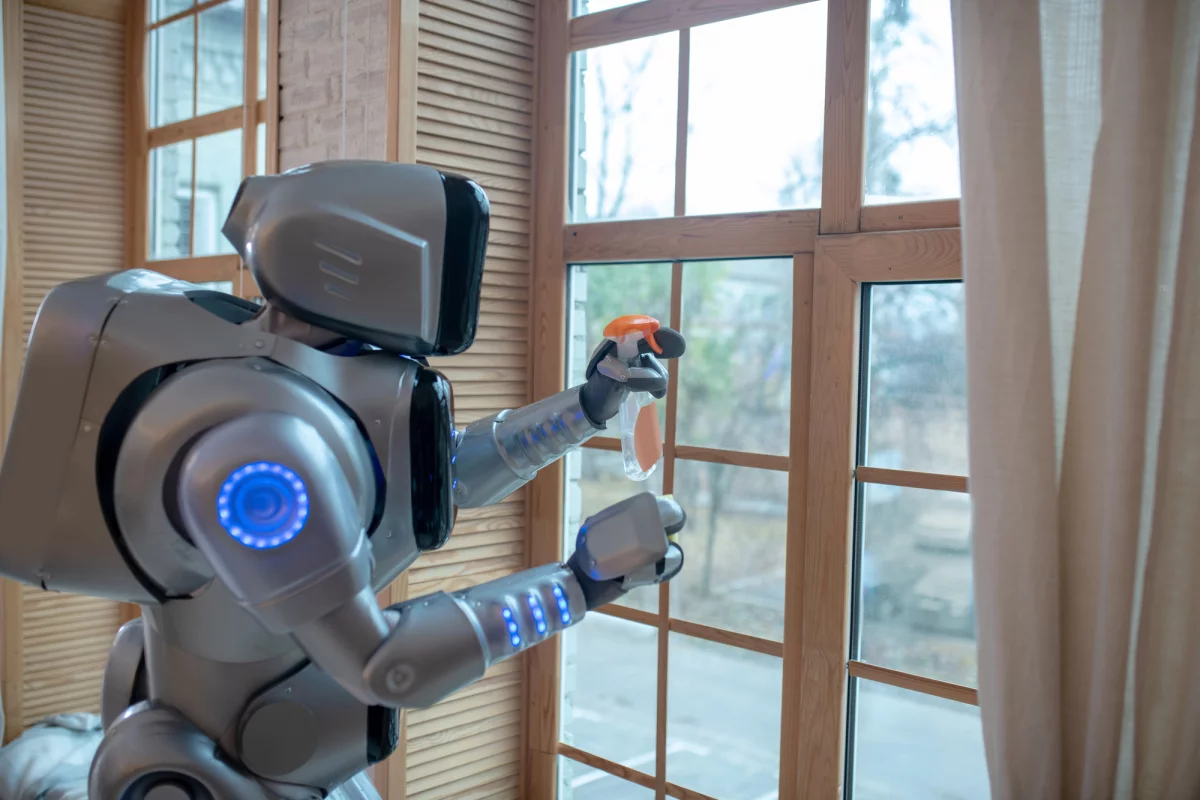
Thanks to the AI-based Speed Adaptation of Imitation Learning (SAIL) system, multi-purpose robots that perform tasks such as cleaning could soon be much more feasible
Depositphotos
View 1 Images
Thanks to researchers at Georgia Tech, robots have taken several new steps towards replacing human labor – and not simply for dangerous tasks such as mining the depths of the Earth and exploring the Moon, or difficult tasks such as high-speed mass-assembly of thousands of cars.
Instead, picture fine-motor, subtly complex tasks that have generally been beyond robotic dexterity and coordination: stacking cups, folding towels, packing food, and placing fruit onto plates – that is, the tasks of workers at hospitals, senior care facilities, child care centers, and restaurants.
Now, if you’re a business owner who wants to pay nobody to do that work and pocket all the profit, you’ll be thrilled. If you’re the person who does such work, or your family members do, or you own a business serving people who do, or you live in a city whose tax-base depends on tax-payers who do such labor, you may see the replacement of humans differently.
But first, let’s examine the genuinely remarkable technical breakthrough. In a recently-presented paper, Georgia Tech researchers Nadun Ranawaka Arachchige, Zhenyang Chen and colleagues explain how they have improved robots to perform domestic and retail work as accurately as, but more quickly than, people can.
According to Shreyas Kousik, co-lead author on the study, he and his colleagues want to create a “general-purpose robot that can do any task that human hands can do.” To make that work outside the lab, speed really matters – hence their innovation: the AI-based Speed Adaptation of Imitation Learning (SAIL) system.
Drawing upon robotics, mechanical engineering, and machine learning, SAIL combines an algorithm to preserve consistent, smooth motion at high speed, high-fidelity motion tracking, self-adjusting speed based on motion complexity, and “action-scheduling” for latency in the real world. Compared to demonstration speeds in experiments of 12 simulated and two actual tasks, two different types of SAIL-enabled robotic arms worked up to four times faster in simulation and up to 3.2 times faster in reality. https://www.youtube.com/embed/c1MbisHP75w?enablejsapi=1
SAIL System Brings Us Closer to General-Purpose Robots
While designers have previously imbued camera- and sensor-using robots with offline Imitation Learning (IL) and Behavior Cloning to perform human-scale tasks, those systems had a limit: the speed of the human demonstration of the task for imitation. In turn, the demonstration speed limits bandwidth or throughput (the ratio of data output to data input) that industrial automation demands. SAIL smashes that barrier.
Previously, working human-scale tasks more quickly that humans did was difficult for robots, because small environmental changes and robotic physical performance can change at high speed, resulting in errors and damage. As Kousik explains, “The challenge is that a robot is limited to the data it was trained on, and any changes in the environment can cause it to fail.”
For instance, one of the experimental SAIL tasks was erasing a whiteboard. A stand-mounted whiteboard wobbles when wiped too quickly, but a human would automatically adjust for that change. Until now, robots didn’t adjust (which this barely related and hilarious video sort of demonstrates).
“Understanding where speed helps and where it hurts is critical. Sometimes slowing down is the right decision,” explains Kousik, to which co-author Joffe adds, “The goal is not just to make robots faster, but to make them smart enough to know when speed helps and when it could cause mistakes.”
To fulfill that goal, SAIL’s modules coordinate acceleration beyond training data, thereby maintaining smooth, fast, accurate motion and tracking, while adjusting speed as-needed and scheduling tasks according to hardware lag. So far, SAIL isn’t a panacea for robotic assimilation and acceleration of human activity, but it’s a significant step toward that goal.
Which brings us back to the beginning, and the robotic job-pocalypse.
According to the McKinsey Global Institute, by 2030, robots, AI, and other automation will terminate between 400 and 800 million jobs worldwide, which Robozaps says means “forcing up to 375 million workers (roughly 14% of the global workforce) to switch occupations entirely.” In the US alone, notes McKinsey, “30 percent of hours worked today could by automated by 2030” – that is, almost a third of the country.
While some people claim that robots are no threat to employment, and if operating for public benefit could be a route towards universal basic income, other analysts highlight the complexity of trying to make such a technotopia possible. And that assumes the powers that be want such a world. If they don’t, who’s going to create 375 million jobs to prevent a global depression?
As the Economic Policy Institute notes, when companies delete 100 retail jobs, an additional 122 people lose their jobs because those 100 retail workers can no longer buy as many goods and services. It’s even worse in manufacturing, because when corporations blow up 100 jobs, they indirectly double-tap another 744. Ultimately, robots won’t need to look or act like The Terminator to destroy civilization. They might just need to fold your towels.
Source: Georgia Tech


