Jaw-dropping analysis here from Nick Delehanty on accommodating asylum seekers, which is set to cost us €1.5bn this year. Deloitte, the auditors? €6m for the D Hotel in Drogheda for six months? Wasn’t that supposed to be returned to normal commercial use after two years in March 2026? Has it been extended? So many unlimited companies (which don’t file public financial accounts), and so many non-standard corporate structures. Where is our mainstream media on this?
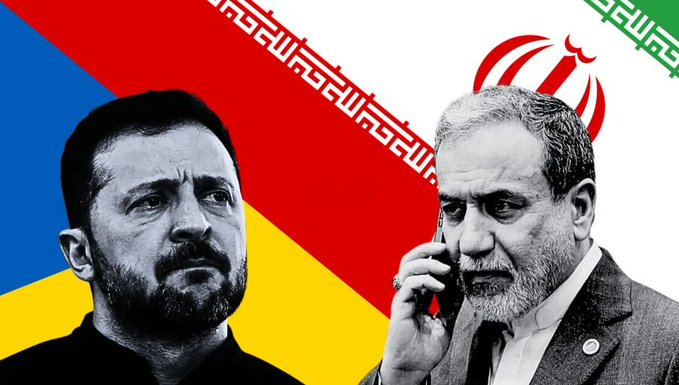
It would seem that Trump can’t make up his mind. Continue the war he and Israel started with Iran, or pursue renewed negotiations? The problem is the US military does not have the means to continue the conflict and Iran is unlikely to accept any proposal from Trump. Iran has all the cards.
CrossTalking with Dimitri Lascaris and David Swanson
The Alleged Mastermind of a $2 Billion U.S. Telemedicine Scam Is Enjoying the Luxury Life in Russia
Investigation
Brian Sutton, accused of masterminding one of the largest fraud schemes to ever be unraveled in the United States, is living freely in Russia. Among his acquisitions there is a fleet of luxury cars, an elite villa near Moscow, and a stake in an MMA club tied to a member of the Russian parliament.
Between 2015 and 2022, a criminal group used dozens of pharmacies across the United States to bill medical insurance companies a staggering $2 billion for fraudulent prescriptions.
The group collected over $758 million, laundering vast sums through offshore accounts before distributing the profits among themselves or reinvesting them in their operation.
Fifteen people were sentenced in California for their roles in the scheme and seven pleaded guilty in federal court, with some later receiving ten-year prison sentences.
But the man prosecutors identify as the group’s ringleader, 34-year-old Los Angeles-born Brian Sutton, has not been tried. The U.S. Attorney’s Office in Brooklin describes the indicted Sutton as “at large,” and a felony case against him in California remains active.
Reporters from OCCRP’s Russian member center, Important Stories, tracked him down in Russia. In a country under the cloud of war and dictatorship, he is living a life of unabashed luxury.
His assets there include nearly two dozen Mercedes Benz cars and several other luxury vehicles, a villa in an exclusive area near Moscow (and another owned by a family member), several businesses, and even a stake in an MMA club tied to a member of Russian parliament whose family is considered close to Chechen strongman leader Ramzan Kadyrov.
Credit: Портал Недвижимости/YouTube; video branded AFY.ru
At center-right, a luxury villa in an elite development near Moscow that was acquired by a member of Brian Sutton’s family, shown in a still from an advertisement video for a nearby property.
“The American justice system will be unable to reach Sutton in Russia,” says Ilya Shumanov, the former director of the local chapter of Transparency International. “There is no extradition treaty between the U.S. and Russia, and cooperation between law enforcement agencies remains exclusively in the area of counterterrorism … The chance of his extradition to the United States is zero.”
“The choice of Russia as a safe haven for international criminals is understandable and is nothing particularly new,” Shumanov noted, citing the case of Rinaldo Nazzaro, the founder of a neo-Nazi paramilitary group who relocated to Russia in the late 2010s.
Sutton and members of his family did not respond to requests for comment. The U.S. Department of Justice, the Santa Clara County District Attorney’s Office, and the Russian Interior Ministry also did not reply.
‘Mutant Pharmacies’
Sutton’s name, and the operation he allegedly led, first came to light in California in 2015, when a CBS news employee noticed that his medical insurance company had paid a shocking $44,000 for a one-month supply of a nutritional supplement.
The Los Angeles pharmacy that filled the prescription and submitted the claim was owned by Sutton’s family, as CBS Evening News reported that June. When confronted there by a producer, Sutton ignored questions and shut the door.
Eventually, the authorities caught on. A 2020 California felony complaint alleged that the group owned five Los Angeles-area pharmacies. It described them as “mutant pharmacies” because they functioned as “mills for fulfilling fraudulent prescriptions for pain creams and durable medical equipment.”
“Many of the pharmacies were not stocked like normal pharmacies,” the complaint read. “The purchase of over-the-counter drugs was so rare that at one location the employees were unable to work the cash register.”
To feed these mills, prosecutors alleged, the conspirators ran an aggressive call center that harassed ordinary citizens with dozens of unsolicited calls, deceiving them into believing they were speaking with their own doctors or insurers. They then used the information they obtained to issue high-cost prescriptions, bombarding unwitting victims with shipments of unwanted medical gear and pain creams they had never requested.
Fifteen co-conspirators eventually pleaded guilty, admitting to running a massive statewide scam and defrauding insurance companies of about $40 million.
A later federal case, prosecuted in Brooklyn, New York, covered what prosecutors described as a wider-ranging and more ambitious iteration of the scheme, tallying the much larger amount of nearly $2 billion in fraudulent medical bills, of which over $758 million was paid out.
The sophisticated operation involved calling patients to offer prescription medications at little to no cost, recruiting doctors to review nonexistent telemedicine visits, and billing insurance companies for drugs that in some cases were not even delivered. The conspirators bought many dozens of pharmacies across the country, expanding into states like New York, New Jersey, Pennsylvania, Texas, and Alabama. To avoid U.S. law enforcement, they set up call centers overseas, including in Russia.
Seven people ultimately pleaded guilty and were convicted for their roles in the operation. But not Sutton, who was out of reach of authorities.
A Luxury Life in Russia
The U.S. Department of Justice describes the group behind the telemedicine fraud as a “Moscow-based criminal organization.” Indeed, Russian land records and leaked databases show that Sutton and his family were establishing themselves in the country by 2019.
That year, leaked data from the Russian road police shows, Sutton bought and registered a Range Rover and a Rolls Royce Wraith in Russia, the first luxury cars of what would ultimately become an impressive fleet. According to a list of Sutton’s assets obtained by reporters, his collection ultimately included six BMWs, two more Rolls Royces, and 23 Mercedes-Benz vehicles produced over a 36-year span.
Also in 2019, a 64-year–old relative, David Sutton — presumably Brian’s father — purchased a luxurious villa near the Russian capital, according to land registry records. Nearly 600 square meters in size, the home includes a large private formal garden and a guest house on the property.
It is part of Barvikha 21, an “elite guarded cottage settlement” whose homes were built “in the style of American architect Frank Lloyd Wright.” Located in the elite Rublevka area to the west of Moscow, and adjoining a 20-hectare forested recreation area, the development is just five kilometers from Putin’s infamous residence at Novo Ogarevo.
Over the next few years, three members of the Sutton family — Brian, David, and a woman named Mila Sutton — listed the address as their residence, according to a leaked database. (Both David and Mila Sutton were also indicted for the medical insurance fraud scheme in California, but neither appears ever to have been arrested or tried. Neither responded to requests for comment.)
But Brian Sutton had ambitions for a larger footprint in Barvikha 21. In 2025, he bought another villa in the same development, combining its territory with an adjacent plot he acquired on which the existing villa had been demolished. His property there now stretches over more than 6,500 square meters, nearly the size of a regulation football field.
Credit: HomeHunter.ru/VK
The elite Barvikha 21 development near Moscow, with Brian Sutton’s villa at left, second from bottom. He also acquired the property visible immediately above it; that villa has since been demolished. Still from a promotional video published by HomeHunter.ru on VK.
Meanwhile, the Russian commercial register shows, Sutton had founded a call center called Well Connect in Moscow in 2019. Though its website is now defunct, the company’s page in the Russian social network Vkontakte is still available. “We do marketing in the sphere of medicine,” it reads, “moving diagnostic methods and the treatment of clients in a better direction.”
According to leaks of Russian tax information, Sutton earned 125 million rubles ($1.6 million) from the company in 2020-2021.
Brian Sutton also tried his hand in the Russian coal-trading business. In 2019, he founded Coal Trade, a Moscow company that, according to its website, included among its partners some of the largest Russian steel manufacturing and mining groups, such as Evraz and its coal business, Raspadskaya. Sutton retained his 90 percent stake in Coal Trade until late 2022, after which it was acquired by a firm whose ultimate owners are unknown. The Evraz plants and Raspadskaya were sanctioned by the United States in 2024.
The available financial data shows that Coal Trade made a profit of about $4.4 million in 2021 and $1.6 million in 2022, but its business started collapsing after Russia’s full-scale invasion of Ukraine that year.
In November 2022, Sutton acquired Relaxzon, a small fitness and spa center in the village of Gorchakovo on the outskirts of Moscow.
United Russia Fighters
The full story of Brian Sutton’s relationship with Russia is unknown. According to leaked records, David Sutton is listed as being born in the Soviet Union, while Brian was born in Los Angeles and holds U.S. citizenship. Both men received Israeli citizenship in 2017. Brian also got a Russian passport in 2022.
Beyond that, Brian Sutton seems to have a connection to Chechnya, a republic ruled with an iron fist by strongman leader Ramzan Kadyrov that is barely reachable even for Russian federal law enforcement.
Sutton’s first known listed place of residence in Russia, according to a police database, was an address in Argun, a town not far from the Chechen capital of Grozny. Several subsequent entries also associate a Grozny address with him, while identifying another address in Moscow as his residence.
Corporate records show that in June 2022 he acquired a 10-percent stake in United Russian Fighters (URF), an MMA club and fighting team tied to Bekkhan Agayev, a member of the Russian Parliament with the ruling United Russia party.
Credit: United Russia
Bekkhan Agayev, a member of the Russian State Duma.
On its Instagram account, the team describes Agayev as one of its “founders,” calling him “a true patriot of Russia who makes a significant contribution to our country’s development every day.” The account also notes that he continues to support the team.
(Agayev does not have a personal stake in the company behind URF, since members of parliament are prohibited from conducting business. A 40 percent share is owned by his son Deni.)
“We’ve gathered a large shipment of humanitarian aid, which will be sent today to the “Arbat” battalion … from our team and our founders,” the club posted on Instagram in 2024. “Don’t stand on the sidelines, it reads. “Victory will be ours!”
Agayev, who has been sanctioned by the United States since 2022, comes from a family that is considered close to Ramzan Kadyrov, the strongman head of Chechnya.
Kadyrov recorded a personal birthday greeting for Agayev’s father, Vakha, for his 60th birthday in 2013, calling him a “dear brother,” and also awarded him the title of “Honorary Citizen of the Republic.” That same year, a street was named after him in the Chechen town of Urus-Martan. Vakha Agayev, who died of COVID in 2020, ran a business that traded in Chechen oil.
Bekkhan Agayev did not respond to questions about the nature of his relationship with Sutton. His son also did not reply.
But Shumanov, the former Transparency International director, said that in the context of modern Russia, protecting one’s property rights or “avoiding pressure from security forces” was “virtually impossible.”
“There’s a high probability that the property and assets that Sutton acquired in Russia will [eventually] go to his influential Russian friends,” Shumanov added. “If he decides to leave Russia, I would venture to guess that many surprises await him. The FBI has a long list of cases of arresting individuals on the U.S. wanted list in other countries.”
With reporting by Dmitry Velikovsky of Important Stories.
Fact-checking was provided by the OCCRP Fact-Checking Desk.
Trump — who has been relatively restrained in criticizing Thune despite his unmet demands to pass the SAVE America Act and kill the filibuster — will have nothing to lose in the last two years of his presidency.
Zoom in: The Senate Republican Conference itself is poised for a drastic power shift away from Thune’s institutionalist wing.
The moderate voices of Sens. John Cornyn (Texas), Thom Tillis (N.C.) and Bill Cassidy (La.) will be gone after Trump undercut them. Sen. Susan Collins (Maine) faces a tough reelection fight.
What’s next: Hardline conservatives and MAGA voices are gaining power.
Longtime thorns in leadership’s side have ascended to committee chairmanships, including Sens. Rick Scott (Fla.), Ron Johnson (Wis.) and Rand Paul (Ky.).
Sen. Mike Lee (Utah) is positioned to lead the powerful Judiciary Committee next year, putting the online MAGA favorite in charge of judicial nominations — including any to the Supreme Court.
For the past year, heightened global demand for AI has fueled stratospheric price jumps for semiconductors and other hardware and Asia—which forms the hardware backbone of the AI supply chain—is cashing in.CHENG XIN VIA GETTY IMAGES
Add Fortune on Google for similar content. Add us on Google
The Fortune Global 500 has long been a scoreboard of corporate scale, reflecting the rise and fall of different industries and sectors. And in 2026, the ranking of the world’s largest companies by revenue reflects just how much the AI boom is supercharging revenues across the tech and semiconductor supply chains.
Recommended Video
Semiconductor manufacturing: How the U.S. can compete with the rest of the world
For the first time, Tencent and Taiwan Semiconductor Manufacturing Company (TSMC) have broken into the top 100, underscoring how surging demand for advanced chips and digital platforms is reshuffling corporate size and power across Asia and the wider world.
For the past year, heightened global demand for AI has fueled stratospheric price jumps for semiconductors and other hardware and Asia—which forms the hardware backbone of the AI supply chain—is cashing in.
TSMC, which serves clients like Apple and Nvidia, surged 44 spots, rising to No. 82. The chipmaker reported total revenue of $122.3 billion in 2025, up 35.6% from 2024. According to CNBC, Nvidia has reserved “the majority” of capacity at TSMC; last October, the two firms also partnered to onshore advanced chip packaging capabilities to Phoenix, Arizona.
Tencent also jumped 19 spots, just making the top 100 at No. 97. The software company, which is behind social media platforms like WeChat and QQ, and global gaming titles like Honor of Kings and PUBG Mobile, raked in $104.6 billion in revenue in 2025, up 14% from the year before. While Tencent’s gaming business grew in 2025, the company also reported strong growth in its advertising business, thanks to new AI-driven ad targeting. (Rumors of Tencent’s falling gaming revenue, however, sparked a Chinese gaming sell-off last week; Tencent’s own shares sank 7.1%, the most since April 2025.)
Tencent, much like its Chinese Big Tech peers, is investing in artificial intelligence. In March, the firm announced plans to double AI-related spending to 36 billion yuan, or $5.2 billion, to invest in model training and the hiring of talent.
Other Asian hardware firms also made huge leaps on the Global 500 list. Wistron, a Taiwan-based electronics manufacturer, rose 298 spots to No. 198, the largest jump by any company on this year’s list. Wistron posted 2025 revenue of NT$2.19 trillion, or $70.18 billion, a 115% jump from the year before. Both Wistron and Quanta Computer, along with Foxconn, are reporting surging revenue thanks to their new business assembling servers using AI processors from companies like Nvidia.
“In the past, one server generation typically lasted about two and a half to three years. You’d spend roughly a year designing a product, then it would stay in the market for about two years,” Simon Lin, Wistron’s chair, told Fortune. “With AI, not only are there new products every year, but each generation is a meaningful technological leap.”
Elsewhere in the AI supply chain, South Korean semiconductor firm SK Hynix rose 101 spots to No. 210, with revenue of $68.3 billion. SK Hynix has become the leading supplier of high-bandwidth memory chips, a key component of the AI processors produced by Nvidia and others. The company recently conducted a $28.5 billion listing in the U.S., the largest-ever share sale by a foreign company in U.S. markets.
Asia’s new debuts
Several Asia-based companies are making their debut on this year’s Global 500 list.
Chery Automobile debuts at No. 383, with $41.8 billion in revenue. Chery has been China’s top car exporter for 23 years, with overseas shipments making up 70% of its entire sales. It mostly exports internal combustion engine vehicles to markets like the Middle East, Africa, and Russia, though it is starting to export electric vehicles as well. Chinese car exports are a rare bright spot in the country’s slumping car market; the country is on track to export 10 million cars this year, up from 7.1 million last year.
WT Microelectronics debuts at No. 431, with $37.8 billion in revenue. The firm was established as a local semiconductor distributor in Taiwan in 1993, but has over the years grown into a major supply chain partner.
There’s one more Global 500 debut relevant to Asia: Coupang, often referred to as “South Korea’s Amazon,” debuts on the Global 500 at No. 479 with $34.5 billion in revenue. The company is incorporated in Delaware and designates Seattle as its headquarters. Yet Coupang generates over 90% of its revenue from South Korea, where it operates one of the country’s largest e-commerce and logistics networks.
A Garda vehicle leaves after Simon O’Donovan appeared before a sitting of the Special Criminal Court in Dublin
A Dublin museum employeehas been charged in connection with an investigation into the discovery of a bomb in a car in the Republic of Ireland.
Simon O’Donovan, 44, with an address at Sperrin Road in Dublin 12, was charged with being in possession of an explosive substance at St Lawrence Rd in Chapelizod, Dublin 10 on 22 July.
He appeared before the Special Criminal Court on Saturday evening, where the court heard he was employed by the Collins Barracks National Museum of Ireland.
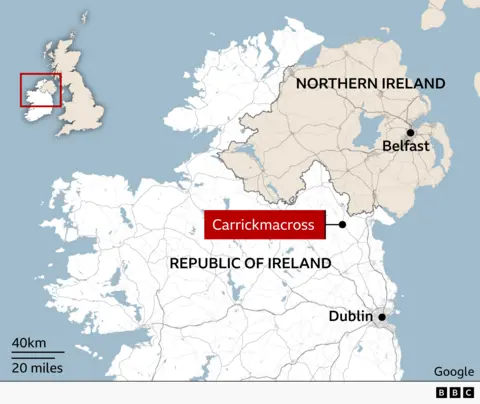
A vehicle was stopped on the N2 near Carrickmacross near the Irish border on Wednesday. On Friday, a 25-year-old woman was charged in relation to the same incident.
The bomb was discovered not far from the Irish border
At the sitting of the Special Criminal Court, Det Sgt Shane Noone said he arrested O’Donovan at 17:07 local time on Friday and informed him he would be charged with the offence.
Solicitor Darragh Mackin said he had not taken instruction from O’Donovan as he was observing a strike over changes to criminal legal aid fees and was only appearing in court out of courtesy.
O’Donovan told Judge Patrick McGrath that he had “no representation at all”, and had asked for “the services of this gentleman beside me”, referring to Mackin.
Law student Isobella Perrie Sullivan, 25, of Abbeylands Park in Clane, County Kildare, appeared before a district court on Friday charged with possession of explosives in connection with the same incident.
Her solicitor said she had been asked to take a bag to Northern Ireland, and had not been aware what was in it.
Perrie Sullivan was granted bail but remains in custody ahead of a further bail hearing on Monday.
“DEVASTATING Defeat!” Trump Plans ‘Massive’ Iran Attack + Piers Morgan vs Cancelled Cornell Student
Jul 28, 2026 Piers Morgan UncensoredThe chaos of unintended consequences is one of the biggest strategic problems with waging war. With Iran’s proxy militias attacking Saudi oil facilities and Ukraine striking Iranian vessels linked to Russia, experts fear we are spiraling toward a conflict that nobody can control. Is the U.S. about to get dragged into a wider war? Uncensored explores why the conversation has pivoted from “getting out” to “how to escalate,” and whether any military operation can lead to a real victory. Joining Piers Morgan to make sense of the escalating tensions in the Middle East and the Saudi nuclear deal is political scientist Professor John Mearsheimer, before Piers is joined by his panel; retired General and former Assistant Secretary of State Mark Kimmitt, Professor of Political Science & Military Analyst Robert Pape and Former General and NATO Supreme Allied Commander Wesley Clark. . Plus, Piers speaks to Ivy League student Austin Franco, whose life has been turned upside down after he went viral for telling prospective employers that he was “not interested in working for a Jew.” Have we made it impossible for young people to make stupid mistakes in the age of social media? In a post-cancel culture society, do people like Franco deserve a second chance? After this interview, Piers wasn’t so convinced… Piers Morgan is proudly independent and sponsored by: Cozy Earth: Visit https://www.CozyEarth.com & Use code PIERS for up to 20% off
00:00 Introduction 03:22 Professor John Mearsheimer gives Piers his assessment on the Iran War 05:07 What should President Trump do now? 09:05 The consequences for civilians 11:23 AD: Cozy Earth: Visit https://www.CozyEarth.com & Use code PIERS for up to 20% off 12:24 Donald Trump signs landmark nuclear deal with Saudi Arabia 14:33 The Saudis recognising Israel and joining the Abraham Accords 18:55 The Ukrainians getting an upper hand on Russia 21:19 Panel discussion begins on the latest on Iran 23:51 What’s in it for the Iranians to do a deal? 38:00 The pending political duality of elections in Israel and the midterms in the U.S. 41:50 How will Trump stop this? 48:00 Will America commit to boots on the ground? 56:00 If Trump had a do over, would he commit to the Iran war again? 57:26 Piers’ monologue on cancelled student Austin Franco 59:49 Austin Franco interview begins 01:00:00 Austin Franco tried to justify why he said he refuses to work for Jews 01:04:00 Piers challenges Austin on antisemitic views Subscribe to stay up-to-date on all Uncensored content.




 Zoom in: The Senate Republican Conference itself is poised for a drastic power shift away from Thune’s institutionalist wing.
 What’s next: Hardline conservatives and MAGA voices are gaining power.