World in so many wars. Be aware of Palantir. Quote on Military Industrial Complex by Dwight D. Eisenhower “In the councils of government, we must guard against the acquisition of unwarranted influence, whether sought or unsought, by the military industrial complex. The potential for the disastrous rise of misplaced power exists and will persist. We must never let the weight of this combination endanger our liberties or democratic processes. We should take nothing for granted. Only an alert and knowledgeable citizenry can compel the proper meshing of the huge industrial and military machinery of defense with our peaceful methods and goals, so that security and liberty may prosper together.
Understand that Republicans and Democrats destroyed the purchasing power of the dollar. Deficit spending and money printing is not only inflation but the inflation tax is the highest tax we pay.
Iranian President Masoud Pezeshkian: Their goal was to completely disarm us. If they do that, they’ll come and destroy our land, just like they’re doing in Gaza, and we’d be powerless. Is it right to let them strip us of our military and defense capabilities and bow down to them? We won’t do that. However, we don’t intend to invade other countries. We aren’t seeking territory or expansion—unlike Zionist Israel, which aims for Greater Israel. We’re not looking for Greater Iran. We see all these neighboring countries as our brothers. There’s no need for conflict; we share borders and are neighbors. But Israel doesn’t respect the borders of Islamic nations; it’s focused on invasion and seizing their land.
As Trump’s Board of Peace unveils a plan to disarm Hamas, will the group now give up its weapons and what would this mean for Gaza’s future? Amid an escalation of violence on the West Bank and with settlements continuing to grow, why does the US President appear not to care? In the wake of the Gianni Infantino revelations, does the head of FIFA actually hate football? Join Rory and Alastair as they answer all these questions and more in this week’s edition of Question Time. ———————————— The Rest Is Politics is powered by Fuse Energy. Stop overpaying for energy. Switch at https://fuseenergy.com/politics and get a free TRIP+ subscription. ——————————–
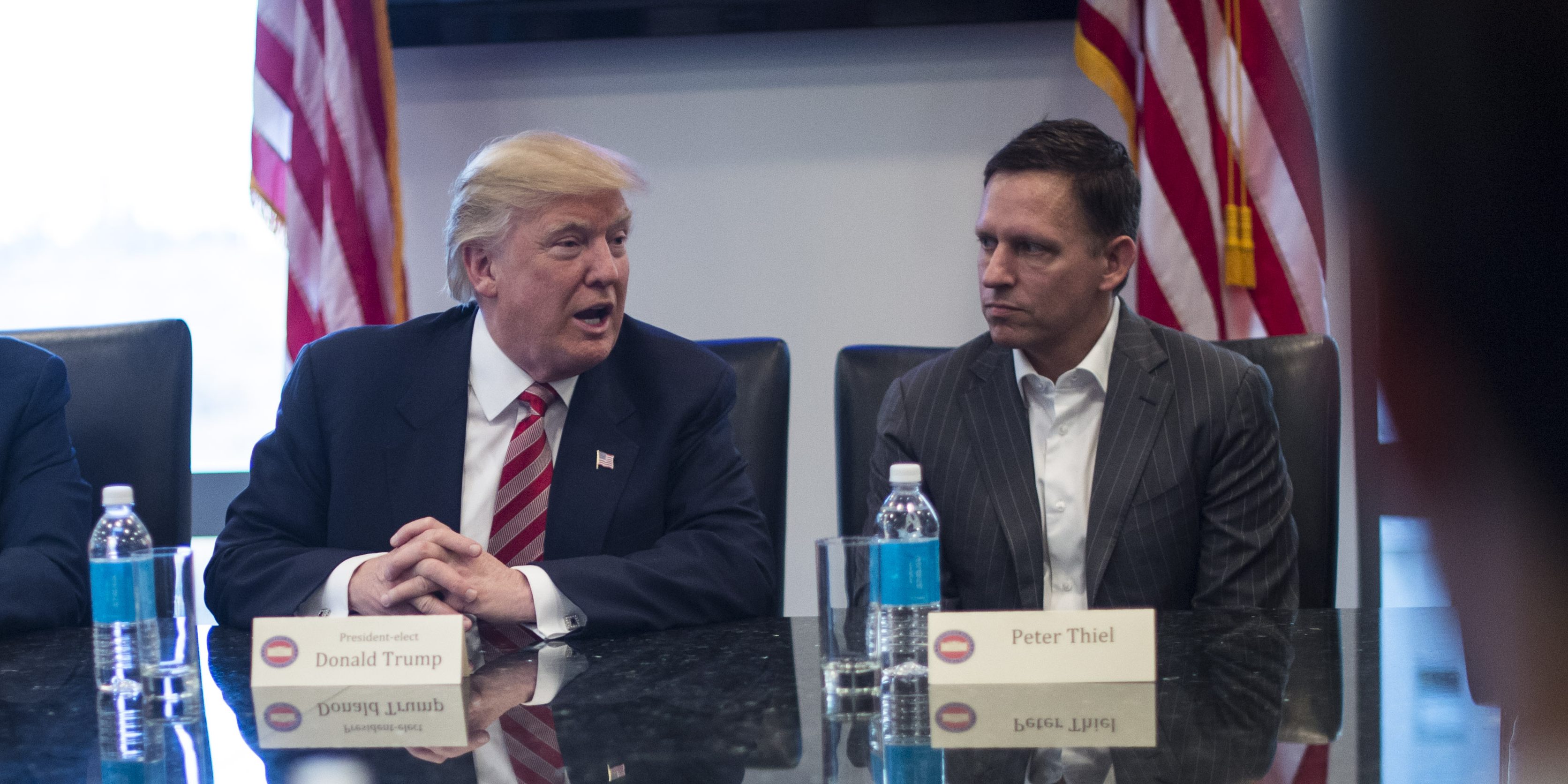
Palantir founder Peter Thiel, right, listens to President-elect Donald Trump during a meeting with tech leaders in New York City on Dec. 14, 2016. Photo: Jabin Botsford/The Washington Post via Getty Images
The Trump administration tapped a surveillance giant with a record of attacking the press to advise the State Department on free speech.
Among the partners for the State Department’s new “Freedom Tech Excellence Program” is Palantir, the AI and data integration firm started by right-wing powerbroker Peter Thiel. Under the program, company employees will go on temporary assignments to advise the government on “digital freedom and freedom of expression,” including counter-surveillance and dealing with First Amendment issues.
“FTEP brings private sector talent to the Department for limited-term assignments to advance diplomatic efforts on key issues including online freedom of expression, privacy-enhancing technologies, countering digital surveillance, and responsible AI governance,” according to the State Department’s website.
“Neither this State Department, nor the partners they have announced so far, are trustworthy leaders in what they identify as online freedom of expression.”
Palantir is best known for building large-scale data analysis platforms. In addition to corporate contracts, the company’s massivegovernment tenders include database, surveillance, and tracking tools for police and federal authorities. Among its government clients are the military, the State Department itself, and U.S. Immigrations and Customs Enforcement. Palantir and its key personnel have also been involved in multiple lawsuits against journalistic outlets.
The firm’s history has raised criticisms of its role in the new State Department initiative, especially given the Trump administration own’s dubious track record on First Amendment issues.
“To some extent, this announcement and this program sound like doublespeak,” said Carrie DeCell, a senior staff attorney at the Knight First Amendment Institute. “Certainly neither this State Department, nor the partners they have announced so far, are trustworthy leaders in what they identify as online freedom of expression or countering digital surveillance.”
The new initiative is planned to run through the beginning of 2029, according to the State Department’s press office.While participants could be placed anywhere in the agency and may require security clearances, the Freedom Tech Excellent Program “is not geared towards bolstering the Department’s internal application or operational use of AI technologies,” the department said in a statement to The Intercept.
Anduril, a military tech firm with links to Palantir and Thiel, was also listed as a partner in the State Department initiative. Anduril’s executive chair Trae Stephens is a partner at Thiel’s Founders Fund, which has invested about $2.6 billion in Anduril. Besides a mutual appreciation of “The Lord of the Rings,” Thiel shares similar politics with Anduril co-founder Palmer Luckey and has backed Luckey’s new bank, Erebor.
Neither Anduril nor Palantir responded to requests for comment.
Palantir’s work has brought it notoriety across the globe, though at times defining what it does can be complex. It has repeatedly eschewed its label as a surveillance firm. Palantir CEO Alex Karp denied on a podcast last year that the company engages in unconstitutional surveillance work.
And, in an unsigned blog post last year, Palantir wrote, “Contrary to some media reports, we are not a surveillance company.”
Palantir, though, enabled U.S. mass surveillance by bolstering the National Security Agency’s global data collection efforts, according to documents provided to The Intercept by the whistleblower Edward Snowden. Palantir helped the NSA expand a program that became notorious for its ability to hoover up Americans’ communications along with those from abroad.
More recently, the firm has become a focal point for protests in the U.K. over its massive contract with the National Health Service and its ties to the Israeli military. Just this week, the NHS apologized after admitting it had falsely stated that Palantir did not have access to identifiable patient data.
Stateside, the company had a contract with New York City public hospitals that gave it access to patient information. The contract was allowed to expire after it came under scrutiny in an Intercept report. The Intercept also reported this year that Palantir has access to sensitive federal databases for its contract to aid in Internal Revenue Service investigations.
Palantir’s IRS work led to a letter last year from 10 members of Congress to Karp requesting information about the “mega-database” built off IRS data. In response, the firm again denied that it was engaging in widespread surveillance of Americans and that it was building any such database.
Palantir also has a 15-year relationship with ICE. The Intercept found that its contracts with the agency have aided immigration raids, including ones that led to family separations. And Palantir built bespoke software for ICE that helps track self-deportations and visa overstays.
In April, Reps. Dan Goldman and Nydia Velázquez, both Democrats from New York, sent a list of questions directed to ICE and its parent agency, the Department of Homeland Security, demanding information about how they were leveraging Palantir’s technology to create “a mass surveillance ecosystem.”
Join Our Newsletter
Original reporting. Fearless journalism. Delivered to you.I’m in
Along with eccentric far-right views and donations to MAGA Republicans, one of Thiel’s most well-known acts was his involvement in the lawsuit that drove the news outlet Gawker into bankruptcy.
Thiel had become upset with Gawker over the media company’s reporting about his personal life. He went on to spend $10 million secretly bankrolling lawsuits against the company, finally scoring with a major judgment in favor of the wrestler Hulk Hogan that caused Gawker to close and sell off its assets.
Journalism advocacy group Reporters Without Borders said that Thiel constituted a “serious threat” to the group’s principles of “freedom of press and independence of media,” particularly in light of the secrecy around his role in the case. His actions were, RSF said, “nothing different to governments using legal or economic leverage to shut down a media that happens to displease them.”
Palantir also recently filed a suit against Swiss online news magazine Republik for reporting on how Palantir repeatedly failed to land contracts with the Swiss government. Palantir claimed that Republik had an obligation to run a list of rebuttals from the firm.
A Swiss court, however, handed Palantir a defeat by siding with the outlet on all but one of the 23 charges and forcing Palantir to pay most of Republik’s legal fees. (In a since-deleted post on Medium responding to the Republik lawsuit, Palantir once again denied that it is a surveillance company.)
David Greene, senior counsel for anti-surveillance nonprofit Electronic Frontier Foundation, said that positioning Palantir as a bulwark for civil rights undermined the government’s own free speech initiative.
“There’s a big problem right now with the U.S. government and the people outside government who exercise power, in terms of trying to claim free speech as a value when they clearly don’t sincerely hold that value,” Greene said. “It really lowers the esteem of the U.S. in terms of having any moral authority on freedom of expression grounds.” Share
IT’S EVEN WORSE THAN WE THOUGHT.
What we’re seeing right now from Donald Trump is a full-on authoritarian takeover of the U.S. government.
This is not hyperbole.
Court orders are being ignored. MAGA loyalists have been put in charge of the military and federal law enforcement agencies. The Department of Government Efficiency has stripped Congress of its power of the purse. News outlets that challenge Trump have been banished or put under investigation.
Yet far too many are still covering Trump’s assault on democracy like politics as usual, with flattering headlines describing Trump as “unconventional,” “testing the boundaries,” and “aggressively flexing power.”
The Intercept has long covered authoritarian governments, billionaire oligarchs, and backsliding democracies around the world. We understand the challenge we face in Trump and the vital importance of press freedom in defending democracy.
We’re independent of corporate interests. Will you help us?
With unprecedented access, BBC World Service makes a 25-hour train journey across the length of Iran. From the country’s political heart in Tehran to its strategic southern coast at the Strait of Hormuz, #BBCEye Investigations meets Iranians from across the social and political divide. Click here to subscribe to our channel 👉🏽 https://bbc.in/3VyyriM Reaching parts of Iran usually inaccessible to foreign journalists, BBC Eye builds a rare picture of a nation at war. A grieving mother in Minab, where a school hit in the opening hours of the conflict became one of its defining tragedies; mourners at the funeral of Iran’s Supreme Leader, defiant in the face of foreign pressure; and the young Iranians facing an uncertain future, guarded about what they feel they can and can’t say about the regime, or about their own lives. The BBC’s Senior international correspondent Nawal Al Maghafi was reporting from Iran on condition that none of her material is used on the BBC’s Persian Service. These restrictions apply to all international media organisations operating in Iran.
00:00 North to South: A journey across Iran 01:29 Boarding the train 03:36 Protests demanding the regime’s downfall 05:18 Intervention from the US and Israel 06:30 Minab: the school strike 08:07 Inside the school 10:04 Meeting one of the first responders 11:38 Visiting the cemetery 13:00 The Strait of Hormuz 14:11 Strikes on Bandar Abbas 15:58 The supreme leader’s funeral
Can’t-miss innovations from the bleeding edge of science and techEmail addressSign Up
We certainly wouldn’t blame you for having completely forgotten that last year, Elon Musk tried to reinvent Wikipedia because he thought it was too woke.
In October, his AI startup xAI launched Grokipedia, named after its AI chatbot. The encyclopedia stole human-written and edited pages from Wikipedia wholesale and ran them through a large language model, which also fielded user-submitted edits, to better reflect Musk’s contorted worldviews.
Perhaps unsurprisingly, the desperate attempt to twist the largest online encyclopedia in human history into an extension of an almost-trillionaire’s bigoted mind appears to have ground to a screeching halt — and, damningly, barely anybody seems to have noticed.
According to a new investigation by Lawfare, Grokipedia appears to have entirely stopped updating itself sometime earlier this year. Reviewing suggested edits from humans has also ground to a halt.
“As far as we can tell, no entry has changed in more than three months,” Lawfare concluded of the site, which is now owned by SpaceX since it merged with Musk’s AI efforts.
Worse yet, the site’s edit log appears to have broken completely as well, making it impossible to track which user-suggested changes were “accepted” or “rejected” by the AI.
Since then, it has turned into a ghost town, a completely redundant and misinformation-filled copy of Wikipedia, which remains one of the last bastions of human-edited and verified sources of information on the internet.
Even when Lawfare submitted an “uncomplicated factual update” about SpaceX having launched its IPO in June — an irrefutable fact that any allegedly “open source, comprehensive collection of all knowledge” should probably include — the Grokipedia entry remained stagnant.
Even pages that are purportedly drawing millions of views aren’t updating. The most recent approved update Lawfare could locate — to the entry about OpenAI’s ChatGPT — dates back to April 24.
As of today, Lawfare found that that there are 13,002 suggestions that “sit unresolved, trapped ‘in review.’”
“Altogether, what we found was that the ‘live’ change feed is gone, past decisions were retroactively reverted without explanation, new decisions are not being issued, and article text appears frozen (and, in some cases, outdated),” the publication concluded. “We do not know whether xAI is preparing a major revision or has altogether abandoned active development of the project.”
It’s a precarious situation. Despite having been abandoned, Similarweb data suggests Grokipedia received over six million visits in June alone. Hundreds of thousands of sites are also still citing Musk’s encyclopedia, which could spread misinformation even further.
Futurism has reached out to SpaceX for an update on the project, but considering the reputation of Musk’s companies and their refusal to interact with the media, we’re not holding our breath for a response.
I’m a senior editor at Futurism, where I edit and write about NASA and the private space sector, as well as topics ranging from SETI and artificial intelligence to tech and medical policy.
Published: November 13, 2009 Last Updated: May 28, 2025
On August 7, 1782, in Newburgh, New York, General George Washington, the commander in chief of the Continental Army, creates the “Badge for Military Merit,” a decoration consisting of a purple, heart-shaped piece of silk, edged with a narrow binding of silver, with the word Merit stitched across the face in silver. It would come to be widely known as the Purple Heart.
The badge was to be presented to soldiers for “any singularly meritorious action” and permitted its wearer to pass guards and sentinels without challenge. The honoree’s name and regiment were also to be inscribed in a “Book of Merit.”
Washington Commands the Continental Army
At the time of the Revolution, America had no money, no military and barely a chance at success. Even George Washington was not immediately seen as a strong military commander, often making mistakes.
1:02m watch
Washington’s “Purple Heart” was awarded to only three known soldiers during the Revolutionary War: Elijah Churchill, William Brown and Daniel Bissell, Jr. The “Book of Merit” was lost, and the decoration was largely forgotten until 1927, when General Charles P. Summerall, the U.S. Army chief of staff, sent an unsuccessful draft bill to Congress to “revive the Badge of Military Merit.”
In 1931, Summerall’s successor, General Douglas MacArthur, took up the cause, hoping to reinstate the medal in time for the bicentennial of George Washington’s birth. On February 22, 1932, Washington’s 200th birthday, the U.S. War Department announced the creation of the “Order of the Purple Heart.”
In addition to aspects of Washington’s original design, the new Purple Heart also displays a bust of Washington and his coat of arms. The Order of the Purple Heart, the oldest American military decoration for military merit, is awarded to members of the U.S. armed forceswho have been killed or wounded in action against an enemy. It is also awarded to soldiers who have suffered maltreatment as prisoners of war.
American filmmaker George Lucas is one of the latest to indicate he’s open to AI in the movie industry.
In a recent interview, the director said resistance to the technology was “very much like sitting here saying: ‘Well, I believe the horse and the buggy is really where it’s at. These cars, they break down, they need gas, there’s all kinds of problems with them and pretty soon they’ll be making them into tanks, and then they’ll be killing people. It’s terrible.’”
“Luddites” have sometimes stood in for enemies of progress: those destined to be swept aside in the forward march of history.
The label of “neo-Luddism” or “digital Luddite” is also being reclaimed by people concerned about labour conditions, society and democracy in an era of AI expansion twinned with personal profit.
Their legacy has been profound, as suggested by both negative and positive polemics related to them in intellectual and cultural commentary, art and literature and popular histories produced as digital technology continues to grow.
When trade unions were illegal
As the new political economy, fuelled by transatlantic slavery and colonial extraction, began to transform work practices in England and introduce new forms of mechanization, skilled artisans and weavers resisted. They sought to protect their livelihoods, their ways of life and their communities.
Trade unions were illegal and the workers did not have political representation. Co-operative societies did not yet exist and state welfare was a distant dream. The only alternative to acquiescence was what historian Eric Hobsbawm memorably called “collective bargaining by riot.”
When the English cartoonist Charles Williams depicted a veterinarian and a blacksmith violently attacking dandies on bicycles for undermining traditional horse-drawn transportation in 1819, the blacksmith’s smashing with a mallet was a clear reference to the spasm of machine-wrecking earlier in the decade.
Williams’s caricature came within a few years of the mass outbreak in Britain when the terms Luddism and Luddite became commonplace.
Cartoon by Charles Williams showing a veterinary surgeon and a blacksmith attacking dandies on bicycles representing the anti-bicycle movement. (Wikimedia), CC BY
‘Leader of the Luddites’ hand-coloured etching from 1812. (British Museum)
In the context of widespread economic misery caused by the war against Napoleon, the weavers blamed new, wide-frame knitting machines for stealing their jobs, reducing their earnings and making a bad situation worse.In targeted attacks, they smashed more than 1,000 of the stocking frames, and the property destruction then spread to the textile weaving and spinning districts of Lancashire and Yorkshire.
The ruling classes managed to restore order, despite sporadic outbreaks until 1816, punctuating their clampdown with exemplary hangings and sentences of transportation to Australia. Their determination to prevent revolution, protect property and enable unfettered economic expansion was patently clear.
Destruction of property spread to the textile weaving and spinning districts of Lancashire and Yorkshire. (Wellcome Collection)
So do the Luddites deserve such a bad rap? As a historian who has examined industrial-era English history, along with many others, I say: absolutely not.
The Luddites were not blindly lashing out but sending a message; to some extent at least, that message was heard. Along with the political radicals and the labour campaigners over the course of the 19th century, they took part in a prolonged struggle waged for rights, dignity and justice. That struggle partially succeeded, forcing the ruling classes to compromise rather than continuing to rely on brute force.
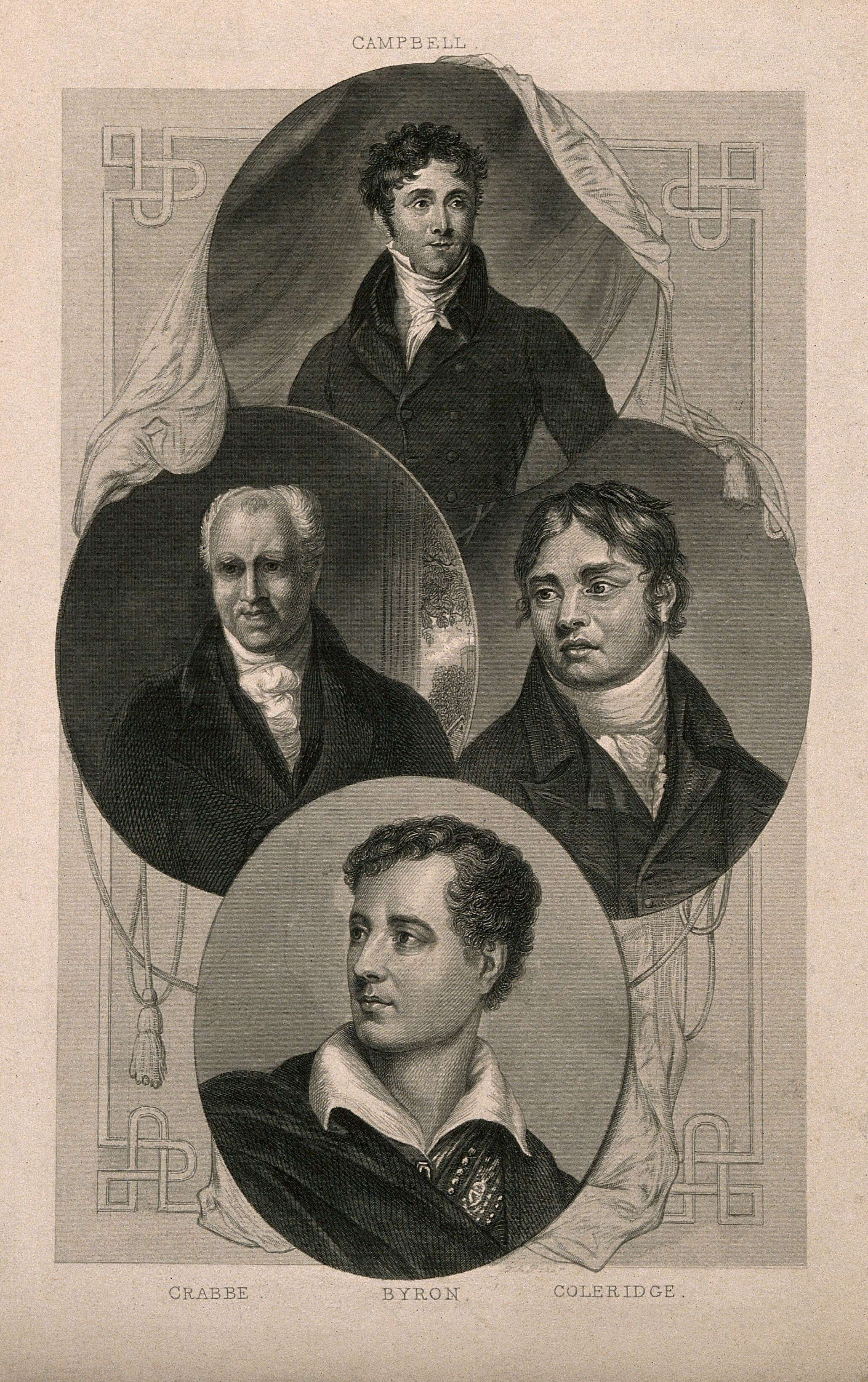
Byron lamented how ‘absolute want’ had ‘unparalleled distress’ had provoked riots. (Wellcome Collection), CC BY
One of the few aristocrats to express sympathy for the Luddites was the poet Lord Byron. In his maiden speech in the House of Lords, Byron lamented that “absolute want” and “unparalleled distress” had provoked the riots and, rather than compassion or an attempt to remedy wrongs, all the government could propose was “dragoons and executioners.”
A few months later, he penned a bitingly satirical poem in a London newspaper with a similar message:
“Some folks for certain have thought it was shocking,
When Famine appeals, and when Poverty groans,
That life should be valued at less than a stocking,
And breaking of frames lead to breaking of bones.”
Fellow poet Percy Bysshe Shelley reacted with similar rage. His 1813 poem Queen Mab, a paean to a utopian future, combined an attack on the state, organized religion and the soul-destroying capitalism of the new machine age.
Mary Wollstonecraft Shelley, wife of Percy and daughter of feminist philosopher Mary Wollstonecraft, was also inspired by Luddism in her writing of the 1818 novel Frankenstein. Victor Frankenstein’s creation, the Monster, like Ned Ludd, only became violent and destructive when horrendously mistreated.
The message was clear: technological progress was not necessarily in itself evil, but if the outcome was a vicious zero-sum game of winners and losers, then industrial capitalism was deeply inhumane and resistance was inevitable.
These were just the earliest writers who reacted to the Luddites. Notable later novelists tilling the same furrow included Charlotte Brontë and Samuel Butler.
Brontë’s 1849 novel Shirley, set in the Yorkshire textile district in 1811-12, combined sympathy for the plight of the workers with a criticism of violence and a call for paternalism from the mill owners.
Butler’s 1872 novel Erewhon, the ultimate Luddite fantasy, featured a society that outlawed machines and destroyed inventions to prevent them from taking over and enslaving humanity.
Not blindly lashing out
The Luddites may have partly lost the battle in Regency England; the state and the propertied classes may have prevailed.
But it’s a mistake to see them as no more than victims crushed by industrialization.
Caricatures of the Luddites as history’s losers are simply false. We have not stopped talking about them ever since.
Brian LewisProfessor of History, McGill University
Disclosure statement
Brian Lewis does not work for, consult, own shares in or receive funding from any company or organisation that would benefit from this article, and has disclosed no relevant affiliations beyond their academic appointment.
Partners
McGill University provides funding as a member of The Conversation CA.
McGill University provides funding as a member of The Conversation CA-FR.
The Conversation UK receives funding from these organisations
Republish our articles for free, online or in print, under Creative Commons licence.Republish this article
The most frequent question we’re asked as arts editors: “Have you seen anything good lately?”
Our newsletter is the answer. We all lead busy lives, with countless things demanding our attention: work, chores, childcare. Free time is precious. But with so many options for what to watch and read at the end of day, listen to on our commute, or visit in town, we don’t want to waste it sifting through them all. Something Good cuts through the noise, with a carefully curated selection of the latest film, TV, book, video game and music releases, as well as live events and exhibitions – straight to your inbox, every fortnight, on Friday afternoons. And unlike other roundups, our selection is chosen by academic experts.


 • AD FREE: What Trump’s Deal Means for Netan…