
1923 … National Folklore programme on RTE 1 last night is excellent portrayal horrors of Civil War 100 yrs on. Now Ireland is at 25th anniversary of the Good Friday Agreement. This is an excellent talk, a true challenge to those who want PEACE
1923 … National Folklore programme on RTE 1 last night is excellent portrayal horrors of Civil War 100 yrs on. Now Ireland is at 25th anniversary of the Good Friday Agreement. This is an excellent talk, a true challenge to those who want PEACE
April 26, 2023

Since OpenAI’s release of ChatGPT last November, the buzz around generative AI has been steadily ramping up. Some are excited about its potential to transform the way we work, create, and live, while others are wary of the dangers it poses and the nefarious ways it can be used. We know that programs like Midjourney, DALL-E, and GPT-4 are enabling millions of people to generate images and text, but not many studies have dug into the impact these tools are having, be it positive or negative.
One such study was released this month. Titled “Generative AI at Work,” the paper, by teams from Stanford and Massachusetts Institute of Technology, is one of the first times researchers take a microscope to the way generative AI is actually affecting peoples’ jobs. The team looked at how employees of a Fortune 500 company were impacted by generative AI when they started using it as part of their day-to-day work.
The study followed 5,179 customer service agents at a large software firm (whose name wasn’t disclosed) over the course of a year. The employees, mostly based in the Philippines, were split into two groups; one was given access to an AI whose help they could choose to integrate into their work, while the other continued as usual.
The AI was trained on data from over 5,000 successful customer service interactions, likely in the form of recordings of high-performing employees having conversations with customers and resolving their issues. The AI then monitored customer interactions in real time and gave agents suggestions of what to say. The employees could choose to use the suggestions word for word, dismiss them altogether, or use a tweaked version.
The researchers looked at how long it took for agents to solve customers’ issues and how successfully they did so. The results? Good things all around.
And that’s not all. Since the AI’s suggestions skewed towards helping agents be patient and empathetic with frustrated customers, the customers treated the agents better, losing their tempers and raising their voices less (it’s not pretty, but let’s be honest, we’ve all been there). As a result, the agents were happier and more satisfied with their work.
Perhaps not surprisingly, the AI was the most helpful for the least-skilled workers and those who had been with the company for the shortest time. Meanwhile, the highest-skilled and most experienced agents didn’t benefit much from using the AI. This makes sense, since the tool was trained on conversations from these workers; they already know what they’re doing.
“High-skilled workers may have less to gain from AI assistance precisely because AI recommendations capture the knowledge embodied in their own behaviors,” said study author Erik Brynjolfsson, director of the Stanford Digital Economy Lab.
The AI enabled employees with only two months of experience to perform as well as those who’d been in their roles for six months. That’s some serious skill acceleration. But is it “cheating”? Are the employees using the AI skipping over valuable first-hand training, missing out on learning by doing? Would their skills grind to a halt if the AI were taken away, since they’ve been repeating its suggestions rather than thinking through responses on their own?
It’s possible that an over-reliance on the tool could be detrimental to employees’ ability to build up and retain skills. But ideally they are learning by doing, just in a faster way, since they’re skipping over the drudgery of many unpleasant interactions with angry customers.
Where does this leave high-skilled employees, though? If their work is being used to train AIs that then freely give their skills to inexperienced employees, that could create issues around fairness and compensation. If you’ve been honing your soothing one-liners for years then a newbie comes in saying all the same things by month two on the job, you’re not going to be thrilled—especially if you’re not getting paid a lot more than the newbie.
Finally, since the AI was essentially training newer employees, their managers didn’t need to spend as much time training them—and more of their time was thus freed up. That means managers could take on bigger teams, which means the company could ultimately hire more employees (if it’s selling enough of its products) and do more business. It seems this particular “generative AI” generated a lot more than just conversation suggestions: it generated employee satisfaction, skill acquisition, and free time.
Will the same hold true for other scenarios where these tools are implemented? Could be, but they should be introduced with caution and oversight nonetheless, as there are likely many secondary effects generative AI could have on a workplace that wouldn’t become apparent right away, and may not be wholly positive.
“We need far more research here,” said Brynjolfsson. “The impact of AI on productivity may vary over time, and adding these tools to the office could require complementary organizational investments, skills development, and business process redesign. And AI systems may impact worker and customer satisfaction, attrition, and patterns of behavior. There’s so much we don’t know.”
In my case, it was a lot slower. Multimorbidites, complication of mental illness, chronic fatigue and eventual cancer. I wrote the book:-
[Source photo: RunPhoto/Getty Images]
MORE LIKE THIS
CEOs are throwing tantrums about productivity and return-to-office plans
It’s not quiet quitting. 1 in 6 workers are actually fighting a hidden illness
It’s time to spring clean your calendar—and your work-life boundaries
BY ROB CROSS AND KAREN DILLON
10 MINUTE READ
“My team is constantly in fire-fighting mode,” Gavin shared with us. As part of a service team in global software organization, Gavin (not his real name) had been coaching his team to try to better advocate for themselves when they were inundated with requests for their time, both from him, as their manager, and from the other parts of the organization that they served. Individually each “ask” might have seemed manageable, but cumulatively they were adding up to the point where they affected his team’s performance—and their overall well-being. He was worried about his entire team being at risk of burn out.
ADVERTISEMENT
What Gavin recognized was the effect on his team of what we call “microstress”—small moments of stress from interactions with people we are close to in our work or personal lives that are so routine we barely know they’ve hit us, but whose cumulative toll is enormous. Our new research into high performers has made clear the destructive impact of unchecked microstress, both on individuals and on teams. In hundreds of interviews, we consistently found that once we got past the surface, even people who had been identified as high performers by their organizations were struggling to keep it all together because they were inundated with microstress.
Where is all this microstress coming from?
Our days are filled with microstress that we don’t even recognize. When these microstresses hit, we typically don’t pause long enough to register what they’re doing to us physically and mentally. Like Gavin’s team, most of us just soldier on. But microstresses can trigger a chain reaction of other, unrecognized stresses that can stretch for hours, even days. For example, we might work harder and longer to compensate for teammates that just missed the mark, putting strain on our personal relationships in the process. Or we might deliver subpar work because we ran out of time, which in turn causes stress in the professional relationships who were counting on us.
Gavin was concerned that his guidance to help his team navigate this all wasn’t sinking in. So he briefly set a trap for them to drive his point home. “I created a couple of false demanding deadlines to see if they were willing to respond in the way I had asked them to in such circumstances, which was to come back and discuss the request and the timing before they just added it to their already overloaded to do list,” he told us. But to Gavin’s dismay, “not one person pushed back. No one even asked if they could get just a little more time.”
The individual people on his team either more or less ignored his request because they were just too overwhelmed to get to it or they planned to resort to personal heroics (one person even mentioned that he intended to skip a long-planned outing with his wife) to make Gavin’s ridiculous deadline. “I was just shocked,” he told us. “My team knows I don’t want them to do that!” So Gavin quickly came clean. “I explained that there’s no need for that—they’re all senior enough to push back.” The point, he made clear, was that he wanted them to be able to recognize when they were being overwhelmed with small demands that were hampering their ability to do their job well, so they could prioritize and use their time more effectively, rather than simply being in firefighting mode all the time.
How do you know if you’re experiencing microstress rather than just having a demanding job? If you’re like the high performers in our research, there are some clues:
If any of that rings true, you are probably suffering from microstress. By contrast, if your days are full, but you have a clear vision for how you’ll excel and can proactively shape how your use your time and with whom, you might just have a demanding job. You can apply the same thinking to your team, too.
The microstresses we identified in our research with high performers came in three broad categories:
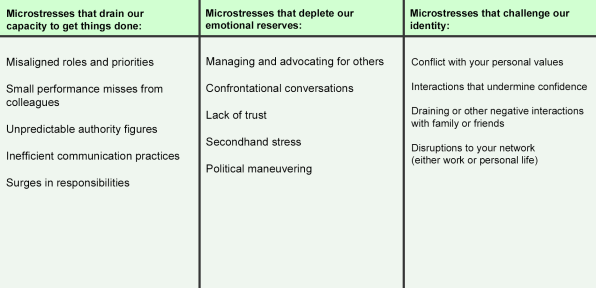
Most of us experience multiple forms of microstress across those categories. Here’s a simple example from our research of how microstress creeps into an ordinary day to derail an otherwise high performing employee. Take Rosa, a recently promoted operations manager in a business services organization, who couldn’t understand why she was receiving increasingly negative feedback. The promotion meant that Rosa (again, a pseudonym) was now reporting to leaders in two different business units, a welcome increase in both her responsibility and visibility in the organization. In the new role, she was now leading a team that was responsible for rapid fixes to crucial software problems that impacted large customers. Three different team leaders with different responsibilities reported to her.
But since the promotion, Rosa felt that she couldn’t do anything right. She was working longer hours, including nights and weekends to try to get on top of the work. At a time when Rosa should have been building morale and establishing her credibility as a leader, she worried if her new team was doubting whether she was up to the job.
On a daily basis, Rosa was kicking herself for not being on top of the job. But what Rosa didn’t recognize at first was that a primary source of her wavering belief in herself were two common sources of microstress.
Part of our identities and our values are the things we take pride in being good at and want to be good at. Microstress that undermines your self-confidence eats away at that. “I started my career excited about being deeply respected for what I do professionally,” she told us. “But this role is so overwhelming now that all I do is make decisions on what balls to drop—not how to be great.”
The microstressors that undermine your confidence don’t have to come from a single person, for example worrying that you’re not living up to your boss’s expectations. Rather, they are more typically a consequence of the demands of work in our hyper-connected world. This can happen in small ways, such as when role design or performance-management systems make it feel almost impossible to succeed. It can happen when you’re embedded in overly inclusive cultures, where the sheer number of people who need to be involved in any decision makes it difficult to move anything forward or pulls us in so many directions that we give up pursuit of what is best or right and fall back to just getting through. Even though you believe you are a conscientious, innovative team player or good leader (and so on), your performance doesn’t reflect those characteristics. You can end up feeling like a failure despite the fact it’s not you who’s creating the disconnect. That’s what was happening for Rosa. The way the job was structured—where she reported up to two different people and was responsible for three different work groups–almost set her up to feel like a failure from the start.
Another common microstress—misalignments—was contributing to the problem. It turned out that each of her key team leads had a slightly different perspective on what a “resolution” to a problem was. For the quality team, resolution meant identifying the root cause; for the engineering team, resolution meant identifying a technical solution. The product management team saw resolution as the final rollout of the fix to customers. Clients, on the other hand, expected all three versions of “resolved” at the same time. And Rosa realized she, too, had never clarified her own expectations with any of the teams, leaving them each to draw their own conclusions about what success looked like. Every person on the team had honestly believed they were doing what was asked of them without realizing how their narrow perspective might have created problems for the team as a whole.
Once Rosa was able to clarify expectations across the different groups, she was able to get everyone on the same page—and the work began to go more smoothly.
What can you to do ensure that those misalignments don’t happen in the first place? Like Gavin did, you can coach your team to work through a simple process to assess any new project:
1. Before taking on a new project: Be careful of the knee-jerk reaction to just say yes without fully investigating what work will be involved. Even if it’s a solo project, ask your employees to think about the time and resources they will need to get this work done and how it might affect other work already on their plate. Ask them to map that out and share your thinking with whoever is assigning you the work before they dive in.
If this is a collaborative project, ask them to think about the relationships and backup resources they’ll need. Who will they be dependent on to get this task done? Will they work together seamlessly or is the collaborative footprint—the people and resources that will play some role in getting the work done-—larger than anticipated?
2. Review the goals, priorities, and stakeholders. Ask your team members to speak with the project sponsor to make sure they clearly understand the goals, priorities, and stakeholders involved. It can be tempting for them to default to “yes” on new projects because they want to convey a positive “can-do” attitude, but they can be open and positive while still saying “I’d like to learn more” before committing. We understand, of course, that they’re not simply free to turn down work a manager asks them to do—especially if your company is under pressure or layoffs are in the air. But they can have a candid conversation with you or the project sponsor about what will be required, what they’ll need help reprioritizing, and what they might be able to put on the back burner. The key here is to have a thoughtful conversation, so you’re all on the same page.
3. Don’t be afraid to clarify expectations to ensure appropriate support exists. Agree to what and when: Early on, take the time with the team to ensure that you reach agreement on the “what” and “when” of the work. Take five minutes to clarify specifics for everyone involved, even tangentially, in the work. Clarify what they are specifically accountable for. Lay out a clear timeline, along with performance expectations.
4. As the project is ongoing, be on the lookout for misalignment and take corrective action early—but positively—even when misses seem small.
Develop your own “sensor system” for uncovering misalignments, so that you can engage quickly to fix problems. This might mean using the last 5 or 10 minutes of a meeting to ask people to state back what they’re committing to in the next cycle, to make sure there are no misinterpretations.
Navigating misalignments is just one way to avoid allowing microstress to affect your team’s performance. But there are many others. In Gavin’s case, he sent a clear message encouraging his team to advocate for themselves by pushing back on unreasonable or less important requests—even when they come from him. “I want to make sure they have a solid plan to help defend themselves again random ‘urgent’ requests and coach them how to be more inquisitive and less assuming,” he shared with us.
And finally, take a moment to consider whether you, as a manager, are unnecessarily causing microstress for your team. In our research, we found that most people recognized that they were often unintentionally causing microstress for others. Removing some of that not only is good for your team but is going to be good for you. Inevitably the microstress we cause others boomerangs back on us in a different form.
The good news for Rosa was that once she understood how misalignments and poor communication were getting in the way of her own performance, she was able to course-correct for both her and her team. We’re happy to report that Rosa is now thriving in the new job. We learned in our research that small adjustments can make a significant difference.
Years of social science research shows us that negative interactions have three to five times the impact of positive one. So removing even just a few microstresses can make an enormous difference. Why leave the greatest leverage opportunity to improve the well-being of you and your team on the table?
Rob Cross is a professor at Babson College and Karen Dillon is a former editor of Harvard Business Review. They are the coauthors of The Microstress Effect: How Little Things Pile Up and Create Big Problems—and What to Do About It.
#####################
From rhymes to chunking and large displays, neurology professor Richard Restak provides key tips to improve your memory
Dr Richard Restak Sat 8 Apr 2023 15.00 BST Last modified on Sun 9 Apr 2023 03.55 BST
Methods for strengthening memory can be traced back hundreds, if not thousands of years. The key insight was learning to think in pictures, rather than words. And when you think of it, this makes sense. We are primarily visual creatures who best remember images, rather than words. The real challenge for our memory (and intelligence) is to correlate things that aren’t ordinarily thought of together. For example: my dog, Leah, is a Schipperke, which is a hard word to remember. Solution? Imagine a tiny boat (representing a tiny dog) with a huge portly captain – the skipper – standing in it while holding a key, skipper key. As in this example, images are most effective as memory prompts when they are whimsical, inappropriate and even outrageous compared to the objects that inspired them. Here are a few key tips to practise for retention and recall of memory.
Picture yourself drinking coffee. Not only can you imagine yourself doing that, but you can also imagine smelling its delightful aroma. In your imagination you can taste it and savour it as it flows over your taste buds. The coffee experience is both verbal (naming and describing it), as well as sensory (tasting, smelling, etc). Nouns like “chair” and “notebook” can be described and imagined in different ways (the comfort of the chair, the softness or hardness of the notebook and so on). The more senses that can be recruited, the more likely you will be able to form a long-lasting memory, as more areas of the brain are involved.
Our brains are designed to work with meaning. If meaning isn’t obvious, we create it. The easiest way to organise unrelated information is to place things you are trying to remember into a framework, like a story or a rhyme. As an example, I parked my car yesterday in space 351 in a seven-storey garage. So how to guarantee that I will be able to find it? By using the sounds-like system based on rhymes. The number “three” rhymes with “tree,” “five” rhymes with “hive,” and “one” rhymes with “sun”. I pictured a tree under a blazing sun in full bloom with beehives so numerous and ponderous that they weigh down all the branches. When I returned to the garage I had no trouble converting the images back to numbers to remember where I’d parked the car.
It was the 16th-century architect and philosopher Giulio Camillo who suggested the memory theatre as a way of using images and loci (the position of these images) to remember. The loci method remains one of the most popular used by mnemonists and a few of the ones I use are 1) my home, 2) a nearby library and 3) a coffee shop. So if I want to remember, say, three items – milk, bread, watermelon – here is how I would do it. House – imagine the house as a pint of milk turned on its side with milk pouring out of the chimney. Library – when I look through the floor-length window facing me, I see loaves of bread instead of books on shelves. Coffee shop – a giant coffee cup on a table outside contains a watermelon. Come up with a longer list of your own loci and place a list of random items in them – the more bizarre or irreverent the images you come up with, the easier they will be to remember.
Simply thinking about how two or more things can be associated requires you to concentrate and attend – two brain activities which on their own lead to enhanced memory. As the 18th-century writer Samuel Johnson put it: “The art of memory is the art of attention”.
Situational awareness exercises are used by US Navy Seals, and other branches of the military. On request a Seal who must be able to describe the location of the doors and windows of the room in which they are sitting, along with other details that would be helpful to remember in order to be able to make a quick escape in the event of an enemy attack. To get a feel for this, the next time you are in a restaurant, close your eyes for a few seconds and mentally picture the arrangement of the people sitting around you at the nearby tables. If you are like most people, you probably won’t do very well with this memory exercise the first time you try it. The goal is to employ your attentional focus in the manner of a searchlight scanning the night sky. The more you practise, the greater the breadth and depth of your memory. You will remember more because at a given moment, your memory is encompassing larger swathes of your immediate surroundings.
One step beyond are situational exercises directed inward. Situational exercises involving self-exploration are used in creative-writing seminars. After encountering unfamiliar people in a social setting, the aspiring novelist is asked to incorporate them into the plot of a novel or short story. As an exercise for remembering an unfamiliar group of people, you can invent a visually vivid story around them. A similar method of looking inwards is used in the training of psychoanalysts. It is referred to as self-analysis. The first patient was none other than Sigmund Freud.
Look at this long string of digits for one minute:
3493705272227500454680208713456553700678192165234456807561450359492340096067659087
Now turn away and write down as many as you can remember, starting from the left. How many were you able to come up with? According to the Montreal Cognitive Assessment (Moca), the gold standard among neuropsychological screening tests, your performance was acceptable if you remembered five or more. But what is the upper limit of numbers that can be remembered by a group of people randomly chosen? In the 1940s, Harvard psychologist George Miller measured the capacity of people’s short-term memory for digits and found that most people could repeat strings of five to nine letters. Now I’ll show you how to repeat more than 20 digits on the first try! Take another look at the digits you attempted to memorise and arrange them like this:
349-370-5272
227-500-4546
802-087-1345
655-370-0678
192-165-2344
568-075-6145
035-949-2340
096-067-6590-87
It should only take a few minutes for you to get the first three phone numbers. But even if you can only remember two of the first three numbers, you have achieved a memorisation of 20 numbers, far higher than the five numbers on the standard neuropsychological test. The organising principle at work here is called chunking – converting random numbers into a memorable string, like a telephone number, so your brain can come up with a way of imposing impose meaning on a meaningless sequence.
To form mental images of the greatest clarity, we are better off separating those images so they don’t overlap. If you are using an iPad for instance, you will see the same images as a desk computer with a big screen. But there’s a vast difference when it comes to committing these to memory – so the next time you are reading an important article, work document or committing a map or photo to memory, choose the biggest screen available to you. Bigger displays are better remembered in the imagination. Smaller displays lead to a narrower visual focus and, as a result, less memory formation.
Working memory, often described as the “queen of memory”, is essentially the ability to keep in your attentional foreground a piece of information while you turn your attention to something else. See how many prime ministers you can think of, starting with Rishi Sunak and going back as far as you can. Now list their names in alphabetical order. To do this, you have to mentally move the names around and rearrange them. What you are doing is encoding one item while retaining access to items recalled moments earlier. This is working memory in action. Experts consider it the basis for general intelligence and reasoning. In general, the people who can hold the greatest numbers of items in mind are best at considering multiple aspects of a problem simultaneously.
Finally, one highly effective technique for improving your memory is to keep re-testing yourself on the material you want to remember. Even after you have learned something, your long-term memory for it will be strengthened if you repeatedly challenge yourself to recall it.
The Complete Guide to Memory: The Science of Strengthening Your Mind by Dr Richard Restak (Penguin Life, £18.99) is available for £16.71 at guardianbookshop.com
Congratulations on being one of our top readers globally – you’ve read 120 articles in t
[Image: Webflow]
3 MINUTE READ
Webflow made its name by offering designers a suite of no-code tools to create fully customizable websites. Soon, users may not even need to use those tools to generate a working site.
By this summer, the company plans to roll out a set of AI-powered features that will let users start with a pre-existing Webflow-provided template and quickly tweak it to their needs using verbal prompts.
For instance, someone building a site for a venture capital firm could grab a template designed for an event business and instruct the AI to restructure it to feature partner biographies rather than event examples.
“It’ll go through every page of that starting point and shift the content and the images to be more relevant to that prompt,” says CEO and cofounder Vlad Magdalin.
Users can then make manual tweaks and edits to the site using the existing palette of design features. A new AI interface will be able to quickly surface relevant sections of Webflow documentation to guide them. A separate new Webflow AI “copilot” interface will also directly make changes on demand, in response to a user’s text prompts.
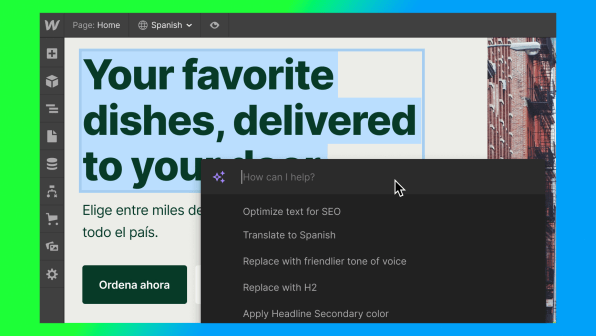
In internal testing, people have successfully experimented with instructions like “make this look like Geocities” to give sample sites a retro ‘90s aesthetic. But Magdalin says more common use cases would likely be asking the AI to add a new section to a website—say, customer testimonials—that matches the existing look and feel. Users could even ask the tool to translate content into another language to appeal to international audiences.
Users will likely also be able to have Webflow’s AI generate a draft blog post from a few bullet points, Magdalin says. That’s something many have already documented being able to do with tools like OpenAI’s ChatGPT, but having AI built directly into Webflow’s content editing system will mean one less step for its users. Planned AI features will also be able to automatically generate some search-engine-optimized features of sites, like the titles and descriptions slurped in by crawlers from Google and Bing, as well as accessibility features like the alt text used by screen readers to describe images.
The company, which has raised more than $330 million, including a $120 million Series C round announced last year, hasn’t yet firmed up details on pricing and availability of the planned AI features, which are built with a mix of OpenAI’s GPT and some internally customized AI models. Many of the features are currently in limited alpha testing, and they’ll likely then move to broader beta testing, with how they’re made available and at what price point dependent on factors like usage and the pricing of external APIs, Magdalin says.
In recent months, AI has increasingly been integrated into creative tools. Modern generative AI first drew public attention through interfaces like ChatGPT and Microsoft’s Bing chat mode, but users ranging from businesspeople creating presentations to exercise enthusiasts crafting workouts quickly saw its potential in drafting longer-form content, even if it occasionally still makes baffling mistakes. Since the start of this year, Microsoft has announced plans to integrate AI assistants into its Office tools like Word and PowerPoint, Mailchimp has enabled AI to draft email marketing copy, and Adobe recently launched an AI-powered creative tool called Firefly.
At Webflow, Magdalin says the goal isn’t to replace the web designers who currently use the product. The AI tools are intended to make their work faster, but there are likely to be some elements of the design process that will still be easier to craft by hand using existing design tools (rather than giving commands to the AI). And, he says, having an AI assistant will likely make it easier for new users to master design tools.
“It opens up the door for people to learn these tools much faster,” he says. “I really do think it’ll move a lot more people into the space.”
Posted by: Oliver Friedman April 20, 2023 at 11:00 am EDT
ChatGPT stunned the world. What comes next?
Speaking live at Session 2 of TED2023 on Tuesday, OpenAI cofounder Greg Brockman took a peek under the hood of GPT-4 — the company’s most advanced large language model — and discussed why he thinks this is a historic moment to shape the future of artificial general intelligence (AGI).
Brockman projected his laptop onto the big screens in the TED Theater and demoed a series of mind-blowing, unreleased plug-ins for ChatGPT. Working live off the internet, he showed how ChatGPT could help you create a recipe for dinner, generate an image of the finished dish, draft a tweet about that dish and build the corresponding grocery list in Instacart — all without you ever having to leave the chatbot. He went on to demonstrate ChatGPT’s new ability to fact-check its own work (with citations you can click on) and interpret a data-intensive spreadsheet even when given relatively vague instructions.
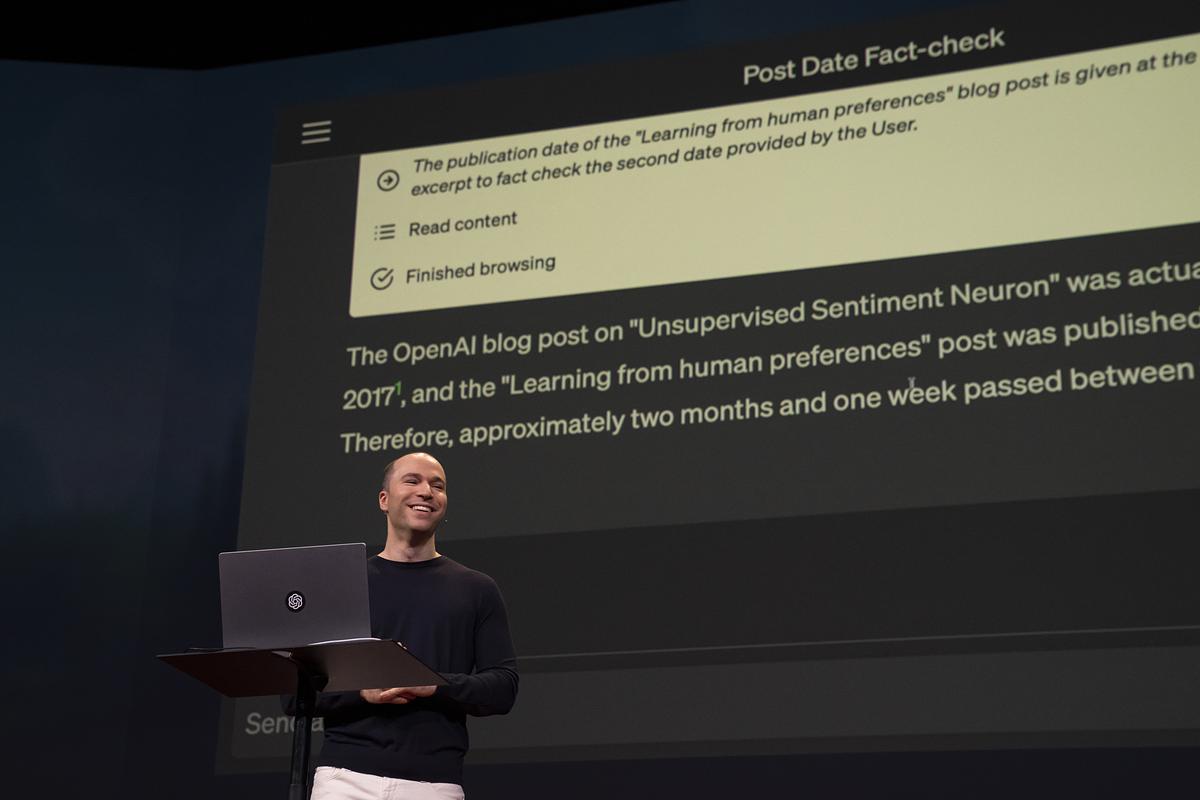
OpenAI cofounder Greg Brockman speaks at Session 2 of TED2023: Possibility on April 17, 2023, in Vancouver, BC, Canada. (Photo: Gilberto Tadday / TED)
The idea, Brockman says, is that the machine learns to “align” with your intent. Just like you might teach a child a task without giving precise instructions, so too will the AI gradually learn to apply its knowledge to novel situations through a feedback loop with users. He hopes this will take the shape of a deep, trustworthy collaboration between humans and AI on the path to completing harder and harder tasks. Humans will be the managers and overseers of this work, Brockman says — the machine just executes the details.
Acknowledging that many people are nervous about the potential of AGI, Brockman nonetheless maintained his view that the technology will create a better world for everyone. The key to achieving this, he says, will be widespread participation and input from people on what the guardrails for the AI should be.
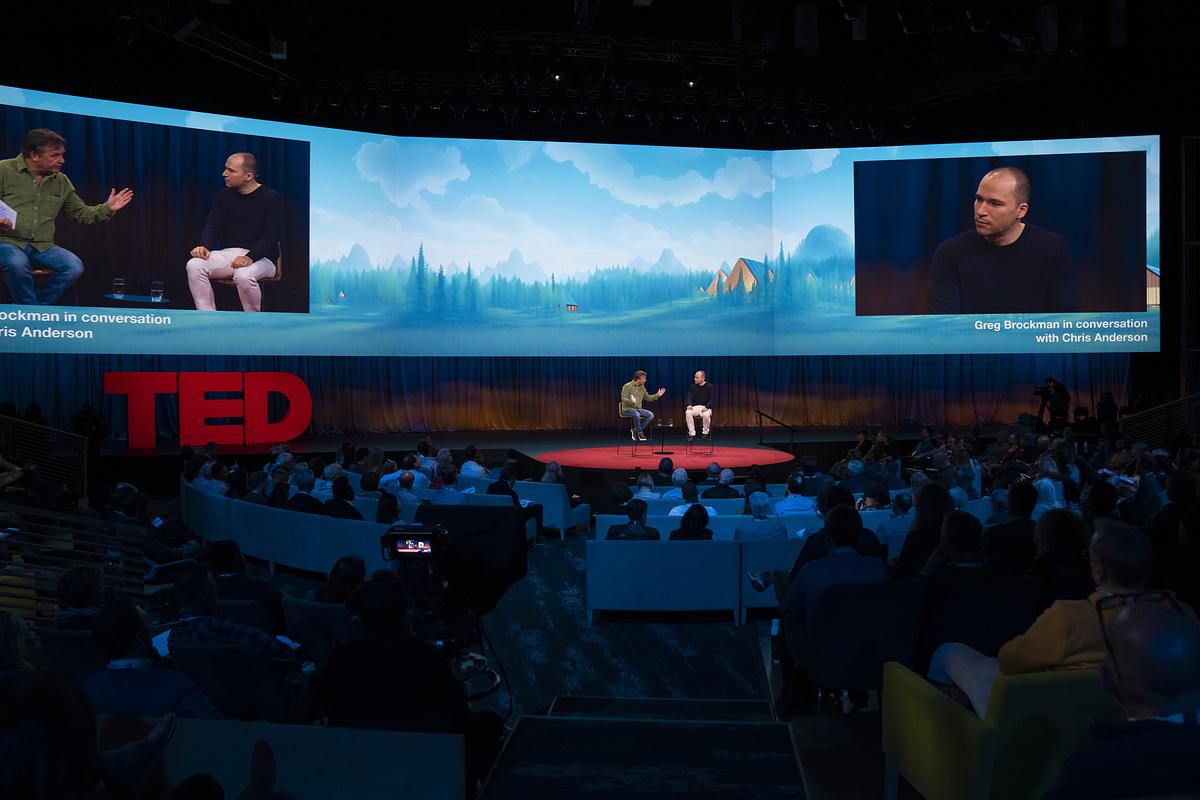
Head of TED Chris Anderson (left) and OpenAI cofounder Greg Brockman speak at Session 2 at TED2023: Possibility on April 17, 2023, in Vancouver, BC, Canada. (Photo: Ryan Lash / TED)
After the talk, head of TED Chris Anderson joined Brockman onstage to dig deeper into the timeline of ChatGPT’s development and the risks, raised by many in the tech industry and beyond, of putting such a powerful tool out into the world. Was it a responsible decision, or a reckless one? Brockman’s stance is that the best approach is to release the machine before it’s super powerful, see it in action and “let reality hit you in the face.” From there, he says, it’s our collective responsibility to provide feedback to the AI on the way to incremental improvement.
One way or another, Brockman says, AGI is poised to transform almost every aspect of how we use computers. It’s time that we all get literate in this technology.
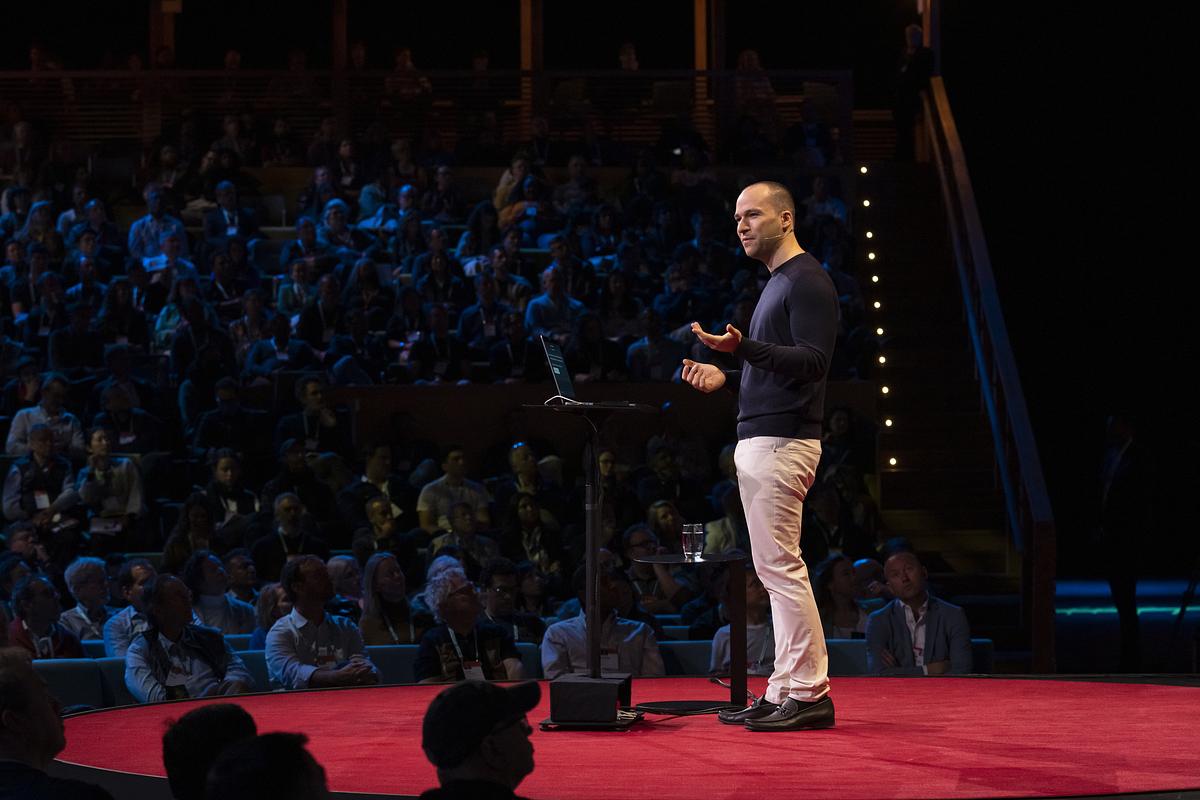
OpenAI cofounder Greg Brockman speaks at Session 2 of TED2023: Possibility on April 17, 2023, in Vancouver, BC, Canada. (Photo: Gilberto Tadday / TED)
ChatGPTChris AndersonGPT-4Greg BrockmanOpenAI
Related Stories
Follow TED
Subscribe to the TED Talks Daily newsletter.
Sign up for our daily or weekly emails to receive notifications whenever new talks are published.
Powered by WordPress VIP
© TED Conferences, LLC
The Guardian – Back to homeThe Guardian
Fearless, independent, reader-funded Support us


Self-proclaimed ‘pro-natalists’ don’t go around saying that they only want white babies, but there’s a thin line between their movement and the ‘great replacement theory’ Fri 21 Apr 2023 06.00 BST
Simone and Malcolm Collins are a thirtysomething couple with three kids called Torsten, Octavian, and Titan Invictus. (They refuse to give their girls traditionally feminine names because they think that means they’ll get taken less seriously.) The Pennsylvania-based pair plan on having at least eight children and hope each of their children can have eight children so that, in 11 generations, the world will ooze with their bloodline and there will be more Collinses stalking the Earth than there are people alive today.
A bit weird, right? Maybe the sort of fantasy you’d be best off keeping to yourself? The Collinses disagree. They’ve made themselves the poster children of “pro-natalism” and are taking it upon themselves to combat what they describe as “fertility collapse” – not only by having multiple kids themselves but by trying to push for policies that would increase birth rates in the developed world. The media is paying attention to their crusade: Britain’s Telegraph profiled the pair this week, with the headline “Meet the ‘elite’ couples breeding to save mankind”. This followed a long profile on the Collinses last November from Insider and pieces by Entrepreneur and Bloomberg.
The Collinses don’t just want to increase the birth rate; they want to optimize the sort of children being born. They used genetic testing for their own embryos and, as Bloomberg reports, “created a spreadsheet with each embryo’s scores, weighting them according to their desired mental health traits”. This sort of thing has led to the pair being called “hipster eugenicists” online, which they seem to find rather amusing. When an Insider reporter mentioned the moniker to them, Simone called that fact “amazing” but scoffed at the idea that they were eugenicists.
The Collinses might not think of themselves in this way, but it’s hard not to view the modern pro-natalist movement, which is largely situated in Silicon Valley, as a rebranding of eugenics. Pro-natalism may mean pro-birth but the loudest voices in the movement are clearly only pro people like themselves being born. The most famous proponent was one Jeffrey Epstein, who planned to develop a super-race of humans with his DNA, by impregnating up to 20 women at a time. There is a constant refrain in pro-natal circles about how important it is for “really smart people” to keep reproducing.
Dismissing the movement as quirky people with quirky ideas risks glossing over some very regressive thinking
While pro-natalists don’t exactly go around saying that they only want white people to be born, there is a very thin line between their concern about birth rates in the developed world and the racist and antisemitic “great replacement theory”, which posits that white Americans and Europeans are being “replaced” by non-white immigrants. It goes without saying that the global population is currently increasing, not decreasing, and the fastest growth is happening in Africa and Asia. Estimates suggest it is only likely to start decreasing in 2100, by which point there will be 10.9 billion people on Earth.
Dismissing those like the Collinses as quirky people with quirky ideas risks glossing over some very regressive thinking. Indeed, much of the media coverage of pro-natalism is reminiscent of the way in which white supremacists like Richard Spencer were treated as “dapper” style icons in 2016 rather than dangerous Nazis and rebranded as the “alt-right”.
Pro-natalism doesn’t just overlap with racism, but also misogyny. When you start to see women as breeding machines whose job it is to repopulate the Earth, you can justify some very dystopian policies. This week, for example, Elon Musk sat down with Fox News’s Tucker Carlson, argued that abortion and birth control might lead to the end of civilization. “[I]n the past we could rely upon, you know, simple limbic system rewards in order to procreate,” Musk said. “But once you have birth control and abortions and whatnot, now you can still satisfy the limbic instinct but not procreate … I’m sort of worried that – hey, civilization, if we don’t make enough people to at least sustain our numbers perhaps increase a little bit, then civilization’s going to crumble.” You can see where this is going, can’t you?
Indeed, you only need to look at Hungary to see the end point. Far-right Viktor Orbán is obsessed with getting Hungarian woman to breed and has devoted a huge amount of resources to pro-natalist policies. Some of these policies are positive (free IVF); many are not. Hungary has recently tightened abortion rules and there has been concern it is trying to limit access to the morning-after pill. Orbán, who is beloved by conservatives in the US, also hasn’t been shy about explaining the racist ideology behind his pro-natalism. “In all of Europe there are fewer and fewer children, and the answer of the west to this is migration,” Orbán has said. “They want as many migrants to enter as there are missing kids, so that the numbers will add up. We Hungarians have a different way of thinking. Instead of just numbers, we want Hungarian children. Migration for us is surrender.”
Are the Collinses worried about the misogynistic aspects of their movement? Not at all – they seem to think they’re doing women a favour. “People often compare our group to Handmaid’s Tale-like thinking,” Malcolm told the Telegraph. “[A]nd I’m like: excuse me, do you know what happens if we, the voluntary movement, fails … ? Cultures will eventually find a way to fix this; how horrifying those mechanisms are depends on whether or not our group finds an ethical way.” It’s a warning that sounds distinctly like a threat.
[Photo: Miguel Á. Padriñán/Pexels; Christina Morillo/Unsplash]
MORE LIKE THIS

Auto-GPT and BabyAGI: How ‘autonomous agents’ are bringing generative AI to the masses
This Pedro Pascal-backed biotech startup just raised $10M to fight aging
What is WaterTok? Why flavored water is blowing up on TikTokBY SUNNY LEE AND TOMAS CHAMORRO PREMUZIC
5 MINUTE READ
ChatGPT, an AI-powered chatbot capable of generating humanlike responses to an unimaginable range of questions and prompts, has accumulated 100 million users in just two months, surpassing the growth rates of popular social media platforms such as TikTok and Instagram. The bot’s amazing performances have elicited a wide range of reactions from critics and fans alike, from awe and admiration to concern and alarmist fears that even creative and skilled jobs may be destined to succumb to machine automation.
Among its many remarkable feats, ChatGPT can pass advanced university exams in law, medicine, and business; translate a picture of the contents of your fridge into a range of exciting recipes; produce an infinite number of essays, poems, and articles (though not, we promise, this one); and translate the picture of a handwritten website sketch into the full code needed to create it. Needless to say, all of these and other achievements occur in just a few seconds.
As psychologists, our primary interest in ChatGPT, AI, and indeed any technology, centers around their human impact, including their potential to change and reshape how we think, work, and live. As Pamela Pavliscak noted, “We design tech and tech, in turn, designs us.”
With the debut of highly versatile, viral, and pervasive technology as ChatGPT, we are bound to uncover consequential repercussions on how humans behave. As illustrated in I, Human: AI, Automation, and the Quest to Reclaim What Makes Us Unique, AI-induced changes aren’t always about generating new human behaviors, but rather, revealing, amplifying, or augmenting existing human beliefs, habits, and adaptations.
For example, much of the pushback against ChatGPT reveals the human inability to accept that something could be smarter than us, even when that thing is our own creation, and thus a natural—okay, artificial—extension of our own intelligence.
Ironically, such defensive pride, and the tendency to dismiss AI in order to reaffirm our intellectual superiority over the machines we’ve created, would put our own value and future at risk. By failing to experiment, learn, and cocreate with the very new technologies we create, we increase the probability that those technologies replace us.
In our view, the evolution of AI innovations is not just a technological breakthrough but also a catalyst for a much-needed shift in our thinking about ourselves and our relationship with the world. Specifically, we see ChatGPT, which merely personifies the latest advancement of mainstream AI today, as a wake-up call for humanity to harness four unique and precious human virtues.
The realization that AI can handle even creative and intellectually complex tasks should be a humbling experience for us. Abstract thinking and other knowledge work, once considered unique to humans, are no longer completely exclusive to us. This realization is reminiscent of a Freudian “narcissistic wound” or attack on our ego as it challenges our long-held belief in human superiority over everything.
This philosophical realization echoes earlier scientific discoveries that the world is not the center of the universe, that we share common ancestries with primates, or that (Freud’s own contribution) humans often lack conscious control over their motives and behaviors. Indeed, after centuries of ascribing to the “I think, therefore I am” mantra to define the essence of humanity, we must, for the first time, ask ourselves what it means to be human in an era in which much of our thinking can be outsourced to machines.
Living in a world with access to ubiquitous information and knowledge can be meaningless unless we leverage our curiosity, our desire to learn and understand. The AI age has amplified the (already high) value of curiosity in the realm of human virtues, redefining the meaning of expertise. What matters today is not experts knowing the answers to all questions but that they are asking the right questions, not retrieving information but critically evaluating and vetting, not collecting insights but making smart decisions based on them.
Paradoxically, ChatGPT or other AI tools may actually numb our curiosity. Some may use AI-powered tools as a quick fix, similar to consuming fast food, for retrieving general facts and insights.
However, those with a curious mindset can use AI tools to expand their perspectives and foster further innovation for humanity. We expect, or at least hope, that while superficial fact retrieval will be a commodity in our cognitive abilities, the capacity to engage in “deep learning” (a term sadly associated with machine rather than human intelligence these days) will be key to our individual and collective success. In other words, if ChatGPT is the intellectual equivalent to fast food—i.e., efficient, cheap, addictive, rapid, but neither nutritious nor healthy—it is time to discover the intellectual equivalent of slow food or farm-to-table.
Understanding ourselves in the age of AI means paying attention to how our interactions with technology are reshaping our behaviors, and what they tell us about ourselves, including our dark side traits: impulsivity, distractibility, self-centeredness, and bias (as highlighted in one of our recent books).
In fact, feeding our own writings, recordings, and content to ChatGPT can give us back an AI-reflection of ourselves, just like in this episode of Adam Grant’s Re: Thinking podcast. A future in which we examine our entire digital footprint to better understand our reputation and identity is not far-fetched, particularly as regulatory pressures around ethical and lawful uses of AI encourage Big Tech platforms to give us back some of the data we’ve relinquished in the form of insights capable of boosting our self-knowledge.
Empathy, a unique human capacity to understand and share the feelings of others, can bring multiple benefits in people’s well-being and societal cohesion. While it may be a stretch to argue that AI tools will directly instill empathy, interacting with AI technology can certainly facilitate the development of empathy.
Through recognizing our intellectual and epistemic limitations and appreciating others’ strengths, even if they are machines, we can become less self-focused, and paying due attention and recognition to others, ultimately leading to feelings of empathy and gratitude. Indeed, numerous studies suggest that humility brings various prosocial attitudes, such as empathy, gratitude, altruism, and benevolence by enabling individuals to let go of extreme self-focus or egocentrism.
The emergence of advanced AI technologies, as with prior technologies, presents both risks and opportunities. Will the benefits outweigh the risks? Our stance is contingent. If we use this chance to become a bit humbler and try to preserve, develop, and reclaim the qualities that make us human unique, maybe mankind’s future will be brighter than today.
Sunny Lee is an associate professor of organizational behavior and head of diversity at the UCL School of Management.
Tomas Chamorro-Premuzic is an international authority in leadership assessment, people analytics, and talent management. He is the chief talent scientist at ManpowerGroup and a professor of business psychology at both University College London and Columbia University. His most recent book is Why Do So Many Incompetent Men Become Leaders? (And How to Fix It).


