
-
Archives
- October 2026
- September 2026
- August 2026
- July 2026
- June 2026
- May 2026
- April 2026
- March 2026
- February 2026
- January 2026
- December 2025
- November 2025
- October 2025
- September 2025
- August 2025
- July 2025
- June 2025
- May 2025
- April 2025
- March 2025
- February 2025
- January 2025
- December 2024
- November 2024
- October 2024
- September 2024
- August 2024
- July 2024
- June 2024
- May 2024
- April 2024
- March 2024
- February 2024
- January 2024
- December 2023
- November 2023
- October 2023
- September 2023
- August 2023
- July 2023
- June 2023
- May 2023
- April 2023
- March 2023
- February 2023
- January 2023
- December 2022
- November 2022
- October 2022
- September 2022
- August 2022
- July 2022
- June 2022
- May 2022
- April 2022
- March 2022
- February 2022
- January 2022
- September 2021
- August 2021
- July 2021
- June 2021
- May 2021
- April 2021
- February 2021
- January 2021
- December 2020
- November 2020
- October 2020
- September 2020
- August 2020
- July 2020
- June 2020
- May 2020
- April 2020
- March 2020
- February 2020
- January 2020
- December 2019
- November 2019
- October 2019
- September 2019
- August 2019
- July 2019
- June 2019
- May 2019
- April 2019
- March 2019
- February 2019
- January 2019
- December 2018
- November 2018
- October 2018
- September 2018
- July 2018
- June 2018
- May 2018
- April 2018
- March 2018
- February 2018
- January 2018
- December 2017
- November 2017
- October 2017
- September 2017
- August 2017
- July 2017
- June 2017
- May 2017
- April 2017
- March 2017
- February 2017
- January 2017
- December 2016
- November 2016
- October 2016
- September 2016
- August 2016
- July 2016
- June 2016
- May 2016
- April 2016
- March 2016
- February 2016
- January 2016
- December 2015
- November 2015
- October 2015
- September 2015
- August 2015
- July 2015
- June 2015
- March 2015
- January 2015
-
Meta
Jeffrey Sachs…follow what he has to say. “Jeffrey Sachs Interview – An important Analysis. Prevent Wider War”. Once upon a time Europe was a backwater…so many empires come and go. Africa soon is going to be a quarter of the world’s population, it is on the ascent. We should be aiming to build a cooperative world, is what Mr Sachs concludes with.
Posted in Uncategorized
Leave a comment
Why China Could Surprise the World by Being the First Country to Adopt Universal Basic Income. Source: BIEN
Why China Could Surprise the World by Being the First Country to Adopt Universal Basic Income


The concept of universal basic income (or UBI) – a regularly provided cash payment distributed without conditions to all individuals within a defined community – has a long history and an as yet unwritten future. As someone considered to be one of the world’s experts on the topic with over ten years of educating people about it under my belt, one question I’m frequently asked is where I think it will happen first. Despite hundreds of years of discussion, and the state of Alaska being one of the only places to implement a UBI at scale so far, which country will be the one to stop talking about it, and just do it? Well, some countries are certainly closer than others, and the idea certainly is more popular in some countries than others, but one entirely possible answer to this question tends to not even be considered in the running – China.
First, although I’m a huge believer in liberal democracy, and am actively worried about the rise of authoritarianism around the world, the fact remains that democracy tends to require the support of the people to be behind the policies enacted. For a country like the United States to enact UBI, there would need to be a sufficient percentage of voters demanding it, combined with a sufficient amount of support within Congress, and a president willing to sign it into law. For a country like China to enact UBI, the decision need only be made at the top of one party, and where once that decision only needed the agreement of a few men, it now only really needs to be made by one man – Xi Jinping.
In the summer of 2021, Xi Jinping began using the phrase “common prosperity” to describe his policy goals for China. He’s described it as people-centered growth where those with high incomes – both individuals and businesses – are encouraged to return more to society. He seems to believe that China has moved beyond its rapid-growth stage and has entered a new stage that will require a reduction of inequality and an uplifting of those left behind. He has also said he wants to make solid progress in achieving common prosperity by 2035. Key measurements of greater common prosperity, aside from reduced inequality, will include improved health and reduced environmental degradation, but most importantly a wider consumption base with more consumer buying power.
It’s that last one that is perhaps the strongest reason of all that China would want to consider implementing universal basic income. Long story short, China’s chief import is demand. It relies on consumers around the world buying what it produces. What has made possible the rise of China as an economic superpower is the American consumer and consumers in other countries around the world. The challenge for China at this point is to have its own consumption-loving middle class – a wide base of consumers with the disposable income and time to buy and consume what China produces.
China’s current median disposable income is about $7,200 in USD in urban areas and about $3,015 in rural areas, compared to about $45,000 that the median American has to spend after taxes. China needs to find a way of boosting disposable income across the board in a way that meets its many stated objectives.
Weak consumer spending in China post-pandemic has been described as being a case of “economic long-Covid” and is even becoming somewhat reminiscent of the Great Depression. A July 2023 meeting of the Political Bureau of the CPC Central Committee, plus recent statements of China’s central bank, and also the Institute of Economics of the Chinese Academy also all agree on the need to direct state capacity towards increasing domestic demand. So it’s not only the international community saying this, but China itself saying this.
Whereas the American consumer came roaring out of the pandemic with a desire to spend, spend, spend, consumers in China did not. They are preferring to just stash their money in savings accounts. This is not good for economic growth. Chinese consumer confidence has fallen almost 10% from its high and now stands at a lower level than ever, including during the pandemic. China desperately needs to figure out a way to get people to spend on goods and services instead of saving their money.
As Paul Krugman wrote in the New York Times, “what China must do seems straightforward: end financial repression and allow more of the economy’s income to flow through to households, and strengthen the social safety net so that consumers don’t feel the need to hoard cash.” UBI accomplishes both aims.
There’s also another reason that China could consider UBI as the tool that will accomplish its economic objectives, and it’s known as dibao. The dibao program is China’s already existing minimum income guarantee. It’s a top-up program originally created for urban areas to reduce urban poverty where if someone earns below the minimum level, they’re provided the difference between what they earn and what is deemed the minimum they need. The problem with such a design is the strong work disincentive it creates due to a 100% marginal tax rate on income. As long as someone has an income below the dibao level, any additional earnings don’t leave them better off. This is contrary to a UBI design, where all additional earnings always leave people better off.
To illustrate, consider you have a part-time job that pays $500 a month and the dibao is set at $1,200 a month. You’d be boosted to $1,200. If you then doubled your hours worked to get $1,000 a month, you’d still be boosted to the same $1,200. All the extra work wouldn’t matter. You’d be no better off despite that additional work. However, with a UBI set at the same $1,200 a month level, doubling your hours worked would move you from earning $500 on top of $1,200, which would total $1,700, to a new total of $2,200 (before taxes).
This is not to say that China would necessarily convert their dibao into a UBI, but that the precedent already exists for China to look at poverty as a lack-of-money problem that can be solved directly with a monthly distribution of money. The origins of the dibao were also in the concerns of “staving off social instability and turmoil” in a time of massive labor market transformation, and it’s viewed as having achieved those goals. As labor automation advances, UBI could be recognized as a far more powerful tool for maintaining social stability in a way that doesn’t create a work disincentive like dibao-like programs do.
These are the three primary reasons I believe China could surprise everyone by being the first to introduce a universal basic income: Xi Jinping could at any point just decide to do UBI. China’s stated goals of a strong consumer class and the notion of common prosperity would be accomplished by a UBI. And China could recognize UBI as a superior policy to its existing minimum income strategy.
There are plenty who disagree with my take on this, including the UNDP who sees UBI as “not financially feasible” in China, but that’s due to the same error that many discussing UBI commonly make. UBI is not more expensive than a targeted income program designed to achieve an identical post-tax income distribution. Targeting just uses phaseouts that mistakenly aren’t considered to be taxes. It costs the same to give someone $50 after phasing it down from $100 as it does to give someone $100 and then tax away $50. However, the former can involve high administrative overhead and high marginal tax rates where the latter requires neither. In reality, targeting is a more expensive way of distributing income with worse results. UBI can achieve the same reduced amount of inequality as a targeted design, but in a more efficient way that generates more labor supply and many other widely desired outcomes.
I know of at least one person in China though who appears to agree with me, and that’s the chief economist of the Bank of China – Xu Gao. He has proposed something he calls an “Ownership Sharing Scheme of State-Owned Enterprises for All” that would establish multiple public investment funds financed with capital from all state-owned enterprises, the profits of which would be distributed universally to the entire population as an annual dividend. UBI enthusiasts may recognize this plan as basically the Alaska model, but using corporate profits instead of oil. This also happens to be basically the same thing Sam Altman has proposed and what I proposed during the pandemic, except using state-owned enterprises instead of publicly-traded corporations to grow the wealth fund.
The general strategy of such a UBI is to go about it in a way that doesn’t use personal income or consumption taxes, and gets citizens a share of overall productivity growth. If there’s a mechanism in place so that as companies do better, people do better, people will want companies to do better. If companies automate labor and as a result become more profitable, people should see larger UBI as a result. A dividend tied to corporate profits does that.
The prospect of a UBI-equipped China may also lead the U.S. into considering UBI, and it’s also possible that the U.S. may soon realize it needs UBI in order to outcompete China in AI. Fear of AI taking jobs is an obstacle to embrace of AI. UBI removes that obstacle, especially one tied to national productivity growth.
The simple fact of the matter is that China needs consumers, and UBI creates consumers. The only real obstacle is that UBI also means trust in individuals. Its lack of conditions means a giving up of some control. The big question is if China will ever trust its people with the freedom that UBI provides. With the rise of AI and its impact on the labor market and thus consumer spending, it may not really have a choice, which also happens to be true for every other country too. But in China’s case, it’s really only about convincing one man that UBI is the way to go.
Want more content like this? Please share it and click the subscribe button. Also consider making a monthly pledge in support of all my work.
Special thanks to my monthly supporters on Patreon: Gisele Huff, Haroon Mokhtarzada, Steven Grimm, Lowell Aronoff, Katie Moussouris, David Ruark, Tricia Garrett, Zack Sargent, Daryl Smith, Larry Cohen, Fabian Kehrer, Liya Brook, Frederick Weber, John Steinberger, Bridget I Flynn, Laurel gillespie, Dylan J Hirsch-Shell, Tom Cooper, Judith Bliss, Robert Collins, Joanna Zarach, ace bailey, Daragh Ward, Andrew Yang, Peter T Knight, Michael Finney, David Ihnen, Elizabeth Corker, Gerald Huff, Albert Daniel Brockman, Natalie Foster, Joe Ballou, Arjun , Mark Donovan, Capitalists for Shared Income, Jason Clark, Chuck Cordes, Thomas Fitzsimmons, Leslie Kausch, Jessica Chew, Braden Ferrin , Juro Antal, Austin Begin, Deanna McHugh, Nikolaus Rath, chris heinz, Pavel S, Zachary Weaver, Justin Seifert, Jodi Sarda, Rosa Tran, Ryan Ash-Miller, miki, bradzone, Lee Lor, Akber Khan, John Sullivan, Team TJ, Yang Deng, Yan Xie, Marie janicke, engageSimply – Judy Shapiro, Tim , Warren J Polk, Jeffrey Emmett, Stephen Castro-Starkey, Kev Roberts, Walter Schaerer, Loren Sickles, Eric Skiff, Thomas Welsh, Kai Wong, and Laura Ashby.
Become a monthly patron to see your name here too!
Scott Santens Twitter
Unconditional/Universal Basic Income (UBI) advocate with a crowdfunded basic income; Founder and President of ITSA Foundation, Author of Let There Be Money; Editor of BasicIncomeToday.com
Posted in Uncategorized
Tagged ai, artificial-intelligence, politics, ubi, universal-basic-income
Leave a comment
US surgeon general Vivek Murthy: ‘Loneliness is like hunger, a signal we’re lacking something for survival’. Source: The Guardian
US surgeon general Vivek Murthy: ‘Loneliness is like hunger, a signal we’re lacking something for survival’
As the 19th and 21st surgeon general, Dr Vivek Murthy has described loneliness as an epidemic on par with tobacco use – the antidote, he says, is human connection
by Katherine RowlandUS surgeon general Vivek Murthy Photo: Guardian Design / Getty ImagesMon 29 Jan 2024 14.00 CET
Dr Vivek Murthy, who is currently serving as the 21st surgeon general of the United States, is the first person in this position to have taken his oath on the Bhagavad Gita, the sacred Hindu scripture.
When he was first confirmed in 2014 under the Obama administration, he was, at 37, the youngest person to assume charge of the nation’s public health. He’s also the first person to have been confirmed twice, having been relieved of his post by Donald Trump, only to be sworn in by his successor. Today, he commands a uniformed service of more than 6,000 public health officers who work on issues as diverse as the opioid crisis, refugee resettlement, emergency preparedness and ebola outbreaks.

There is much that sets Murthy apart from his predecessors, but one detail stands out: he’s a high-ranking government official who insists on the importance of care, compassion and deep listening. Love, he says, is the foundation of good policies and needs to inform the nation’s public health agenda.
At first blush, this message sounds almost utopian – but Murthy’s own idealism is fortified by evidence. As he recounts in his 2020 book, Together: The Healing Power of Human Connection in a Sometimes Lonely World, it was in the course of talking to Americans across the country that he realized the extent to which people were suffering from sadness, withdrawal and isolation.
“Loneliness,” he wrote, “ran like a dark thread through many of the more obvious issues that people brought to my attention.”
As surgeon general, he has described loneliness as an epidemic on par with tobacco use and obesity, and is at the helm of a new World Health Organization commission to address the hazards of social isolation. Not only does it undermine physical and mental health, but, in his diagnosis, it underpins many of our more pernicious ills, including violence, addiction and extremism. The antidote, he says, is human connection.
https://interactive.guim.co.uk/uploader/embed/2023/11/archive-zip/giv-13425SACijDhlvmi7/
I spoke with Murthy over Zoom; this conversation has been edited for length and clarity.
Before Covid, I imagine that most people did not view loneliness as a grave public health threat. It was a state of mind or an unfortunate corollary of our modern lives, but not something on the scale of an epidemic. But you started raising the alarms on this issue well before the pandemic. What circumstances led you to feel concerned about our state of disconnection?
Vivek Murthy: I’ve had my own personal experience with loneliness, which made me more sensitive and attuned to the issue. Having lived through it as a kid, then also as an adult, made me acutely aware of how painful loneliness is and how much shame is often associated with it.
But it was when I started practicing medicine that I came to see just how common loneliness was, and it wasn’t something I had learned about in medical training. I wasn’t quite sure, when I encountered patients who are lonely, what I was supposed to do.
So I did the only thing I knew how to do, which is try to respond from a human perspective: just to listen to people. But in the back of my head was this nagging feeling that there’s this deeper challenge that people are encountering that’s impacting their health, wellbeing and happiness.
It was back in 2015, when I was surgeon general the first time and travelling around the country, that I realized this is far more than an issue that was affecting my life, or my patients’ lives. This was a national problem, a national epidemic. And that’s what inspired me to dig into some of the data around it.

I was really shocked to discover just how powerful the health implications of loneliness are. I hadn’t realized that being socially disconnected was associated with a marked increase in depression and anxiety, as well as in heart disease, dementia and premature death. These things underscored the point that loneliness is a public health threat – and one that affects millions of people across America.
Loneliness, while pervasive, can be hard to articulate. Going back to those clinical encounters and the conversations you were having around the country, how did you diagnose this collective condition? What sorts of feelings were individuals expressing?
It’s interesting you ask that, because very few of them use the term lonely. They would use other words to describe it. Many of them would say, I feel like I’m just invisible. They would say, if I disappear tomorrow, nobody would even notice, no one would even care. Many of them felt like nobody really knew them for who they were.
On college campuses a lot of students said, I’m surrounded by students, but nobody really knows me and I don’t feel like I can be myself. People didn’t feel like there were folks that they could truly be open, vulnerable and honest with.
So even though they didn’t use the word, they were describing exactly what loneliness feels like.
You mentioned feelings of shame and invisibility. Before this conversation, I scribbled a note that when I’ve been most lonely, I’ve felt culpable for my detachment. But you’ve described loneliness as more of a cue, like hunger or thirst, that directs our attention to what we actually need. How do we take steps to emerge from the enclosure of ourselves and attempt to service that need?
Part of the reason we feel a sense of shame is because of societal norms and expectations, which have made us feel like we always have to be engaged and surrounded with other people, and that if we are not, then something is wrong with us. It’s the same feeling that makes people feel that if you’re lonely, you’re not likable or you’re not lovable.

That’s what I felt as a kid, when I was struggling with loneliness. I thought it was my fault. I thought that something must be wrong with me. I didn’t realize that many other kids were feeling the exact same way. It’s so hard to tell from the outside how someone else is doing, which is one of the reasons why I always encourage people to check in on their friends, to not assume that because a colleague or classmate looks great that everything is fine. If we first recognize that this is a universal feeling, that helps take some of the sting off of loneliness and some of the shame away from it.
The second [step] is to realize that loneliness is like hunger and thirst, that it’s a natural signal our body sends us when we’re lacking something we need for survival – in this case social connection.
Lastly, it’s important to recognize that it’s when loneliness persists for a long time that it starts to harm us, that it has negative effects on our mental and physical health. That’s why it’s important that we have tools to address it. That might be something as simple as reaching out to a friend to say hello or stopping by a family member’s house just to spend time together.
The more we talk openly about this, the more we tear down that wall of shame.
I’ve been thinking about where our conversations are taking place. We’re increasingly spending our time on platforms that are premised on connection and yet are driving us further apart. Between hate and violence and polarization, the stakes of speaking feel incredibly high right now. If open dialogue is central to healing the social fabric, how do we reclaim conversation as a way to actually know and hear and understand one another?
One of the things that has happened in recent years is that our capacity for dialogue has broken down. In some ways, we have forgotten how to talk to one another openly, honestly and respectfully.
That means not only that we can’t learn from each other, but that we become more siloed and isolated from one another. And that creates the fodder for anger, resentment and polarization.
It’s important to recognize that what we’re talking about is healthy dialogue. Sadly, what you see on social media all too often is not a healthy dialogue; it’s people talking past each other. It’s people trying to make a point in order to garner more attention, more likes.
Fulfillment comes from people and purpose. It comes from the relationships you have and from doing things in your life that give you a sense of meaning
What we also see is people hurling vitriol and attacks at one another. And whether that’s to express their own frustration or whether that’s being done in a performative way, it has a similar result, which is that it shuts down honest dialogue. The notion that social media is going to be the solution to our problems with dialogue is misguided and hasn’t been borne out by lived experience.
What we need instead is to focus on high quality interactions, where we approach engagement with one another with a fundamental sense of respect. We need to recognize that we may not have the same point of view as somebody else, we may not see the world in the same way or have the same life experiences, but every person is deserving of respect as a human being; that’s the one essential premise.
Do you think our devices are interfering with this sort of exchange?
We just came off of this college campus tour. In talking to students across America, many of them say that they don’t see a lot of dialogue taking place in-person around them. The dining halls on college campuses, which used to be one of the loudest places I remember from when I was in college, have become much quieter. People are listening to something in their earbuds. They’re looking at their phones, they’re on their laptops. And young people are telling us that when conversations become uncomfortable or hard, it’s much easier to just pull out your phone.
So we really need spaces where young people can see healthy dialogue taking place, where they can participate in it without their devices. And I say that not because devices are all bad, but because we also need to be comfortable with talking to people face-to-face without the aid of technology. That is a skill that I worry is diminishing.

We haven’t always thought that learning how to communicate and start a conversation and deal with disagreement is a skill set that needs to be taught in school. We assume people just pick that up in the course of everyday life. We have created a fundamentally different environment where technology has transformed how we interact with one another and I don’t think we can make that assumption anymore.
How do you describe what healthy communication means to young people?
Something that I say to college students all the time is that quality matters so much more than quantity. One of the many harmful consequences of the age of social media is that it convinced us that quantity of connections is what matters. People began tracking, how many followers do I have? How many people are liking or reposting what I put up? What we used to think of as friends became our followers. But your followers are not the people who are showing up for you in the middle of a crisis. They’re not who you can call when you have a relationship breakup and you’re in turmoil and you’re wondering whether you’re worthy as a human being. The people you call your close friends are the people who understand you for who you are, who are committed to you. You don’t need hundreds and hundreds of people. Just having a couple of people in your life who understand and care about you for who you are can be enough.
I’m struck that a lot of our conversations around mental health nationally have centered on treating illness and dysfunction. We enumerate different diagnoses, and yet, we often overlook healing and wholeness and actually feeling good in the world. If you were to paint a picture of what promoting mental health looks like, as opposed to treating mental illness, what are some of the qualities that you would emphasize?
That’s a really good question. You may not, for example, have a diagnosis of major depressive disorder, but you may not be feeling great about your life, you may not be bringing your best self to work, to your relationships, to school, to your community. Our goal should be to support mental health and wellbeing, which is a bigger goal than solely preventing diagnosable mental illness.
And what does that look like?
It does not mean that you’re happy every hour of the day, but it does mean being able to deal with adversity when it arises, in a healthy way. It looks like being able to approach a life with a sense of hope and optimism. It looks like being able to enjoy and appreciate and be grateful for things in your life, big things and small things, even during difficult times.

This is on my mind because I [recently] gave a commencement address and was talking to students about the importance of clarity in our lives, of understanding what matters to us for our fulfillment. I asked a group of young people, what is the world telling you about what you need to do to be successful? How will you know when you’ve gotten there?
And this young woman just looked at me and shrugged her shoulders, almost in defeat, and just said, more cars, more money, more fame. Clearly she didn’t believe that that felt right. But what she was saying is that the world was telling her that success is really about fame. It’s about power. It’s about money. You get those things, you’re successful. But as I was telling the students, success without fulfillment is not success at all.
Fulfillment comes from people and purpose. It comes from the relationships you have and from doing things in your life that give you a sense of meaning. That doesn’t mean you have to be saving the world or saving lives. It could be that you serve by making people’s lives better right around you, by taking care of your children, by taking care of your parents, by volunteering in your community. There are many ways to serve, to derive meaning.
You have such a deep lens into the state of the American people. You’ve observed a lot of pain and hardship. What do you do to offset the creep of despair as you take in the wreckage of routine violence and disconnection? How do you safeguard your own spirit as you take in this landscape?
For me, it’s a few things. Spending time with my small kids always lifts my energy. Small kids have a unique ability to be present, to appreciate small things and big things and they force you as a parent or a caregiver to bring your attention to them and to be present in the moment. I find that to be really powerful.
But they’re also very loving and affectionate. One of the great healing forces we have in our lives is love. If we can experience that through our kids, through our parents or our friends or other family members, that can be powerful and healing. We all need a dose of that in our lives.

I’m constantly seeking out sources of inspiration in my life to keep me in a good place. People who spend time with me will often say, you seem like you’re very optimistic about the world – and I am. But what they don’t always know is that since I was a child, I’ve had a tendency to get despondent quickly. And so as a response to that, over the years I’ve worked very hard to find sources of inspiration and to keep them ready at hand. Those might be speeches that have reminded me of what matters and touched my soul. Those might be biographies of people, spiritual leaders, humanitarian leaders, others who I have deeply admired and whose work revitalizes my spirit and my being.
Lastly, in the mornings I try to just take a very short time to meditate after I get up. One of the greatest challenges we have in modern life is tuning out the noise. There are so many things pulling away our energy and our vitality and our sense of optimism. Whether it’s through the news or social media or our environment, there is a constant flow of information that’s impacting how we think and feel to the point that sometimes we don’t even know what we feel. When I was growing up, you just turned off the TV and all that noise went away. It’s a lot harder to turn that off now.
So I found that meditating is my time where I can consciously shut everything out, and just remember something that I’m grateful for, and feel good about my life and the day. Everyone has their own tools. These are the things that I use to try to keep myself anchored and centered during tough times.
Posted in Uncategorized
Tagged connection, depression, loneliness, mental-health, relationships
Leave a comment
Abandoned potential homes in Ireland; Census said 166,000+. Urban abandonments and dereliction maintained a dialogue of potential homes abandoned and it is now people like Jude Sherry, Frank O’Connor, Anois who maintain the narrative. Vacant property tax has been introduced but it is a cosmetic failure. What can Ireland learn from Japan? There is no need, other than the profit motive, to hoard properties while our homeless crisis is rising and while immigrants are arriving in Ireland. McVerry Trust started the initiative rolling back in 2018 by engaging with the Government Repair and Lease; now there are better incentives for landlords to get the resources to invest in properties and re-introduces homes to the market space. Article about Japan is from Business Insider. Ireland needs to “Piggy Back” on the experience of others – it is time to back out greedy people from our system to provide accommodation for people in need.
Why Japan has more than 8 million cheap abandoned houses that people are renovating into dream homes
Amanda Goh, Jordan Pandy, and Cheryl Teh
Jan 24, 2024, 8:06 AM UTC
- More than 8.5 million abandoned homes in rural Japan are creating a “ghost town” problem.
- A push into the city and population decline are two reasons these homes sit empty.
- Locals see them as a burden, while foreigners view them as an opportunity to own property cheaply.

NEW LOOK
Sign up to get the inside scoop on today’s biggest stories in markets, tech, and business — delivered daily. Read preview Email address
By clicking “Sign Up”, you accept our Terms of Service and Privacy Policy. You can opt-out at any time.

Japan has millions of abandoned rural houses for sale.
The glut delights foreigners who’ve been able to buy one for as little as $23,000. But underlying the surplus are meaningful shifts in Japan’s culture. Demographic and economic patterns — including a shrinking population and migration from the countryside to cities — are combining to create a “ghost town” problem in Japan.
There are more than 8.5 million akiya, or abandoned homes, in rural Japan, according to the country’s 2018 Housing and Land Survey, its most recent on record. By some counts, there are many more. The Nomura Research Institute, or NRI, pegs the number closer to 11 million. The institute predicts akiya could exceed 30% of homes in Japan by 2033.
For foreigners looking for a change of scenery, akiya are an opportunity to be a homeowner abroad on the cheap. Some foreigners have even turned to akiya to enrich themselves by launching short-term-rental businesses.
Why people are buying them is an easy answer — they’re cheap. But why so many have sat empty for so long is more complicated.
Why are there so many abandoned houses in Japan?
Business Insider’s Singapore bureau reported on Japan’s “ghost town” problem in 2021. At the core of the issue, they found, is that Japan’s population has been steadily migrating into cities for several decades, leaving an increasingly empty countryside behind them.
As Richard Koo, the chief economist at NRI, told them at the time, the Japanese countryside has been hollowing out since the mid-’90s.
There’s also the matter of a shrinking population. Japan’s fertility rate declined for a seventh consecutive year in 2022, falling to 1.26 births per woman from 1.30 births per woman in the previous year.
According to Chris McMorran, an associate professor in the department of Japanese studies at the National University of Singapore, the vacancy issue will only get worse “because the core of the problem is there aren’t enough people to go around in Japan.”
Why aren’t more Japanese people buying abandoned countryside homes?
The Japanese prefer new builds to pre-owned homes, Koo said. Part of this is due to the lack of a strong DIY renovation culture in the country, Douglas Southerland, the senior economist responsible for OECD monitoring of the Japanese economy, told BI at the time.
Structural safety is also a major concern: Many akiya were built before a 1981 Building Standard Law amendment that required better earthquake resistance.
Finally, most young people simply don’t want to live in the countryside, McMorran said. Apart from limited opportunities, the akiya themselves are a huge deterrence.
“The fact that there are so many empty houses is a blight on the landscape, and a further deterrent, because people don’t want to live in a terminal village surrounded by ‘ghost houses,'” McMorran said.
Natasha Durie, a PhD student from the School of Anthropology and Museum Ethnography at Oxford University, is conducting fieldwork in Gifu, Japan.
While she knows of young Japanese people who have bought and renovated akiya, she says most locals still aren’t quite ready to try it out for themselves.
“There is this drive in Japan to have new things, and a lot of these houses aren’t seen as inhabitable or desirable. I think that a lot of people see it as something that other people do and not something that they do, since renovating a house is a lot of effort,” Durie told BI.
Why can’t the Japanese government demolish these homes?
Japan’s property rights laws make it hard for the government to interfere. Before 2015, the government had no right to get akiya owners to manage their homes properly, McMorran said.
It’s also tricky to locate the owners of houses that have been left vacant for a long time.
“It’s an enormous effort to trace down who the house belongs to, so most of the time, the government just gives up,” Koo said. “So the akiya sits there for years with the government unable even to take it down.”
Some foreigners say renovating an akiya is more affordable than buying a home in their own country
For some buyers, like Eric McAskill, who grew up in Vancouver, Canada, the money saved on renovating an akiya instead of buying property in their home country is too good to pass up.
According to the Canadian Real Estate Association, the benchmark price for residential properties in the metro area of Vancouver, Canada was $1,168,700 CAD, or $866,620, in December 2023. McAskill told BI in September 2023 that he purchased a five-bedroom akiya for $23,600 in Nagano Prefecture and has spent $7,400 on renovations with another estimated $7,400 left to spend.
“I’d say that’s on the high end,” he told BI of his renovation. “I could get away with doing it for cheaper because I can do some of the work myself, or I have friends who work in the trades here as well.”
Married couple Jaya Thursfield and his wife, Chihiro, moved from England to Japan and bought a $30,000 akiya in Ibaraki Prefecture in 2019. The two put more money into their renovation than McAskill — about $150,000 — but still view it as a more affordable option than buying a home in London.
Take Kurosawa and Joey Stockermans, who can’t afford homes in their native North America, bought an akiya in a city on Kyushu for $42,000 in June 2023. The friends plan to use it as a vacation residence and a short-term rental.
They also saw a business opportunity and founded Akiyamart, an online listing site to make it easier for foreigners to find one for themselves.
However, the influx of foreign demand has done little to change local perceptions toward akiya, Durie said.
“A lot of the people I speak to are from this area and have grown up here. And I’d say a lot of them don’t even really know about the foreign interest in akiya,” Durie said. “They find that quite surprising.”
Make Learning a Part of Your Daily Routine. Source: Harvard Business Review. (Personal comment: for those who have ‘senior moments”; early onset dementia, or have suffered from traumatic brain injury, this is an interesting article, just change it a little keeping in mind “The Hare and the Tortoise”. Learning, no matter how slow and tedious makes you a survivor). “Squiggly”: worth watch TED talk
Make Learning a Part of Your Daily Routine
In our increasingly “squiggly” careers, where people change roles more frequently and fluidly and develop in different directions, the ability to unlearn, learn, and relearn is vital for long-term success.
- Helen Tupper
- Sarah Ellis
Read when you’ve got time to spare.
Want to Listen to this article? Sign in
More from Harvard Business Review
- What’s Holding Back Your Career Development?
- How to Become Your Own Career Coach
- The 6 Fundamental Skills Every Leader Should Practice

Littlewitz/Getty ImagesPhoto by Littlewitz/Getty Images
Our capacity for learning is becoming the currency we trade on in our careers. Where we once went to work to learn to do a job, learning now is the job. Adaptive and proactive learners are highly prized assets for organizations, and when we invest in our learning, we create long-term dividends for our career development.
Reid Hoffman, the founder of LinkedIn, shared that when assessing founders of potential investments, he looks for individuals who have an “infinite learning curve”: someone who is constantly learning, and quickly. Satya Nadella, the CEO of Microsoft, echoed the importance of learning when he said, “The learn-it-all will always do better than the know-it all.”
However, it’s not as simple as acquiring new knowledge. In our increasingly “squiggly” careers, where people change roles more frequently and fluidly and develop in different directions, the ability to unlearn, learn, and relearn is vital for long-term success. Based on our experience designing and delivering career development training for over 50,000 people worldwide, working with organizations including Virgin, Unilever, and Microsoft, we’ve identified several techniques and tools to help you make learning part of your day-to-day development.
Learning
Since we spend so much of our time, energy, and efforts at our day jobs, they provide the most significant opportunities for learning. The challenge is that we don’t invest intentionally in everyday development — we’re so busy with tasks and getting the job done that there’s no space left for anything else. Deprioritizing our development is a risky career strategy because it reduces our resilience and ability to respond to the changes happening around us. Here are three ways to take ownership of your learning at work.
Learn from others
The people you spend time with are a significant source of knowledge. Creating a diverse learning community will offer you new perspectives and reduce the risk that you’ll end up in an echo chamber. Set a goal of having one curiosity coffee each month, virtually or in person, with someone you haven’t met before. This could be someone in a different department who could help you view your organization through a new lens or someone in your profession at another company who could broaden your knowledge. You can extend your curiosity even further by ending each conversation with the question: “Is there anyone else you think it would be useful for me to connect with?” Not only does this create the chance for new connections, but you might also benefit from a direct introduction.
Experiment
Experiments help you test, learn, and adapt along the way. There are endless ways you can experiment at work — for example, using different tools to increase the interactivity of your virtual presentations, exploring the impact of camera-on versus camera-off meetings, switching from video to phone calls, or even trying out new negotiation tactics.
For an experiment to be effective, it needs to be a conscious choice and labeled as an opportunity for learning. Keep a learn-it-all log where you track the experiments you’re running and what you’re learning along the way. It’s important to remember that you should expect some experiments to fail, as that’s the nature of exploring the unknown.
Create a collective curriculum
In a squiggly career, everyone’s a learner and everyone’s a teacher. As a team, consider how you can create a collective curriculum where you’re learning from and with each other. We’ve seen organizations effectively use skills swaps where individuals share one skill they’re happy to help other people learn. This could look like a creative problem-solver offering to share the processes and tools they find most helpful, or someone who has expertise in coding running beginner lunch-and-learn sessions. Skills swaps are a good example of democratized development where everyone has something to contribute and is learning continually.
Unlearning
Unlearning means letting go of the safe and familiar and replacing it with something new and unknown. Skills and behaviors that helped you get to where you are can actually hold you back from getting to where you want to be. For example, a leader might need to unlearn their default of always being the person who speaks first in meetings. Or a new manager might need to unlearn always saying “yes” as their workload increases.
During the pandemic, we were all forced to unlearn some aspects of our lives, like how we collaborated on work or what school looked like for our kids. Unlearning feels uncomfortable, but the past couple of years have reminded us how adaptable we can be. Here are three ways to make unlearning an active part of how you work.
Connect with challengers
We unlearn when we look at a problem or opportunity through a new lens. This is more likely to happen if we’re spending time with people who challenge us and think differently than we do. The purpose of connecting with challengers is not to agree or debate but to listen and consider: What can I learn from this person?
Seek out people who have an opposite experience from you in some way. For example, if you’re in a large organization, find someone who has only ever worked for themselves. If you have 25 years of experience, find someone just starting out. People who have made different choices and have different areas of expertise than you are a good place to discover a new source of challenge. Asking people, “How would you approach this challenge?” or “What has your experience of this situation been?” is a good way to explore an alternative point of view.
Identify habits and hold backs
We all have habits that helped us get to where we are today. However, habits can create blind spots that stop us from seeing different ways of doing things or new approaches to try out. Our brains use habits to create mental shortcuts that might make us miss out on opportunities to reflect on and unlearn our automatic responses.
Create a habit tracker by writing down all the actions and activities you do by default over the course of a week. Pick three habits to consciously unlearn and try out a new way of working. For example, if you habitually set up meetings, see what happens when you leave it to someone else. If you habitually problem solve, try out asking for other people’s perspectives first. Testing your habits helps increase your awareness of your own actions.
Ask propelling questions
Propelling questions reset our status quo and encourage us to explore different ways of doing things. They often start with: How might we? How could I? What would happen if? These questions are designed to prevent our existing knowledge from limiting our ability to imagine new possibilities. They fast-forward us into the future and prompt positive action in the present.
To put propelling questions into practice, it’s helpful to pair up with someone else and take turns asking and answering questions. These five peer-to-peer propelling questions can get you started:
- Imagine it’s 2030. What three significant changes have happened in your industry?
- How might you divide your role between you and a robot?
- Which of your strengths would be most useful if your organization doubled in size?
- How could you transfer your talents if your industry disappeared overnight?
- If you were rebuilding this business tomorrow, what would you do differently?
Relearning
Relearning is recognizing that how we apply our strengths is always changing and that our potential is always a work in progress. We need to regularly reassess our abilities and how they need to be adapted for our current context. For example, collaboration remains as important as ever, but maybe you’re relearning how to do it in a hybrid world of work. Or maybe you’ve made a career change and you’re relearning what it looks like to transfer your talents to a new setting. Here are three ways to use relearning to stay nimble in the face of change.
Stretch your strengths
One of the ways to make your strengths stronger is to use them in as many different situations as possible. If you become too comfortable applying them in the same way, your development stalls. Strengths solving involves relearning how to use your strengths to offer support and solve problems outside of your day-to-day work. This could be in your networks, organizations you volunteer for, or even side projects you’re involved in. For example, one of our workshop participants is a commercial marketing director who applies her creativity not only in her day job, but also in the successful brownie business she started during lockdown.
Get fresh-eyed feedback
Looking at your skills from someone else’s perspective will help you identify opportunities to relearn. Asking for feedback can help open your eyes to your development blind spots and take back control of your growth. When your objective is to relearn, we find that presenting people with even-better questions works particularly well to provide them with the safety to share candid feedback. For example: How could I make my presentations even better? How could I make our team meetings even better? What’s one way I could do an even better job of progressing my performance?
Relearn resilience
Relearning takes resilience, and if you feel pessimistic about the progress you’re making, you might be tempted to give up. Refocusing on what’s working well can help you continue to move forward.
Try writing down three very small successes at the end of each day for two weeks. Your successes can come from your personal or professional life, and though it can be hard to spot them at first, the more you do this, the easier it gets. A very small success could include asking one person for feedback, helping a colleague prepare for a presentation, or even encouraging your toddler to eat a vegetable! At the end of two weeks, you’ll have 42 very small successes, creating the motivation and momentum to continue investing in your development, even when it feels hard.
* * *
We can’t predict how our careers will develop or what the world of work will look like in the future. Investing in our ability to learn, unlearn, and relearn helps us increase our readiness for the opportunities that change presents and our resilience to the inevitable challenges we’ll experience along the way.
Helen Tupper is the cofounder and CEO of Amazing If, a company with an ambition to make careers better for everyone. Together with her business partner Sarah Ellis, she is the author of TheSunday Times number-one bestseller The Squiggly Career, You Coach You, and host of the Squiggly Careers podcast. Their TEDx talk, “The best career path isn’t always a straight line,” has over one million views. Prior to Amazing If, she held leadership roles at Microsoft, Virgin, and BP and was awarded the FT & 30% Club’s Women in Leadership MBA Scholarship.
Sarah Ellis is the cofounder and CEO of Amazing If, a company with an ambition to make careers better for everyone. Together with her business partner Helen Tupper, she is the author of The Sunday Times number-one bestseller The Squiggly Career, You Coach You, and host of the Squiggly Careers podcast. Their TEDx talk, “The best career path isn’t always a straight line,” has over one million views. Prior to Amazing If, Sarah’s career included leadership roles at Barclays and Sainsbury’s before she become managing director at creative agency Gravity Road.
Posted in Uncategorized
Tagged education, leadership, learning, personal-growth, self-improvement
Leave a comment
AI Technology Gives A Voice to Those with Speech Disabilities. Source: NoCamels

Eight-year-old Ezri, who has cerebral palsy, uses Voiceitt to help express himself (Screenshot)
By the time Sara Smolley was born, her grandmother was unable to talk to her. She had been diagnosed with early onset Parkinson’s disease at the age of just 40, which stripped her of much of her motor capabilities.
“More than anything, it was her speech that was impacted,” says Smolley, the co-founder and VP Partnerships of Voiceitt, an Israeli speech recognition platform for people who have non-standard speech.
“Of course, that affected her ability to build a relationship with my brothers and me, as we couldn’t understand what she was saying,” she tells NoCamels.
The AI-powered Voiceitt platform is designed to recognize and translate speech by people with an underlying medical condition, disability or age-related condition that means their speech is hard to understand.
Smolley’s regret over her inability to communicate with her grandmother inspired her to create Voiceitt. And co-founder Danny Weissberg, a veteran software developer, had a similar experience with a very close relative who suddenly lost her ability to communicate vocally after she suffered a stroke.
As a result of their personal experiences, they came to realize that with enough time and close contact, caregivers could indeed understand family members who could not fully use their voices.
“Just like a mother understands her child,” Smolley explains. “It became our mission to help people communicate by voice.”

The Voiceitt platform is web based, which means that it can be accessed from any internet-connected device without having to download a program or app.
It works either as voice to text or voice to synthesized speech, with the latter allowing the user to speak in person in real time, as part of a face-to-face conversation, or in a virtual, online meeting.
The technology is based on machine learning and speech recognition algorithms that are customized to the user, allowing the platform to assimilate each user’s unique way of speaking.
“We realized pretty soon that this idea of enabling in-person communication is transformative and very empowering for people with speech disabilities,” Smolley says.
“In this new world of voice-activated smart homes, smart cars, smart speakers, smart appliances, we could do a lot more by not just building a product, but essentially opening the world of these new technologies for people with speech disabilities.”
The platform asks a new user to repeat dozens of words, phrases and sentences in order to learn their speech patterns, and, says Smolley, “pretty much the person can use the software right away.”
But even after the original training process, the machine learning algorithms continue to develop and adapt to the user’s speech as they gather more data.
“Speech recognition is extremely complex and requires a lot of data and a lot of underlying sophisticated technologies,” she explains.
The company spent years developing the technology, and is already on its second incarnation, launched about six months ago after 18 months of development. According to Smolley, the new platform is more advanced and can more seamlessly translate a person’s speech.
“[Speakers] can use the technology pretty much the way a standard speaker might use dictation or speech recognition, by saying any word they want and any sentence in their language, enabling really spontaneous and fluid communication,” she says.
The new edition also shortens what Smolley calls the “onboarding” process, with users now asked to repeat up to just 200 phrases, compared to the average of 800 to 1,000 required by the initial technology.
Sign up for our free weekly newsletter
The training session includes a hands-free version, so the mobility impaired users do not have to click to move between one phrase and the next. There is also a simpler word bank for people who struggle with longer phrases.
The platform also allows for basic spoken commands, such as “undo,” “copy” and “paste.”
Voiceitt Product Manager Michael Cash, who has cerebral palsy, tells NoCamels that the platform was specifically created with users with physical disabilities in mind. In fact, he says, he played an integral role in the development of the new platform – in particular its continuous speech feature.
“I’m able to dictate emails and work-related documents, which is a lot quicker than typing on a keyboard,” Cash says. “I can even use it on my phone to send WhatsApp messages and emails.”

Smolley says that making the user interface accessible was crucial for the team.
“It’s not just about the deep [learning] technology,” she says. “When it comes down to it, can a person with a disability use it independently?”
She points out that people with a speech disability often have other comorbidities or other motor control challenges, such as cognitive, mobility, dexterity or visual impairments.
“We’ve really invested effort and thought – working together with speech-language pathologists, occupational therapists, other stakeholders in the community, clinicians and otherwise – to make the product itself very accessible for someone with complex needs,” she says.
New users are even asked to indicate which disabilities they have so that the platform can understand who its users are and how best to accommodate them.
The company started out with grants from the Israel Innovation Authority, the branch of the government dedicated to advancing the national high-tech sector, and the BIRD (US-Israel Binational Industrial Research and Development) Foundation, whose mission is to encourage R&D that would benefit both countries.
Later, it received investment from tech heavy hitters, including Microsoft, Amazon and Cisco, as well as from the AARP (formerly the American Association of Retired Persons), a US organization focusing on issues affecting the over-50s.
Smolley says that Amazon, Microsoft and the rest of the “Big Five” tech giants – Apple, Google and Meta – are working on their own speech accessibility project. But so far, she says, this is solely focused on collecting voice data from people with speech disabilities to help improve their existing platforms rather than creating something new with a specific objective of “translating” speech.
The fact that the world’s major tech companies are working together on the project shows how difficult and complex the issue is, she says.

As such, she explains, the Voiceitt platform is unique in that it already has massive amounts of data to work with and is constantly expanding these data sets. A lack of such data, she says, is a barrier to entry.
Cash says that in the six months since the upgraded platform went live, the company focused on relationships with companies and organizations that want to acquire Voiceitt for their users, as well as institutions seeking to embed the technology into their own platforms.
“What is so meaningful for us is through communication to allow the person to be their best selves, whether it’s at work or in their personal lives,” Smolley says.
“And communication is so pivotal to that.”
Posted in Uncategorized
Tagged ai, artificial-intelligence, inclusion, machine-learning, technology
Leave a comment
With $200 million and state approval, University of Austin is ready to start accepting applicants. Source: The Texas Tribune. Check out Niall Ferguson on this site especially the Hoover Institute video 25th January 2024
With $200 million and state approval, University of Austin is ready to start accepting applicants
The university was started by a group of higher education critics who believe traditional higher education has abandoned its commitment to open inquiry, free speech and civil discourse.
by Kate McGee
Nov. 8, 2023 Updated: Nov. 9, 2023 Share

Sign up for The Brief, The Texas Tribune’s daily newsletter that keeps readers up to speed on the most essential Texas news.
A new university in Austin that was launched two years ago to combat a perceived waning dedication to free speech and civil discourse at traditional universities is now accepting its first group of applicants to enroll in the fall of 2024.
Founders of the University of Austin announced Wednesday that the state has granted them the authority to award degrees, clearing a major hurdle to opening. School leaders also said they will offer the inaugural 100-student class full scholarships for the entirety of their four-year undergraduate program, using $200 million the school has raised in private donations since leaders announced plans to create the new liberal arts university in the Texas capital.
“This is an opportunity for students to not only go to a university but help us build the university or build the culture of the university, create the institution with us,” UATX President Pano Kanelos told The Texas Tribune. “We thought that there would be a wonderful way to reward them for being part of this project by offering these scholarships.”
Students will be admitted on a rolling basis until the school reaches its first 100 students, Kanelos said.
UATX’s mission is to create a “fiercely independent” school that offers an alternative to what founders see as a rise in “illiberalism” on college campuses.
“We’re done waiting for America’s universities to fix themselves,” stated a promotional video for the school posted on Twitter — now known as X — when leaders announced their intention to start the school in 2021. “So we’re starting a new one.”
The announcement two years ago received national attention due to the school’s board of advisors, which include former New York Times columnist Bari Weiss, former Harvard University president Lawrence H. Summers and playwright David Mamet. Founders include Weiss, Kanelos, historian and Hoover Institution fellow Niall Ferguson and Austin entrepreneur Joe Lonsdale. Critics panned the announcement as a reactionary response by a group of people who had previously been at the center of controversies.
Weiss resigned from the Times in 2020 after stating that the newspaper’s workplace culture was hostile toward anyone whose political views were not left of center. Ferguson resigned from his role as leader of a speakers program at Stanford University in 2018 after he sent conservative student activists emails encouraging them to gather “opposition research” on liberal student leaders. Lonsdale faced scrutiny a few years before for his relationship with a Stanford undergraduate whom he mentored, leading university officials to ban him from campus. The school reversed its decision after new evidence cleared him of wrongdoing.
Catch up on education news with our weekly newsletter

Catch up on education news with our weekly newsletter
Browse all newsletters at texastribune.org/newsletters.
The new school is now close to achieving many of the goals its founders set in 2021.
They found a location in the Scarborough building on Sixth Street and Congress Avenue in downtown Austin, with plans to build a larger campus in the outskirts of the city in the future. They are also working to establish student housing in downtown Austin. They’ve almost met their initial goal to raise $250 million in a few years. The $200 million raised so far comes from 2,600 individual donors, according to Kanelos. More than 100 funders have given gifts over $100,000, with some gifts in the millions. Kanelos said the university plans to keep tuition around $32,000 a year.
Kanelos also said the university plans to initially partner with Capital Factory — a startup incubator in Austin that takes in early-stage startups and matches them with mentoring to grow their companies — for laboratory space. School leaders plan to hire 15 to 20 faculty members at first, with a goal to maintain a ratio of one professor for every seven students. According to the university, more than 6,000 faculty across the country have reached out about possible teaching opportunities.
When it comes to admissions, the school aims to be highly selective. Kanelos said his team wants to enroll at least 1,000 students in the next few years before reevaluating what their ideal enrollment goal should be. UATX will require standardized test scores for admission. Submitting a test score for admission is optional for many universities, a trend that gained steam during the COVID-19 pandemic when it was harder for many students to access the test. The shift continued as supporters of test-optional policies have argued that scores are not predictive of student performance and are an additional enrollment barrier for low-income students.
UATX’s undergraduate program is the latest offering since the university announced its launch. It started with a non-credit program for the past two summers called Forbidden Courses, which was open to students from other universities to participate in discussions about topics that “often lead to censorship or self-censorship in many universities.” Sessions this past summer had titles like “Science and Christianity,” “The Psychology of Morality” and “Writing Sexual Politics.” The school also created a summer program in New York, Austin and San Francisco where high school students can take college-level courses over a three-day period.
Meanwhile, school leaders spent the past year trying to earn state approval to issue degrees. UATX submitted an application with the Texas Higher Education Coordinating Board in December 2022. A group of experts conducted a site evaluation this spring.
Last month, the board gave the school permission to start granting degrees by authorizing a two-year certificate. The board can renew the certificate every two years for an eight-year period while the school seeks accreditation from a national accrediting body. The school’s founders believe the standard accreditation process needs reform but acknowledge oversight is necessary so degrees are considered legitimate. Accreditation is also required for students to receive federal Pell grants to cover tuition and fees.
Kanelos said the application process was intensive and that the school was required to hire staff, such as a librarian and registrar. They had to develop student services plans and a curriculum.
“The good thing about it is that once you’re done with it you’re really ready,” Kanelos said. “You have an operational university.”
The four-year program at UATX will start with two years of general education requirements called the Intellectual Foundations program, which will include classes in philosophy, history and literature. All students will take the courses in the same sequence so they build on one another. Instead of declaring a major, students will become a fellow in a particular area of study during their third and fourth year, during which their learning will revolve around specific projects.
“The first two years are more theoretical, philosophical, contemplative, and then the latter two years are bringing action to thought,” Kanelos said.
Throughout the four years, each student will also pursue a project to solve a major political, social or economic problem with the goal to develop a tangible solution by the time they graduate.
Since UATX founders announced their intention to start the new school, conversations have only intensified about free speech and academic freedom on college campuses, Kanelos said.
“We feel like the kinds of things that were motivating to us, that were sort of principles of ours at the beginning, are coming into alignment with what people understand to be important in higher education,” he said.
Disclosure: New York Times has been a financial supporter of The Texas Tribune, a nonprofit, nonpartisan news organization that is funded in part by donations from members, foundations and corporate sponsors. Financial supporters play no role in the Tribune’s journalism. Find a complete list of them here.
The Texas Tribune partners with Open Campus on higher education coverage.
Texans need truth. Help us report it.
Independent Texas reporting needs your support. The Texas Tribune delivers fact-based journalism for Texans, by Texans — and our community of members, the readers who donate, make our work possible. Help us bring you and millions of others in-depth news and information. Will you support our nonprofit newsroom with a donation of any amount? Yes, I’ll donate today
Information about the authors
Kate McGee
Higher Education Reporter
World-first blood test for brain cancer may increase survival rates, say experts. Source: The Guardian
The Guardian – Back to homeThe Guardian
Support the Guardian
Fund independent journalism with €10 per month
Show More

World-first blood test for brain cancer may increase survival rates, say experts
Inexpensive test can help diagnose even ‘inaccessible’ tumours earlier, speeding up treatment and improving outcomes
Andrew Gregory Health editor
Fri 26 Jan 2024 01.01 CET
Surgeons and scientists have developed a world-first blood test for brain cancer that experts say could revolutionise diagnosis, speed up treatment and boost survival rates.
For years, brain tumours have remained notoriously difficult to diagnose. They affect hundreds of thousands of people worldwide each year, and kill more children and adults under the age of 40 in the UK than any other cancer.
Now a research team has designed a simple blood test that could help diagnose patients with even the deadliest forms of brain cancer much more quickly, potentially sparing them from invasive and high-risk surgical biopsies. The breakthrough was reported in the International Journal of Cancer.
Experts said the inexpensive liquid biopsy could also lead to earlier diagnosis, which in turn would speed up treatment and potentially increase survival rates. The test would be particularly beneficial for patients with “inaccessible” brain tumours, who could benefit from starting treatment as soon as possible, they added.
Researchers at the Brain Tumour Research Centre of Excellence, run by Imperial College London and Imperial College healthcare NHS trust, found the test could accurately diagnose a range of brain tumours, including glioblastoma (GBM), the most commonly diagnosed type of high-grade brain tumour in adults, astrocytomas and oligodendrogliomas. The test had “high analytical sensitivity, specificity and precision”, the team reported.
“This groundbreaking research could lead to earlier diagnosis and improved outcomes for brain tumour patients,” said Dan Knowles, the chief executive of the charity Brain Tumour Research.
Scientists are already planning further studies to validate the results, and if successful, patients could benefit from the new test in as little as two years.
The TriNetra-Glio blood test, developed with funding from Datar Cancer Genetics, works by isolating glial cells that have broken free from the tumour and are found circulating in the blood. The isolated cells are then stained and can be identified under a microscope.
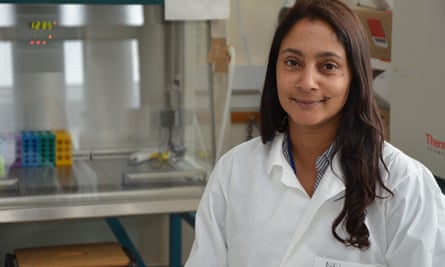
Dr Nelofer Syed, who leads the Brain Tumour Research Centre of Excellence, said: “A non-invasive, inexpensive method for the early detection of brain tumours is critical for improvements in patient care. There is still some way to go, but this solution could help people where a brain biopsy or surgical resection of the tumour is not possible due to the location of the tumour or other constraints.
“Through this technology, a diagnosis of inaccessible tumours can become possible through a risk-free and patient-friendly blood test. We believe this would be a world first as there are currently no non-invasive or non-radiological tests for these types of tumours.”
Kevin O’Neill, consultant neurosurgeon at Imperial College healthcare NHS trust and honorary clinical senior lecturer at Imperial College London, who leads the Brain Tumour Research Centre of Excellence with Syed, said: “This test is not just an indicator of disease, it is a truly diagnostic liquid biopsy.
“It detects intact circulating tumour cells from the blood, which can be analysed to the same cellular detail as an actual tissue sample. It’s a real breakthrough for treatment of brain cancers that rarely spread around the body.
Intellectuals and Treason to the Ideals of the University. American academics are guilty of Treason. Recommend Niall Ferguson, Hoover Institute, Stanford. He has the courage to call out “Cancel Culture”. Woke is the destroyer. Discernment engagement, people are challenged to engage, to think, to be discerning.
Posted in Uncategorized
Leave a comment
“Misinformation/Disinformation” – major threat and added as same to the Davos list 2024. Ian Bremmer, GZERO speaks to Al Gore. We have excellent journalists but the traps of going down rabbit holes and being influenced by conspiracy theories are very real threats to US democracy. New terminology is not about “Artificial Intelligence” but more to do with “Artificial Insanity”. People must be more discerning about information. 2nd interview start creating your knowledge base about US Politics; the election; the guardrails; the challenge to Democracy. January 6th looked horrible but Republicans proved complacent. Recommend Francis Fukuyama … wisdom worth engaging with.
Posted in Uncategorized
Leave a comment

