What is the least corrupt country in the world? According to a Berlin-based nonprofit called Transparency International, that would be Denmark. Finland is close behind. At the very bottom of the list is Somalia, dead last out of 180 nations.
Founded in 1993 by a retired World Bank Official, Transparency International operates in more than 100 countries, promoting accountability and exposing public sector corruption.
The team, led by CEO Daniel Eriksson, attended the 2024 Munich Security Conference last week with a warning about the rise of “strategic corruption,” a geopolitical weapon involving bribes and disinformation to attain a political goal in another nation.
“Our definition of corruption is the abuse of entrusted power for personal gain,” Eriksson told GZERO’s Tony Maciulis.
This year is critical for democracy as dozens of countries head to the polls for elections that could determine policy and politics for the remainder of the decade. Among other projects aimed at rooting out political corruption, Eriksson’s team tracks foreign funding meant to influence the outcomes of campaigns or get certain candidates elected.
The EU is watching Albania’s deal to hold asylum seekers for Italy. Rights activists are worried
EU members and institutions are trying to push long-awaited asylum and migration reforms through the bloc’s parliament before the Europe-wide elections in June
Migrants gather at a reception center for migrants in Lampedusa, Italy, September 17, 2023.YARA NARDI (REUTERS)
Italy has long complained about not getting enough help from its EU partners in dealing with migrants arriving on its shores from northern Africa. Italy’s right-wing Premier Giorgia Meloni is keen to show she is taking action as arrivals spiked 55% this year, to nearly 160,000 — though still well below the levels reached during the 2015 crisis.
Also in January, Albania’s Constitutional Court rejected a legal challenge that could have blocked the deal. Albania’s parliament approved the deal with 77 votes to zero on Thursday, while 63 lawmakers were marked not present as the opposition refused to participate. The president also will issue a decree as the final step of approval.
Migrants from Africa seeking a better life in Europe have been a sensitive issue for EU member countries in the Mediterranean. It is set to be a hot issue in Europe-wide elections in June. EU members and institutions are trying to push long-awaited asylum and migration reforms through the bloc’s parliament before the polls. Mainstream parties hope the new rules will allow them to refute anti-migrant arguments espoused by populist and far-right groups.
What’s known about the deal
Under a five-year agreement announced in November, Albania will shelter up to 36,000 migrants a year as Rome fast-tracks their asylum requests.
Those picked up within Italy’s territorial waters, or by rescue ships operated by non-governmental organizations, would retain their right under international and EU law to apply for asylum in Italy and have their claims processed there.
Italy has agreed to take back any migrants whose requests have been rejected, and they will likely be repatriated. Children and pregnant women will not be covered by the plan.
One of the processing centers will be located in the port of Shengjin, one of the main tourist areas on the Adriatic Sea, about 75 kilometers (46 miles) south of the Albanian capital, Tirana.
The second facility will be 20 kilometers (12 miles) north at a former military airport in Gjader. Italy will spend nearly 600 million euros ($650 million) over five years for the construction and operation of the two centers under Italian jurisdiction. Up to 3,000 migrants at a time can stay at the two facilities. Outside security will be provided by Albanian guards.
The facilities are expected to be operational by spring.
What Italy gets out of it
The deal could help relieve chronic overcrowding at initial asylum processing centers in Italy, where hundreds of thousands of migrants are held after risky sea voyages across the Mediterranean Sea from Libya, Tunisia, Turkey and other countries.
Italy has sought more help from its fellow EU nations.
Many of the migrants are ineligible for asylum as they leave due to poverty, not persecution or war. While waiting for a final decision on their asylum applications, many make their way to northern Europe, hoping to find family or jobs.
Italy has sought help from other EU nations to handle the increasing number of arrivals. Data from its Interior Ministry showed that migrant arrivals in Italy in 2023 were about 155,750, or about 55% more than the previous year, including more than 17,000 unaccompanied minors.
What’s in it for Albania
When the deal was announced, Meloni said Albania “behaves as if it’s one” of the EU member states. Albania “is not only a friend of Italy, but also a friend of the European Union,” she said.
Many in Albania see it as quid pro quo for Italian hospitality when thousands of Albanians fleeing poverty after the fall of communism in 1991 found refuge in Italy.
Albania, a small west Balkan country, does not belong to the EU but is seeking membership, beginning talks with Brussels last year. Despite poverty, it has a history of accepting refugees, including members of China’s Uyghur ethnic group, Afghans and dissidents from Iran, as well as taking a million ethnic Albanians from neighboring Kosovo during wartime in 1999.
But members of Albania’s center-right opposition opposed the deal on human rights grounds. Thirty opposition lawmakers went to the Constitutional Court in an unsuccessful bid to block ratification.
Humanitarian and legal concerns
Migration experts say the agreement follows a worrying trend of EU nations looking beyond the bloc’s borders to manage migration. Denmark has floated the idea of sending asylum seekers to be held in African nations.
The Council of Europe’s commissioner for human rights has expressed a range of concerns, including whether migrants would have access to adequate legal aid.
The European Commission, which supervises the application of EU laws, left the door open for the agreement, as long as it’s only applied to migrants picked up in international waters.
The Migration Policy Institute Europe says the deal fails to describe what migration procedures would be followed, leaving open questions as to how exactly the process would work.
Sign up for our weekly newsletter to get more English-language news coverage from EL PAÍS USA Edition
The man who revealed the flaws of German colonial ambitions
Cai Nebe18 hours ago18 hours ago
Quane Martin Dibobe was brought to Germany to increase enthusiasm for colonialism. But he would become a pioneering human rights activist who challenged Germany’s exploitative relationship with its colonies.
Quane Martin Dibobe broke ground by becoming a train driver on Berlin’s early metro, but he was also an important human rights activistImage: BVG-Archi
Who was Quane Martin Dibobe?
Dibobe was born near Douala, Cameroon, in 1876, where his father held local political office. He was educated at a mission in Cameroon where he learned to read and write in German. He arrived in Germany in the mid-1890s to participate in the Great Industrial Exposition of Berlin.
What was the first German colonial exhibition of 1896?
This fair aimed to show that Germany was a “land of boundless opportunity.” A concerted propaganda effort was underway to convince Germans that it was right for Germany to have colonies. It included ethnological expositions of “everyday life in the colonies.” Today, we would call this a human zoo.
Dibobe was just one of over 100 Africans who arrived in Berlin — some taken by force, others lured by promises of pay. They came from German territories in Namibia, Togo, Tanzania, Cameroon — Ovaherero, Nama and Masai among others. Quane Dibobe was only known as “No. 76.” In reality, he and others were nothing like the “primitive natives” presented in artificial villages.
Ethnological exhibitions were surprisingly common in Europe in the early 1900s, with people from the colonies displayed in fake villages. This photo of Masai people stems from the Berlin Zoological Gardens in 1920, but similar displays continued until the 1950sImage: picture alliance/akg-images
Around 7 million Germans flocked to the exhibit over six months to see Dibobe and others like him as they were forced to act out an imagined life — cooking, dancing, hunting — in a fake African village.
Dibobe and many others were forced to undergo humiliating physical examinations carried out by students of Germany’s fledgling race science — to prove the since-discredited pseudo-science of eugenics.
What did Dibobe do after the exhibition?
Dibobe stayed in Berlin, which was not unusual. The few Africans were often accepted in cosmopolitan spaces and could find jobs or apprenticeships. Dibobe first became a craftsman before joining the Berlin railway company. He married his landlord’s daughter after the missionary who had baptized Dibobe in Cameroon confirmed his identity.
By 1902, Dibobe became a train driver for Berlin’s fledgling metro — a prestigious job then — and became a celebrity.
He later wrote: “Through diligence and impeccable conduct, I gained a position of trust.”
Did Dibobe ever return to Cameroon?
Colonial authorities sent Dibobe back to Cameroon in 1907 to consult on the construction of a railway line. German infrastructure in Cameroon still stands to this day, and some historians talk of nostalgia for the German era, especially when compared to the exploitative practices of France and Britain, which took over German colonies after 1919.
Yet, Dibobe was shocked at the beatings, expropriation, racism and mistreatment Cameroonians endured at the hands of German companies.
Martin Dibobe became famous as Germany’s first black train driverImage: BVG Archiv
What was the status of German colonial subjects?
Back in Germany, Dibobe participated in workers’ strikes, supported the Social Democrats, and was active in the League for Human Rights organization, which was formed in 1914. And as more Black people arrived in cities like Berlin, Hamburg and Bremen, Dibobe and many others who remained in Germany found themselves in a no-man’s-land citizenship.
Authorities, however, had no intention of giving German colonial subjects the same rights as German citizens, as that would mean the law would have to be applied equally in the colonies.
So, in mid-1919, on behalf of Africans living in German colonies, Dibobe and 17 other Afro-Germans petitioned the government for representation, equal rights and an end to forced labor, among 32 points, while pledging allegiance to the German Weimar Republic.
In 2016, almost 100 years after Dibobe’s petition, a plaque was unveiled in Berlin commemorating Dibobe’s legacy at his last known addressImage: picture-alliance/dpa/T. Rückeis
What became of the Dibobe Petition?
Because Germany had ceded its colonies to other European nations in accordance with the Treaty of Versailles, the petition’s demands were never acknowledged.
Dibobe lost his railway job. He attempted to return to Cameroon in 1922. However, the new French colonial rulers refused him entry because they believed he would cause unrest. Instead, the 45-year-old Dibobe headed for Liberia and left no trace. It’s assumed he died there.
As a result, Dibobe is not well-known in Cameroon, as most of his legacy is recognized in Germany.
Quane Martin Dibobe: From exhibit to anti-colonial activist
But over a century later, his petition is regarded as one of the most important political documents of African migrants of the early 21st century.
Shadows of German Colonialism is produced by DW, Germany’s international broadcaster, with funding from the German Federal Foreign Office (AA). Consulting was provided by Lily Mafela, Kwame Osei Kwarteng and Reginald Kirey.
Most people have heard of savant syndrome, first described in 1887, whereby a person is naturally endowed from early life with remarkable skills in music, artistic, mathematics, memory or mechanical skills, an ability that stands out in marked contrast to their general impairments in social interactions, language and other mental faculties. Dustin Hoffman gave a good impression of the savant syndrome in the 1988 film Rain Man.
I was unaware of an alternative form of savantism, acquired savantism, until reading a fascinating account by David Treffert in Scientific American, August 2014. In acquired savantism, a person develops a newfound ability to sculpt, paint, play music, perform remarkable mental calculations or display extraordinary memory after suffering some form of brain injury. Treffert reasonably speculates that these remarkable abilities lie dormant in everybody’s brain but can only be expressed when the proper brain circuits are activated or switched off.
Research in this area may develop technologies that will allow people to switch on such remarkable abilities at will. Alternatively, methods may be devised to achieve the same result through focused practise of particular skills.
Treffert describes several examples of acquired savant syndrome. One is the case of Alonzo Clemons. Clemons was a quick learner as an infant. He suffered a brain injury in a fall at the age of three. This dramatically slowed his cognitive development, causing serious intellectual disability with limited vocabulary and speech. However, he later developed a spectacular skill for sculpting using whatever materials were to hand. He could look at a picture of an animal and sculpt a 3-D replica within half an hour, with every muscle outlined perfectly.
Another example is Derek Armato, a 40-year-old man who never showed any interest or skill in music. Following recovery from a severe concussion, he found himself drawn irresistibly to the piano. He began to see black and white spots that he could transpose into notes on the piano. He now makes his living composing music and performing.
Artistic skills
In the 1990s it was noticed that elderly patients suffering from frontal temporal dementia (FTD) started to demonstrate marked musical or artistic skills for the first time. This dementia differs from Alzheimer’s in that brain degeneration only affects the frontal lobes and not widespread areas of the brain. FTD targets brain parts that normally inhibit the visual system at the back of the brain involved in processing incoming visual signals from the eyes. Release of this inhibition allows the brain to process sight and sound in new ways, unleashing artistic and creative sensibilities, although the frontal lobe damage may lead to inappropriate behaviour that characterises FTD.
It appears that acquired savant syndrome results from diminished activity in some brain regions combined with a counterbalancing intensification of activities in other areas. There is also rewiring to connect regions that were not previously connected, releasing dormant capacity due to enhanced access to newly connected areas. Treffert says that a unifying phenomenon in all savants is one of left brain damage (causing language deficiencies and poor social fluency) and right brain recruitment. Rewiring allows the release of right brain capacities that would normally lie dormant (Psychiatric News, March 5th, 2010).
This hypothesis is backed up by experimental evidence gathered by Richard Chi and others at the University of Sydney. Electrical stimulation of discrete regions of the brain was used to simulate acquired savant skills in volunteer subjects. Electrical stimulation was used to reduce activity of part of the left hemisphere of the brain involved with sensory input, memory, language and other processes, and to increase activity in the right anterior temporal brain lobe. The volunteers were asked to solve a challenging puzzle, either with or without this brain electrical stimulation. No volunteer could solve the puzzle before stimulation, but 40 per cent of the volunteers were able to solve the puzzle during simulation. Treffert predicts that, in time, it will probably become possible for anyone to unleash some of their buried genius by toggling brain regions on and off using electrical or magnetic stimulation.
Treffert speculates that all brains are preloaded with a reservoir of innate predispositions for processing what the brain can “see”.
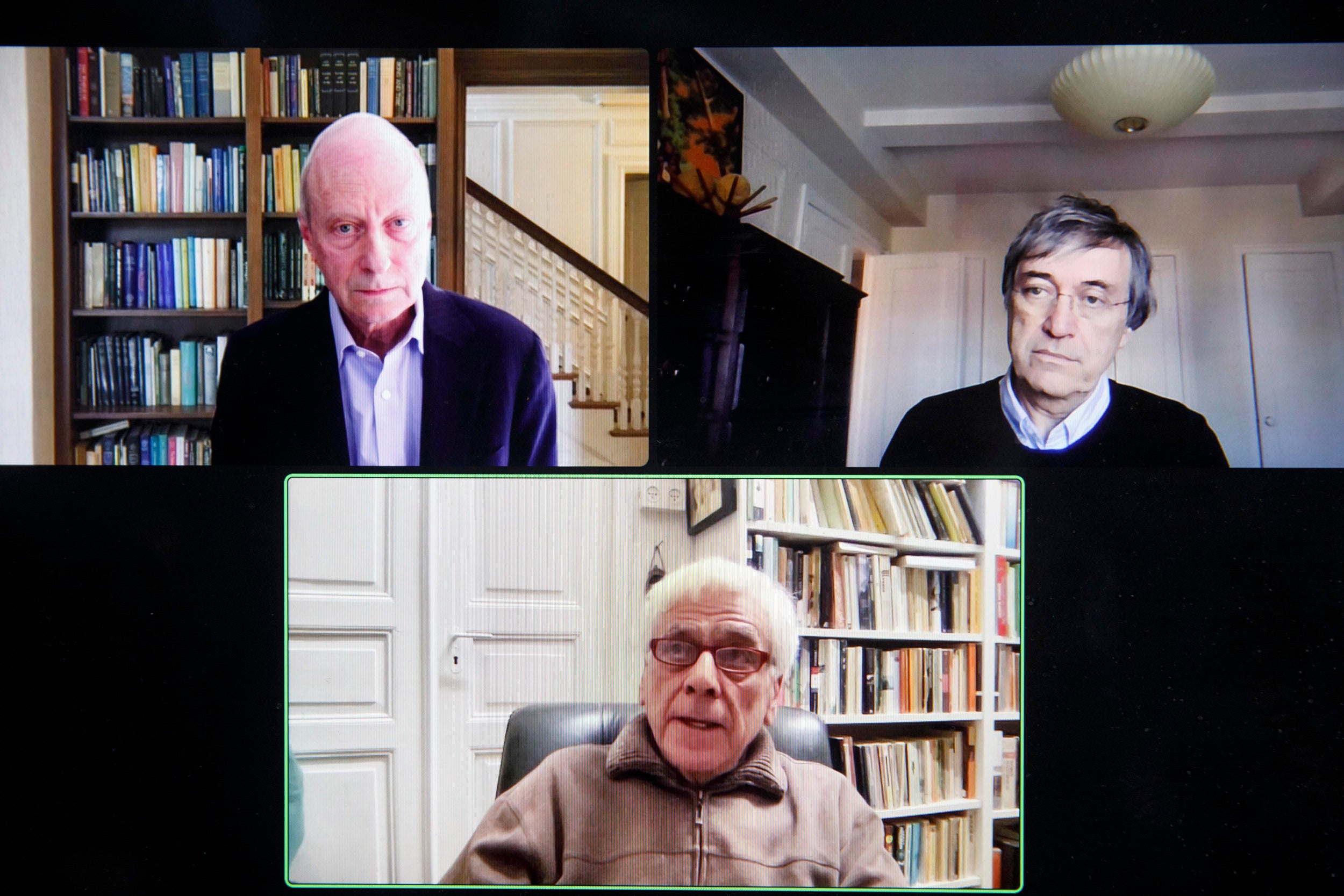
Michael Sandel (clockwise from top left) moderated a discussion between Israeli and Palestinian philosophers Moshe Halbertal and Sari Nusseibeh.Kris Snibbe/Harvard Staff Photographer
‘What we really need is just to sit together and face each other’
Israeli, Palestinian philosophers exchange tales of personal loss, find points of contention, agreement over war
Christy DeSmith
Harvard Staff Writer
February 20, 2024 5 min read
Open, honest, and respectful conversation remains the best hope for finding common ground on the Middle East. That was the takeaway from the fourth installment in the Weatherhead Center’s “The War in Israel/Gaza” series, which featured a pair of Israeli and Palestinian philosophers in a dialogue moderated by Michael Sandel.
At the top of Friday’s virtual event, both academics articulated a sense of personal crisis.
Moshe Halbertal, the Gruss Professor of Law at New York University School of Law and John and Golda Cohen Professor of Jewish Thought and Philosophy at Hebrew University of Jerusalem, cited the trauma and “sense of fragility” felt in Israel following the Hamas surprise attack on Oct. 7. He also expressed anguish over “sensing a strong delegitimization of the very existence of Israel” from “people whom I thought were partners.”
“In moments of pessimism, I try to come back to my basic convictions,” Halbertal said. “My basic conviction is there is no other solution but a two-state solution. There should be a Jewish nation-state side by side with a Palestinian nation-state. Our self-determination will be justified only if there is a Palestinian self-determination.”
Former Al Quds University president Sari Nusseibeh, now an emeritus professor of philosophy, said that he felt a loss of the kind of optimism that once fueled his work as a Jerusalem representative with the Palestinian Authority, the governing body of the West Bank.
“It seemed to me there was enough sanity on both sides to continue negotiating,” Nusseibeh said. “But in the last four months, I’ve been totally thrown out of that mode of thinking.”
Sandel, the Anne T. and Robert M. Bass Professor of Government, characterized the discussion as an exchange between old friends from Jerusalem. The audience learned of the pair’s frequent interactions during the 1990s Oslo peace process, with Nusseibeh reminiscing further about a pleasant gathering at Halbertal’s home.
Halbertal and Nusseibeh spoke of losing loved ones on or after Oct. 7. Halbertal remembered “a very close student who was murdered with his son” by Hamas. Nusseibeh was more oblique in referencing a “terrible” situation involving cousins on his mother’s side.
“It makes me think irrationally to bring it up,” he shared.
Beyond their shared personal tragedies, Nusseibeh joined Halbertal in condemning Hamas’ invasion, calling recent events “including first and foremost the seventh of October itself” examples of senseless brutality. He also endorsed Halbertal’s views on the two-state solution, calling it the most practical of all proposals.
“But we’ve worked on a two-state solution for so many years,” said Nusseibeh, whose family has roots in Jerusalem going back 13 centuries. “It failed, but it can be tried again — it should be tried again.”
Likewise, both deeply opposed Israel’s occupation of Palestinian territories in the West Bank and Gaza. “I’m against the occupation as an act of force,” said Halbertal, who was born in South America to a Holocaust survivor father before the family moved to Jerusalem. “The occupation is wrong, and I hope it can end peacefully.”
Discussion of just warfare — whether a military action can be morally justified — surfaced disagreement when Sandel asked both men: “Is Israel’s war in Gaza a just war?”
Halbertal explained that, as he saw it, the Oct. 7 attacks were not about resisting the occupation. “Hamas, since its dominant role in the ’90s … has done everything to harm the possibility of a peaceful solution,” he said.
Confronting the militant group was necessary, Halbertal continued, since Israel is obligated to protect citizens from further violence. “The only justification of war — if there is any — is defense,” he said. “Then there is another question the philosopher asks, which is not the justice of the war but the justice in the conduct in the war. That’s a different question.”
“And what would be your answer to that second question?” Sandel pressed.
“Clearly, it’s not an indiscriminate, intentional attack on civilians, which is the worst thing a country can do,” Halbertal replied. “It’s an attempt to harm Hamas.”
But he acknowledged the cost to Gazans at large is “so big, so painful.”
“You have to ask yourself, ‘How do I end it in a way that would relieve the civilians … given the legitimate aims that are there?’ And then, ‘How do I reconstruct life?’”
In that respect, Halbertal concluded, Israel’s actions will also be “assessed by what happens after the war.”
Nusseibeh responded by noting himself “suspicious” of such thinking. Palestinians see forceful occupation as inseparable from Israel, he said, just as Israelis may see civilian deaths in Gaza as inseparable from Hamas.
“You can’t just justify one kind of self-defense at the expense of another,” he argued. “That’s why this language, to my mind, is unconvincing and can lead a lot of people astray from what needs to be done. And what we really need is just to sit together and face each other and find other ways to resolve our problems.”
A SpaceX Falcon 9 rocket lifts off from the launch pad at Launch Complex 39-A at the Kennedy Space Center in Cape Canaveral, Fl. in April 2022.
Alex G Perez/AGPfoto/Sipa USA via Reuters Connect
Maybe Russia should’ve been invited to Munich after all … News dropped on Thursday that Moscow is developing new space-based nuclear weapons.
Could these new nukes hit American cities? No, according to the White House. But they could hit satellites, wreaking havoc on terrestrial communications, transportation systems, and even financial transactions. In other words, Russia could take cyberattacks to a higher level, literally.
While China and the US also have the ability to attack satellites, neither has gone nuclear with it. The Outer Space Treaty of 1967 explicitly bans the use of nuclear weapons in space. Russia seems not to be paying much heed to that old scrap of paper.
But more dangerous still, the rupture between Moscow and Washington over Ukraine has left the world’s two leading nuclear superpowers with almost no dialogue or treaty limitations on nuclear weapons at all.
That vacuum is now about to extend into space itself.