David Miliband on global crises: Gaza, DRC, Sudan, Ukraine
The International Rescue Committee president discusses the urgent international responses required for ongoing emergencies.
In this episode, we explore the essential role of non-governmental organisations in confronting global emergencies.
The International Rescue Committee, initiated by Albert Einstein, is known for its impactful work.
The organisation delivers aid and hope to at-risk populations in conflict zones, notably Gaza, marked as the most hazardous area for civilians and aid workers.
Amid turmoil in Sudan, the Democratic Republic of the Congo and Ukraine, David Miliband, president of the International Rescue Committee, talks to Al Jazeera.
With nearly half of the globe heading to the polls this year amid lightning-speed developments in generative AI, fears are running rampant over tech-driven disinformation campaigns.
During a Global Stage panel at the Munich Security Conference, Bulgarian politician and European Parliament member Eva Maydell said she fears we will soon be unable to separate fact from deepfake fiction.
While acknowledging the important developments AI and emerging tech offer, Maydell warned that we also “need to be very sober” about how they are threatening the “very fabric of our democratic societies” and eroding trust.
While the EU is trying to push voluntary measures and legislative proposals, Maydell points out that political conversations often revolve around the sense that “we’ll probably never be as good as those that are trying to deceive society.”
“But you still have to give it a try, and you need to do it in a very prepared way,” she adds.
Dear everyone who has followed my story and anyone else who cares to read this…
If you’re reading this, it means this has probably been posted by my daughters as I’ve sadly died. Sorry to break the news to you this way, but if I hadn’t, my inbox would eventually have been full of emails asking if I’m OK, which would have been hard for my daughters to answer… In the end I died simply by deciding not to eat or drink any more. The last cuppa tea…my final hug in a mug, the hardest thing to let go of, much harder than the food I never craved…This wasn’t decided on a whim of self pity as you’ll discover by reading on.
Dementia is a cruel disease that plays tricks on your very existence. I’ve always been a glass half full person, trying to turn the negatives of life around and creating positives, because that’s how I cope. Well I suppose dementia was the ultimate challenge. Yes, dementia is a bummer, but oh what a life I’ve had playing games with this adversary of mine to try and stay one step ahead.
I’ve been resilient throughout my life, even from a young child, so resilience is inbuilt in me to cope with whatever life throws my way.
Who would have thought, when diagnosed all those years ago, that my life would turn out quite as it did? I’ve always liked to have a plan, something that makes me feel in control of dementia. I ‘planned’ for the future by completing my LPA’s and ReSPect form, and sorted my advanced care plan in minute detail with my wonderful GP.
Sadly assisted dying isn’t an option in this country. With something that will affect 100% of the population, regardless of wealth, intelligence or ethnicity, it’s amazing how such little value is placed on the act of dying. For those that have read my book, One Last Thing, you will understand why I feel so strongly about assisted dying. The only legal choice we shouldn’t have in life is when to be born; for everything else, we, as humans, should have a choice; a choice of how we live and a choice of how we die.
Facts and figures show how, in those countries where assisted dying is legal, people live longer. Having that ‘magic potion’ within touching distance enables them to choose life for much longer. In countries where it’s illegal, such as the UK, people have to die sooner than they might otherwise choose. Like me, they have to have the capacity to make such a decision if death isn’t to be a lonely and often violent act.
My first book was kept on some people’s bookshelves for a year, or even two, because they were afraid to open it and read what’s inside. But when they did they found nothing of the fear they were expecting and instead found dementia unravelled. I want the same to happen with my last book, One Last Thing – How to live with the end in mind. Some people will be afraid to open it, yet, when they do, they’ll question their own reluctance to talk about the one thing that will affect us all.
To feel I had some control over the future makes the business of living so much easier. To talk about death makes it easier to concentrate on living.
To have an option within your grasp enables you to relax and live life. In America, for example, some people are eligible for assisted dying. But when they receive the magic potion that would take them from this life, having it enables them to feel in control, and many choose life instead of death for much longer.
So, what has all this to do with my death? If assisted dying was available in this country, I would have chosen it in a heartbeat, but it isn’t. I didn’t want dementia to take me into the later stages; that stage where I’m reliant on others for my daily needs; others deciding for me when I shower or maybe insisting I had a bath, which I hate; or when and what I eat and drink. Or what they believe to be ‘entertainment’. Yes, I may be happy but that’s irrelevant. The Wendy that was didn’t want to be the Wendy dementia will dictate for me. I wouldn’t want my daughters to see the Wendy I’d become either.
Through writing my last book, I spoke to many amazing people, both in favour of assisted dying, against it, but also those in palliative care. Many of those specialists believe we should concentrate on providing gold standard palliative care. But in my humble opinion, it shouldn’t be a case of one OR the other. The choice should be ours to make. Yes, of course gold standard palliative care should be available for all, but so should the choice of assisted dying. Even the most wonderful palliative care imaginable could not stem the incoming tide of dementia. It was up to me to do that.
The incredible inventors within our great NHS have enabled advancements in treatments not even imaginable some twenty or thirty years ago, but, they will never discover a treatment to prevent the inevitability of death. While all these advancements have been taking place, successive governments have ignored the growing ageing population; have allowed, through lack of investment, our greatest gift, the NHS, to crumble before our eyes. To die later surely means to need more medical intervention. Everyone but our governments have seen this happening. Dying has been ignored, swept under the proverbial carpet. The choice of assisted dying could be the answer to so many people who actually don’t want to exist when medicine can keep them alive. Those who succumb to illness may not want to have their life prolonged, simply because it’s possible. Or maybe some people would just like to call time on their life because, in their mind, they’ve had a good life and now is the time to end before the tide of good fortune turns.
In the end, I wanted to choose the one option I said in my first book I would never choose – Dignitas, in Switzerland. After looking at every option and eventuality, this was the only place that would give me a dignified death. I’ve no fear of flying on my own now, as I would never ask my daughters or anyone else to fly with me, because of the complexities of the law when they flew back. But it also means my daughters can’t be there with me, holding my hands in my final moments.
I was hoping to go there at the beginning of the year. However, my plans were turned upside down when I had my fall, breaking both my wrists and revealing damage to my neck and spine. I would no longer be confident to travel alone to Switzerland.
I’ve said for a long time that I don’t want to be an inpatient in a hospital, or a resident in a Care Home. It’s the wrong place for me; the loss of routine, familiar surroundings and people. For some they may believe it’s the right place, or they have no option. I’m NOT saying it’s wrong for everyone, I’m saying it’s wrong for me. You may say, ‘but my mum’s in the late stages and she’s very happy in her care home’. I’m really pleased she is, truly, I am. It’s just not the place I want to end my years.
Many people focus on moments of happiness. Someone I interviewed was very adamant someone in the late stages of dementia was happy because he played the piano and made other residents happy… but my argument was, what about the other 23 hours of his day? Are they spent in confusion, of wondering why he’s there? Does he like being totally reliant on others? Would his former self have chosen this ending to his life? These questions can never be answered, of course, but I’ve taken the decision to answer them for me now, while I’m able.
I’ve always given people hope, or I like to think so. Have I stopped giving people hope by choosing the death I’ve chosen. Or have I given people hope, that IF they wish, they too can have hope for an existence of their choosing, or a death of their choice?
My life was for living, but now it’s time for dying. So, if you want to do something for me, please campaign for assisted dying to be law here.
Adapting to this life with dementia is over, but I don’t consider dementia has won, as that would be negative and you all know I’m a positive person. It’s ME calling time on MY dementia – checkmate, before IT plays its final move. As the video below shows, that was created for my first book… I was determined I wouldn’t forget, and by doing this now, I haven’t. Yes, I’ve had to die before my time, but I had to make sure I had capacity and hadn’t allowed dementia to creep in overnight and take that capacity away from me.
In the end, after my accident, the only choice open to me was to stop eating and drinking.
I learnt about Voluntary Stopping Eating and Drinking (VSED) as my way out of this world during the writing of my book. I spoke at length with my daughters and I spoke at length with my GP over the last few months, always including her in conversations with my daughters, to give that ‘expert’ information to questions I could never have answered.
I don’t feel hunger or thirst, meaning that part of the process would be less stressful for me than for others.
After my fall downstairs at home, my lovely friend Philly came to stay with me to help support my daughters and me. It was during this time, and after many conversations with my girls and Philly, that I decided this was my time to end this cruel life dementia had thrust upon me. I wasn’t depressed, I wasn’t forced or cajoled in any way whatsoever, it was solely down to my choice. I was ready.
You may or may not agree with what I’ve done, how and when I’ve chosen to leave this world, but the decision was totally mine.
My girls have always been the two most important people in my life. I didn’t take this decision lightly, without countless conversations. They were the hardest conversations I’ve ever had to put them through. Some people may be angry at what I’ve done and that’s their prerogative – but don’t take that anger out on anyone other than me. This was all MY CHOICE, my decision. So please respect my daughters’ privacy, as they didn’t choose the life I chose, of standing up to and speaking out against dementia.
Thank you to all those who have supported me along the way…your support was invaluable.
So, enjoy this video knowing that dementia didn’t play the winning card – I did.
Julia VerginPublished 03/07/2023Published March 7, 2023last updated 02/22/2024last updated February 22, 2024
Russia’s Ukraine war is not only taking a toll on people’s lives, it’s also been devastating for the environment — the long-term effects are hard to judge.
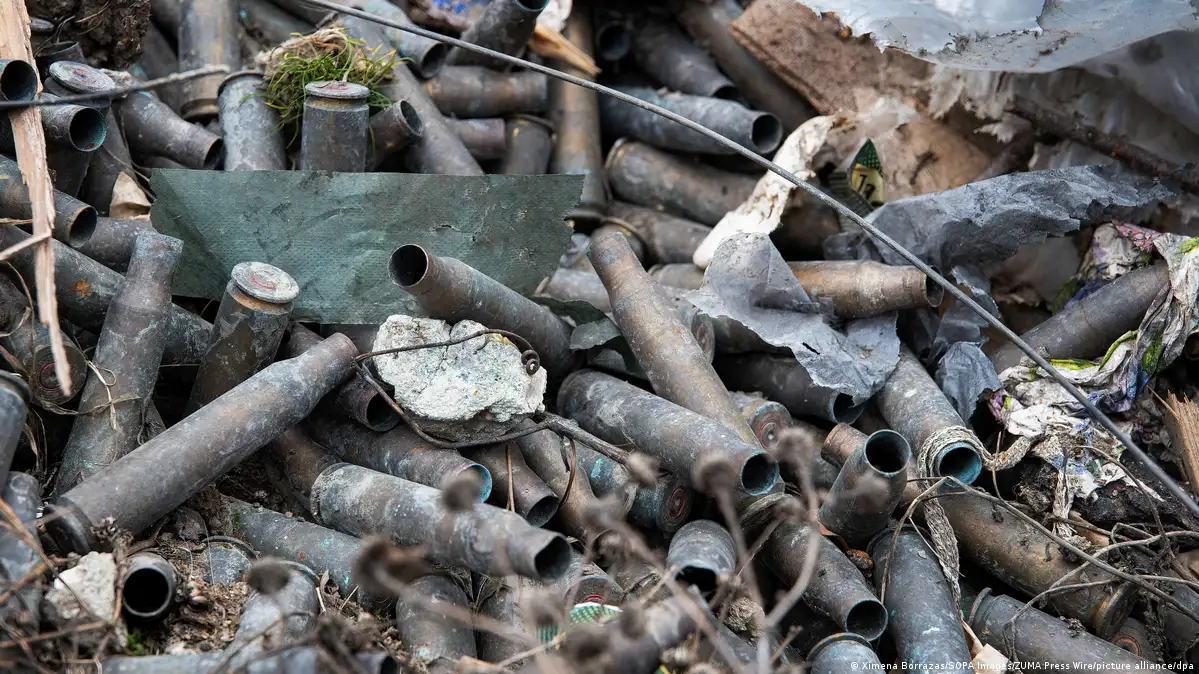
Wars leave not only death and destruction in their wake — but also a lot of poisonous waste.Image: Ximena Borrazas/SOPA Images/ZUMA Press Wire/picture alliance/dpa
The Russian war on Ukraine started two years ago. And there is no end in sight. But even if the soldiers stopped firing their guns and stopped dropping bombs today, if there were no more explosions at refineries and other industrial facilities — the people of Ukraine would still not be safe.
Research suggests the effects of the war on people, wildlife and the environment will last long into the future.
A study into the environmental ramifications of the conflict suggests that the first year-and-a-half of the war alone was responsible for an extra 150 million tons of CO2 emissions — to compare, that’s the same amount of CO2 that Belgium emits per year.
Those are the conclusions of the Initiative of GHG Accounting of War, a group of experts who have been monitoring the environmental damage caused by the war. They presented their findings in December 2023 at a UN Environment conference in Dubai.
A war on people and the environment
A new analysis by the US-Ukrainian research team presents further data: Landscape destruction, shelling, forest fires, deforestation and pollution have affected 30% of Ukraine’s protected areas.
The team, which is led by Daniel Hryhorczuk, Professor Emeritus at the Institute for Environmental and Occupational Safety and Epidemiology at the University of Illinois School of Public Health in the US, fears that Russia’s occupation of the Zaporizhzhia nuclear power plant and the destruction of the Kakhovka dam will lead to lasting ecological catastrophe.
In addition, they say the local air, water and soil are contaminated with chemicals on a large scale, and that 30% of Ukraine is contaminated with landmines and unexploded ordnance.
Once those chemicals get into the soils and ground water, it may only be a matter of time before they are transmitted to humans via plants, animals, and drinking water.
At least, that is what toxicologists say could happen. They are not entirely sure how the environment will deal with these toxic substances, or what effect they could have on humans.
TNT is carcinogenic
Among the most dangerous elements in munitions are the explosives themselves, and the heavy metals. That includes Trinitrotoluene, better known as TNT, a nitroaromatic compound known for its explosive power.
“We know through experiments on rats and mice that TNT is toxic,” said Edmund Maser, director of the Institute for Toxicology at the University Clinic in Kiel, Germany.
Maser researches the effects of the munitions that were dumped in the German part of the North and Baltic Seas after World War II — 1.6 million tons of munitions are rusting away there.
Toxicologists have also observed in the Seas that the TNT released from the dumped munitions is harming animals in the surrounding area: “TNT compromises the ability of marine life to reproduce, grow, and develop,” said Maser. “We also know from these studies that TNT and other explosives are carcinogenic.”
Mercury, arsenic, and lead destroy cells
Some heavy metals, such as arsenic and cadmium, are carcinogenic.
“Above all, the detonators contain heavy metals, such as mercury in the form of a fulminate that makes the TNT explode faster,” said Maser. A fulminate acts as a kind of catalyst.
As a heavy metal, mercury is also damaging for nerve cells: “It can lead to birth defects in unborn babies,” said Maser.
Lead has similar effects and can cause developmental disorders or miscarriages.
Kateryna Smirnova, a researcher at the Sokolovsky Institute for Soil Science and Agrochemistry Research at Ukraine’s National Academy of the Sciences, said that soil samples from Kharkiv — one of the major battle sites in the east of the country — had already shown higher concentrations of lead and cadmium.
Smirnova’s colleague, Oksana Naidyonova, a microbiologist at the Sokolovsky Institute, explained that heavy metals have a negative effect on bacteria in the soil.
“They inhibit the development of plants and the supply of micronutrients, which leads to physiological defects and reduces their ability to withstand disease,” Naidyonova said.
Ukraine war: Researchers on the run
But the chemicals will not necessarily stay in the soil. TNT, for example, could be carried away by the wind and distributed farther afield, said Maser. Rain could even reach some of the substances found deeper in the ground.
“The elements may then get into surface waters and contaminate streams, rivers, and lakes,” he said.
A toxic cycle
If animals ingest the chemicals, those chemicals can enter the food chain and eventually become dangerous for humans as end consumers, said Maser.
And if the rains run off, allowing the chemicals to seep into the ground water, “that would mean drinking water was at risk of becoming contaminated,” Maser added.
If the water becomes contaminated this way, plants could consume mercury and other chemicals. If these plants happen to be crops like wheat or vegetables, then the same chemicals would end up on our dinner plates.
Environmental damage in the billions
The example of Ukraine illustrates the immense costs of the destruction caused by war. According to this latest analysis, the war in Ukraine has caused environmental damage of more than $56.4 billion (€52 billion).
Hryhorczuk’s team is calling for the environmental consequences of all armed conflicts to be investigated and for more effective measures to be taken to protect the environment during war. They also want those responsible for damaging the environment during war and those who instigate a war to be held to account.
Ian Bremmer and Deputy Secretary General of NATO Mirceǎ Geoana discuss the second anniversary of Russia’s invasion of Ukraine, Alexei Navalny, and the future of the NATO alliance. Subscribe to GZERO on YouTube and turn on notifications (🔔): http://www.youtube.com/@GZEROMedia Sign up for GZERO Daily (free newsletter on global politics): https://rebrand.ly/gzeronewsletter Are NATO allies as united in their support for Kyiv as they were when Russia began its invasion of Ukraine two years ago? That was the question at the top of everyone’s minds at the Munich Security Conference, where world leaders gathered to discuss the biggest challenges to global security. On GZERO World, Ian Bremmer sat down with Deputy Secretary General Mirceǎ Geoana on the sidelines of Munich to discuss the ongoing war in Ukraine and what the conflict means for the future of the NATO alliance. “Ukraine is more than Ukraine, and Ukraine is more than European security,” Geoanǎ explains, “Ukraine is an indicator of the willingness and the capacity of the West to be able to cope with challenges coming from China or anywhere else.” Geoanǎ also called the recent death of Alexei Navalny a “wake-up call” for the West and challenged President Trump’s recent comments about allowing Russia to invade NATO countries that don’t meet the target of spending 2% of GDP on defense. While he admits Europe could do better, he points out that NATO allies are well above the 2% target on aggregate due to heightened security concerns in former Soviet countries and the Baltics. “In the end, this alliance, [which will celebrate] 75 years in the next few weeks, will be as indispensable to America and to all of us like it’s been since the inception,” Geoanǎ says. Dig deeper: As Russia’s invasion of Ukraine enters its third year, what’s the plan for both sides as casualties rise, Europe’s support wavers and US funding for Ukraine hangs in the balance? Ian Bremmer explains: https://youtu.be/XMciOleZwgo Catch GZERO World with Ian Bremmer every week on YouTube https://www.youtube.com/playlist?list… Also available at https://gzeromedia.com/gzeroworld and on US public television. Check local listings Want to know more about global news and why it matters? Follow us on: Instagram: https://instagram.com/gzeromedia Twitter: https://twitter.com/gzeromedia TikTok: https://tiktok.com/@gzeromedia Facebook: https://facebook.com/gzeromedia LinkedIn: https://linkedin.com/in/gzeromedia Threads: https://threads.net/@gzeromedia Subscribe to our YouTube channel and turn on notifications (🔔): http://www.youtube.com/@GZEROMedia Sign up for GZERO Daily (free newsletter on global politics): https://rebrand.ly/gzeronewsletter Subscribe to the GZERO podcast: https://podcasts.apple.com/us/podcast… GZERO Media is a multimedia publisher providing news, insights and commentary on the events shaping our world. Our properties include GZERO World with Ian Bremmer, our newsletter GZERO Daily, Puppet Regime, the GZERO World Podcast, In 60 Seconds and GZEROMedia.com #GZEROWorld#RussiaUkraineWar#Ukraine
50 minutes agoThe EU has a population of 448 million people. So theoretically, it should have a military as big or bigger than the US. But the US supplies most of the military equipment for the Ukraine war. The EU is the author of its own demise.
This is a poem from many years ago, submitted to a citizen journalism site. It is worth sharing this winter day. Sadly there is no name and my only hope is, if he or she was homeless then, that their path in life changed and that they now have a home, a family and a support system. We must never forget the paucity in provision for people with mental illness and how they navigate the system is a mammoth and often most impossible system to negotiate hence much time of rescue is either homeless, hostels or in prisons. This is deemed sufficient to be their respite.
A Poem on Homelessness in Dublin.
A smile which lights up the City, A face that has a story, Inside those plastic bags Only she knows.
Buses, stations, streets, the airport Destinations she illuminates, A face, a smile, a story Opening the hearts of those around her .
Waiting at Pearse Street station Surrounded by her precious jewels, First thing on a Sunday morning, She drinks tea from her paper cup.
It could be anywhere you see, A little head popping up On a Luas near Abbey street, Hunched-backed yet beautiful.
Saying hello to the little girl in Mcdonalds, One wonders if she had children of her own? Cleaning the table so carefully, so happily, A lady of elegance Abandoned.
Unlost but lost, Smiling at a selfish world, She is my hero Her name is Bags.
Psychoanalyst and licensed clinical social worker Erica Komisar explains how psychoanalysis really works and how it can help help parents better understand and support their children. Contrary to popular belief, psychoanalysis goes far beyond the Freudian theories you may have heard of. The field offers insight into the emotional intricacies of anxiety, attachment issues, and the pivotal role parents play in their child’s development and mental health. Understanding how a child’s needs evolve as they grow older is crucial for parents to adjust to each stage and avoid either being emotionally neglectful or becoming overbearing helicopter parents. Childhood has become increasingly stressful in recent years, but with the right approach, parents can course-correct to counter the current cultural tides. Subscribe and ring the notification bell so you don’t miss a single video! Subscribe to the podcast: https://anchor.fm/emergent-order