Bill tabled in Scotland could legalise assisted dying for terminally ill adults. The Guardian

Support the Guardian

Fund independent journalism with €10 per month Support us
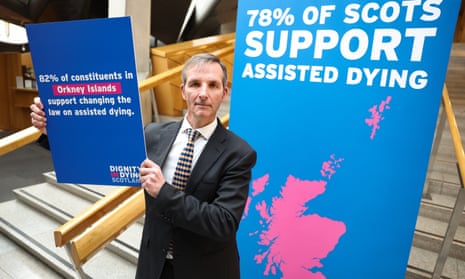
The Scottish Liberal Democrat MSP Liam McArthur with placards promoting his bill

‘Politicians are catching up with the public’: MSP Liam McArthur, who tabled the assisted dying bill on Thursday. Photograph: Jeff J Mitchell/Getty Images

Scotland

Bill tabled in Scotland could legalise assisted dying for terminally ill adults

If law is passed Scotland would become first part of UK to offer terminally ill people assistance to end their lives

Libby Brooks Scotland correspondentThu 28 Mar 2024 12.40 CETLast modified on Thu 28 Mar 2024 13.01 CET

Scotland could become the first part of the UK to offer terminally ill adults assistance to end their lives if Holyrood approves a new bill.

The Scottish Liberal Democrat MSP Liam McArthur, who tabled the assisted dying for terminally ill adults (Scotland) bill on Thursday, said “politicians are catching up with where the public has been for some time” as extensive polling for Dignity in Dying Scotland found 78% of respondents supported legalisation.

Publishing the bill in the Scottish parliament, McArthur said: “Our current laws on assisted dying are failing too many terminally ill Scots at the end of life. Too often, and despite the best efforts of palliative care, dying people are facing traumatic deaths that harm both them and those they leave behind.

https://6e2e155f78b63f9f18281cd055ef98bf.safeframe.googlesyndication.com/safeframe/1-0-40/html/container.html

“This bill contains robust safeguards, similar to those which have been safely and successfully introduced in countries such as Australia, New Zealand and the United State, where they continue to enjoy strong public support.”

McArthur’s bill will be the fourth attempt to introduce assisted dying legislation at Holyrood and is tightly drafted to assuage concerns that it will place pressure on vulnerable people who fear being a burden on their loved ones. It is still expected to be fiercely opposed by disability rights and faith groups.

It is only open to adults who have been resident in Scotland for at least a year and who have been assessed by two independent medical practitioners to be terminally ill, of sound mind and under no pressure. Applicants must administer the life-ending drugs themselves.

Addressing the depth of concerns for human rights on both sides of the debate, Fraser Sutherland of the Humanist Society Scotland, which has supported the development of the bill, pointed out that the proposed law only applies to terminally ill people, so disabled people would not be eligible.

“At this point, the ‘slippery slope’ argument is often used to suggest it is only a matter of time before the law is expanded. But, contrary to certain media narratives, we have seen many assisted dying laws similar to Liam McArthur’s bill (ie those that apply only to terminally ill people) introduced without any subsequent expansion”.

But a letter sent to MSPs from a coalition of disability rights groups, including the Better Way Campaign, Disability Equality Scotland and Inclusion Scotland, urges MSPs to vote against the bill.skip past newsletter promotion

Sign up to First Edition

Free daily newsletter

Our morning email breaks down the key stories of the day, telling you what’s happening and why it matters

Enter your email address

“In an era when long-term conditions are lasting for longer, and health and social care are becoming increasingly expensive, vulnerable groups are specifically threatened by the future consequences of assisted dying legislation. It is not difficult to imagine that an individual’s judgment that ‘my life is not worth living’ can morph into others’ perception that ‘his or her life is not worth living’.”

Dr Gillian Wright, a former palliative medicine registrar now representing Our Duty of Care, an alliance of healthcare professionals opposing assisted dying, said:
“The primary danger of assisted suicide is that individual lives are devalued by society because they are ill, disabled, confused or that their contribution to society is perceived to be minimal. The secondary danger is that terminally ill and disabled individuals may begin to devalue themselves because of the burden that they perceive they are to society.”

Posted in Uncategorized | Tagged , , , , | Leave a comment

Alzheimers and Dementia: In an ageing population and living longer, this will apply to people. Amnesia from brain injury shares some examples that may help. This 60 minute documentary from the US is to enlighten us how to engage, to share and cope. We can’t ignore Dignity in Dying when considering the impact of Alzheimers, Frontal Lobe Dementia and other dementias. Please search Wendy Mitchell and her journey on this site, a more remarkable woman, who made a decision. Her blog is essential reading.

9 Mar 2024 Full Episodes | 60 Minutes From 2018, Dr. Jon LaPook’s groundbreaking report following an Alzheimer’s patient and her caregiver husband for 10 years to document the struggles they face. From 2019, Bill Whitaker’s heartbreaking look at frontotemporal dementia. From July 2017, Lesley Stahl’s examination of efforts to prevent Alzheimer’s. And from this past January, Sharyn Alfonsi’s story on a new approach to brain surgery that could revolutionize the treatment of Alzheimer’s disease.

Posted in Uncategorized | Leave a comment

Brain Awareness Month: Mental Illness. A surprise here. Being part of a Horizon programme for women with depression run by Trinity College Dublin and St Patrick’s hospital, one of the subjects we were taught was an introduction to “Acting” by an esteemed lecturer in Drama at Trinity. It had a very significant impact for me and others. Hence, I am introducing this…”Not Yet…Be forever open to creativity and learning. Worth listening to this talk, a save yourself a lot of fear of failure.

15 Nov 2023 CEMEX Many of us dread having to convey our ideas to others, often feeling ill-equipped, anxious, and awkward. Experts help by focusing on planned communication experiences; yet, most of our professional and personal communication occurs in spontaneous situations that leave us flustered and stumbling for words. Together, we’ll explore science-based strategies for managing anxiety, responding to the mood of the room, and making content concise, relevant, compelling, and memorable. By the end of this class, you’ll know how to navigate the situation like a pro and bring out your very best.

Posted in Uncategorized | Leave a comment

Is Britain on the Brink of Collapse? | Peter Hitchens talks to Aaron Bastani

287,052 views Premiered on 17 Mar 2024 Downstream – NEW episodes every Sunday 6pm UK Peter Hitchens is an author and journalist whose contrarian takes on drug policy, education and foreign policy have found him occupying a singular place in the British media – with his brand of conservatism often angering audiences who would consider themselves staunchly conservative. He sat down with Aaron to discuss grammar schools, Gaza and Britain’s profoundly inhumane actions at the end of the Second World War. 00:00 Intro 03:16 What keep you up at night? 04:41 The fall of the Tories 12:09 The decline in British education 25:45 Do we live in a dangerous world? 27:59 British ‘war crimes’ in WWII 39:00 British WWII Myths 51:05 Israel & Palestine 1:10:56 Putin and Russia 1:19:57 Nordstream 1:21:56 The future of Britain Novara Live broadcasts every weekday from 6PM on YouTube and Twitch. Episodes of Downstream are released Sundays at 6PM on YouTube. __________________________ Support our journalism by buying Novara Media merch: https://shop.novaramedia.com

Posted in Uncategorized | Leave a comment

Yuval Noah Harari, a favorite of mine. Take a look back to 2015. Intelligence Squared: “How Did The Wealthy Gain Power In The Past?

25 Feb 2024 #yuvalnoahharari#intelligencesquared#civilisation In this clip from our 2015 session ‘The Myths We Need To Survive’, historian Yuval Noah Harari engages in a thought-provoking discussion with Intelligence Squared. He delves into the origins of civilisations and the ascent of the wealthy to power, exploring the mechanisms that enabled them to maintain their influence through to contemporary times. Share your insights with us in the comment section below! See the full session here:    • Yuval Noah Harari on the myths we nee…  

Posted in Uncategorized | Leave a comment

Regardless of the platform or algorithm, it’s humans that make social media toxic. Source: EL PAIS

EL PAÍS

Technology

subscribeLOG IN

Technology

social media

Regardless of the platform or algorithm, it’s humans that make social media toxic

A study published in ‘Nature’ analyzes 500 million messages over three decades to better understand bad manners on the internet

Redes sociales tóxicas
A young woman checks her cell phone.Juan Algar (Getty Images)
Jordi Pérez Colomé

Jordi Pérez Colomé

Social media changes over the years, but toxic human behavior persists. In academia today, a persistent debate is determining social media’s impact on our lives and democracies, especially whether it has contributed to making public debate more toxic. A new study published in Nature isolates several behaviors to try to better understand where online toxicity begins and ends. The research analyzes more than 500 million threads, posts and conversations across eight platforms over 34 years.

The finding is that toxicity is much more linked to humans and has not emerged now specifically as the result of social media: “The study indicates that, despite changes in social media and social norms over time, certain human behaviors persist, including toxicity,” says Walter Quattrociocchi, a professor at the University of La Sapienza (Rome) and a co-author of the study, along with other academics from his university, City University and the Alan Turing Institute in London. “This means that toxicity is a natural outcome of online discussions, regardless of the platform.”

The platforms from which the English-language posts under study originated are Facebook, Gab, Reddit, Telegram, Twitter, YouTube, Usenet (a forum created in 1979) and Voat (an American news aggregator). The authors defined toxicity as “a rude, disrespectful or unreasonable comment likely to make someone leave a discussion.”

Toxicity does not drive people away

Another novel aspect of this study is that it goes against the usual understanding of social media and finds that toxicity does not drive users away from it. That response is assumed to be a human reflex and normal in an environment where users cannot detect other attitudinal cues, such as gestures or tone of voice. “The study’s findings challenge the common belief that toxicity diminishes a platform’s attractiveness,” says Quattrociocchi. “[This study] shows that user behavior in toxic and non-toxic conversations has nearly identical patterns in terms of engagement, suggesting that the presence of toxicity may not deter participation, as is commonly assumed.”

Academic research on online behavior has found it difficult to find good data to distinguish which behavior is properly human and which is caused by social media design and its famous algorithms. This paper on toxicity attempts to partly unravel that difference. The study found that toxicity on social media is more a product of human nature than of technology: “Toxicity in online conversations does not necessarily stop or encourage people’s interactions. It is more a reflection of human behavior itself as seen across platforms and contexts,” says Quattrociocchi.

The study also found that polarization and a diversity of opinion may contribute more to hostile online discussions than toxicity itself. Users may end up lengthening the conversation and disrespecting a political opponent over conflicting opinions rather than reading rude or hostile comments. “We can conclude that polarization tends to reinforce participation on platforms by promoting argumentative interactions between users of different opinions,” Quattrociocchi asserts. “Interactions caused by controversy and debate may have a greater impact on maintaining user activity than toxicity,” he adds.

This finding may help social media approach content moderation differently and better filter toxic content so that such human behavior exists less online. “Systems could be designed to encourage healthy discussions without falling into toxicity, and content moderation could be sensitive to the complexities of human behavior,” the researcher explains.

Although the study notes that some toxicity is linked to human behavior on social media, that does not mean that all online interactions are doomed to be toxic or that efforts to mitigate such encounters are futile. “The most effective way to reduce online toxicity is to make people aware of our online behavior, and for that, above all, we need cognitive media training,” says Quattrociocchi.

Sign up for our weekly newsletter to get more English-language news coverage from EL PAÍS USA Edition

More information

Donald Trump supporters on Capitol Hill

Kicking toxic people off social media reduces hate speech on the internet

Emanoelle Santos

Fake news

The dangerous impact of ‘fake news’ on the lives of Spanish speakers in the United States

Andrea J. Arratibel | Mexico

Posted in Uncategorized | Leave a comment

How does war affect nature? Syria has lost 20% of its forests in 10 years. “The researcher recalls that the Geneva Convention talks about protecting nature during conflicts and calls for sanctions on armed groups or countries that fail to comply with environmental laws during wars.” Source: EL PAIS. Comment: Why do we ignore Ecocide and continue to fund barbaric wars of attrition, greed, power, totalitarian, authoritarian, theme democracy as held by President Biden and former President Trump and their input to wars, both going forward for US President election 2024?

https://0eae9b02a07d3134454d6b922e61164b.safeframe.googlesyndication.com/safeframe/1-0-40/html/container.html

Select:

EL PAÍS

SUBSCRIBELOG IN

Climate

FORESTS

How does war affect nature? Syria has lost 20% of its forests in 10 years

Explosions spark forest fires while the impoverished population is using trees as a source of fuel, which is driving desertification in the country, according to a study

Fires and a landfill next to a forested area in Idlib, in northeastern Syria, in 2020
Fires and a landfill next to a forested area in Idlib, in northeastern Syria, in 2020.NURPHOTO (NURPHOTO VIA GETTY IMAGES)
Miguel Ángel Medina

MIGUEL ÁNGEL MEDINA

Madrid – 

Wars are, foremost, a human drama. Thousands of people see the tragedy of each conflict firsthand. But with a broader focus, it is possible to assess the wider impact of war. What happens to the trees, to the animals, to the ecosystem? A study has analyzed the situation in Syria, which has been in the grips of a bloody civil war since 2011. It found that the country has lost around 20% of its forests in a decade (from 2010 to 2019). On the one hand, artillery explosions spark forest fires that are difficult to put out due to the lack of resources and, on the other, internal refugees and the impoverished population use trees as a source of fuel, which in the long run may drive the desertification of the Mediterranean country.

“The effect of wars is not limited to the suffering of people, but also extends to nature and all living beings,” explains Angham Daiyoub, a 30-year-old Syrian who in 2018 traveled to Catalonia to start a master’s degree in forest management at the University of Lleida. She knows the suffering of the Syrian people first-hand: she lived through the conflict for several years, and her family continues to reside in Syria. Now in Spain, she set out to study how weapons and bombs have affected Syria’s environment.

A fire in 2017 in the forests of Latakia, next to the Turkish border.
A fire in 2017 in the forests of Latakia, next to the Turkish border.ANADOLU (GETTY IMAGES)

Her research led to War and Deforestation: Using Remote Sensing and Machine Learning to Identify the War-Induced Deforestation in Syria 2010–2019, a study published in the scientific journal Land, which is focused on land systems and management.

The work is based on the study of Landsat and PALSAR satellite images with 30 meters of definition, which made it possible to differentiate between forested and non-forested areas. “We chose images from 2010, before the war started, from 2015 and 2019,” says Daiyoub, who is now a researcher at the Center for Ecological Research and Forestry Applications (Creaf) in Barcelona. Deforestation was analyzed using machine learning techniques based on models from previous years and the annual mapping of these areas.

“In conflict areas such as Syria, where field-based methods are challenging due to war conditions, remote sensing by satellite images is an appropriate instrument for analyzing the impact of the conflict on the landscape,” the study states.

A forest in northwest Syria, in an image provided by researcher Angham Daiyoub.

The research shows that between 2011, when the war in Syria began, and 2019, the conflict devastated 19.3% of the country’s forest cover, which represents 63,700 hectares of its territory — an area equivalent to the city of Madrid.

The loss of forest cover has continued over time, with the damage concentrated in the coastal-mountain range of the northeast and around the capital, Damascus, which is located in the south. The highest rate of deforestation was observed between 2010 and 2015, when total forest cover fell by 11.5% (or 38,000 hectares). During the 2015-2018 period, a more gradual but constant decrease was also observed, with forest cover declining by 7.8%.

A Syrian man lights a fire in a refugee camp in the Idlib area, in 2021.
A Syrian man lights a fire in a refugee camp in the Idlib area, in 2021.ANADOLU (ANADOLU AGENCY VIA GETTY IMAGES)

Daiyoub explains that the loss of forest cover is due to the war. “First of all, bombings and missiles spark fires in the forests that are difficult to put out, because there are no means to do so. Secondly, 90% of the population lives below the poverty line, and there are many internal refugees with very few resources, without access to gas or electricity, so they cut down the trees to cook, to warm themselves, and to sell the wood,” she says by phone. This unsustainable way of managing the forest means that the area cannot bounce back and becomes degraded.

Erosion and storms

The study highlights that the proximity of forested areas to roads, refugee camps and urban settlements has been one of the key drivers of deforestation. “Forests are fundamental for the ecosystem, for people, to combat water and air pollution. If they are cut down, all that is lost. But what’s more, many forested areas in Syria are in the mountains, and if they are left without trees, this can cause erosion when there are storms, changing the microclimate of the area and driving desertification and aridity,” says the researcher. “The part where there are the most forests is the Mediterranean, where there are all types of plants and animals, which are also affected by this situation,” she continues.

Angham Daiyoub, in an image provided by the Syrian researcher.

The research points out that in the decade before the war, Syria recorded positive annual rates of forest growth, according to the Syrian Monitoring of Agricultural Resources. In this period, the Food and Agriculture Organization of the United Nations (FAO) reported an increase of 119,000 hectares of forest cover in the country, a rise that was largely attributed to government forest recovery campaigns.

Daiyoub says that the conclusions of the study can be extrapolated to other conflicts. “It is estimated that two million hectares of forest were lost in the Vietnam War, around 20% of the forest mass in the south of the country. And in Ukraine it is also affecting protected areas, displacing animals, burning forests and degrading the soil,” she says. The researcher recalls that the Geneva Convention talks about protecting nature during conflicts and calls for sanctions on armed groups or countries that fail to comply with environmental laws during wars.

Sign up for our weekly newsletter to get more English-language news coverage from EL PAÍS USA Edition

Posted in Uncategorized | Tagged , , , , | Leave a comment

Stigma and Mental Illness. I have taken this TEDx from Royal Society of Psychiatrists Ireland webpage. Too often we dismiss the abilities of people with mental illness. Schizophrenia conjures up dread for many a parent or person who is diagnosed. I recommend this talk from an advocate for students and schizophrenia. Too many opportunities are lost leaving people with mental illnesses on the trash heep of society. Me, I made it to the final exam BESS, Trinity College Dublin, all assignments done, presentations too. But the mind caved in and it lasted years under the guise of chronic fatigue. However I emerged an mental illness, anxiety, traumatic brain injury advocate, in a loner way. 7 years at college gave me an education which has been the greatest gift in my life.

Posted in Uncategorized | Leave a comment

Psychiatry, the Cinderella profession where funding is half what other countries pay, and terms and conditions fall short also. Check out this link. It is no wonder certain private psychiatrists put their patients through hoops to get an appointment, and can you imagine some have the audacity to charge before you even attend? Why?

Posted in Uncategorized | Leave a comment

Comment: Ireland needs to ask similar questions. Census revealed a vacant stock in excess of 166,000 but the Value is a big ? Heading in the Guardian: UK housing is ‘worst value for money’ of any advanced economy, says thinktank

Housing

UK housing is ‘worst value for money’ of any advanced economy, says thinktank

British properties are ‘expensive, cramped and ageing’ compared with other similar economies, says Resolution Foundation

PA Media

Mon 25 Mar 2024 01.01 CETShare

The UK’s “expensive, cramped and ageing” housing stock fares poorly compared with other advanced countries, analysis by a thinktank suggests.

Households are paying more than other countries – but getting less in return, the Resolution Foundation said.

“When it comes to housing, UK households are getting an inferior product in terms of both quantity and quality,” the thinktank said.

The housing permacrisis … houses in Stoke-on-Trent in 2022.

The Foundation’s housing outlook used OECD data to compare the UK’s housing issues with other similar economies.

It said that while there was “limited cross-national data” on floor space, homes in England had less average floor space per person (38 sq metres) than many similar countries, including the US (66 sq metres), Germany (46 sq metres), France (43 sq metres) and Japan (40 sq metres).

https://61a7d303bb9b12651d6284f2878ba23d.safeframe.googlesyndication.com/safeframe/1-0-40/html/container.html

The UK’s housing stock is also relatively old, with 38% of homes built before 1946, the report said, compared with around a fifth (21%) in Italy and one in nine (11%) in Spain.

Older homes can be poorly insulated, leading to higher energy bills and a higher risk of damp, according to the Foundation, which is focused on improving the living standards for those on low to middle incomes.

Researchers also considered what it would cost to rent all homes – incorporating what owners would pay if they rented their home at market rates – to show how the market price of housing varies across different countries.

The report said: “If all households in the UK were fully exposed to our housing market, they would have to devote 22% of their spending to housing services, far higher than the OECD average (17%), and the highest level across the developed economies with the solitary exception of Finland.”

Adam Corlett, principal economist at the Resolution Foundation, said: “Britain’s housing crisis is likely to be a big topic in the election campaign, as parties debate how to address the problems of high costs, poor quality and low security that face so many households.

https://61a7d303bb9b12651d6284f2878ba23d.safeframe.googlesyndication.com/safeframe/1-0-40/html/container.html

“Britain is one of many countries apparently in the midst of a housing crisis, and it can be difficult to separate rhetoric from reality. But by looking at housing costs, floor space and wider issues of quality, we find that the UK’s expensive, cramped and ageing housing stock offers the worst value for money of any advanced economy.skip past newsletter promotion

Sign up to Headlines UK

Free newsletter

Get the day’s headlines and highlights emailed direct to you every morning

Enter your email addressSign up

https://www.google.com/recaptcha/api2/anchor?ar=1&k=6LdzlmsdAAAAALFH63cBVagSFPuuHXQ9OfpIDdMc&co=aHR0cHM6Ly93d3cudGhlZ3VhcmRpYW4uY29tOjQ0Mw..&hl=en&type=image&v=Hq4JZivTyQ7GP8Kt571Tzodj&theme=light&size=invisible&badge=bottomright&cb=h0iy38ojph7aPrivacy Notice: Newsletters may contain info about charities, online ads, and content funded by outside parties. For more information see our Privacy Policy. We use Google reCaptcha to protect our website and the Google Privacy Policy and Terms of Service apply.

“Britain’s housing crisis is decades in the making, with successive governments failing to build enough new homes and modernise our existing stock. That now has to change.”

A Department for Levelling Up, Housing and Communities spokesperson said: “Housebuilding is a government priority and despite global economic challenges we remain on track to meet the manifesto commitment of delivering one million homes this parliament, and have introduced reforms to improve the planning system.

“At the same time as increasing the quantity of homes we are driving up quality, with the number of non-decent homes down by 2 million since 2010.

“Our landmark renters reform bill is progressing through parliament and will give tenants more security in their homes, while our £11.5bn investment in the affordable homes programme and £1.2bn local authority housing fund will help build a new generation of affordable and social housing.”

Posted in Uncategorized | Tagged , , , , | Leave a comment