The (correct) decision of European governments to roll out massive supports for businesses and consumers during Covid lockdowns was always going to come at a cost. Many companies that would have shuttered in the normal course of events continued trading during lockdowns to avail of government payments. Six years on, bankruptcies are high and rising across the EU.
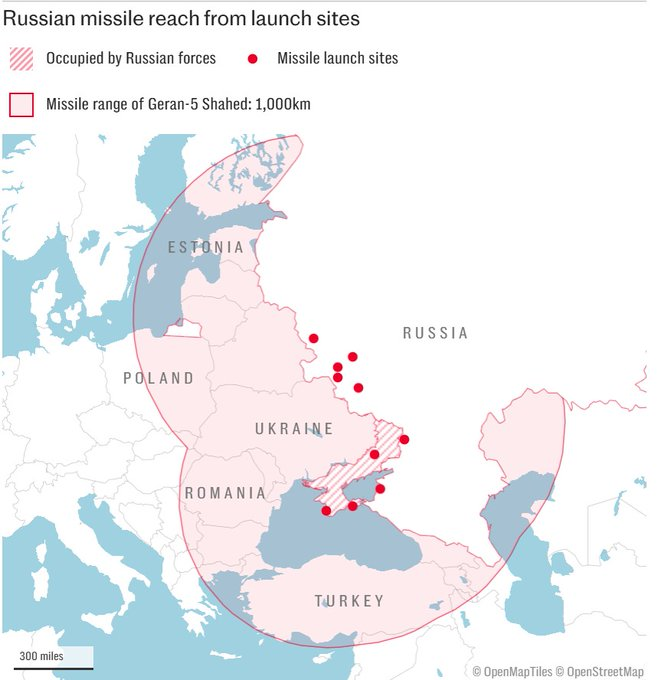
Russia has reportedly built a network of drone bases close enough to strike deep inside NATO territory.
A Telegraph investigation identified 10 Russian bases with newly constructed launch pads for Moscow’s most advanced long-range attack drones, using leaked documents and satellite imagery.
The sites sit along Russia’s borders with Ukraine and Belarus.
At least 59 new launch rails were spotted, including around 20 extended rails designed for the longest-range drones, potentially putting cities like Warsaw within reach.
And these bases aren’t just sitting idle. 7 of the 10 sites have already reportedly been used in recent strikes on Kyiv.
NATO says it’s “ready to defend every inch of allied territory.”
China Launches First Regular Arctic Cargo Route to Europe A Chinese logistics firm has launched the first regular cargo service connecting Asia and Europe via the Arctic, taking advantage of melting polar ice and avoiding Red Sea threats.
Anja Koch in Saxony-Anhalt, Germany08/15/2026August 15, 2026
For decades, coal was the lifeblood of the eastern German state of Saxony-Anhalt. But in 2020 the German government decided to phase out coal. To cushion the impact, the government approved a massive support program.
For more than a century, coal mining shaped eastern Germany, often at the cost of entire villages such as Grossgrimma, whose residents were relocated before mining plans were ultimately abandoned.
As Germany phases out coal by 2038, Saxony-Anhalt faces uncertainty over jobs, identity, and economic prospects. More than €5 billion ($5.8 billion) in transition funding is financing projects like a new education campus, but many locals remain skeptical, questioning how the money is spent and whether it will create lasting opportunities.
Despite concerns, some residents remain hopeful that innovation and younger generations can drive the region’s future.
BREAKING: The 60-day US-Iran deadline just ran out with no deal.
The Islamabad MoU gave both sides until today to lock in a final agreement. Nothing got signed.
They can’t even agree on what the expiry means. Washington calls it the end of a ceasefire. Tehran says the MoU ended the war, so there was never a truce to extend.
Hormuz is the real fight. Iran reclosed it, the US reinstated its blockade, and Trump’s now floating declaring the strait U.S. territory.
Everything points to more escalation. But six months in, both sides are exhausted enough that neither might have the appetite.
Nechirvan Barzani, president of Iraq’s semi-autonomous Kurdistan Region, receives an award in Erbil, the region’s capital, last month. Photo: Gailan Haji/Middle East Images/AFP via Getty Images
In mid-May, U.S. negotiators trying to reach a deal with Iran to end the war ran into a problem: They couldn’t tell if the people across the table actually spoke for the country’s powerful Islamic Revolutionary Guard Corps (IRGC), Axios’ Barak Ravid scoops.
So Trump administration officials did something unconventional — they went around Iran’s negotiators and reached out directly to IRGC leadership.
The person they tapped for the backchannel was Nechirvan Barzani, the president of the Kurdistan region in Iraq, who had something very few others do: the trust of both U.S. and IRGC leaders.
Why it matters: The episode — which was detailed by three sources with direct knowledge, and hasn’t been previously reported — shows how tricky it’s been for the U.S. to negotiate with a country where Washington isn’t sure who exactly is in charge.
The sources said Barzani managed to establish a direct connection with the IRGC commander-in-chief, Gen. Ahmad Vahidi, and received assurances from him that he was on board with the deal under discussion at the time.
Brett McGurk, who has served as a Middle East adviser to four presidents, told Barak: “Nechirvan Barzani is a pragmatic problem solver. He’s respected across the region. He knows nearly everyone in Tehran as well as Washington. That’s who you call in a pinch.
“What to watch: Barzani has recently sent messages to the White House offering to help restart U.S.-Iran negotiations, according to a source with knowledge of the matter.
The only way to pull or push people to a different place or worldview is to show them what better looks like. So Jim sketched this out, based on Autumn’s experience and what Mayo is building:
How it could/should work: Imagine the responseonce Autumn started getting sick. (Her earliest symptom was pericarditis, inflammation around her heart.)
Instead of going to a random doctor with scant understanding of her condition, she gets routed to someone with true expertise, who taps into a pool of data on other women with pericarditis.
She hops on a Zoom with this person — who could be anywhere worldwide with access to her health data. Her vitals are easily checked at home beforehand and fed into the data. The doctor and Autumn decide together if an in-person examination is warranted.
Now, imagine Autumn is actively sick and needs to go to the hospital.
She lands in what Mayo calls a neighborhood: imaging, labs, procedures, consults and recovery all co-located for complex patients, instead of a scavenger hunt across buildings and appointment desks. Her costs are clear and flagged.
The room itself feels healthy: controls for sound, lighting, temperature and TV. An electronic screen shows today’s schedule and exactly what has to happen before she goes home. Family can easily Zoom in to chat and see her. Robots run supplies and meals, so nurses spend their hours on Autumn, not chores.
AI stays in the background:sequencing appointments across specialists, transcribing and summarizing conversations, catching conflicts in a brutal medication regimen. The machines absorb the paperwork. The humans focus on Autumn.
The bottom line: None of this requires an invention. Every piece of it exists right now, somewhere. What’s missing isn’t technology. It’s the will to rebuild care around the patient — the opposite of our existing mess.
It’s the power of AI that could make the biggest difference and scale this further, the fastest, Farrugia argues.
Mayo’s scarcest asset — coordinated diagnostic brilliance based on real data, cases, lab results and patients — is exactly what AI is getting good at. Mayo knows it, running more than 12,000 clinical studies and building its Mayo Clinic Platform to digitize its expertise.
Testing technology:Before we tried Mayo, Autumn’s coordinating doctors asked to use AI-assisted recording and transcription. I did the same for the AI agent I built to tackle Autumn’s case using Claude. Both of us fed this into systems to make better data-informed calls.
To this day, my personal AI agent has proven smarter than every doctor, other than Mayo’s.
Think about what Mayo data changes: A community hospital in Oshkosh, Wisconsin, will never recruit 4,000 Mayo-caliber specialists. It doesn’t need to. It could tap into Mayo’s expertise and data to instantly help tens of millions of patients.
The harder-to-implement components of scaling Mayo — the talent, the brand, the destination economics — matter far less if the intelligence itself can be tapped by all doctors and patients.
A new health care goal could be Mayo-quality care for everyone. This moves us beyond government-run health care versus free markets.
The bottom line: American health care is the most expensive, bureaucratic, seemingly unfixable program on Earth. But smart policymakers, working with experts at Mayo and beyond, could spare millions of Americans Autumn’s health care hell. Shame on us if we don’t.
Axios CEO Jim VandeHei devoted this weekend’s Axios C-Suite newsletter to the challenges he and his wife, Autumn, have faced in navigating America’s health care system — and their glimpse of medical nirvana:
My wife, Autumn, has spent nearly a quarter of the past four years in ERs and hospitals, untangling and battling three chronic conditions — and a shamefully broken U.S. medical system.
We live in Washington, D.C., with top-rated hospitals in our backyard. Yet her experience has been eye-opening and often horrifying, especially for a nation that spends twice as much on medical care as our rivals.
And we’re the lucky ones, with blue-chip insurance, a sophisticated understanding of the system and resources to attack problems. Most patients don’t have those things.
All of this left us infuriated and hopeless — until we landed in a small Minnesota city and glimpsed medical nirvana: the Mayo Clinic in Rochester. It was like discovering a foreign land — or seeing a future that could and should be.
The best part: I soon discovered AI could easily help unlock the best of Mayo for everyone. Dr. Gianrico Farrugia, a gastroenterologist who’s president and CEO of the Mayo Clinic, told me he’s racing to show the federal government and other hospitals how to replicate the Mayo magic.
How it works: Mayo doctors work as teams. They’re paid to heal, not to operate or medicate. Nurses handle four or so patients — fewer than we’ve experienced at even some of the best hospitals back home.
Everyone is kind and talented. Rooms are clean. Every appointment begins on time. Imaging and blood tests get scheduled immediately, not after months of anxious waiting. Results land instantly in your online portal.
But the real difference-maker: Doctors and patients leverage massive databases of medical information, sorted and analyzed by AI, then channeled into 500 different algorithms to help find cures and better serve patients.
Consider cases like Autumn’s: She has several different things wrong requiring expertise across many domains. Few, if any, humans could piece together this puzzle alone. This is where AI could make a big impact — now.
Mayo recentlysigned a deal with Microsoft to expand and expedite its own frontier AI model to further scale and refine this work. Both are fine-tuning the AI with hopes of sharing it broadly.Dr. Gianrico Farrugia, Mayo Clinic president and CEO. Image via Mayo Clinic
“None of this works unless health data is arranged maximally for humans and AI agents,” Farrugia told me. “What makes it work or scalable is organizing all the knowledge so doctors can use it optimally and so agents can use it optimally, so we get the best data to help patients.
“The catch: “I could give this to every hospital — and they can’t use it.” That’s because most hospitals lack the technology, money, systems and focus to use health data drawn from patients and broader pools.




 Scoop: Trump’s secret Iran backchannel
 Nechirvan Barzani, president of Iraq’s semi-autonomous Kurdistan Region, receives an award in Erbil, the region’s capital, last month. Photo: Gailan Haji/Middle East Images/AFP via Getty Images
 Part 3: The future, reimagined
 Jim would love to hear your thoughts:
  If you’re a CEO or on a CEO’s team:


 Testing technology: Before we tried Mayo, Autumn’s coordinating doctors asked to use AI-assisted recording and transcription. I did the same for the AI agent I built to tackle Autumn’s case using Claude. Both of us fed this into systems to make better data-informed calls.
 Jim’s column continues below.
 How it works: Mayo doctors work as teams. They’re paid to heal, not to operate or medicate. Nurses handle four or so patients — fewer than we’ve experienced at even some of the best hospitals back home.
 Dr. Gianrico Farrugia, Mayo Clinic president and CEO. Image via Mayo Clinic
