Perfectionism and mental health problems: Limitations and directions for future research. Resource United States Government NCBI. Comment: TBI merits “no two injuries yield the same outcomes”; add bipolar, anxiety, depression, OCD, and again there are ripples that some people experience and what I can say is “perfection of an OCD kind, underlies my basic personality traits and hence many difficulties including a complete irrationality about handwriting, body dysmorphia, near perfection house and garden, filing in order, and more, being unlike others and therefore wrong, especially from approximate age 10. 5 decades later I finally discover the link between perfection and mental illnesses. Worth sharing.

Skip to main content

U.S. flag

An official website of the United States government

Log in

Access keys NCBI HomepageMyNCBI Homepage Main ContentMain Navigation

Preview improvements coming to the PMC website in October 2024. Learn More or Try it out now.

As a library, NLM provides access to scientific literature. Inclusion in an NLM database does not imply endorsement of, or agreement with, the contents by NLM or the National Institutes of Health.
Learn more: PMC Disclaimer | PMC Copyright Notice

Logo of wjcc

World J Clin Cases. 2022 May 16; 10(14): 4709–4712.

Published online 2022 May 16. doi: 10.12998/wjcc.v10.i14.4709

PMCID: PMC9125265

PMID: 35663083

Perfectionism and mental health problems: Limitations and directions for future research

Nabi Nazari

Author informationArticle notesCopyright and License informationPMC Disclaimer

Go to:

Abstract

Research has indicated that perfectionism is prevalent among adolescents and may be harmful in terms of its association with mental health problems. This letter aims to create a paradigm for future studies of the perfectionism. Specifically, we suggest gaps and implications that must be considered at perfectionism future research in terms of assessments, interventions, settings, potential treatments, gender, and social media.

Keywords: Perfectionism, Adolescents, Treatment, Gender, Mental health problems

Core Tip: Consistent with biopsychosocial and public health promotion perspectives on health, comprehending the consequences of perfectionism for health and well-being necessitates unifying instead of soloing studies on such linked factors and examining them in their particular contexts. As a transdiagnostic process, that perfectionism is hard to change. Consequently, treatments must be customized to address perfectionists’ cognitive and emotion control difficulties, and adolescents meta-cognitive views about ability, self, and meaning of failure.

Go to:

TO THE EDITOR

We read, with great interest, the article by Livazović addressing the relationships between perfectionism and the quality of interpersonal interactions (family members, peers, and colleagues) and media consumption[1]. This study aimed to determine the predictive value of social connectedness, demographic characteristics, and media use with regard to perfectionism. These results add to the growing body of knowledge. We agree with the authors’ insight that perfectionism is best defined as a multidimensional construct. Additionally, perfectionism is best characterized as a multidimensional personality trait. This conceptualization is critical. Perfectionism exhibits distinct and often antagonistic interactions with positive and negative psychological processes and their consequences. To fully comprehend multifaceted perfectionism, it is fundamental to understand how many aspects connect to processes and results and how they link to stable personality qualities. Additionally, it is critical to understand how perfectionism and its many characteristics fit within a comprehensive personality framework.

From the perspective of self-determination theory, multidimensional perfectionism comprises two distinct components: (1) Perfectionistic striving (PS); and (2) Perfectionistic concern (PC). PS is mainly associated with motivations and regulatory styles characterized by higher degrees of self-determination, such as intrinsic motivation, integrated regulation, and identified regulations[2]. In contrast, PC is mainly associated with motivations and regulatory styles characterized by lower degrees of self-determination, such as introjected regulation. However, PS may also show positive relationships with introjected and external regulation even when the overlap with perfectionist concerns is controlled, suggesting that the motivational qualities of PS may reach the domain of less self-determined regulation. One possibility is that the pattern of striving and concerns shows positive relationships with external and introjected regulation, which can be explained by the fact that both regulations focus on rewards and punishments.

Gender and perfectionism

In terms of gender, girls are more likely than boys to be addicted to technology and to be compared with others. Self-critical perfectionism was associated with an increased risk of sadness and a decreased sense of self-worth among girls who used social media. By avoiding social media more often, the impact may be mitigated. This gender difference may be because what girls use on online media is more important than the amount of time. A new study examined whether perfectionism has a significant effect on determining whether and how online behavior impacts the mental well-being of girls[3].

Health and perfectionism

Concerning health issues, scholars’ dependence on subjective self-report questionnaires to measure health-related constructs is a well-known and significant weakness in perfectionism. However, the employed measures are critical for capturing health outcomes that may be employed to predict morbidity[4]. They are insufficient to address the complicated relationships between perfectionism, psychological distress, health practices, and health. Consequently, researchers have encouraged the conduction of multi method and multi-informant studies that better reflect biopsychosocial models of health. The suggested objective is that research in this area will also prove that the health costs associated with perfectionism cannot be limited to higher levels of neuroticism or lower levels of conscientiousness. Additionally, perfectionism has specific mental health problems distinct from the health risks and related variables linked with the other personality traits. Once the unique health risks associated with perfectionism are better understood, it will be critical to develop a research agenda focused on developing and implementing a preventive approach that simultaneously decreases perfectionistic strivings and concerns while increasing resilience in at-risk perfectionists.

Intervention

Direct classroom treatments targeting perfectionism result in considerably reduced levels of perfectionism in children and adolescents. Empirical data support the adoption of intensive, complex interventions focused exclusively on perfectionism rather than on numerous goals to reduce perfectionism’s detrimental effects. This is consistent with the finding that cognitive-behavioral therapies targeting perfectionism have been linked with significant reductions in perfectionism and moderate reductions in emotional disorders, anxiety, and depression in adult clinical populations. Key themes were also identified to develop resilience to diminish perfectionism in classroom settings[5], including lowering the perceived importance of meeting impossible standards, viewing failures as stepping stones to success and growth, being compassionate to counter self-blame, and to provide stress management. Compared to adult interventions, findings revealed that perfectionism interventions in children and adolescents have comparable effects in transdiagnostic outcomes[5], particularly affectivity, self-criticism, body dissatisfaction, and maladaptive behavior.

Self-compassion may be an effective intervention to reduce the severity of maladaptive affective behaviors in response to difficult everyday situations and stressful events that can facilitate recovery from adversity. There is growing evidence that higher levels of self-compassion are linked with greater levels of positive and adaptive responses (e.g., happiness, optimism, life satisfaction, and specific goal achievement, healthier physiological responses to stress, and negative outcomes (e.g., lower levels of depression, anxiety, and stress)[6,7]. Particularly for perfectionism, the mechanisms related to self-compassion, such as awareness about painful experiences instead of avoiding, connectedness instead of isolating, and kindness instead of harshly judging, may be protective factors against psychopathology vulnerabilities.

Conclusion

Consistent with biopsychosocial and public health promotion perspectives on health, comprehending the consequences of perfectionism for health and well-being requires unifying instead of soloing studies on such linked factors and examining them in their particular contexts. From a developmental psychopathology viewpoint, perfectionism’s effect on children’s health might take numerous pathways. For example, perfectionism may have a detrimental effect on children’s health[8]. A developmental validation and implication of the objective and specific multidimensional research instruments is a sophisticated approach to measure perfectionism and support professionals in reducing the burden of harm-related perfectionism among adolescents. Another pathway involves greater paternal and environmental risk factors (including parental perfectionism) and the impacts of the risk factors on parenting quality, which lead to higher levels of youth perfectionism and mental health problems. There is currently a lack of evidence to investigate perfectionism interventions’ most effective format and specific disorders. As a transdiagnostic process, perfectionism is harmful and hard to change. Consequently, treatments must be customized to address perfectionists’ cognitive and emotion control difficulties and adolescents’ meta-cognitive views about the ability, self, and meaning of failure[9].

Go to:

Footnotes

Conflict-of-interest statement: Conflict-of-interest statement: The authors declare that they have no conflict of interest.

Provenance and peer review: Invited article; Externally peer reviewed.

Peer-review model: Single blind

Corresponding Author’s Membership in Professional Societies: American Psychological Association, C2000157758.

Peer-review started: January 27, 2022

First decision: March 16, 2022

Article in press: April 9, 2022

Specialty type: Medicine, research and experimental

Country/Territory of origin: Iran

Peer-review report’s scientific quality classification

Grade A (Excellent): 0

Grade B (Very good): B

Grade C (Good): C, C

Grade D (Fair): 0

Grade E (Poor): E

P-Reviewer: Morozov S, Russia; Tasdelen Bas M, Turkey; Chaudhury S, India S-Editor: Wang LL L-Editor: A P-Editor: Wang LL

Go to:

References

1. Livazović G, Kuzmanović K. Predicting adolescent perfectionism: The role of socio-demographic traits, personal relationships, and media. World J Clin Cases. 2022;10:189–204. [PMC free article] [PubMed] [Google Scholar]

2. Stoeber J, Gaudreau P. The advantages of partialling perfectionistic strivings and perfectionistic concerns: Critical issues and recommendations. Personality and Individual Differences. 2017;104:379–386. [Google Scholar]

3. Etherson ME, Curran T, Smith MM, Sherry SB, Hill AP. Perfectionism as a vulnerability following appearance-focused social comparison: A multiwave study with female adolescents. Personality and Individual Differences . 2022;186:111355. [Google Scholar]

4. Molnar , D S., Sirois, F. M., Flett, G. L., Janssen, W. F., & Hewitt, P. L. Perfectionism and health: The roles of health behaviors and stress-related processes. In: J. Stoeber. The psychology of perfectionism: Theory, research, applications. Routledge/Taylor & Francis Group, 2018: 200-221. [Google Scholar]

5. Lloyd S, Schmidt U, Khondoker M, Tchanturia K. Can Psychological Interventions Reduce Perfectionism? Behav Cogn Psychother. 2015;43:705–731. [PubMed] [Google Scholar]

6. Flett GL, Hewitt PL. A proposed framework for preventing perfectionism and promoting resilience and mental health among vulnerable children and adolescents: The Prevention of Perfectionism. Psychol Schs. 2014;51:899–912. [Google Scholar]

7. Nazari N, Hernández RM, Ocaña-Fernandez Y, Griffiths MD. Psychometric Validation of the Persian Self-Compassion Scale Youth Version. Mindfulness (N Y) 2022:1–13. [PMC free article] [PubMed] [Google Scholar]

8. Fan Q, Li Y, Gao Y, Nazari N, Griffiths MD. Self-Compassion Moderates the Association Between Body Dissatisfaction and Suicidal Ideation in Adolescents: A Cross-Sectional Study. Int J Ment Health Addict . 2022:1–18. [PMC free article] [PubMed] [Google Scholar]

9. Egan SJ, Wade TD, Shafran R. Perfectionism as a transdiagnostic process: a clinical review. Clin Psychol Rev. 2011;31:203–212. [PubMed] [Google Scholar]


Articles from World Journal of Clinical Cases are provided here courtesy of Baishideng Publishing Group Inc


Follow NCBI

Connect with NLM

National Library of Medicine
8600 Rockville Pike
Bethesda, MD 20894

Web Policies
FOIA
HHS Vulnerability Disclosure

Help
Accessibility
Careers

Posted in Uncategorized | Tagged , , , , | Leave a comment

Minds that don’t conjure images: How a brain with aphantasia works. Source: El Pais. See youtube for a more detailed explanation, titled The Imagination by Professor Joel Pearson

Science

SILICON VALLEYYOUTUBEGOOGLELATEST NEWS

NEUROSCIENCE

Minds that don’t conjure images: How a brain with aphantasia works

A scientific review unpacks what we know about the neurological characteristic that limits the creation of conscious visuals and affects 1% of the population

Afantasía
Two radiologists review a brain scan.SIMONKR (GETTY IMAGES)
Jessica Mouzo

JESSICA MOUZO

Imagine a Christmas tree. Or try to visualize in your mind the last meal you ate yesterday. Recall the face of a family member you haven’t seen in a while. Surely, the majority of us are able to evoke these mental images without a problem, perhaps to varying levels of precision and detail, but with the same fluidity with which we recall objects, people and lived experiences every day of our lives. But a certain percentage of us, around 1% of the total population, can’t carry out such exercises: these are the people living with aphantasia, a neurological condition that prevents the creation of conscious mental images. A scientific review has dug into our still-limited understanding of the characteristic, concluding that it is associated with reduced autobiographical memory and facial recognition. Also, that it is more common among autistic individuals and people in scientific professions.

Typically, our imagination hangs onto the sensory properties of objects and activities when they are absent, such as what the color orange looks like or the sound of thunder. Through an intricate neurological process, we are able to mentally call up these images. However, people with aphantasia are unable to build these internal images, to visualize them through thought. That doesn’t mean they have no imagination, qualifies Adam Zeman, professor at the University of Exeter and author of the aforementioned scientific review. “It indicates a lack of visual imagery and oftentimes, also sensory imagery, but people with aphantasia can be imaginative in the sense of creativity,” says the scientist, who published the article in the journal Trend in Cognitive Sciences.

First of all, it’s important to establish that aphantasia is not an illness. It’s more accurately classified as a characteristic that explains how an individual process information and that, “occasionally, can be a symptom of a neurological or psychological disorder,” says Zeman. A cerebral lesion or the evolution of a pathology can cause a loss of the ability to call up visual images in the mind, but the characteristic can also be hereditary and lifelong. The healthy people who experience it are completely functional.

In this sense, Saul Martínez-Horta, neuropsychologist at Barcelona’s Hospital Sant Pau who did not participate in the review, emphasizes that “normality in human cognition is diverse” and can function in very different ways. With aphantasia, he points out, “the way the neurological systems that process visual information are organized will probably be different,” but that doesn’t mean a person is incapacitated. “When something has always took place without any effect on our day-to-day life, that doesn’t mean much. But if something appears suddenly, like an inability to project images in the mind, that could be an indication that something has happened,” he says. Psychiatrists have reported the appearance of aphantasia in the context of depression, depersonalization and psychosis, among other conditions.

Zeman’s scientific review found that 1% of the population experiences pronounced aphantasia, but the spectrum is varied, and 2% to 6% of people were found to have “vague and tenuous” visual imagination. There’s also the other side of the coin, which is that around 3% of the population tends in the opposite direction and displays signs of hyperphantasia, the ability to generate hyperrealistic images in the mind. “There’s an entire spectrum of ability to evoke, but there is no standard value and it’s very difficult to quantify. Probably, it’s what one is born with,” says Javier Camiña, spokesperson for the Spanish Neurology Society, which did not participate in the investigation.

According to scientists, aphantasia is overrepresented among people who work in mathematics, computations and the sciences, a phenomenon that Martínez-Horta associates with convergent thinking. “In convergent thinking, when you consider the uses of a pen, your thoughts will be rigid and methodical: it is used for writing. On the other hand, divergent thinking is more childish: the pen can be a weapon or used to put up your hair. Aphantasia is associated with a convergent pattern, that is more bound by the predictable,” he says. In traditionally more creative industries, there is a greater likelihood of finding individuals with hyperphantasia.

Less autobiographical memory

When it comes to experimental memory measurements, people with aphantasia have also shown mild to moderate impairment. “Consistent with the close relationship between remembering the past and imagining the future, the richness of descriptions of imagined scenes is also reduced in aphantasia. Aphantasia similarly reduces the detail of eyewitness testimony,” Zeman points out in the article. Autobiographical memory, which refers to memory of a person’s own life, is also reduced among these individuals, to the point of being linked to a syndrome in which the individual lacks vivid first-person memories of his or her life history, even though he or she is able to function normally in day-to-day life.

Scientists are still trying to ascertain how a brain with aphantasia works. “The key difference probably lies in connectivity, with a stronger connection between the regions of thought and sensory areas among people who have more vivid mental images,” says Zeman. Camiña agrees that there likely are “differences in the modulation of certain processes” that play a role in the brain’s powers of perception. “In the absence of a stimulus, cerebral structures like the prefrontal cortex play a role; also, the limbic system, because we have to evoke past memories; and the fusiform gyrus, which is involved in facial recognition. Rather than structurally altered areas, there’s may be abnormal regulation of connectivity between these areas.

Indeed, another peculiarity of aphantasia is difficulty in recognizing faces: about 40% of people who experience this neurological feature say they have difficulties with facial recognition, more than twice as often as people who do not have the trait. The studies analyzed by Zeman also indicate that people with aphantasia score higher on questionnaires that measure the autistic spectrum.

Zeman also suggests that aphantasia “can offer certain protection against some mental health conditions,” because some studies have pointed to an elevated ability to create mental images as a risk factor for hallucinations caused by schizophrenia and Parkinson’s, as well as visual intrusions caused by post-traumatic stress. Still, the experts consulted for this article wanted to be prudent, and suggested that the issue is complex. “Likely, if that person has schizophrenia or Parkinson’s, they are going to have different hallucinations, possibly less symptoms. But it’s not the deciding factor. A person who starts out with hyperphantasia, if they suffer from post-traumatic stress, they will have the ability to recall a traumatic episode and it will show up with more frequency, intensity and duration of symptoms,” says Camiña.

Ability to dream

Paradoxically, although aphantasia prevents evoking conscious images, people with the neurological characteristic can dream. “This is probably explained by the fact that the path to the imagination in the brain is very different when it comes to voluntary imagination in a wakened state versus the imagination of dreams,” says Zeman. People with aphantasia are able to have dreams with visual qualities, although some studies describe avisual dreams “with variable narrative, textual, conceptual, auditory and emotional content” more frequently than among participants who do not have the characteristic, states the scientific review.

Experts admit that identifying aphantasia is complex because there are no infallible tests for its diagnosis and there is a high level of subjectivity in its perception. “Explaining how I see my internal world is very difficult. A person who has challenges in constructing internal images doesn’t know it. The majority discover what aphantasia is when they read about it somewhere,” points out Martínez-Horta. But that complexity doesn’t mean that it doesn’t exist or that everything is a product of our own perception. Zeman says that behavioral, physiological and neural data exists that unpacks differences in the aphantasia spectrum. He gives one such example in the article itself: “Whereas normal participants listening to (extremely) scary stories show a hike in their galvanic skin response (GSR) (they sweat!), people with aphantasia do not. The natural interpretation is that, in the absence of imagery, the impact of emotive language is reduced because imagery typically mediates between verbal description and emotional response.”

Sign up for our weekly newsletter to get more English-language news coverage from EL PAÍS USA Edition


Posted in Uncategorized | Tagged , , , , | Leave a comment

Hippocampus : what does it do in the brain? Memories of different variations. Habit or skill for example.

Posted in Uncategorized | Leave a comment

BreastCheck 2017 found the lump; the operation, chemo and radiation followed but I thankfully am a survivor. no camels are moving detection a stage further with the assistance of AI, hence this article to inform people and help others.

Israeli Hospitals Using AI To Spot Breast Cancer Tumors  

By Shiri Epstein, NoCamelsApril 09, 2024 < 1 minute

News Briefs

A woman undergoing a mammogram (National Cancer Institute)

Health centers across Israel have begun to use artificial intelligence to identify breast cancer tumors that may previously have been undetected. 

The iCAD detection program has the ability to see through dense tissue and aims to improve diagnostic capabilities and increase early detection of breast cancer in women aged 40 and older. 

The platform can also calculate a woman’s risk of developing a malignant breast tumor in the two years ahead. 

The decision to use the platform at clinics belonging to Clalit, Israel’s largest health maintenance organization, came following a successful pilot at Rabin Medical Center in Petah Tikva, involving a review of more than 15,000 mammograms. 

“Early detection and intervention remain the two most impactful treatments for breast cancer which is why we always encourage women, and anyone at risk of developing cancer to routinely ensure that they are being scanned through semi-annual mammography exams,” said Dr. Ahuva Grubstein, the head of the Breast Imaging Unit at Rabin Medical Center. 

“By utilizing better tools like artificial intelligence to aid radiologists in these scans, we are able to increase the reliability of the scans and the cases of early detection, thus saving lives,” she said.  

Subscribe to NoCamels weekly newsletter and get our top stories

Posted in Uncategorized | Tagged , , , , | Leave a comment

Russia’s Demographic Crisis. Premature deaths; rise in people with disabilities, less babies born. What does this mean? This will lead to a demographic collapse in Russia. Sadly what is happening in Ukraine; how many people have emigrated. Recommend analysis of Joe Bloggs released today 12th April 2024


Posted in Uncategorized | Leave a comment

AI is transforming student selection in university admissions. Article in El Pais

Education

Artificial intelligence

AI is transforming student selection in university admissions

Colleges are using artificial intelligence to screen candidates, conduct admission interviews and help freshmen choose a major

graduation at the University of Miami
A student takes a selfie during graduation at the University of Miami in 2023.Universidad de Miami
Elisa Silió

Elisa Silió

Miami –

No university administrator anywhere would consider entrusting the entire admission process to a computer. However, many of them view artificial intelligence (AI) as a valuable tool for initial screenings of the vast pool of annual applicants. It’s also a rising trend in corporate recruiting. According to a recent Infojobs report, AI was used by 5% of Spanish companies for hiring in 2023, with plans to extend this to another 11% soon. Ultimately, human judgment prevails in the final decision-making process. While Spanish public universities do not currently use AI for this purpose, private universities may embrace it in the future. The application of AI in student selection was a topic of discussion among university officials at the Reinventing Higher Education conference co-hosted by Spain’s IE University and the University of Miami in Florida.

“The top areas where AI can bring huge benefits are healthcare and education. So, I think it’s a mistake to try to avoid or ban it,” said University of Miami President Julio Frenk, who has launched a pilot program in admissions. “We review 50,000 applications every year and select around 8,000 to 9,000 students. If advanced language models can enhance selection, admission committees can make better-informed, fairer decisions for students.”

The University of Miami requires candidates to submit their grades and write an essay about their life experiences. “We seek traits to spot individuals who’ve conquered challenges. While we still need human judgment, AI can efficiently sift through huge applicant pools.” Frenk firmly denies their approach is elitist. “It’s pointless to accept someone only for them to leave after a year because they’re overwhelmed by the workload. This approach helps us focus our scholarships more effectively.”

Universities looking interested in applying AI in admissions processes need to clearly define the essential skills and competencies they require in students. By integrating an AI platform and training a customized algorithm, they can identify candidates who meet their criteria, while reducing individual biases. AI can also schedule and conduct interviews, keeping candidates informed throughout the admissions process. People must monitor the process closely and analyze student grade data for insights on trends and areas for improvement.

David Garza, rector and executive president of the prestigious Monterrey Institute of Technology (TEC) in Mexico, says his university has not considered using AI in admissions because their priority has been on applying it in teaching. TEC created its own bot to answer practical questions from university students and help teachers plan and prepare classes. Garza says he’s in favor of AI in admissions because “it can help us synthesize information. However, the final decision in a sensitive process like this one should remain in the hands of committees.” TEC requires an admission exam, a summary of academic achievements and an essay. If the application’s authorship is in doubt, a video is requested. TEC annually admits 6,000 students who go through a special high-school prep course, and another 6,000 from a pool of 18,000 applicants.

A class at Spain's IE University in Madrid.
A class at Spain’s IE University in Madrid.IE

Many universities in Singapore, a global powerhouse in AI research, use AI in admissions processes. But not Singapore Management University. It’s vice-rector for research, Archan Misra, attended the conference in Miami and told us that if the university decides to use it in the future, it would implement “a kind of feedback loop,” so that students who exhibited the same pattern of success would be consistently selected. Misra, a computer science professor, offered another useful application of language models. “We’re considering AI to suggest interview questions for students, but the interviewer has the final call on which questions to ask. It’s a tool, not an AI-based student ranking system.”

At IE University, with campuses in Madrid and Segovia, the admission process is quite complex since it attracts students from 160 countries. They have a unique approach to using AI in admissions. University President Santiago Íñiguez described their development of an AI application to assist students in selecting a major. “We have two applications that provide uniform answers to the students’ questions and help them identify the most suitable major.” Íñiguez believes these types of applications are very helpful as they store and draw on all the information from previous candidate interviews.

IE University “no longer gives as much weight in admissions to essays and motivational letters,” said Íñiguez. Letters of recommendation have also dropped in importance. The AI used in admissions weighs an applicant’s complete academic record, admission test results and interview (to assess maturity). IE University accepts 9% of its applicants.

Minerva University president and founder Ben Nelson, which claims to be more selective than Harvard with a 1% admission rate, is concerned about AI in admissions leading to “false positives” and “false negatives.” He advises rigorous testing before implementation. “It can be useful, but you have to be very confident about it.” His San Francisco-based university uses “many of its own automated formulas” to evaluate the applicants’ mathematics and language achievements, and the rest of the process is “manual.” About 25,000 students apply to Minerva every year.

Sign up for our weekly newsletter to get more English-language news coverage from EL PAÍS USA Edition

Posted in Uncategorized | Tagged , , , , | Leave a comment

The rise of eco-anxiety: scientists wake up to the mental-health toll of climate change. Publication: Nature

The rise of eco-anxiety: scientists wake up to the mental-health toll of climate change

Researchers want to unpick how climate change affects mental health around the world — from lives that are disrupted by catastrophic weather to people who are anxious about the future.

Facebook Email

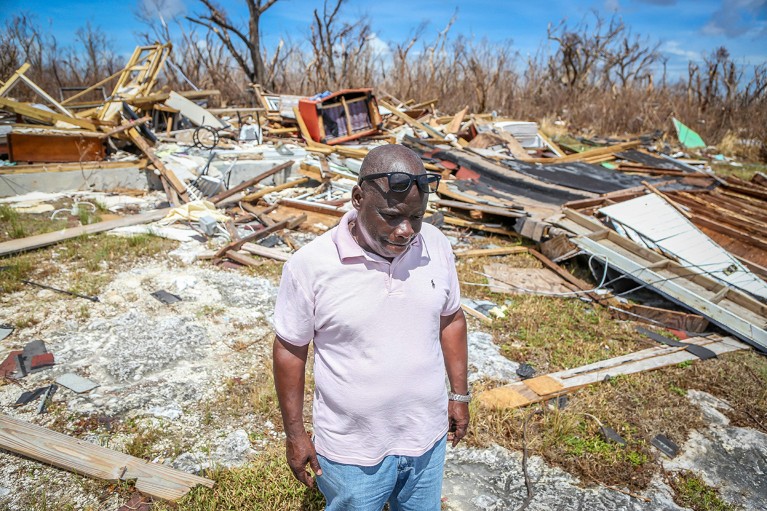
A person stands among the rubble of his hurricane-destroyed home in High Rock, Grand Bahama, Bahamas, September 2019.
The Bahamas is vulnerable to storms and hurricanes. Extreme weather can exacerbate mental-health illnesses. Credit: Zak Bennett/AFP via Getty

Every year for six years, Laureen Wamaitha hoped that her fields in Kenya would flourish. Every year, she’d see drought wither the crops and then floods wash them away. The cycle of optimism and loss left her constantly anxious, and she blamed climate change. “You get to a situation where you have panic attacks because you’re always worried about something,” she says.

Medical student Vashti-Eve Burrows, meanwhile, saw powerful hurricane Dorian rage through the Bahamas in 2019 and now she is fearful about the future of the country, an island archipelago that is vulnerable to sea-level rise and storms. “Will there even be a Bahamas in maybe 20 to 30 years?” she says.

Wamaitha and Burrows are part of a growing chorus of people speaking up about the impacts of climate change on mental health. Climate change is exacerbating mental disorders, which already affect almost one billion people and are among the world’s biggest causes of ill health. A global survey in 2021 found that more than half of people aged 16–25 felt sad, anxious or powerless, or had other negative emotions about climate change1. Altogether, hundreds of millions of people might be experiencing some type of negative psychological response to the climate crisis.What happens when climate change and the mental-health crisis collide?

Scientists say the topic has been sorely neglected, but is leaping up the research agenda. “I’ve seen an explosion of research in the last five years for sure. That’s been very exciting,” says Alison Hwong, a psychiatrist and mental-health researcher at the University of California, San Francisco. The growing severity of heat, hurricanes and other impacts mean “it’s impossible to ignore”, she says.

Researchers want to unpick the many pathways by which climate change affects mental health, from trauma caused by hurricanes, floods, droughts and fires to ‘eco-anxiety ’— a chronic fear of environmental doom. Studies on methods that can help people prevent or manage these problems are also needed, although some work suggests that climate action and activism might help.

A seam of climate injustice is exposed by the research. Young people are likely to experience the greatest mental burden from climate change that older generations have caused. Groups of people that already experience poverty, illness or inequalities are most at risk of deteriorating mental health. “Climate change exacerbates already existing economic situations, where it’s the poorer people who are feeling even worse,” says Jennifer Uchendu, a researcher, climate activist and founder of SustyVibes, an environmental group based in Lagos, Nigeria.

Mental-health toll

The fact that climate change affects people’s mental health is not surprising: what’s new is the attention the issue is attracting — and the myriad ways that scientists are documenting its varied and sometimes shocking effects.

It is well known that extreme weather events and disasters can have an immediate traumatic impact — as well as “a long tail of mental-health conditions like post-traumatic stress disorder, anxiety, depression, substance abuse,” says Emma Lawrance, who studies mental health at Imperial College London. Also taking a mental-health toll in vulnerable countries are less sudden — but nonetheless devastating — disruptions caused by global warming’s impacts, such as forced migration, loss of livelihoods, food insecurity and community breakdown.

Turkana people source water from a low-level outdoor well to survive drought in Northern Kenya, 2023.
Research on how climate-change impacts, such as drought, affect mental health is growing.Credit: Simone Boccaccio/SOPA Images/LightRocket via Getty

There is evidence that directly experiencing higher temperatures can worsen mental health. A 2018 study of suicide data from the United States and Mexico over two or more decades showed that suicide rates rose by 0.7% in the United States and 2.1% in Mexico, with a 1 °C increase in average monthly temperature2. The researchers projected an extra 9,000–40,000 suicides by 2050 in the two countries if no action was taken against climate change. Other work has shown that higher temperatures are linked to poor sleep — which can in turn contribute to mental distress3.

Studies also suggest that people with existing mental illness are at greater risk of dying during extreme heat4, but “understanding why that is and what we can do to stop it is really unexplored”, Lawrance says. One potential explanation is that some psychiatric drugs can interfere with the body’s response to heat5.

Eco-anxiety goes global

Another striking field of research examines how the awareness of climate change and its impacts can lead to concern or distress, a phenomenon sometimes called eco-anxiety, eco-distress, climate grief or solastalgia (distress linked to environmental change). In a 2018 survey, 72% of people aged 18–34 said that negative environmental news stories affected their emotional well-being, such as by causing anxiety, racing thoughts or sleep problems (see go.nature.com/3vbbt7p). A 2020 survey6 in the United Kingdom found that young people aged 16–24 reported more distress from climate change than from COVID-19.

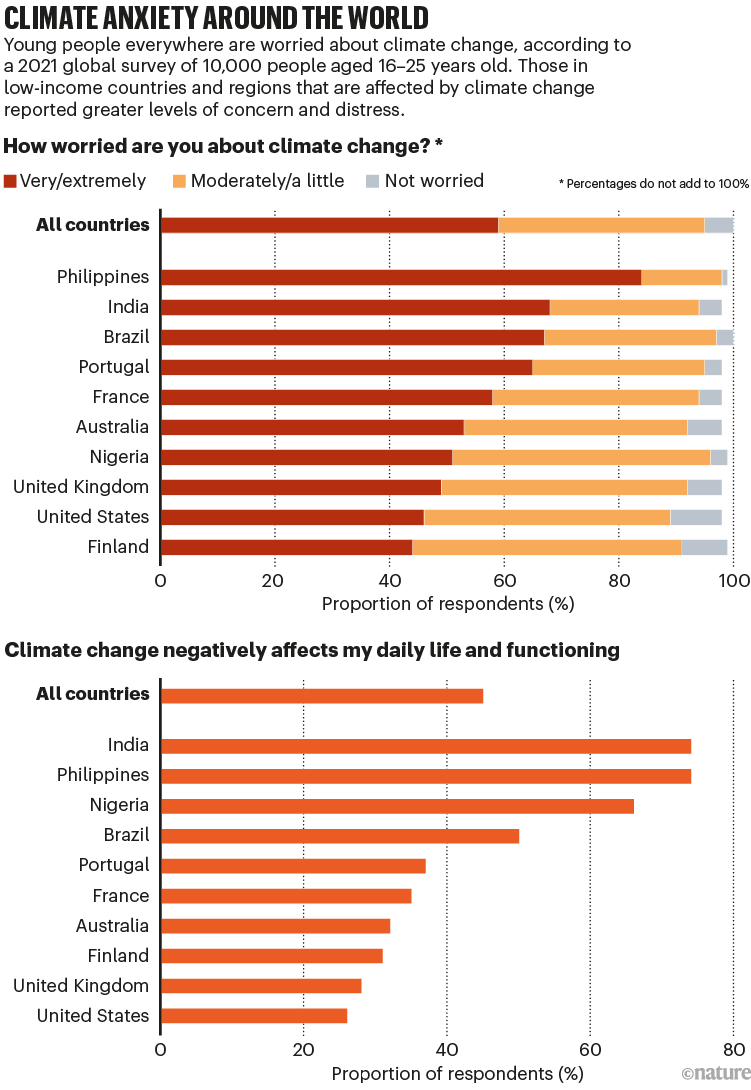
A few years ago, such ‘eco-emotions’ were sometimes dismissed as fretting of the ‘worried-well’ in high-income countries, Lawrance says. But research that shows the global reach of these feelings is challenging that view. The 2021 survey1 was the biggest so far on climate anxiety and included 10,000 children and young people in 10 countries. More than 45% of respondents said that worry about climate change had a negative impact on eating, working, sleeping or other aspects of their daily lives. Reports of climate change affecting people’s ability to function were highest in the Philippines, India and Nigeria and lowest in the United States and United Kingdom — contradicting the idea that eco-anxiety is just a rich-country problem (see ‘Climate anxiety around the world’).

Climate anxiety around the world: chart showing the results of a 2021 global survey of 10,000 people aged 16–25 years old.
Source: Ref. 1

For some, eco-anxiety might be linked to first-hand experience of climate-related devastation. The fact that young people in the Philippines reported some of the highest levels of worry was no surprise to John Jamir Benzon Aruta, an environmental psychologist at De La Salle University in Manila. In 2013, he saw first-hand the devastation and trauma caused in the Philippines by Typhoon Haiyan — one of the most powerful tropical cyclones ever recorded. “You see houses, communities devastated. You also see corpses all over the place,” he says. “Just witnessing the aftermath made me feel traumatized.”

But the 2021 survey documented widespread distress that went beyond those who were immediately affected by extreme climate events. Around 75% of respondents said that climate change made them think the future is frightening and 56% said that it made them think that humanity is doomed. People who felt their government was failing to act on climate issues were more likely to feel eco-distress.Are we all doomed? How to cope with the daunting uncertainties of climate change

Climate change isn’t the first existential crisis that humanity has faced. But researchers point out that it is different from some other threats: it is happening now rather than being a future risk, such as a nuclear war; it’s affecting the entire globe at once; and many people feel angry that they have to bear the brunt of climate change that other people have caused.

Feelings of eco-anxiety are not necessarily a sign of dysfunction. “If you are under immediate threat, it is a realistic, rational, healthy survival instinct to react by being anxious or to experience fear,” says Elizabeth Marks, a clinical psychologist at the University of Bath, UK, and one of the survey’s lead authors. It could even be harmful to think of these feelings as a disorder. “If we think of it as a diagnosable condition, that risks placing the blame on the individual as having an unhealthy response,” she says. That said, some people might become so impaired by their eco-distress that they would benefit from psychological help.

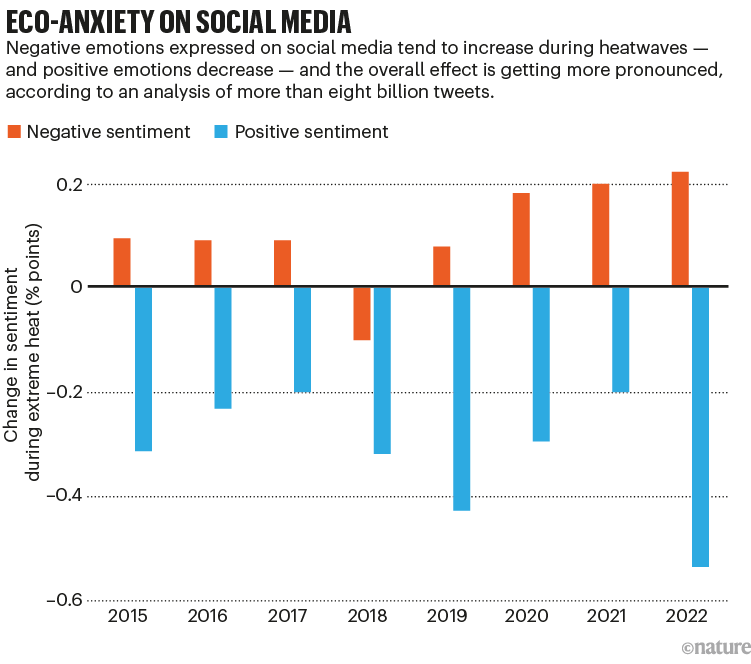
Social media is being used to monitor negative feelings linked to climate change. In 2023, Kelton Minor, a research scientist at Columbia University’s Data Science Institute in New York and Nick Obradovich, a climate mental-health researcher at the Laureate Institute for Brain Research in Tulsa, Oklahoma, reported an analysis of more than eight billion posts on Twitter (now known as X) that appeared between 2015 and 2022 from people who had opted to share their geolocation data. (The analysis was part of a wider report on health and climate change7.) The researchers analysed the tweets for positive words (such as good, well, new and love) and negative ones (bad, wrong, hate and hurt), and linked them to climate data from the tweeters’ locations. Perhaps unsurprisingly, the team found that heatwaves and extreme rainfall increased negative feelings and decreased positive ones compared with control days without extreme weather in the same place and time of year. They also found that these negative reactions became worse over the years (see ‘Eco-anxiety on social media’).

Eco-anxiety on social media: chart showing change in sentiment on social media during extreme heat.
Source: Ref. 7

Beyond the Western view

The full effects of climate change on mental health are hard to measure. A combination of factors, including the stigma around mental health and lack of access to health-care services, mean that many people with mental-health concerns go undiagnosed. When Wamaitha talked to her family in Kenya about how worried she was, they’d say: “It’s not a big deal, it’s part of life,” she says. Anxiety and depression are barely recognized as disorders in her region, she says. Mental-health services are scarce and older people just “think that you’re very sensitive” because they survived droughts in the past. In the 2021 survey, nearly 40% of young people worldwide said their concerns about climate change had been ignored or dismissed.Climate change is also a health crisis — these 3 graphics explain why

Researchers are particularly worried that countries and regions that experience the harshest effects of climate change are where the least climate mental-health research has been done. In her studies, Uchendu found that most research was Western-centric. “Not a lot of people were talking about these issues in Africa,” she says. In 2022, she started the Eco-anxiety in Africa Project, which, in collaboration with the University of Nottingham, UK, has documented the emotional turmoil that heat and erratic weather has created for people living in five African cities.

Another question researchers have is how context and culture affect climate anxiety. Some studies have shown that “connection to country” — through cultural practices such as hunting and gathering food — is important to the mental health and well-being of some Aboriginal Australians and Torres Strait Islander communities8, says Michelle Dickson, who studies the mental health of Indigenous Australians at the University of Sydney, Australia. But rising sea levels, drought and bushfires threaten those practices. Tools used in health-care settings “rarely take into account the important cultural values that underpin Indigenous mental health”, says Dickson, who is a Darkinjung/Ngarigo Australian Aboriginal.

Dickson is now co-leading a project to empower communities to design their own climate action plans — allowing researchers to test whether doing this could improve people’s mental health.

People fill water containers with drinking water from a tanker in New Delhi, India, as heatwaves increased demand for water.
Heatwaves — such as one that hit New Delhi in 2022 — can worsen mental disorders and are linked to increased negative feelings.Credit: Kabir Jhangiani/Pacific Press/LightRocket via Getty

Overcoming eco-distress

Addressing climate-fuelled mental-health conditions will be a colossal task when mental-health care globally is already poor: only around 3% of people with depression receive adequate treatment in low- and lower-middle-income countries, and 23% in high-income countries9. Lawrance says that many communities are finding their own ways to cope, but that the effectiveness of these efforts is rarely studied and shared. “There’s a massive gap around evaluation,” she says.

Some evidence suggests that taking action to combat climate change can help people to manage eco-anxiety. “There does seem to be an argument for supporting people to take collective action,” says Marks, such as joining campaign groups with like-minded people. It’s also important to “recognize that I feel this way because I care”, she says. “These climate emotions are actually something to be honoured and allowed, not pushed away.” Marks also suggests that some people who are feeling eco-distress limit the amount of time they spend ‘doom-scrolling’ through climate news.Extreme heat harms health — what is the human body’s limit?

Researchers are starting to take collective action themselves. Last month, the Connecting Climate Minds project, one of the most ambitious research efforts in the field of climate-related mental health10, released a series of regional ‘research and action’ priorities, including, for example, to understand how climate change compounds the stress of wars, violence and disease epidemics in sub-Saharan Africa. The project includes researchers, policymakers and people with first-hand experience of climate change. Uchendu says that in one of the meetings, someone joining remotely was standing in flood water in their room. “It was mind-blowing,” she says.

Wamaitha, who along with Burrows is one of many people who shared their experiences with Connecting Climate Minds, has turned some of her concerns into action. Last year, after trying and failing to grow drought-resistant crops, she quit farming and is now working at a non-governmental organization in Bura, Kenya, that is focused on poverty relief. She is earning enough to study for a master’s degree in public health, and she raises awareness of global health on the social-networking site LinkedIn. But she is anxious about the future and worries about whether to have children. “I don’t think I am in a good environment to be able to bring kids into this particular place,” she says. “That is the saddest thing when I think about it.”

Burrows, who is studying medicine at the University of the West Indies in Saint Augustine, Trinidad and Tobago, says she chooses to be positive and does small things to help the environment, such as walking instead of driving. She says that she prays that wealthy countries and companies “will really, truly understand what is happening and not just say smooth words to try to pacify us in the moment”. They should act to “help the smaller countries and the world at large”, she says.

Nature 628, 256-258 (2024)

doi: https://doi.org/10.1038/d41586-024-00998-6

References

  1. Hickman, C. et al. Lancet Planet. Health 5, e863–e873 (2021).Article  PubMed  Google Scholar 
  2. Burke, M. et al. Nature Clim. Change 8, 723–729 (2018).Article  Google Scholar 
  3. Chevance, G. et al. Sleep Med. Rev. https://doi.org/10.1016/j.smrv.2024.101915 (2024).Article  Google Scholar 
  4. Bouchama, A. et al. Arch. Intern. Med. 167, 2170–2176 (2007).Article  PubMed  Google Scholar 
  5. Martin-Latry, K. et al. Eur. Psychiatry 22, 335–338 (2007).Article  PubMed  Google Scholar 
  6. Lawrance, E. L. et al. Lancet Planet. Health. 6, e726–e738 (2022).Article  PubMed  Google Scholar 
  7. Romanello, M. et al. Lancet 402, 2346–2394 (2023).Article  PubMed  Google Scholar 
  8. Butler, T. L. et al. Soc. Sci. Med. 23, 138–157 (2019).Article  Google Scholar 
  9. Moitra, M. et al. PLoS Med. 19, e1003901 (2022).Article  PubMed  Google Scholar 
  10. Lawrance, E. L. et al. Nature Mental Health 2, 121–125 (2024).Article  Google Scholar 

Download references

Reprints and permissions

Latest on:

What happens when climate change and the mental-health crisis collide? Editorial Iran frees scientists who studied big cats in surprise move News The EU’s ominous emphasis on ‘open strategic autonomy’ in research Editorial

Nature Careers

Jobs

Download PDF

Related Articles

Subjects

Sign up to Nature Briefing

An essential round-up of science news, opinion and analysis, delivered to your inbox every weekday. Email address Yes! Sign me up to receive the daily Nature Briefing email. I agree my information will be processed in accordance with the Nature and Springer Nature Limited Privacy Policy.

Posted in Uncategorized | Tagged , , , , | Leave a comment

TBI or damage to brain, recommend this video to help with perspective. You may not recall it, apart from as you watch it, but this explains Anterograde Amnesia in the case of Henry Molaison.

________________________________________________________________

https://www.ncbi.nlm.nih.gov › articles › PMC3192650

————————————————————————————————–

Posted in Uncategorized | Leave a comment

Forgot where you put your keys? A neuroscience professor offers 5 tips to improve your memory. Source: Fast Company. Next Big Idea Club. Charan Ranganath is a professor of neuroscience and psychology and director of the memory and plasticity program at the University of California, Davis. He has been studying the neuroscience of memory for more than 25 years.

Fast company logo

https://cdeeb63fd39b4eee1851dc1af47b63a1.safeframe.googlesyndication.com/safeframe/1-0-40/html/container.html

04-06-2024 WORK LIFE

Forgot where you put your keys? A neuroscience professor offers 5 tips to improve your memory

UC Davis professor Charan Ranganath says when we look at memory as a resource to pull from, as opposed to a comprehensive archive of the past, we can make mindful choices in the present to curate a rich set of memories to take with us into the future.Forgot where you put your keys? A neuroscience professor offers 5 tips to improve your memory

[Photo: PhotoMIX Company/Pexels]

BY Next Big Idea Club7 minute read

Charan Ranganath is a professor of neuroscience and psychology and director of the memory and plasticity program at the University of California, Davis. He has been studying the neuroscience of memory for more than 25 years.

Below, Ranganath shares five key insights from his new book, Why We Remember: Unlocking Memory’s Power to Hold on to What Matters. Listen to the audio version—read by Ranganath himself—in the Next Big Idea app.

1. Memory is not about the past; it’s about the present and future.

Whenever I tell people that I study memory, one of the most common responses I get is, “Maybe you can study me—my memory is terrible.” And sure, I get it, whether it’s being unable to recall someone’s name, trying to find where you put your keys, or even losing track of what you were talking about a few minutes ago, forgetting sucks. But let’s face it: We all forget, and if there is one thing that memory research has shown, it is that most of our experiences are doomed to be forgotten. And that’s okay because our most typical complaints and worries about everyday forgetting are driven mainly by deeply rooted misconceptions about what memory is for in the first place.

Contrary to popular belief, the neural mechanisms of memory were not cobbled together to remember the name of the guy we met at that thing. Memory is the process by which our brains extract what’s important—that is, information that helps us make sense of an uncertain and ever-changing world. We use memory to reason, plan, and imagine, to communicate and connect, to forge our identities, and to ground ourselves in time and space.

When we look at memory as a resource to pull from, as opposed to a comprehensive archive of the past, we can make mindful choices in the present to curate a rich set of memories to take with us into the future.

2. Memories are dynamic.

When we recall a memory, we don’t replay the past; we imagine how the past could have been. This means that our recollections are shaped by our beliefs, goals, and perspectives, much like a painting reflects an artist’s unique perspective on their subject. Whenever we reconstruct these memories, the brain tinkers with them, strengthening, weakening, or modifying different aspects of the memory from the moment it is pulled up. The constructive and malleable nature of memory means that we can often remember events incorrectly, sometimes leading to colossal errors, such as when news anchor Brian Williams mistakenly recalled being in a helicopter that was shot down in Iraq.

Our brains are susceptible to distorted memories by design. The world around us is constantly changing, so we need to update our memories to reflect these changes. If you catch someone you thought was trustworthy in a lie or got food poisoning after a tasty dinner at a new sushi restaurant, you’d want to adjust your recollections based on that new information.

Many of us have experienced traumas or experiences that are laced with unpleasant feelings. Having a brain that has evolved to revise these memories means we can reframe how we feel about them by incorporating a new perspective. In doing so, we can update painful memories so that they can be experienced more tolerably, providing us with valuable lessons for the future.

3. Embrace the struggle.

Our computational models suggest that the brain is wired to learn from mistakes and challenges, a phenomenon called error-driven learning. This simple principle can explain the conditions under which we learn best and retain what we have learned over the long haul.

Every time we recall a memory, that memory can be updated. That’s where error-driven learning comes in. We think that attempting to recall a memory is like a stress test. If your brain struggles to do it, then once you get the answer, the brain can repair the coalition of neurons that are responsible for pulling up that memory so that next time, it can come up more easily.

Error-driven learning explains the benefits that come when we actively learn by doing rather than passively learn by memorizing. It helps explain why students benefit more from practice tests than simply studying. This is one of the reasons why students are generally better at retaining information after they have been tested on the material rather than if they only studied it.

The implications of error-driven learning are potentially huge. When a student finds coursework challenging, we tend to think that the student isn’t smart or that they are performing poorly. The reality is that you can learn the most when you are being challenged. But to get the lasting benefits of error-driven learning, you will not always be successful. So, we should normalize mistakes and failures in education and incentivize constant improvement instead of only rewarding success. Rather than emphasizing mastery, we should celebrate the struggle of working to learn, rather than proving that you have learned something.

4. Flex and protect your prefrontal cortex.

We tend to focus on our shortcomings when it comes to memory, but for the most part we do a pretty good job of remembering what we need to thanks to the prefrontal cortex, an evolutionary newcomer that takes up about a third of the real estate in the primate brain.

The prefrontal cortex is often described as a “central executive,” meaning that it coordinates activity across different neural networks in the service of a goal, which is also why it plays a starring role in many of our day-to-day memory successes and failures.

  • First, it allows filtering out distractions so that we can create rich and detailed memories that stand out from the clutter of mundane experiences.
  • Second, the prefrontal cortex allows us to mobilize strategies for learning efficiently, like the kinds of strategies that memory athlete Yänjaa Wintersoul used to memorize the entire Ikea catalog in one week.
  • Third, the prefrontal cortex gives you the mental resources to think critically when you remember so that your recollections do not become distorted.
  • Finally, the prefrontal cortex allows deployment of memories in real time to anticipate what is about to happen next. The ultimate example of this is NBA legend LeBron James, who uses his exceptionally detailed memory of past basketball games to rapidly read what’s playing out on the court and make predictions in real time.

Unfortunately, the prefrontal cortex is one of the first regions to decline as we age, and we make things worse when we multitask, are stressed out, or do not sleep enough. Frontal function is also affected by physical health conditions like diabetes and possibly long COVID and by mental health conditions like depression and post-traumatic stress disorder. Fortunately, we can improve frontal function through physical exercise, mindfulness practices, eliminating environmental distractions (like text and email alerts), and compensating for sensory problems by using hearing aids.

5. Diversify your brain’s training data.

The most advanced artificial intelligence products acquire knowledge by plowing through massive amounts of human-generated training data. Humans, in contrast, get “training data” from lived experiences as we go to different places and interact with different people. Episodic memory (the ability to travel back in time to past events) allows us to use our unique experiences to update our knowledge and flexibly adapt to new situations rapidly.

We can get the most from episodic memory by diversifying our training data. If we change scenery from time to time and expose ourselves to people from diverse backgrounds and perspectives, we can form richer, more distinctive episodic memories.

Conversely, when we spend too much time interacting with the same people, in the same places and situations, we have impoverished memories. For instance, during the pandemic lockdowns, as we spent each day sitting in the same room, interacting with the same people (mostly over screens), the days seemed to go on forever, and yet by the end of the week, we were left with few memories of what we did during that time.

In the age of generative AI, we can expect that a premium will be placed on idiosyncratic human creativity and innovation, which in turn benefits from seeking social interactions and media from diverse sources. A new work of art, music, or literature doesn’t arise out of thin air—it emerges from the process of integrating elements from different past experiences. By exposing ourselves to a diverse range of people and ideas, we can discover connections and recombine episodic memories into imaginative constructions that transcend the sum of their parts.

What makes human imagination special is that it offers a version of reality marked by the idiosyncrasies of its creator, rather than a perfect recording. The same can be said of memory because our memories reflect both what we experienced and our interpretations of what happened.


This article originally appeared in Next Big Idea Club magazine and is reprinted with permission.


Posted in Uncategorized | Tagged , , , , | Leave a comment

The Power of Dyslexia: Father & Son’s Journey. 50% of people in prison have dyslexia. But there is Hope too. Is it due to genetics?

4,585 views 7 Apr 2024Explore the complexities of Dyslexia: an often misunderstood condition. Follow Arthur and his family as they explore whether dyslexia is merely a weakness or a profound strength waiting to be uncovered. Through personal anecdotes, expert interviews, and eye-opening insights, this documentary sheds light on the creative brilliance and unconventional thinking inherent in dyslexic individuals. Join us on this captivating exploration of dyslexia’s journey from challenge to triumph, as we delve into its impact on entrepreneurship, science, design, and comedy. Don’t miss out on this enlightening journey that challenges traditional perceptions and celebrates the unique abilities of dyslexic minds. Subscribe now to embark on this empowering adventure! Twitter:   / realstoriesdocs  

Posted in Uncategorized | Leave a comment