The future of Ein el-Hilweh, the massive Palestinian refugee camp in Lebanon whose fate is linked to Gaza. Source: EL PAIS

ISRAEL-HAMAS WAR

The future of Ein el-Hilweh, the massive Palestinian refugee camp in Lebanon whose fate is linked to Gaza

Violence between varying factions ceased after the outbreak of war in October, but there is fear that fighting will break out if a ceasefire in the coastal enclave
La paz y el futuro de Ein el Hilweh, el gran campo de refugiados palestinos de Líbano, unidos al destino de Gaza

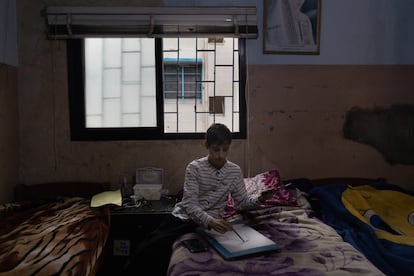
Rahif Almeari, a 13-year-old Palestinian artist, draws in his room. On the walls, the marks of bullet holes from the last outbreak of violence in Ein el-Hilweh, the largest Palestinian refugee camp in Lebanon.Marta Maroto

Marta Maroto

Ein el Hilweh (Lebanon) – Apr 23, 2024 – 20:14 CEST

He paints so as not to forget. “And to tell, through art, what the Palestinian people are going through,” Rahif Almeari explains, somberly. At 13 years old, he is surely the youngest artist at Ein el-Hilweh, the largest refugee camp in Lebanon, which is considered a kind of capital of the country’s Palestinian community. On panels of wood, the adolescent, who is the grandson of a carpenter who was driven from his home in 1948 following the creation of the state of Israel, paints the symbols of his grandparents’ homeland. “Israel wants to erase our culture, but it is my responsibility as an artist to paint the olive trees and the keffiyeh to tell the Europeans and all foreigners who we are,” he explains.

The 60,000 inhabitants of Ein el-Hilweh, which is the site of frequent showdowns between factions, follow the news from Gaza fearfully, because they sense that more than ever, their future survival is tied to what happens in the coastal enclave. “With what we are suffering, it makes no sense to be at each other’s throats,” says Almeari, indicating the marks of bullet holes in his bedroom. They are a reminder of the last outbreak of violence in the camp, which began last summer after the assassination of General Abu Ashraf al Armoushi, a high-ranking official from the Palestinian nationalist movement Fatah, the party of the current Palestinian government led by Mahmoud Abbas. His death was attributed to radical militias with ideological ties to jihadist groups like the Islamic State and the Al-Nusra Front, which through the years have found refuge in Ein el-Hilweh.

In that wave of conflicts between groups linked to Fatah and more extremist movements, at least 11 civilians died and more than 40 were injured. “They attacked the heart of the Fatah military branch with the goal of politically weakening us,” Yusef Zraihy, head of the party in southern Lebanon, told EL PAÍS.

But the war in Gaza put an end to these internal battles and in mid-October, rival militias arrived at a tacit agreement to lay down their weapons. These conversations moved forward with mediation by the Lebanese government, but the inhabitants of Ein el-Hilweh fear that a possible ceasefire in the Gaza Strip could mean the return of violence to their camp. Life in its streets has been paralyzed for nearly the past seven months and the bombings and death tolls in Gaza fill both daily conversation in the market and prayers, amid the general sense of helplessness over not being able to help their compatriots.

“All eyes are on Gaza and the political and security situation in the camps is calm. Still, we fear that when the war ends there could be an outbreak of new conflict,” says Samer Mannaa, a Palestinian activist. “And whoever controls Ein el-Hilweh will control the refugee community,” he concludes.
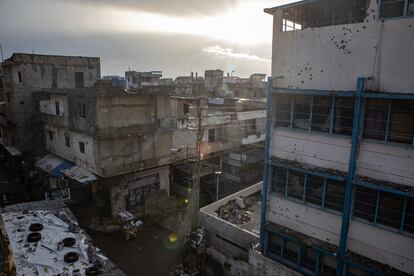
One of the main streets of Ein el Hilweh, connected to one of the entryways to the camp. On the right side of the image, one of the UNRWA schools that was destroyed by armed factions.

Ein el-Hilweh is located just a few miles from the coastal town of Sidon, a city in southern Lebanon. It is the largest of the 12 refugee camps that were created in the country after the 1948 Nakba — “catastrophe” in Arabic — in which Palestinians were forcibly driven from their homes. Today, according to numbers from the United Nations Relief and Works Agency for Palestine Refugees in the Near East (UNRWA), there are 500,000 registered refugees in Lebanon, including those who were driven out more than 70 years ago, and their descendants. The same agency estimates that no more than 250,000 refugees continue to live in the country, with the rest having emigrated elsewhere. Of this total, 200,000 receive annual assistance from the organization, which calculates that 80% of Palestinian refugees live in poverty.

A thousand shrapnel holes

With his gaze fixed upon an open book resting on his knees, Almeari waits in front of the small candy stand his family runs outside the front door of their house. The entire street, from the metal of the stand to the cardboard that protects it from the sun, is strafed with a thousand shrapnel holes, a landscape that has become normal at the camp. The boy sets off to look for the heavy, rusty keys for the doors of the house that his grandparents lived in until 1948 — reminders that Palestinian refugees and their descendants treasure. His father, Hussein Almeari, a carpenter who was also born in the refugee camp, has a map of the family lands that his father carved into wood. Rahif seems to have inherited his elders’ passion, creating scenes from acrylic paint on pieces of wood his father prepares for him.

“I adore Ein el-Hilweh, it is my home. That’s why it hurts me so much to see it like this,” says Hussein Almeari, gesturing to the walls. When the wave of violence took hold last July, the family evacuated the camp. When they came back at the end of October, their home had been nearly destroyed: they found numerous bullets embedded in the walls, which had been ripped through by explosives.

Their home is located at the crux of different neighborhoods which, just like the UNRWA schools, were the battlefields of rival militias. It’s not the first time that the educational facilities of Ein el-Hilweh have been occupied and destroyed, Dorothee Klaus, director in Lebanon of the U.N. agency, tells EL PAÍS. “Our response in the past was to increase fortifications to protect the children, but that had the opposite effect and turned schools into attractive areas for military operations,” she says.

Some of the drawings of young refugee Rahif Almeari on the pieces of wood that his father prepares. In addition to Palestinian symbols, the teen also paints nature scenes and landscapes.

The UNRWA — which employs 3,500 refugees in Lebanon — provides health services, education, basic infrastructure, social assistance and sanitation. “The host government has made it clear that it has neither the will nor the capacity to take on this responsibility, either politically or financially,” the director says. The lives of the Palestinian refugees are governed by autonomous rules that are independent of Lebanon, which in 1969 — two years after the Six-Day War, which caused the second large migratory wave of Palestinians to Lebanon — ceded political and security administration of the refugee camps to the Palestinian community.

Stripped of their rights

But that apparent Palestinian sovereignty in the Lebanon camps does not appear to have come with rights. A national regulation denies the refugees access to citizenship and property rights and also restricts the possibility of them occupying positions in key professions like medicine, law and engineering. “The Lebanese state deprives us of our basic human rights. We’re not even second-class citizens, because we’re not citizens,” says Hatem Mokdade, an unaffiliated activist.

The disappointment felt in the camps is refracted onto the United Nations agency, which has been accused of a lack of response. “We have not abandoned our right to return, but right now we need electricity, basic services and to address issues of corruption. The UNRWA has spent 75 years in a state of emergency, but what we need is development,” says Mokdade.

In addition to the complexity of the Palestinian situation, there is the reality of a Lebanon that is in permanent crisis and which, since October, has been in a war against Israel on its southern border through pro-Iranian militia Hezbollah. Plus, there are UNRWA’s economic difficulties, now exacerbated after donor countries suspending funding following Israel’s allegations that 12 of the U.N. agency’s staff had participated in the Hamas October 7 attack. In that attack, 1,200 Israelis were killed and more than 200 were taken hostage, a hundred of whom remain in the hands of their captors in Gaza.

The U.S. Congress has blocked the Biden administration from resume UNRWA financing until March 2025 at the earliest. The United States is the agency’s primary source of funds, but other countries, like Spain, have diverged from the U.S. decision and announced additional aid to keep the agency in operation. The Colonna Report, an independent investigation commissioned by the United Nations and led by former French foreign minister Catherine Colonna, which was published on Monday, April 22, concluded that Israel has not provided evidence to support its accusations against the UNWRA.

Translated by Caitlin Donohue.

Sign up for our weekly newsletter to get more English-language news coverage from EL PAÍS USA Edition

Posted in Uncategorized | Tagged , , , , | Leave a comment

Colonel Douglas MacGregor interviewed by George Galloway. “His coke dealer must be delighted”. What does this mean? “The end of NATO is on the horizon…”. “…Russia will demilitarise what is left of Ukraine…”. Then there is the Middle East

45,850 views 22 Apr 2024 #ColDouglasMacgregor#USCongress#Ukraine The US government consists of 535 lobbyists, says Colonel Douglas Macgregor. All of them, with very few exceptions, are bought men

Posted in Uncategorized | Leave a comment

Reflections by Fr. Shay Cullen, – The real purpose of Israel’s occupation of Palestine. Fr Shay Cullen is a person who has wisdom which should be shared. Experience is powerful and his work for over 50 years in the Philippines, as can seen via Preda Organisation, advises us to be aware before we react.

Conversation opened. 1 unread message.

Reflections by Fr. Shay Cullen, – The real purpose of Israel’s occupation of Palestine

Inbox

The real purpose of Israel’s occupation of Palestine
Fr. Shay Cullen 
20 April 2024 

It was a shocking and painful “no” vote by the United States to veto a draft declaration at the United Nations (UN) Security Council recognizing Palestine as a full member of the United Nations. Palestinian President Mahmoud Abbas condemned the U.S. veto and said it was “unfair, unethical, and unjustified.” Twelve members of the Security Council approved the recommendation to the 193-member UN General Assembly for its approval that “the State of Palestine be admitted to membership” of the UN. Only the conservative British and neutral Switzerland abstained. 

The United States is more and more isolated by the world community by its seemingly endless support for Israel even when it bombed and killed 35,000 Palestinians, mostly women and children, starving more to death, and bombed Iran this week. All this was done with US-supplied munitions and missiles in retaliation for the killing of 1,200 Israelis and taking of 250 hostages by Hamas, named as a terrorist organization by western countries. 

In a strong emotional statement, the Palestinian Ambassador Riyad Mansour at the UN said: “The fact that this resolution did not pass will not break our will and it will not defeat our determination. We will not stop in our effort.” The declared hope of most nations and of Palestine is for an end to hostilities, peace-making and a two-state solution.  Prime Minister Benjamin Netanyahu of Israel is totally against a two-state solution and so are some of his backers. The question is why? 

He is the longest-serving prime minister in the country’s history, having served for a total of over 16 years. He is very unpopular in Israel for his savage retaliation and conduct of the war against Hamas and the killing of so many innocent Palestinians and his failure to win the release of 150 or so hostages held by Hamas.

In 2019, Netanyahu was found to have committed criminal acts such as breach of trust, bribery, and fraud. When he is out of power, it is likely he could be convicted and go to jail. He formed an extreme fanatical right-wing government to stay in power and avoid prosecution. He is also criticized for his total opposition to any two-state solution.

It was on his watch that the savage attack by Hamas fighters took place last 7 October 2023. He is also responsible for allowing Hamas to grow so strong by allowing huge sums of money to flow to them from Iran and Qatar and other sources. These payments in US dollars were flown into Israel and delivered directly to Hamas in the Gaza strip. 

That is proven in a powerful video expose, well-documented by the BBC Panorama program titled “Hamas’s Secret Financial Empire” by John Ware. Netanyanu indirectly armed Hamas, a policy opposed by Israeli military commanders who warned Netanyahu. The BBC, citing documents and interviews with retired Israeli military intelligence commanders, showed that there was nothing secret about these funds. 

The reason Benjamin Netanyahu allowed this money to flow to Hamas was to keep the Palestines on the West Bank and in Gaza corrupted, appeased, divided and fighting each other politically. The policy and plan is that they must never be allowed to unite and form a single Palestine state. 

That would defeat the long-term goals of Zionist elements in Israel. Their plan is to permanently divide and conquer, and to claim all of Palestine lands as part of the State of Israel. The surviving Palestinians would be powerless and contained. 

But Israel’s policy is to occupy more and more of Palestine land with illegal settlements, even killing and driving away the original owners and making their stolen lands their own. The same goes on in East Jerusalem. There is little or no justice for the Palestinians. 

There is hardly a squeak of protest from Western politicians and leaders other than vocal Irish campaigners and politicians that denounce the destruction that Israel does in the name of self-defense. 

While Israel has a right to self defense against terrorist attacks, what they are doing has reached a state of mass killing, called “genocide” by the International Court of Justice last January 2024.

Genocide is the gross violation of human rights and is immoral, criminal, illegal, wrong and unjust. It is the total destruction of the Palestinian homes and is a war by starvation driven by greed.

The military assaults fueled by revenge in retaliation for the biggest defeat suffered by the Israel army ever by Hamas are indefensibly funded by Netanyahu himself as explained above, thanks to the BBC Panorama investigative report.

There is a grim and deadly impunity for all this granted to Israel by the western world. No demand for a ceasefire by them other than a weak whimpering cry for restraint. Millions of people around the world are calling for an immediate ceasefire but they are ignored while Israel continues bombing. 

One compelling explanation of the massive western support for Israel to continue to occupy Palestine and even take total control of the lands and sea is of course the massive deposits of oil and gas that lie beneath Palestine land and waters off the coast of Gaza. A UN Trade Development Report says “geologists and resources economists have confirmed that the occupied Palestinian territory (oPt) lies above sizeable reservoirs of oil and natural gas wealth, in Area C of the West Bank and the Mediterranean coast off the Gaza Strip.”

The new discoveries of oil and natural gas in the Levant Basin, amount to 122 trillion cubic feet of natural gas at a net value of $453 billion (in 2017 prices) and 1.7 billion barrels of recoverable oil at a net value of about $71 billion. This offers an opportunity to distribute and share about US$524 billion among the different parties in the region and promote peace and cooperation among old belligerents, the study notes. 

Israel is presently tapping into those resources with a huge oil rig in the Mediterranean. These resources are partially owned by the Palestinians and denied to them. 

The Palestinians have no share so long as they are divided and not recognized as a sovereign state. Is that what is behind the veto by the United States? If there was an independent Palestine state, it would have total control over its own natural resources and reap the benefits for the well-being and recovery of its own people.

www.preda.org

*****

*Need help? Contact:

newsletters@preda.org

*Privacy Policy:

We will never share, sell, or rent individual personal information with anyone without your advance permission or unless ordered by a court of law. Information submitted to us is only available to employees managing this information for purposes of contacting you or sending you emails based on your request for information and to contracted service providers for purposes of providing services relating to our communications with you.*Physical Address:

CONTACT US:

PREDA Foundation, Inc. P.O Box 68 Olongapo City 2200

Preda Main Center Upper Kalaklan, Subic Bay Olongapo City 2200 Philippines

E-mail: shaycullen@gmail.com, Information Officer: predainfo@gmail.com

TO SUPPORT THE WORK OF PREDA FOUNDATION, you may freely pass on the article or republish it in various print or online publications. To know more about other ways to SUPPORT the WORK of PREDA FOUNDATION, contact us directly through our email: shaycullen@gmail.com or predainfo@gmail.com*Unsubscribe:

https://preda.org/mailings/mail.cgi/t/fqzz7fuAEkJiOuobKgNAu8QFnUIv28QbkgnZ9g8I

Posted in Uncategorized | Tagged , , , , | Leave a comment

EL PAIS: Fewer screens and more domino: Why playing cards and board games are staging a comeback in bars. Comment: Ireland needs to step on the shoulders of Giants. “It’s a totally different experience and is compatible with electronic leisure: it’s something that requires meeting up, getting together and spending time with friends. Many adults now associate the screen with work and want to take a break from spending so many hours in front of a computer and on a cell phone,” says José Luis Viruete, head of communications at Asmodee Ibérica, whose extensive catalog includes popular games such as Dobble and Dixit.

Society

YoutubersLatest News

LIFESTYLE

Fewer screens and more domino: Why playing cards and board games are staging a comeback in bars

The sight of a group of friends playing a game together is no longer confined to retirees. Young people are rediscovering Connect 4, Trivial Pursuit and chess, and establishments are embracing a long-term business opportunity: building a community among their clients

A couple plays Scrabble while sipping wine in a Los Angeles bar.

A couple plays Scrabble while sipping wine in a Los Angeles bar.Jay L. Clendenin (Los Angeles Times via Getty Imag)

Eva Güimil

Eva Güimil

Oviedo – Apr 21, 2024 – 18:31 CEST

A few months ago, Bloomberg journalist Joe Weisenthal humorously lamented on the social network X: “All the cool people of NYC are playing chess late at night in bars now. Wild times.” The post, which was accompanied by a photo of various people gathered in front of chess boards, opened a small debate and generated more than 300 comments where people were mostly in favor of the late-night games. “Where is that?” someone asked. “It’s the only bar I’d like to go to right now.”

Although the New York scene of dancing and debauchery until dawn is certainly not dead, it is becoming more and more common, in New York and elsewhere, to find late-night tables where people consume pints, cocktails and juices while playing board games. And this is not just in bars. Board games have invaded spaces where it was unthinkable a few years ago. Last week, there was a TikTok video of group of young people playing Catan before a concert of the Argentine band Miranda!

These are not isolated facts, but proof that traditional games have established themselves as a leisure activity option among people in their 20s and 30s, something that few could have foreseen. We are told of a youth absorbed in the screens that would eventually lose all human contact but, all of a sudden, a bunch of kids under 20 are sitting at a table in a bar and one of them takes some cards out of his backpack and they all get into a game of something as unfashionable asChinchón or Brisca (both popular Spanish card games).

A couple plays chess in a Berlin bar.
A couple plays chess in a Berlin bar.Sean Gallup (Getty Images)

In addition to the “Mobile, wallet, tobacco, keys” as sung by Las Bistecs in their song Cosas Negras, we should now add the Spanish deck of cards by Heraclio Fournier, something of a national treasure in Spain. “They don’t take up any space and you can play anywhere. If the bus takes a long time? One game. As long as there is more than one of you, you can play,” says María, who never leaves home without them. “Also, if you play something familiar, you can focus on the game while you talk about anything else.”

This is not a far cry from the leisure time enjoyed by our grandparents, who always sat at a table for four, singing and playing the dominoes while at another table a group of ladies shook the Parcheesi cup. Interestingly, and according to the people who have participated in this article, women over 40 years old are the ones who play the least. In most of the hotel establishments there have always been cards and a board, but until a few years ago they came to be seen as ornamental objects. Younger people were reluctant to ask to use them, playing games seemed to be confined to the faculty cafeteria or family evenings, but this scenario has changed in the last few years.

These are not leisure places exclusively for games where you can also drink, but bars that have made room on their shelves to display them as an extra, just like the newspapers, the television set or Wi-Fi connection. “The idea came up during a trip to Copenhagen,” says Inés, who owns El Paraguas with her husband Jorge, a popular spot in the nightlife scene of the Spanish city Oviedo, where you can always find someone playing chess or Trivial Pursuit. That trip served as the inspiration for a second location, La Armónica del Paraguas, where games have a prominent place. “There we discovered the Bastard Café, a downtown classic where you can find over a thousand games, and we loved it. There were all kinds of players, but most of them were in their 20s and 30s.”

A couple plays Scrabble in a London pub.
A couple plays Scrabble in a London pub.ADRIAN DENNIS (AFP via Getty Images)

They were inspired and, eight years later, they feel that it is a success. Manu, who is in his 20s and has always been a fan, runs the establishment. “I used to play Bang!, Virus, Saboteur, Shit Happens [special card games]… but then there was the lockdown and that was the end of that.” As soon as the Covid-19 restrictions began to be lifted, the gatherings on sidewalk cafés for “board game evenings” returned. “We would play Time’s up, Trivial Pursuit and Risk until it was curfew [under the pandemic restrictions]; and the next day we would meet on another sidewalk café to play Secret Code and Wingspan. There wasn’t a week that went by when I didn’t have a chip or the dice in my hands.”

He now provides advice to others on games, but has not given up on them. “Sometimes my friends play Taboo at the bar and want me to join in while I’m slicing lemons.” Manu notices differences in the types of customers who come to have a game. “The younger ones prefer Dixit, Dobble, which has caused more than one friendship to break up, or Trivial Pursuit, and those in their 30s and older prefer backgammon and chess.” He has also identified what he calls “Tinder couples,” who he says are first-timers, and who opt for another classic, Connect 4.

Manu believes that the people who come to play create “a better atmosphere.” “They want more than just a bar, they want to experience a fun atmosphere.” He also says that those who come to play “long games” tend to consume little alcohol: “They come, order something, usually soft drinks or juices, grab the game they have their eye on, put the tables together and start playing. And they stay there happily. From time to time I pass by to see if they need anything, but I don’t interrupt. They get into the game, laugh, joke, pause if someone needs to smoke or go to the bathroom, and then someone comes to ask for something that is missing. But maybe after an hour and a half, they’ve had three orange juices, and now they’re having a Nestea and a Kas. Not a drop of alcohol and they’re enjoying themselves. If they’re having a good time, why should they drink?”

Pensioners in Ciñera, León, play dominoes in a bar.
Pensioners in Ciñera, León, play dominoes in a bar.David Ramos (Getty Images)

While there are bars where after a certain time the cards and boards disappear, for Manu it is not a problem for people to occupy a table for hours (and anyone who has played Risk knows that it is literally for hours). “We’re aware that there are other types of venues that favor heavier consumption with music, lights and dancing, and that in relaxed places you always have the risk that people will gather without consuming, but I don’t think that games encourage this. We’ve gone for something quieter, although we know that we won’t get rich with this business model,” jokes Inés.

This is very much in line with the thoughts of David, owner of La Raposa, an establishment where you can listen to hardcore music and watch a soccer match while playing a game of Jenga. “We want to offer more than just a place to drink; we want to create community.” David sought to replicate the environment in which he grew up: “Playing created some great dynamics.” When it comes to choosing games, he is quite selective: “As it’s a bar known for its left-wing ideology, I try to include games that also encourage critical thinking, such as the feminist trivial game and so on.” He also agrees that the public is heterogeneous, but that young women are the ones who tend to gather to form playing groups.

He is not surprised that someone might bring their own games from home, but he is that the game extends into the early hours of the morning when it was customary for evening and weekday entertainment. “Now large groups of kids come on Saturdays to play a game of Trivial Pursuit or Dixit and stay there all night. Hanging out and playing is a way to curb the anxiety of planning where you will go next.”

He also has a response to another of the comments to the tweet that mocked the “wild” New York night and asked why these people didn’t play in their homes: “I share an apartment and, though my roommates are nice, I cannot occupy the living room to play a game of Risk for hours on end or make too much noise.” And some games are noisy or too festive, such as Time’s up or Party, two of the most popular board games. He also claims that a bar that has games “sends a message”: it is usually a quiet place, “with a good vibe.”

Men play cards in a bar in Acciaroli, southern Italy.
Men play cards in a bar in Acciaroli, southern Italy.KONTROLAB (LightRocket via Getty Images)

The fact that there are different personalities among those who come together to play is important for Patri: “You need a balance between those who are competitive and those who are compliant so that everything goes well, so that there’s the right balance to enjoy it without it getting out of hand. The intensity and the way of playing changes and that’s the beauty of being able to play in a bar, you can adapt it to the spirit of the group.” Socializing is one of the strong points that always comes up when talking about board games. “People like to socialize and one of the oldest tools that exist for this is board games. We like to challenge each other, but most of all we like to have a good time and have fun. That’s what a board game does, it gives you hours of quality entertainment,” says Fernando Falomir, marketing manager of the Spanish gaming company Falomir.

Its potential to connect people is one of the main advantages of board games: it is a way to make friends, which is why in Spain, the bars that provide this type of entertainment are often the first stop for foreign students, especially for those from northern European countries, where this type of entertainment is a daily feature. “It’s a totally different experience and is compatible with electronic leisure: it’s something that requires meeting up, getting together and spending time with friends. Many adults now associate the screen with work and want to take a break from spending so many hours in front of a computer and on a cell phone,” says José Luis Viruete, head of communications at Asmodee Ibérica, whose extensive catalog includes popular games such as Dobble and Dixit.

The introduction of new audiences and new scenarios has certainly contributed to this booming market. “Although the confinement saw a boom that obviously couldn’t continue in the same way in the following years, the sector has been growing for 10 years and will continue to do so in the near future,” he points out. Fernando Falomir agrees: “Right now, the sector is in a very good moment for the consumer, as both creators and publishers are trying to launch games of increasingly higher quality both in terms of mechanics and components.”

The companies that market the games are not surprised that they have found their way onto bar tables: “We believe this is a natural evolution of gameplay,” says Viruete. “It’s very much our custom, and if our elders gathered to play dominoes or Mus [a card game], it was only a matter of time before others did the same to enjoy a game of something like Exploding Kittens.”

Sign up for our weekly newsletter to get more English-language news coverage from EL PAÍS USA Edition

Posted in Uncategorized | Tagged , , , , | Leave a comment

Harvard Medical magazine: The Connections Between Smell, Memory, and Health. Comment. TBI 1994 no smell, loss hearing right ear et al but the common reaction when you said “No smell/Taste” was how lucky you were!! I am delighted to see this article and giving importance to olfactory functions also.

The Connections Between Smell, Memory, and Health

The ability of odors to bring to mind past experiences has intriguing scientific and therapeutic implications

April 2024

  • by Molly McDonough
  • 7 min read

“What can you do with your nose?”

That’s the question psychologist Donald Laird posed in a 1935 paper — one of the first studies exploring links between odor and memory. Even as many of his contemporaries in sensory neurobiology were preoccupied with vision, and prominent scientists, including Darwin and Freud, had disparaged humans’ sense of smell, Laird, a Colgate University professor, argued that olfaction had been unduly dismissed. “Even our contemporary psychologists,” he wrote, “with dignified aplomb, casually pass by the sense of smell as something that is notable among animals but sadly deficient in mankind.”

Laird had an inkling that the human nose could do more than it got credit for, that it could even hold clues to the inner workings of memory. So he and colleagues asked 254 study participants to record moments in which smells spurred flashbacks to the past. They received hundreds of anecdotes, from a whiff of perfume reviving the discomfort of an awkward dance class to the smell of wool recalling a long-lost uncle’s overcoat. One participant, the son of a sawmill worker, reported that the smell of sawdust brought on “a series of vivid pictures so graphic that for the moment I live the scenes again.” The mere sight of sawdust, in contrast, fell flat.

The memories these passing odors evoked were remarkably intense, emotional, and deep-seated — more than just “casual will-o’-the-wisps in our mental fabric,” Laird wrote. The study’s insights provoked a bigger question about smell: “Can this be a sense which educators have overlooked,” he posited, “as an avenue into the mind?”

Fast-forward nearly a century, and scientists are making strides in understanding the connection Laird intuited — and even harnessing it to improve health. “It’s now clear that even though our sense of smell is not as robust as that of a mouse or bloodhound, it is deeply tied to our cognitive centers, our emotional centers, and our memory centers,” says Sandeep Robert Datta, a professor of neurobiology at Harvard Medical School. “We’re dependent on it for a sense of well-being and centeredness in the world.”

How smells trigger memories

Datta, whose HMS lab studies how animals use senses to understand the world around them, says that neuroscience has revealed the mechanisms behind odor’s power to spur memory — a power with evolutionary origins. Our ancient ancestors relied on smell to build maps of their surroundings and remember where they’d been. “You can think of the original brain as being a sense of smell plus a sense of navigation plus a sense of memory,” Datta says. “That explains why all those structures are so intimately connected, and why odor memories are so evocative.”

A photo of Sandeep Robert Datta
Sandeep Robert Datta

These connections persist in our physiology. The human nose houses hundreds of odor receptors, each primed to interact with specific subsets of odor molecules. When those molecules waft into the nose and bind to their matching receptors, Datta says, it’s “like a key being inserted into a lock,” and brain cells called olfactory sensory neurons fire electrical signals along axons to different parts of the brain.

The signals make a quick stop in the olfactory bulb before traveling to key areas of the brain involved in learning, emotion, and memory: the olfactory, or piriform cortex, which identifies smells; the amygdala, which is involved in generating emotion; and the hippocampus, which stores and organizes memories. If the hippocampus deems the smell important — if it were connected with a particularly emotional moment, for example — it can file the information and store it indefinitely. Even decades later, the same scent can bring the memory and emotional salience of the moment flooding back.
 

https://magazine.hms.harvard.edu/media/oembed?url=https%3A//vimeo.com/928859994/4a6e89a875%3Fshare%3Dcopy&max_width=600&max_height=339&hash=IIm5C5zuWE3KwVj8fUYATOWaBWhM63brt8D_sHlLLIU How smells are stored in the brain

Sights, sounds, and other sensory information must first travel through the brain’s thalamus before reaching the amygdala and hippocampus. In contrast, the olfactory system is positioned right next to them, appearing to have “essentially evolved to hardwire information to these memory and emotion centers,” says Datta. This could explain why studies have found that, when compared with memories triggered by other senses, odor-evoked memories tend to be more emotional and more likely to extend back earlier in one’s life.

Olfaction and health

It’s no surprise that perfume makers, candle companies, and even retail chains capitalize on odor’s power to spur memory. But the potential implications extend into medicine too.

“Smell can instantly trigger an emotional response along with a memory, and our emotional states have a very strong effect on our physical well-being,” says Rachel Herz, a neuroscientist at Brown University who studies the psychological science of smell. In addition to citing myriad studies that link smell-induced memories to mood improvement and stress reduction, Herz points to research showing that smells evoking personal memories promote slower, deeper breathing than pleasant but more generic smells and linking odor-evoked memories to significant reductions in markers of inflammation.

These beneficial effects may explain why the loss of olfaction — a condition called anosmia — can be damaging to mental health. “If we are suddenly denied our sense of smell, we feel adrift and confused about where we are in a way we didn’t expect,” says Datta. “We’re constantly being reminded about where we’ve been and where we are through our sense of smell.”

Of course, not all smells evoke the feelings of well-being and centeredness Datta describes. If evolution has shaped the link between smell and memory, then odors don’t just tell us what’s good — they also alert us to what’s bad. “If someone has a smell that is linked to their trauma, that smell is almost certainly one of the most robust triggers for their trauma,” says Kerry Ressler, HMS professor of psychiatry and chief scientific officer at McLean Hospital. From the burning diesel fumes of a combat zone to an abuser’s cologne, invisible odors can arise without warning and quickly trigger an intense flashback or post-traumatic stress disorder episode.

Ressler, whose research in mice has explored the neurobiology of fear and anxiety, was drawn to the study of smell because of the intriguing opportunities it presents. Each olfactory receptor in the mammalian nose is linked to a specific gene, which scientists can manipulate to alter how the brain perceives smells — and even to induce the brain to form false odor memories. These direct links allow researchers to study how the brain responds to the environment, including traumatic experiences, and how these responses in the brain might be reversed during recovery from trauma.

Photo of Kerry Ressler
Kerry Ressler

In one study, Ressler and colleagues introduced certain smells to mice along with negative stimuli, such as a small shock to the foot. The mice’s behavior indicated that they developed not only a fear of or aversion to these smells, but also more neurons in the nose specifically linked to those odors, as well as larger glomeruli, clusters of nerve cells that transmit signals from odor molecules to the brain.

Ressler and colleagues wanted to understand whether these fears could be reversed through extinction — a method of exposure therapy in which a stimulus (in this case the odor) linked to a negative memory is presented again systematically without negative reinforcement. It appeared to work: The mice’s behavior indicated that they had learned the smells were safe, and their glomerular area and number of nose neurons returned to normal. “This suggests that the olfactory system is plastic for the environment the animal lives in, to be able to hold the odor memories in some sort of state of environmental importance,” Ressler says.

These findings could have implications for the treatment of PTSD in humans. Ressler says that there’s a need for larger studies of odor-exposure therapy, but researchers are beginning to experiment with it: A 2019 study, for example, found success in treating veterans with combat-related PTSD using a virtual reality exposure therapy that included the release of odors like diesel fuel. Ressler suggests that patients could also be trained to develop “safety memories” around a given smell, such as lavender, that could be used to quell feelings of anxiety or flashbacks when they arise.

Sniffing out memory’s secrets

Researchers are still unraveling the full extent to which smell can be, in Laird’s words, an “avenue into the mind.” For her part, Herz wonders whether the rarity of certain scents — the fact that we might smell something only once — could mean that there are memories buried in our brains, to be remembered only if the smell is encountered again. “You could have a piece of your past either forever forgotten or potentially newly remembered through scent alone,” she muses.

Others have wondered whether scents might help spur lost recollections in people with dementia, Alzheimer’s, and other conditions causing memory loss. While the concept of “reminiscence therapy” using smell is relatively new and untested, it’s already being used in some hospitals and care facilities. For example, Hebrew Home at Riverdale, a long-term care community in New York City, has offered residents kiosks with seasonally rotating smells that evoke a sense of nostalgia, such as the scents of baseball mitts and hot dogs.

Curiously, research also suggests that smell loss can be one of the first symptoms of Alzheimer’s disease. Mark Albers, HMS assistant professor of neurology, and colleagues at Massachusetts General Hospital have found that a reduced ability to identify scents could precede the development of the disease by several years, and that a smell test could be used to identify those at risk. “It’s unclear why the olfactory system is so sensitive to the disease process that causes Alzheimer’s,” says Datta, “but it also almost certainly relates to this intersection between smell and memory.” 
 
“We’re all concerned with our memories and the decline in our memory as we age,” Datta adds. “One hope is that we can use smell memory to learn more about what goes awry during diseases like Alzheimer’s.” He explains that the interactions between the olfactory cortex and the hippocampus can serve as a model for processes that the brain uses when trying to remember things other than smells, and the circuits supporting smell look very similar, architecturally, to the circuits involved in memory. “Thinking about olfactory memory as a model for memory in general is really useful,” Datta says.

So, what can you do with your nose? Perhaps even more than Laird ever would have guessed.

Molly McDonough is the associate editor of Harvard Medicine magazine.

Images: Anna Olivella (Datta); John Soares (Ressler)

Animation: Rick Groleau

Posted in Uncategorized | Tagged , , , , | Leave a comment

How AI will step off the screen and into the real world. TED. Car drives by looking at the bushes and the trees on the road…explore. Maths Maths Maths and then of course biology. “AI that adapts after training”. Text to Robot exists but needs further input

How AI will step off the screen and into the real world

339,206 views |

Daniela Rus |

TED2024

• April 2024

The convergence of AI and robotics will unlock a wonderful new world of
possibilities in everyday life, says robotics and AI pioneer Daniela
Rus. Diving into the way machines think, she reveals how “liquid
networks” — a revolutionary class of AI that mimics the neural processes
of simple organisms — could help intelligent machines process
information more efficiently and give rise to “physical intelligence”
that will enable AI to operate beyond digital confines and engage
dynamically in the real world.

Posted in Uncategorized | Leave a comment

AP: Record numbers in the US are homeless. Can cities fine them for sleeping in parks and on sidewalks? Comment: What can we learn from this in Ireland? Who supplies the tents? This can become, if not already is, an industry

Record numbers in the US are homeless. Can cities fine them for sleeping in parks and on sidewalks?

The justices on Monday will consider a challenge to rulings that found punishing people for sleeping outside when shelter space is lacking amounts to unconstitutional cruel and unusual punishment

A woman gathers possessions to take before a homeless encampment was cleaned up in San Francisco, Aug. 29, 2023

A woman gathers possessions to take before a homeless encampment was cleaned up in San Francisco, Aug. 29, 2023.Jeff Chiu (AP)

Washington –

The most significant case in decades on homelessness has reached the Supreme Court as record numbers of people in America are without a permanent place to live.

The justices on Monday will consider a challenge to rulings from a California-based appeals court that found punishing people for sleeping outside when shelter space is lacking amounts to unconstitutional cruel and unusual punishment.

A political cross section of officials in the West and California, home to nearly one-third of the nation’s homeless population, argue those decisions have restricted them from “common sense” measures intended to keep homeless encampments from taking over public parks and sidewalks.

Advocacy groups say the decisions provide essential legal protections, especially with an increasing number of people forced to sleep outdoors as the cost of housing soars.

The case before the Supreme Court comes from Grants Pass, a small city nestled in the mountains of southern Oregon, where rents are rising and there is just one overnight shelter for adults. As a growing number of tents clustered its parks, the city banned camping and set $295 fines for people sleeping there.

The 9th U.S. Circuit Court of Appeals largely blocked the camping ban under its finding that it is unconstitutional to punish people for sleeping outside when there is not adequate shelter space. Grants Pass appealed to the Supreme Court, arguing the ruling left it few good options.

“It really has made it impossible for cities to address growing encampments, and they’re unsafe, unhealthy and problematic for everyone, especially those who are experiencing homelessness,” said lawyer Theane Evangelis, who is representing Grants Pass.

The city is also challenging a 2018 decision, known as Martin v. Boise, that first barred camping bans when shelter space is lacking. It was issued by the San Francisco-based 9th Circuit and applies to the nine Western states in its jurisdiction. The Supreme Court declined to take up a different challenge to the ruling in 2019, before the solidification of its current conservative majority.

If the decision is overturned, advocates say it would make it easier for cities deal with homelessness by arresting and fining people rather than helping them get shelter and housing.

“In Grants Pass and across America, homelessness has grown because more and more hardworking people struggle to pay rent, not because we lack ways to punish people sleeping outside,” said Jesse Rabinowitz, campaign and communications director for the National Homeless Law Center. Local laws prohibiting sleeping in public spaces have increased at least 50% since 2006, he said.

The case comes after homelessness in the United States grew by 12%, to its highest reported level as soaring rents and a decline in coronavirus pandemic assistance combined to put housing out of reach for more people, according to federal data. Four in 10 people experiencing homelessness sleep outside, a federal report found.

More than 650,000 people are estimated to be homeless, the most since the country began using the yearly point-in-time survey in 2007. People of color, LGBTQ+ people and seniors are disproportionately affected, advocates said.

Two of four states with the country’s largest homeless populations, Washington and California, are in the West. Officials in cities such as Los Angeles and San Francisco say they do not want to punish people simply because they are forced to sleep outside, but that cities need the power to keep growing encampments in check.

“I never want to criminalize homelessness, but I want to be able to encourage people to accept services and shelter,” said Thien Ho, the district attorney in Sacramento, California, where homelessness has risen sharply in recent years.

San Francisco says it has been blocked from enforcing camping regulations because the city does not have enough shelter space for its full homeless population, something it estimates would cost $1.5 billion to provide.

“These encampments frequently block sidewalks, prevent employees from cleaning public thoroughfares, and create health and safety risks for both the unhoused and the public at large,” lawyers for the city wrote. City workers have also encountered knives, drug dealing and belligerent people at encampments, they said.

Several cities and Democratic California Gov. Gavin Newsom urged the high court to keep some legal protections in place while reining in “overreach” by lower courts. The Martin v. Boise ruling allows cities to regulate and “sweep” encampments, but not enforce total bans in communities without enough beds in shelters.

The Justice Department also backed the idea that people shouldn’t be punished for sleeping outside when they have no where else to go, but said the Grants Pass ruling should be tossed out because 9th Circuit went awry by not defining what it means to be “involuntarily homeless.”

Evangelis, the lawyer for Grants Pass, argues that the Biden administration’s position would not solve the problem for the Oregon city. “It would be impossible for cities to really address the homelessness crisis,” she said.

Public encampments are not good places for people to live, said Ed Johnson, who represents people living outside in Grants Pass as director of litigation at the Oregon Law Center. But enforcement of camping bans often makes homelessness worse by requiring people to spend money on fines rather than housing or creating an arrest record that makes it harder to get an apartment. Public officials should focus instead on addressing shortages of affordable housing so people have places to live, he said.

“It’s frustrating when people who have all the power throw up their hands and say, ‘there’s nothing we can do,’” he sad. “People have to go somewhere.”

The Supreme Court is expected to rule by the end of June.

Sign up for our weekly newsletter to get more English-language news coverage from EL PAÍS USA Edition

More information

Posted in Uncategorized | Tagged , , , , | Leave a comment

Grok asks what is Project Nimbus. Check out contracts of Google and Amazon with IDF. Be aware. Note avoid Google adverts because that is how Google generates income and stop engaging and purchasing from Amazon, if it is that your conscious tells you that Palestine needs support against what some are calling a Genocide.

Timmy

@SlowRunGames

·

What is Project Nimbus?


Posted in Uncategorized | Leave a comment

Warning… Ukraine is heading towards TOTAL COLLAPSE : Scott Ritter, see his biography below.

16,871 views 21 Apr 2024 Interviews Scott Ritter is a former Marine intelligence officer who served in the former Soviet Union, implementing arms control agreements, and on the staff of General Norman Schwartzkopf during the Gulf War, where he played a critical role in the hunt for Iraqi SCUD missiles. From 1991 until 1998, Mr. Ritter served as a Chief Inspector for the United Nations in Iraq, leading the search for Iraq’s proscribed weapons of mass destruction. Mr. Ritter was a vocal critic of the American decision to go to war with Iraq. His new book, Disarmament in the Time of Perestroika: Arms Control and the End of the Soviet Union, is his ninth.

Posted in Uncategorized | Leave a comment

Professor Mearsheimer “Russia Smashes NATO”. A person we need to heed.

Posted in Uncategorized | Leave a comment