The Connections Between Smell, Memory, and Health. Source: Harvard Medicine magazine. Comment: 1993 I fractured my skull and lost hearing in right ear and sense of smell (ofactory) inter alia so much more especially revealed as science leaps ahead with explanations.

April 2024

The Connections Between Smell, Memory, and Health

The ability of odors to bring to mind past experiences has intriguing scientific and therapeutic implications

Spring 2024

  • by Molly McDonough
  • 7 min read

“What can you do with your nose?”

That’s the question psychologist Donald Laird posed in a 1935 paper — one of the first studies exploring links between odor and memory. Even as many of his contemporaries in sensory neurobiology were preoccupied with vision, and prominent scientists, including Darwin and Freud, had disparaged humans’ sense of smell, Laird, a Colgate University professor, argued that olfaction had been unduly dismissed. “Even our contemporary psychologists,” he wrote, “with dignified aplomb, casually pass by the sense of smell as something that is notable among animals but sadly deficient in mankind.”

Laird had an inkling that the human nose could do more than it got credit for, that it could even hold clues to the inner workings of memory. So he and colleagues asked 254 study participants to record moments in which smells spurred flashbacks to the past. They received hundreds of anecdotes, from a whiff of perfume reviving the discomfort of an awkward dance class to the smell of wool recalling a long-lost uncle’s overcoat. One participant, the son of a sawmill worker, reported that the smell of sawdust brought on “a series of vivid pictures so graphic that for the moment I live the scenes again.” The mere sight of sawdust, in contrast, fell flat.

The memories these passing odors evoked were remarkably intense, emotional, and deep-seated — more than just “casual will-o’-the-wisps in our mental fabric,” Laird wrote. The study’s insights provoked a bigger question about smell: “Can this be a sense which educators have overlooked,” he posited, “as an avenue into the mind?”

Fast-forward nearly a century, and scientists are making strides in understanding the connection Laird intuited — and even harnessing it to improve health. “It’s now clear that even though our sense of smell is not as robust as that of a mouse or bloodhound, it is deeply tied to our cognitive centers, our emotional centers, and our memory centers,” says Sandeep Robert Datta, a professor of neurobiology at Harvard Medical School. “We’re dependent on it for a sense of well-being and centeredness in the world.”

How smells trigger memories

Datta, whose HMS lab studies how animals use senses to understand the world around them, says that neuroscience has revealed the mechanisms behind odor’s power to spur memory — a power with evolutionary origins. Our ancient ancestors relied on smell to build maps of their surroundings and remember where they’d been. “You can think of the original brain as being a sense of smell plus a sense of navigation plus a sense of memory,” Datta says. “That explains why all those structures are so intimately connected, and why odor memories are so evocative.”

A photo of Sandeep Robert Datta
Sandeep Robert Datta

These connections persist in our physiology. The human nose houses hundreds of odor receptors, each primed to interact with specific subsets of odor molecules. When those molecules waft into the nose and bind to their matching receptors, Datta says, it’s “like a key being inserted into a lock,” and brain cells called olfactory sensory neurons fire electrical signals along axons to different parts of the brain.

The signals make a quick stop in the olfactory bulb before traveling to key areas of the brain involved in learning, emotion, and memory: the olfactory, or piriform cortex, which identifies smells; the amygdala, which is involved in generating emotion; and the hippocampus, which stores and organizes memories. If the hippocampus deems the smell important — if it were connected with a particularly emotional moment, for example — it can file the information and store it indefinitely. Even decades later, the same scent can bring the memory and emotional salience of the moment flooding back.
 

https://magazine.hms.harvard.edu/media/oembed?url=https%3A//vimeo.com/928859994/4a6e89a875%3Fshare%3Dcopy&max_width=600&max_height=339&hash=IIm5C5zuWE3KwVj8fUYATOWaBWhM63brt8D_sHlLLIU How smells are stored in the brain

Sights, sounds, and other sensory information must first travel through the brain’s thalamus before reaching the amygdala and hippocampus. In contrast, the olfactory system is positioned right next to them, appearing to have “essentially evolved to hardwire information to these memory and emotion centers,” says Datta. This could explain why studies have found that, when compared with memories triggered by other senses, odor-evoked memories tend to be more emotional and more likely to extend back earlier in one’s life.

Olfaction and health

It’s no surprise that perfume makers, candle companies, and even retail chains capitalize on odor’s power to spur memory. But the potential implications extend into medicine too.

“Smell can instantly trigger an emotional response along with a memory, and our emotional states have a very strong effect on our physical well-being,” says Rachel Herz, a neuroscientist at Brown University who studies the psychological science of smell. In addition to citing myriad studies that link smell-induced memories to mood improvement and stress reduction, Herz points to research showing that smells evoking personal memories promote slower, deeper breathing than pleasant but more generic smells and linking odor-evoked memories to significant reductions in markers of inflammation.

These beneficial effects may explain why the loss of olfaction — a condition called anosmia — can be damaging to mental health. “If we are suddenly denied our sense of smell, we feel adrift and confused about where we are in a way we didn’t expect,” says Datta. “We’re constantly being reminded about where we’ve been and where we are through our sense of smell.”

Of course, not all smells evoke the feelings of well-being and centeredness Datta describes. If evolution has shaped the link between smell and memory, then odors don’t just tell us what’s good — they also alert us to what’s bad. “If someone has a smell that is linked to their trauma, that smell is almost certainly one of the most robust triggers for their trauma,” says Kerry Ressler, HMS professor of psychiatry and chief scientific officer at McLean Hospital. From the burning diesel fumes of a combat zone to an abuser’s cologne, invisible odors can arise without warning and quickly trigger an intense flashback or post-traumatic stress disorder episode.

Ressler, whose research in mice has explored the neurobiology of fear and anxiety, was drawn to the study of smell because of the intriguing opportunities it presents. Each olfactory receptor in the mammalian nose is linked to a specific gene, which scientists can manipulate to alter how the brain perceives smells — and even to induce the brain to form false odor memories. These direct links allow researchers to study how the brain responds to the environment, including traumatic experiences, and how these responses in the brain might be reversed during recovery from trauma.

Photo of Kerry Ressler
Kerry Ressler

In one study, Ressler and colleagues introduced certain smells to mice along with negative stimuli, such as a small shock to the foot. The mice’s behavior indicated that they developed not only a fear of or aversion to these smells, but also more neurons in the nose specifically linked to those odors, as well as larger glomeruli, clusters of nerve cells that transmit signals from odor molecules to the brain.

Ressler and colleagues wanted to understand whether these fears could be reversed through extinction — a method of exposure therapy in which a stimulus (in this case the odor) linked to a negative memory is presented again systematically without negative reinforcement. It appeared to work: The mice’s behavior indicated that they had learned the smells were safe, and their glomerular area and number of nose neurons returned to normal. “This suggests that the olfactory system is plastic for the environment the animal lives in, to be able to hold the odor memories in some sort of state of environmental importance,” Ressler says.

These findings could have implications for the treatment of PTSD in humans. Ressler says that there’s a need for larger studies of odor-exposure therapy, but researchers are beginning to experiment with it: A 2019 study, for example, found success in treating veterans with combat-related PTSD using a virtual reality exposure therapy that included the release of odors like diesel fuel. Ressler suggests that patients could also be trained to develop “safety memories” around a given smell, such as lavender, that could be used to quell feelings of anxiety or flashbacks when they arise.

Sniffing out memory’s secrets

Researchers are still unraveling the full extent to which smell can be, in Laird’s words, an “avenue into the mind.” For her part, Herz wonders whether the rarity of certain scents — the fact that we might smell something only once — could mean that there are memories buried in our brains, to be remembered only if the smell is encountered again. “You could have a piece of your past either forever forgotten or potentially newly remembered through scent alone,” she muses.

Others have wondered whether scents might help spur lost recollections in people with dementia, Alzheimer’s, and other conditions causing memory loss. While the concept of “reminiscence therapy” using smell is relatively new and untested, it’s already being used in some hospitals and care facilities. For example, Hebrew Home at Riverdale, a long-term care community in New York City, has offered residents kiosks with seasonally rotating smells that evoke a sense of nostalgia, such as the scents of baseball mitts and hot dogs.

Curiously, research also suggests that smell loss can be one of the first symptoms of Alzheimer’s disease. Mark Albers, HMS assistant professor of neurology, and colleagues at Massachusetts General Hospital have found that a reduced ability to identify scents could precede the development of the disease by several years, and that a smell test could be used to identify those at risk. “It’s unclear why the olfactory system is so sensitive to the disease process that causes Alzheimer’s,” says Datta, “but it also almost certainly relates to this intersection between smell and memory.” 
 
“We’re all concerned with our memories and the decline in our memory as we age,” Datta adds. “One hope is that we can use smell memory to learn more about what goes awry during diseases like Alzheimer’s.” He explains that the interactions between the olfactory cortex and the hippocampus can serve as a model for processes that the brain uses when trying to remember things other than smells, and the circuits supporting smell look very similar, architecturally, to the circuits involved in memory. “Thinking about olfactory memory as a model for memory in general is really useful,” Datta says.

So, what can you do with your nose? Perhaps even more than Laird ever would have guessed.

Molly McDonough is the associate editor of Harvard Medicine magazine.

Images: Anna Olivella (Datta); John Soares (Ressler)

Animation: Rick Groleau

Topics Covered:

Posted in Uncategorized | Tagged , , , , | Leave a comment

In 2024, Democracy Is On The Ballot – OpEd. By IFIMES. Eurasia Review

patriot flag United States use

In 2024, Democracy Is On The Ballot – OpEd

0 Comments

By IFIMES

By Marc R. Pacheco

In 2024, when half of the world’s population is heading to the polls, democracy is on the ballot.

More than ever before, American voters face an existential choice about the direction of our country this November, a choice that will have implications for the future of our republic’s representative democracy.

The outcome of this year’s election will also define the future of America and whether we continue to lead democracy in the world.

The two major candidates in the presidential election, President Joe Biden and former President Donald Trump, have very different views about the future of governance in America and of America’s role in the world.

President Joe Biden is running a campaign based on upholding American values of freedom and opportunity for all by supporting the foundational institutions and rule of law that have made America a model for the rest of the world on how to implement and uphold core democratic principles. Biden has also continued his strong advocacy for the expansion of democracy throughout the world.

Biden has had the most productive first term of any president in my lifetime with the passage of legislation that has strengthened America’s economy, including the American Rescue Plan, the Inflation Reduction Act, the CHIPS and Science Act, and the Bipartisan Infrastructure Law.

These and other policies have spurred historic economic growth across the United States, with nearly 11 million jobs created since Biden took office. The unemployment rate is at a more than 50-year low, with 2021 and 2022 being the two strongest years of job growth in American history. A record number of small businesses have also been started since Biden took office and over 750,000 new manufacturing jobs have been created in the United States.

Biden has also made historic progress on civil rights and social issues, including expanding benefits for American veterans with the PACT Act, passing the Respect for Marriage Act, signing executive orders to advance equity and racial justice and protect reproductive rights, providing student debt relief for middle- and working-class families, and enrolling more Americans in health insurance than ever before. President Biden also made the historic nomination of Justice Ketanji Brown Jackson, the first Black woman and first public defender to serve on the Supreme Court.

On the international stage, President Biden has continued to support Ukraine amid Russia’s aggression, strengthened NATO by welcoming the additions of Finland and Sweden to the alliance, and most importantly, taken aggressive action on climate change by rejoining the Paris Climate Agreement and funding, through the Inflation Reduction Act, the most significant investment in climate solutions in world history.

Many of these accomplishments have been overlooked in favor of headline-grabbing issues and the ongoing legal troubles of his opponent in November, former President Donald Trump.

Trump is running a campaign on revenge and retribution and has alluded to using the power of the presidency in an unprecedented way that threatens to dismantle America’s system of government and abandon America’s long-standing support of democracies around the world.

In office, Trump pulled America out of the Paris Climate Agreement and weakened the country’s relationships with its closest allies.

Should he be elected to a second term, Trump has said he would be a dictator “only on day one.” He has also promised to double down on his isolationist approach, including abandoning NATO, which would almost certainly lead to the collapse of the alliance, leaving Europe and our allies vulnerable to a variety of threats.

Included in those threats are those posed by major authoritarian countries that are looking to bring the same anti-democratic rule they impose on their own people to those beyond their borders. Many are also threatened by fringe political movements that seek an upheaval of their country’s democratic system, much like what happened in the wake of the 2020 U.S. election when Trump and his supporters attempted, on January 6th, to overturn the results of a free and fair election.

In and out of office, Trump has also cozied up to authoritarian leaders whom he has often praised publicly and shown a willingness to mirror many of the tactics employed by continuously eroding people’s confidence in vital institutions, from the federal government to experts in the academic and scientific communities and even the press, the most important of all institutions in a democracy.

America’s third president, Thomas Jefferson, affirmed the importance of a free and independent press as part of a democracy when he said: “Were it left to me to decide whether we should have a government without newspapers or newspapers without a government, I should not hesitate a moment to prefer the latter. But I should mean that every man should receive those papers and be capable of reading them.“

In authoritarian countries, the free and independent press is often suppressed and even banned in favor of state-run media that distorts facts and keeps citizens uninformed or disinformed on issues and events, foreign and domestic.

In the digital age, social media has grown to play a major role in the spread of information. However, it lacks the journalistic standards followed by the legitimate press, making it a minefield of misinformation and disinformation from both governments and outside political forces, in the form of everything from fake news to AI-produced deepfakes.

When it comes to elections, the media’s role in delivering facts play an important role in ensuring an informed citizenry, one that can make electoral decisions based on accurate information about candidates’ actions, viewpoints, and rhetoric.

One of the major points overlooked by the press and the discourse on social media is that the president is not the only person who will define the future direction of American democracy this November.

34 U.S. Senate and all 435 U.S. House of Representatives races will be decided at the ballot box, with each of those elected playing an essential role in preserving our republic.

American voters must be engaged in these races to make sure that we elect people who will keep their oath to the constitution held high above their allegiance to a person or party and who will be willing to do the right thing for the country and its leadership internationally, as opposed to what is best for their political and personal future.

Our leaders must adhere to the sacred system of checks and balances America was founded on, a system that is paramount to shielding the country from the erosion of the democratic system and ensuring the protection of essential freedoms.

For generations, the United States watched foreign democracies toppled in coups and the rise of one authoritarian regime after another, each stripping away freedoms—from subverting free speech, limiting a free and fair press, quelling political opposition, and other foundational aspects of democracies.

During that time, Americans often said it would never happen here and that our government, the longest continuously running experiment in democracy, is strong enough to deflect that type of turmoil.

But, since the country’s founding, citizen participation has been crucial in preserving our republic’s representative democracy.

This notion was shared by one of America’s founding fathers, Benjamin Franklin, who was asked after the Constitutional Convention of 1787 what type of government America would have, to which he answered: “A republic, if you can keep it.”

American voters must understand that we are the ones who must keep our system intact while also keeping in mind the impacts these elections will have beyond our borders as the great advocates and defenders of democracy in the world.

We have the power, and that power is in our vote.

Americans must be engaged in this election and understand that, unequivocally, in 2024 democracy is on the ballot.

  • About the author: Marc R. Pacheco, Dean of the Massachusetts Senate and member of IFIMES Advisory Board
  • Source: The views expressed in this article are the author’s own and do not necessarily reflect IFIMES official position.

FacebookTwitterEmailFlipboardMastodonLinkedIn

Share

IFIMES

IFIMES – International Institute for Middle-East and Balkan studies, based in Ljubljana, Slovenia, has special consultative status with the Economic and Social Council ECOSOC/UN since 2018. IFIMES is also the publisher of the biannual international scientific journal European Perspectives. IFIMES gathers and selects various information and sources on key conflict areas in the world. The Institute analyses mutual relations among parties with an aim to promote the importance of reconciliation, early prevention/preventive diplomacy and disarmament/ confidence building measures in the regional or global conflict resolution of the existing conflicts and the role of preventive actions against new global disputes.

Posted in Uncategorized | Tagged , , , , | Leave a comment

TBI or Stroke: Does Aphantasia make sense to you? If so, then consider this new finding about the “inner voice”. Denmark has an excellent reputation for neurological conditions.

LIVE TV

ugc_banner

Silent inside? Study links lack of inner voice to cognitive challenges

Copenhagen, Denmark Edited By: Prapti Upadhayay Updated: May 17, 2024, 11:49 PM IST

Share On Linkedin

main img

Representative photo showing a human brain Photograph:(Agencies)

Follow Us

Story highlights

It was widely believed that inner speech was a common human experience. But scientists have discovered recently that not everyone has this constant inner monologue, 5–10% of people do not have an inner voice.

Ever thought about what it might be like to go through life without your inner voice? The inner monologue is familiar to most people, yet not everyone has had the same experience.

https://1dc8fae386c18ed2804f46ac08ed712c.safeframe.googlesyndication.com/safeframe/1-0-40/html/container.html

Scientists have discovered recently that 5–10% of people do not have an inner voice.

“Some say that they think in pictures and then translate the pictures into words when they need to say something,” linguist Johanne Nedergård from the University of Copenhagen said.

“Others describe their brain as a well-functioning computer that just does not process thoughts verbally, and that the connection to loudspeaker and microphone is different from other people’s. And those who say that there is something verbal going on inside their heads will typically describe it as words without sound,” Nedergård added. 

The absence of an inner voice, which Nedergård and colleague Gary Lupyan from the University of Wisconsin-Madison have called anendophasia, may have an impact on how individuals solve issues and recall information.

These findings were published in the journal Psychological Science.

Out of the 93 persons that participated in the study, 52 had poor inner speech.

Participants were given four tasks to perform, including recalling words in order and assessing whether a collection of photographs contained words that rhymed.

Given that it helps to mentally repeat phrases, the team’s original hypothesis was that those who had anendophasia would have trouble remembering these lengthy lists of words.

“And this hypothesis turned out to be true. The participants without an inner voice were significantly worse at remembering the words. The same applied to an assignment in which the participants had to determine whether a pair of pictures contained words that rhyme, e.g. pictures of a sock and a clock. Here, too, it is crucial to be able to repeat the words in order to compare their sounds and thus determine whether they rhyme,” Nedergård said.

This research prompts the question: does anendophasia affect the people who have it in some significant way?

“The short answer is that we just don’t know because we have only just begun to study it. But there is one field where we suspect that having an inner voice plays a role, and that is therapy; in the widely used cognitive behavioural therapy, for example, you need to identify and change adverse thought patterns, and having an inner voice may be very important in such a process,” Nedergård said. 

“However, it is still uncertain whether differences in the experience of an inner voice are related to how people respond to different types of therapy,”  Nedergård added.  

(With inputs from agencies)

==============

Anendophasia

Posted in Uncategorized | Tagged , , , , | Leave a comment

hello@email.aphantasia.com. TBI – what happens is so silent to most people, but if you are curious, you use computers and social media, you can get to some conclusions … Tom is from Aphantasia Network and he is highlighting what was discovered and named by Dr Zeman, Exeter University. This piece from Tom explains so much for me and for people who have had strokes or other neurological difficulties. Please Share.

Tom

This is fascinating.  Traumatic brain injury had many impacts on my life, but finding Dr Zeman, Exeter University, gave me a very distinct path of questioning as to whether I lost my ability to visualise and imagine and this combined with amnesia made my journey highly personal but also an explanation for others.

I have not joined up yet because I have cognitive difficulties and money is hard to work out. 

I love your posts and videos.

I am sending you my WordPress.  There are no categories just evidence that in the now, in the day, I am thinking of others and how we can improve the lives of people.

WordPress:  canisgallicus.com

Twitter:  @canisgallicus

Ironically social media has been a marvellous support for me – I have 2700+ followers and many virtual friends which suits me because I don’t have a lot of concentration for friendships and phone calls.  X have blocked me and request that I do a matching test which is impossible for me. I have tried the test over 50 times and sent many emails but I am having no success, I really hope X can understand the importance of what they offer to people who need to augment their memory and engage in a virtual reality.

Regards

Michelle Clarke

On 18/05/2024 18:52 IST Tom from Aphantasia Network <hello@email.aphantasia.com> wrote:

It’s all a matter of perspective

“I do a lot of work in my head. Sometimes it’ll be weeks of me looking like I’m not doing anything. Then I sit down and the finished product all comes flowing out. Now, that might seem cool at first but it means I’m not an organized person. And I tend to forget a lot. Listening to you describe the tools and methods you use to thrive as an Aphant, I’m thinking this could be like a superpower. Since you can’t visualize you’re forced to document, take notes, be organized, do like mind maps and stuff. I can see how that might make you much more productive than the average person.”

That’s a real conversation I had with one of my marketing team members.

We were in a meeting and he was interviewing me and he just went on this stream-of-consciousness monologue.

He’s a Creative and based on what he told me, it seems like he’s got a vivid imagination and is capable of high fidelity visualization.

But by his own admission, that comes with its own drawbacks.

He’s disorganized, forgets things he deems unimportant and is easily distracted.

Compare that to Aphants.

“As an artist with aphantasia I hear other artists saying they can never make the drawing on paper as ‘good’ as the one they imagined in their heads, and that it discourages them. I feel very lucky that i dont have that at all.” – Elizabeth

We don’t “work in our heads” so we’re forced to document and be organized.

Aphants also report other positive traits like:

  • Ability to focus / resistance to distraction
  • High attention to detail
  • Excellent memory for facts, data, pattern recognition
  • No negative visualization (worst case scenarios)

On that last point, imagine how many people are held back by imagining hypotheticals of what could go wrong.

Or to take it to an extreme, imagine an assault victim or combat veteran who doesn’t get flashbacks of their trauma.

In such cases, Aphants are unencumbered and unburdened by visualization.

Not to be glib, if you look at it the right way Aphantasia can be a superpower.

These types of mindset shifts are common in our paid membership community.

Someone will throw out an off-hand comment or observation that seems innocuous to them but is a #mindblown moment to others.

And you get this effect for a few reasons:

  1. Our members want to understand their experience and use it to their advantage. Not just find out they’re Aphants and go on feeling like they’re “disadvantaged.” They want to master their Aphantasia. If they didn’t, they wouldn’t pay for the privilege.
  2. Everyone’s sharing their experiences and insights and we’re all learning from each other. Since launching the membership, I’ve learned so much about Aphantasia that I wouldn’t have otherwise.
  3. Negative, low-vibe people don’t stick around or are kicked out. The community we’ve built tends to attract super-high-quality members who care about self-improvement and personal growth. Such people are a pleasure to be around and to get to know.

But that’s not all you get when you join Aphantasia Network’s paid community.

Here’s what’s also included in your membership:

  • Private, invitation-only Aphantasia Chat on Discord
  • Engaging Aphantasia meetups online and IRL
  • Live streams with leading scientists in the field of Aphantasia research
  • Members-only content to deepen your understanding
  • Unlimited access to live data reports and comprehensive research summaries

…And much more!

Whenever you’re ready, you can join our paid membership community in 2 ways.

The first is our lifetime membership, which offers the best value.

You get instant access to everything I described for a one-time payment of $249.

>>> Yes! I want a lifetime membership

The second, is our annual membership.

You get instant access to everything I described for $99 per year.

This works out to $8.33 per month or less than the price of your lunch today.

>>> Sign me up for annual membership

I look forward to connecting with you in the community.

Cheers,
Tom Ebeyer

P.S. You don’t have to take my work for it. Here’s what our members think:

“After I retired, I learned that scientists were now studying my condition and had a name for it: Aphantasia. Since then, I have met many others like me. In percentages there aren’t many of us, but as individuals there are millions of us all over the world. I have learned so much more about it and have learned that we Aphants are not all alike. There are many, who like me, are good at STEM careers, but there are others who are good in the arts and other fields. We all learn strategies that work for us. All people are unique. Aphants and non-aphants too, have unique abilities and talents. We need to learn from each other to prosper. If you think you may be an aphant, find out! If you are, find people like you to learn with and from. I highly recommend joining the Aphantasia Network and their Discord community where you, like me, can learn about this growing science, and learn from others who have gone before. ” – Frank Schütz

“G’Day to all our new members. I’m pretty new myself, but finding this is an awesome forum for some very interesting conversations (unlike FB!!! LOL). Hoping there will be someone new from Australia. We are a bit out-numbered! 🤣” – Auri’an Lay

“I admit I am down the rabbit hole of aphantasia because I am the polar opposite and it’s actually helping me understand how I relate to people better. I am incredibly visual and do much in my head. Now when I talk to people I try and figure out if we’re thinking differently and I think it’s helping me communicate better. When I discover someone is not a visual thinker I can adjust the way I communicate. I think this science is SUPER important and I’m so happy the world is finally starting to focus on it even though it’s probably been with us since the dawn of time.” – Nick June

>>> Read more

About Aphantasia Network

Aphantasia Network is shaping a new, global conversation on the power of image-free thinking. We’re creating a place to discover and learn about aphantasia. Our mission is to help build a bridge between new scientific discoveries and our unique human experience — to uncover new insight into how we learn, create, dream, remember and more with blind imagination.

We at Aphantasia Network are strongly committed to protecting your privacy and providing a safe online experience for all of our visitors while offering a high-quality user experience here at https://aphantasia.com/. We know that you care about how the information you provide to us is used and shared. We have developed this Privacy Policy to inform you of our policies regarding the collection, use, and disclosure of Information we receive from users of the Website. Imagination Spectrum Inc. operates the Website. This Privacy Policy, along with our Term & Conditions, governs your use of this site. By using the Website or by accepting the Terms of Use (via opt-in, checkbox, pop-up, or clicking an email link confirming the same), you agree to be bound by our terms and this Privacy Policy.

If you have provided personal, billing or other voluntarily provided information, you may access, review and make changes to it via instructions found on the Website or by emailing us at hello@aphantasia.com. To manage your receipt of marketing and non-transactional communications, you may unsubscribe by clicking the “unsubscribe” link located on the bottom of any related email from the Company. Emails related to the purchase of orders are provided automatically – Customers are not able to opt out of transactional emails. We will try to accommodate any requests related to the management of Personal Information in a timely manner. However, it is not always possible to completely remove or modify information in our databases (for example, if we have a legal obligation to keep it for certain timeframes, for example).


Aphantasia Network, 3580 Wolfedale Road, Unit A, Mississauga, ON Canada.
Don’t want to stay in the loop? We’ll be sad to see you go, but you can click here to unsubscribe

Posted in Uncategorized | Leave a comment

The Guardian: How a doctor, sailor and lecturer changed Europe’s assisted dying debate. (see details for Ireland below)

The Guardian – Back to homeThe Guardian

Support the Guardian

Spur independent journalism from €4 per month Support us

People wearing bright orange scarves hold placards above their heads

People attending an assisted dying rally near the National Assembly in Paris in January. Photograph: Dimitar Dilkoff/AFP/Getty Images

Assisted dying

How a doctor, sailor and lecturer changed Europe’s assisted dying debate

Moves to legalise euthanasia are gathering pace and public opinion in many countries is now in favour of reform

Harriet Sherwood, Senay Boztas, Ashifa Kassam and Rory Carroll Thu 16 May 2024 17.21 CEST First published on Thu 16 May 2024 13.00 CEST

The case of Zoraya ter Beek comes at a time when moves to legalise assisted dying are picking up pace across Europe. Seven European countries have already legalised euthanasia and courts in Italy and Germany have ruled in its favour. A bill to allow people to request assistance in dying will go before the French parliament on May 27. Ireland is also considering legislation, and a bill has been tabled in the Scottish parliament. https://interactive.guim.co.uk/uploader/embed/2024/05/assisted_dying_map/giv-13425XNYxPLGqbunu/

The issue triggers passionate arguments on both sides, but there is little doubt that public opinion in many European countries now supports people with terminal illnesses having some control over the timing and manner of their death.

Here, Guardian correspondents look at the changing picture of assisted dying in Europe.

The Netherlands

In 1973, the prosecution of a rural doctor, Truus Postma, for injecting her terminally ill mother with 200mg of morphine challenged the Netherlands to rethink death options. It became the first country to legalise euthanasia in 2002, and now has one of the world’s most open laws.

Truus Postma getting out of a car

Truus Postma. Photograph: Bert Verhoeff/Anefo/Nationaal Archief

As well as physical diseases, such as terminal cancer, it recognises suffering in dementia, psychiatric causes and “multiple geriatric symptoms” such as immobility, deafness and blindness. Euthanasia can only be carried out by a doctor.

https://68198c85bff274faaa1497eb20299514.safeframe.googlesyndication.com/safeframe/1-0-40/html/container.html

People requesting euthanasia must be of sound mind and make a voluntary request. They must be experiencing “unbearable suffering with no prospect of improvement”, be properly informed about their situation and choices, and have no other reasonable solution. An independent doctor must agree (and, by convention, also a second psychiatrist in cases of non-physical suffering).

Every case is examined by regional committees, and doctors risk prosecution if a committee concludes that the conditions were not met – which has happened in one case of a dementia patient and another involving psychiatric suffering.

Some have raised concerns about an increasing number of cases in recent years in areas such as advanced dementia, “duo” euthanasia of couples, and psychiatric suffering.

But Menno Oosterhoff, a psychiatrist who has given euthanasia for psychiatric suffering, said there was “greater acceptance” of such cases. “You are talking about unbearable and hopeless suffering, and we know this because a lot of people commit suicide.

“If you had said 50 years ago that within 50 years one in 20 people will die from euthanasia, we would have screamed bloody murder. Most people now think it is humane that you should no longer make people suffer to the bitter end. There has been a huge change in the Netherlands.”

Senay Boztas in Amsterdam

Spain

In Spain, it was a charismatic sailor who cast a spotlight on the issue, setting in motion a movement that led to physician-assisted dying and euthanasia being legalised in 2021.

Nearly 20 years earlier, Ramón Sampedro, who was paralysed from the neck down after a diving accident at the age of 25, had asked the country’s courts to allow him to die.

Ramón Sampedro lying in a bed

Ramón Sampedro described himself as ‘being a living head glued to a dead body’. Photograph: Lavandeira Jr/AP

When his appeals were rejected, he turned to his friends for help in ingesting a potassium-cyanide concoction. At the time, the identity of those who had helped him to kill himself – a crime punishable by up to 10 years in prison – remained a mystery.

“When I have drunk this I will have renounced one of the worst types of slavery, that of being a living head glued to a dead body,” said Sampedro, whose story was told in the 2004 Academy award-winning film The Sea Inside.

His case is often credited with why, in the lead-up to Spain’s 2021 legalisation, polls suggested that as many as 87% of the country agreed with the statement that “people with incurable diseases should have the right to access medically assisted dying”.

What sets Spain apart is that assisted dying is recognised as a constitutional right, said Loren Arseguet of the campaign group Right to Die with Dignity. “The Dutch law, for example, is made to protect doctors who practise euthanasia,” she said. “While in Spain, it is a patient’s right if they meet the conditions of the law.”

The law also provides a special dispensation for medical workers who refuse to participate on grounds of belief.

In the first 18 months, 383 people with serious and incurable or debilitating diseases opted for an assisted death, according to the country’s health ministry. During this time frame, about 0.07% of all deaths in Spain were by euthanasia, compared with 5.1% in the Netherlands or 2.5% in Belgium, said Arseguet.

The Spanish law does not distinguish between physical or mental illnesses when it comes to requesting assisted dying, said Arseguet. Instead the law is quite broad, allowing anyone to make a request if they have a “severe, chronic and debilitating condition or illness” with no possibility of improvement.

People wearing caricature masks of Salvador Dalí carry skull and crossbones flags through a street

People protesting against a law to legalise assisted dying, in Madrid in 2020. Photograph: Manu Fernández/AP

The process of seeking approval took an average of 55 days in 2022. Candidates must submit two requests in writing and undergo consultations with medical professionals not previously involved in the case before being signed off by a regional committee of experts.

The issue remains polarising, with conservative and far-right lawmakers staunchly opposed. This division is reflected across Spain’s 17 autonomous regions. “In regions where the conservative People’s party are in power, they’ve done the minimum of what’s legally necessary, but they haven’t made much effort in terms of training professionals or educating the public,” said Arseguet.

Ashifa Kassam in Madrid

Ireland

In 2013, Marie Fleming, a university lecturer with multiple sclerosis, went to the supreme court to demand the right to an assisted death. She lost the case, but won widespread public attention. A high court judge said she was “the most remarkable witness which any member of this court has ever been privileged to encounter”. Fleming died in December 2013.

Just over 10 years later, in March this year, an Irish parliamentary committee recommended legislation to permit assisted dying for those with a terminal illness or only a short time to live.

Right-to-die campaigner Marie Fleming

Right-to-die campaigner Marie Fleming. Photograph: Niall Carson/PA

The legislation would apply to people diagnosed with an illness or a medical condition that is “incurable, irreversible, progressive” and at an advanced stage that will cause death within six months. The time limit for those with a neurodegenerative condition would be extended to 12 months.

The all-party committee submitted its landmark report after 14 months of testimony from experts in law, ethics, medicine, disability, palliative care and psychiatry, as well as from people who shared personal accounts of end-of-life care. “These heartfelt stories were difficult to tell and difficult to hear but they helped to inform the committee members and deepened our understanding of this sensitive topic,” the report said.

The report’s conclusions appeared to be in tune with public sentiment, which has become increasingly secular in a country once dominated by the Catholic church. A 2020 opinion poll found that 52% of voters favoured allowing people to be given medical assistance to end their lives, with 17% opposed and about a quarter undecided.

Representatives of Christian churches and a Muslim cleric opposed the recommendation, saying it was morally wrong to kill. Some psychiatrists argued it could lead to “a slippery slope” with increasing numbers seeking to end their lives.

Three members of the 14-member committee, including the chair, Michael Healy-Rae, dissented and said the existing ban should be retained. Assisting a death carries a potential 14-year jail sentence in Ireland.

Constitutional law experts said the recommendation would require a simple law change, not a referendum. It is unclear if the recommendation will be enacted.

Rory Carroll in Dublin

UK

Dame Esther Rantzen’s disclosure in December that she would like the option of an assisted death in the face of her diagnosis of terminal lung cancer galvanised the debate over end-of-life care in the UK.

The 83-year-old television personality said she had joined Dignitas, the Swiss centre that offers assisted dying to non-Swiss nationals for about £15,000. “If the next scan says nothing’s working I might buzz off to Zurich – but it puts my family and friends in a difficult position because they would want to go with me. And that means that the police might prosecute them. So we’ve got to do something,” she told the BBC. The law needs to “catch up with what the country wants”.

Campaigners for assisted dying gathered outside parliament in April.

Campaigners for assisted dying gathered outside parliament in April. Photograph: Tolga Akmen/EPA

Within days, Keir Starmer, the leader of the opposition, announced he was backing calls for a change in the law, and later the prime minister, Rishi Sunak, said he would facilitate a change in the law if MPs wanted it.

Westminster MPs last voted on a proposal to legalise assisted dying in 2015, when they overwhelmingly rejected it by 330 to 118.

But since then there has been a significant shift in opinion in favour of assisted dying among lawmakers, members of the public and medical organisations. A change in the law to allow assisted dying for terminally ill adults is backed by 75% of the British public.

In February, a parliamentary inquiry into assisted dying warned of a looming divergence between different parts of the UK and British Isles.

At the moment, assisting a suicide in England and Wales is a crime with a maximum sentence of 14 years. A similar law is in place in Northern Ireland. In Scotland, there is no specific crime but helping a person to die could lead to prosecution for culpable homicide.

But Scotland and the crown dependencies of Jersey and the Isle of Man are all taking active steps towards legalising assisted dying. In each place, it would be restricted to residents in order to avoid “death tourism”.

Harriet Sherwood in LondonExplore more on these topics

Posted in Uncategorized | Tagged , , , , | Leave a comment

Sam Altman: Recommends the power of reading books. This is his list for 2024. Viktor E. Frankl Man’s Search for Meaning… highly recommend, it is a book that sits on my desk to remind me that there are good people, true survivors.

Sam Altman

46 books recommended by Sam Altman

Sam Altman is an American entrepreneur, programmer, investor and blogger. He is the CEO of OpenAI and the former president of Y Combinator.

Website icon
Twitter icon

technology

venture capitalist

entrepreneur

author

scroll down

homepeopleventure capitalists

Sam Altman

46 books recommended by Sam Altman

Last Updated Jan 31, 2024

Man's Search for Meaning

Man’s Search for MeaningViktor E. Frankl

Amazon.com button
Apple books button

Thinking, Fast and Slow

Thinking, Fast and SlowDaniel Kahneman

Amazon.com button
Apple books button

Zero to One

Zero to OnePeter Thiel

Amazon.com button
Apple books button

Meditations

MeditationsMarcus Aurelius

Amazon.com button
Apple books button

Brave New World

Brave New WorldAldous Huxley

Amazon.com button
Apple books button

Anna Karenina

Anna KareninaLeo Tolstoy

Amazon.com button
Apple books button

The Score Takes Care of Itself

The Score Takes Care of ItselfBill Walsh

Amazon.com button
Apple books button

The Beginning of Infinity

The Beginning of InfinityDavid Deutsch

Amazon.com button
Apple books button

Einstein

EinsteinWalter Isaacson

Amazon.com button
Apple books button

Blitzscaling

BlitzscalingReid Hoffman

Amazon.com button
Apple books button

Foundation

FoundationIsaac Asimov

Amazon.com button
Apple books button

Superintelligence

SuperintelligenceNick Bostrom

Amazon.com button
Apple books button

A Pattern Language

A Pattern LanguageChristopher Alexander et al.

Amazon.com button
Apple books button

The Republic

The RepublicPlato

Amazon.com button
Apple books button

The Origin of Consciousness

The Origin of ConsciousnessJulian Jaynes

Amazon.com button
Apple books button

The Death and Life of Great American Cities

The Death and Life of Great American CitiesJane Jacobs

Amazon.com button
Apple books button

The Old Way

The Old WayElizabeth Marshall Thomas

Amazon.com button
Apple books button

Dealers of Lightning

Dealers of LightningMichael A. Hiltzik

Amazon.com button
Apple books button

The Principia

The PrincipiaIsaac Newton

Amazon.com button
Apple books button

Call Me by Your Name

Call Me by Your NameAndré Aciman

Amazon.com button
Apple books button

Hateship, Friendship, Courtship, Loveship, Marriage

Hateship, Friendship, Courtship, Loveship, MarriageAlice Munro

Amazon.com button
Apple books button

The Picture of Dorian Gray

The Picture of Dorian GrayOscar Wilde

Amazon.com button
Apple books button

Hacking Sales

Hacking SalesMax Altschuler

Amazon.com button
Apple books button

Molecular Biology of the Cell

Molecular Biology of the CellBruce Alberts

Amazon.com button

Winning

WinningJack Welch

Amazon.com button
Apple books button

The Art of War in the Middle Ages

The Art of War in the Middle Ages Charles Oman

Amazon.com button
Apple books button

A Heartbreaking Work of Staggering Genius

A Heartbreaking Work of Staggering GeniusDave Eggers

Amazon.com button
Apple books button

Plentiful Energy

Plentiful EnergyYoon Il Chang

Amazon.com button

The Supermen

The Supermen Charles J. Murray

Amazon.com button

Solution Selling

Solution SellingMichael T. Bosworth

Amazon.com button

Hunger of Memory

Hunger of MemoryRichard Rodríguez

Amazon.com button
Apple books button

Skunk Works

Skunk WorksBen R. Rich, Leo Janos & Leo Janos

Amazon.com button
Apple books button

How I Raised Myself from Failure to Success in Selling

How I Raised Myself from Failure to Success in SellingFrank Bettger

Amazon.com button
Apple books button

Powering the Future

Powering the FutureRobert B. Laughlin

Amazon.com button
Apple books button

Pandaemonium

PandaemoniumHumphrey Jennings

Amazon.com button
Apple books button

The Beak of the Finch

The Beak of the FinchJonathan Weiner

Amazon.com button
Apple books button

The Transit of Venus

The Transit of VenusShirley Hazzard

Amazon.com button
Apple books button

The Sleepwalkers: How Europe Went to War in 1914

The Sleepwalkers: How Europe Went to War in 1914Christopher Clark

Amazon.com button
Apple books button

Hold'Em Poker for Advanced Players

Hold’Em Poker for Advanced PlayersDavid Sklansky

Amazon.com button
Apple books button

The Endurance

The EnduranceCaroline Alexander

Amazon.com button
Apple books button

The Trial of Socrates

The Trial of SocratesI.F. Stone

Amazon.com button

The Art of War for Lovers

The Art of War for LoversConnell Cowan

Amazon.com button

The Fall by Albert Camus

The Fall by Albert CamusAlbert Camus

Amazon.com button
Apple books button

The Crime of Reason

The Crime of ReasonRobert B. Laughlin

Amazon.com button
Apple books button

Fundamentals of Plasma Physics

Fundamentals of Plasma PhysicsPaul M. Bellan

Amazon.com button
Apple books button

A Life Decoded

A Life DecodedJ. Craig Venter

Amazon.com button
Apple books button

explore all books

People also viewed

Craig Blair

entrepreneurtechnologyventure capitalist

James Allworth

entrepreneurtechnology

Chris Dixon

entrepreneurtechnologyventure capitalist

Steve Jurvetson

entrepreneurtechnologyventure capitalist

Andrew Wilkinson

designerentrepreneurtechnologyventure capitalist

David Heinemeier Hansson

entrepreneursporttechnology

Marty Cagan

entrepreneurtechnologyventure capitalistauthor

Delian Asparouhov

entrepreneurtechnologyventure capitalist

Cal Newport

educatortechnologyauthor

Bryan Johnson

entrepreneurtechnologyventure capitalist

Meg Whitman

entrepreneurpoliticstechnology

Ray Dalio

entrepreneurinvestorventure capitalistauthor

explore all people

FAQs

Did Sam Altman recommend all these books?

This book list has Sam Altman’s must-read recommendations, it can also be comprised of mentions, suggestions or social media posts.

How do you know Sam Altman mentioned these books?

Every suggestion made by Sam Altman is validated by our editors either via reaching out to the featured person, their social media or mentions from interviews.

Did Sam Altman actually create this list?

A few of our lists have been created by the featured person. The rest are either crowdsourced or created by the Good Books staff.

Still have questions?

Contact

Explore our book lists

Best Books For Men

The 48 Laws of Power by Robert Greene
Greenlights by Matthew McConaughey
12 Rules for Life by Jordan Peterson

Best Environment Books

How to Avoid a Climate Disaster by Bill Gates
The Overstory by Richard Powers
The Uninhabitable Earth by David Wallace-Wells

Best Books For Women

Lean In: Women, Work, and the Will to Lead by Nell Scovell and Sheryl Sandberg
My Body by Emily Ratajkowski
The Handmaid's Tale by Margaret Atwood

Best Personal Development Books

Everything Is Figureoutable by Marie Forleo
You Are a Badass: How to Stop Doubting Your Greatness by Jen Sincero
Atomic Habits by James Clear

Best Cryptocurrency Books

Mastering Bitcoin: Programming the Open Blockchain by Andreas Antonopoulos
The Bitcoin Standard: The Decentralized Alternative to Central Banking by Saifedean Ammous
Bitcoin Billionaires by Ben Mezrich

Books Billionaires Read

explore all our lists

Try Audible Premium Plus and Get Up to Two Free Audiobooks

Check it out

Good Economics For Hard Times by Abhijit Banerjee
Figma UI mockup
Figma UI mockup
Figma UI mockup
Figma UI mockup
Figma UI mockup
Figma UI mockup
Figma UI mockup
How To Avoid A Climate Disaster by Bill Gates
Figma UI mockup
Figma UI mockup
Good Books logo
the reading journal
Right arrow icon
Download on the App Store
contact us

hi@goodbooks.io

menu

homeblogbookspeopletop 100listsseriessubmit

useful

shopinstagramfacebooktwitterlinkedinnewsletter

company

advertisecontributecareersprivacytermscookies

© 2023 Good Books Inc. All rights reserved. Good Books is a participant in the Amazon Services LLC Associates Program, an affiliate advertising program designed to provide a means for sites to earn advertising fees by advertising and linking to Amazon.com.
homelistsseriestop 100blog

Search icon

Managed by Google. Complies with IAB TCF. CMP ID: 300

Posted in Uncategorized | Leave a comment

Michael J. Sandel, philosopher: ‘I resist the tendency to see technology as an autonomous force that we cannot control’ EL PAIS

https://14aad8e3b1c6eaa07c5ac23610b86d57.safeframe.googlesyndication.com/safeframe/1-0-40/html/container.html

Select:

EL PAÍS

subscribeLOG IN

Science

Silicon ValleyYoutubeGoogleLatest News

Bioethics

Michael J. Sandel, philosopher: ‘I resist the tendency to see technology as an autonomous force that we cannot control’

In his book ‘The Case against Perfection,’ the American philosopher addresses the challenges of genetic engineering. He argues that ‘turning parenthood into an extension of consumerism is at odds with unconditional love’

Michael J. Sandel
Michael J. Sandel, in the gardens of Hotel Único, in Madrid, on Wednesday, May 8, 2024.Jaime Villanueva
Pablo Guimón

Pablo Guimón

Madrid – May 12, 2024 – 05:40 CEST

At the end of 2001, the American political philosopher Michael J. Sandel — a star professor at Harvard University — received an unexpected invitation. He was asked to join the newly-created President’s Council on Bioethics. While he isn’t an expert in the subject, he was attracted by the idea of reflecting on genetic engineering, cloning and stem cell research — nascent fields that posed colossal moral challenges.

Sandel, 71, continued to develop these topics in his famous classes. One of the issues that most intrigues the Minneapolis-born thinker is genetic improvement and the ethics surrounding it. In 2007, he published a short book on the subject: The Case against Perfection: Ethics in the Age of Genetic Engineering. In just over 120 pages, the celebrated professor displays his intelligence and incisiveness when it comes to unresolved ethical dilemmas. The work offers a glimpse into some of his ideas about justice, democracy, community and meritocracy, which he has developed in other books, such as The Tyranny of Merit (2020).

Sandel’s publications have made him a reference for contemporary political thought. He received EL PAÍS on a sunny Wednesday in a small hotel in Madrid.

Question. Many people are concerned about genetic engineering, but it’s not easy to explain the reasons why. How would you summarize the ethical problem it raises?

Answer. When people try to express the source of their concerns, they most often point to issues of fairness. And it’s certainly a cause for serious concern: will we move closer to a world in which the rich can buy genetic improvements for themselves and for their children? Or, in the case of genetic enhancements for athletes, for example, the concern would be that it’s unfair for some people to use gene doping to improve their performance in the Olympic Games, while others don’t. That’s a fairness argument, but I don’t think that’s the main objection, or the main reason why people feel uncomfortable. I think the deepest source of discomfort has to do with what it means to be human and how we confront our nature.

Let’s take the example of parents, who [may] try to improve their children by making them taller, smarter, or stronger. It’s very tempting, because parents want to do everything they can to help their children. The equity objection would say that wealthy parents will be able to improve their children, while low-income parents won’t. But the deeper objection to improving children is that it would erode the norm of unconditional love. Because we choose our friends based on the qualities we find attractive, yet we don’t choose our children. The unpredictability of our children’s outcomes is an important underlying condition. It’s the source of unconditional love that parents have for their children.

Q. Does genetic engineering put that unconditional love at risk?

A. We would be turning children into consumer goods, instead of human beings to love and appreciate, regardless of their genetic characteristics. When we buy a car, we want to specify the color, style, shape, speed and brand. But bringing that mentality of hyperchoice to parenting would turn parenting into an extension of consumerism. And that’s at odds with unconditional love.

Q. It’s nice what you say about parenting: that it’s a school of humility.

A. Parenting teaches humility, because being a good parent is recognizing that we need to master impulse control. In our careers or in sports competitions, we want to assert dominance and control, as much as possible. But with our children, although we want to teach them and we want to mold them, we also need to learn to accept them. All parents have to do it. Wrestling with the tension between these two impulses to nurture and improve children, to help them grow… but also to accept them, to contemplate them, to love them no matter how strong they are, how smart they are, or how beautiful they are. Humility consists of recognizing the limits of our ability to exert control, whatever our resources may be.

Q. Is that humility an attitude that we can extend to other areas of life?

A. Yes. Because it’s not only by raising children that we learn the humility that comes from recognizing the limits of dominance and control. Parenthood teaches us to accept the unpredictable, to live with the spontaneous. And, in our social lives, I think we must also recognize the limits of consumer choice and the limits of our attempts at dominance. We have to learn to live with what’s different, what’s unexpected, what’s dissonant. Humility limits our tendency as a society to relate only to certain types of people, for example. And it opens us up to a respectful acceptance of variety and diversity. I believe that humility is a civic virtue that’s in short supply.

Q. The moral frontier in genetic engineering would be found in the distinction between curing and improving. But how do you know where exactly one thing ends and the other begins?

A. [Regarding] the use of genetic technologies to cure or prevent a disease, in most cases, we already know what it means. And, at the other extreme, the case is quite clear: [for instance], if we simply want our son to be better at soccer and for him to be able to run faster. But there are cases that fall on the border. For example, cosmetic surgery. With genetic engineering, we could make ourselves stronger, smarter and more handsome. That’s cosmetic surgery in the extreme. So, what would be a border case? I guess orthodontics, the straightening of teeth. It’s not really necessary from a medical point of view, but it’s a type of cosmetic [alteration] that we usually accept.

Q. In The Case Against Perfection, you write about two deaf parents who wanted to design a deaf son.

A. I respect the demands of those in the deaf identity movement who affirm that deafness shouldn’t be considered a disability, but rather a distinctive way of [preserving] one’s own language and sense of community and identity. But it’s one thing to accept deafness and build a life in a culture that recognizes and affirms that way of being and quite another to try to use genetic intervention or, where appropriate, sperm or egg analysis to try to have a deaf child. And the difference can be captured in the following way: suppose [they attempted this] and suppose they still were to end up with a hearing child. Would it be morally justifiable at birth to ask a doctor to perform surgery to remove the child’s ability to hear? It’s quite difficult to say that such a thing is morally permissible. But if that’s not morally permissible, why is it acceptable to try to conceive a deaf child? Therefore, the objection here isn’t to the deaf community’s claim that they have a distinctive way of life with a language worthy of respect — the problem is in trying to intervene to deprive a child of the capacity to hear.

Q. And what about attempts to prolong life?

A. There are many medical discoveries that have the effect of prolonging life. If we become immune to certain diseases, that has the effect of prolonging life. But there’s still a medical purpose, [in that such procedures] try to restore or preserve the normal functioning of the body. Another thing is the prolongation of life as such.

I’m very wary of the Silicon Valley billionaires who are investing hundreds of millions of dollars in the extension of life. I think it’s a strange concern, among all the pressing social issues and human needs. Investing in genetic research that can allow people to live healthy lives, that’s clearly on the medicine side. But extending the limits of a normal human life alone… I think there’s some arrogance in their interest in living forever. Maybe this is unfair, but it reflects a certain emptiness or lack of meaning in their lives, because it’s just about adding time. And adding time without any purpose, I think, is morally empty.

Michael J. Sandel
Sandel, philosopher and Harvard professor, in Madrid.Jaime Villanueva

Q. You maintain that freedom consists of a permanent negotiation with what we’ve received.

A. We tend to think that freedom means dominating and controlling nature to satisfy our desires. But that idea of freedom is wrong. We’re seeing the weakness of that notion of freedom when we consider the climate crisis, because it arose precisely from centuries of thinking that human freedom consists of using, dominating and directing nature, so that it serves our purposes and desires. That was an enormous source of growth, wealth and prosperity, there’s no doubt about it. But it also led to a failure to respect nature.

As we confront climate change, I believe that the environmental ethics we’re beginning to develop will require a move away from the idea of freedom as unlimited, unfettered dominion over nature. When I write that freedom is negotiating with the given, I truly mean that. Freedom from nature means seeking a way of living in harmony with it, which includes a certain element of acceptance, rather than an unrestricted stance of dominance and control. That doesn’t mean we can never cut down a tree to build a house. But we do have certain debts and obligations with nature. To live in harmony with it, it’s necessary to moderate our impulse to control. That’s negotiation. In a way, it’s parallel to the ethics of respect and acceptance that we just talked about in relation to unconditional love for children. We want to shape and improve and help and direct our children to a certain point, but we also want to accept them for who they are: people who are different from us, who need to have some space.

Q. You wrote The Case Against Perfection before The Tyranny of Merit, but in the first book, you already pointed out aspects that you would develop in the second. If we repeal the genetic lottery, you warned that successful people will tend to think that they’re entirely responsible for their success. But what if, instead, we used genetic engineering to mitigate the disadvantages of the most disadvantaged communities?

A. I find the idea that social and economic arrangements are set in stone to be chilling. We cannot change socioeconomic arrangements and so, therefore, we must rely on technology to adapt people to the world we’ve created for ourselves. In a way, this [way of thinking] is the deepest form of disempowerment.

The social contract — or the form of government, or the form of the economy — is a human agreement, subject to debate, subject to change. Nature is a given… although today, it seems that it can be reversed. We’re in the era of genetic engineering. Now, we consider nature to be, ultimately, manipulable and malleable. But human arrangements, social arrangements, government, economics — these are considered to be beyond human control. I think [this idea] isn’t only paradoxical, but also perverse, because the entire project of moral and political improvement is abandoned. The whole argument of the book is really about trying to redirect human purpose and freedom to critically reflect on the world and the social and economic arrangements that we’ve created. We shouldn’t consider technology to be the way to adapt to the world that we’ve created for everyone.

Q. Do you reject the notion that genetic engineering is too big for ethics? That it transforms nature and, therefore, the notions of what’s good or bad?

A. This is exactly the attitude I’m trying to challenge. I believe that genetic technologies hold great promise for improving our lives, curing diseases and allowing us to live healthier lives. The danger is if these genetic technologies start to be used not for medical purposes, but to modify our children for competitive purposes, or to adapt us to the social dispositions and prejudices that we’ve collectively created. I resist our tendency to view genetic technology — or any other technology — as an autonomous force that we cannot control, direct, or question.

Q. On another note: this year, your country faces a repeat of the election that took place four years ago, between Joe Biden and Donald Trump. How do you see the political scene in the United States today?

A. We’re deeply polarized. People on both sides barely know how to talk to each other. So, our civic life isn’t doing very well. The odds are hard to predict, but I have a feeling it’s around 50-50.

If Trump returns to the White House, he’ll be dangerous. Even more so than the first time. Because, during his first presidency, malevolence was [surpassed] by his incompetence. He didn’t know how the government really worked, so he couldn’t implement some of his more extreme ideas. Furthermore, he’s very undisciplined. And he had some people who held back some of his worst impulses. But he’s learned from that experience, if you can call it learning. He now knows more about how the government works and will appoint people who will be less opposed to what he wants. Therefore, we would be facing a more effective version of Trump. He would be very dangerous, because this time, his campaign isn’t really based on ideas. It’s based — as he himself describes it — on retaliation. And that’s not a very promising recipe for a successful presidency from the standpoint of democracy.

Sign up for our weekly newsletter to get more English-language news coverage from EL PAÍS USA Edition

More information

He Jiankui

The man behind the first genetically modified human babies wants to resume experimenting

Nuño Domínguez

David Liu quimico

David Liu, chemist: ‘We now have the technology to correct misspellings in our DNA that cause known genetic diseases’

Manuel Ansede

Posted in Uncategorized | Tagged , , , , | Leave a comment

Ecocide, the climate change war. What about carbon capture? This is an interesting article from Singularity Hub.

May 10, 2024

A new direct air capture plant in Iceland will quadruple global capacity.

Pulling carbon dioxide out of the atmosphere is likely to be a crucial weapon in the battle against climate change. And now global carbon capture capacity has quadrupled with the opening of the world’s largest direct air capture plant in Iceland.

Scientists and policymakers initially resisted proposals to remove CO2 from the atmosphere, due to concerns it could lead to a reduced sense of urgency around emissions reductions. But with progress on that front falling behind schedule, there’s been growing acceptance that carbon capture will be crucial if we want to avoid the worst consequences of climate change.

A variety of approaches, including reforestation, regenerative agriculture, and efforts to lock carbon up in minerals, could play a role. But the approach garnering most of the attention is direct air capture, which relies on large facilities powered by renewable energy to suck CO2 out of the air.

One of the leaders in this space is Swiss company Climeworks, whose Orca plant in Iceland previously held the title for world’s largest. But this week, the company started operations at a new plant called Mammoth that has nearly ten times the capacity. The facility, also in Iceland, will be able to extract 36,000 tons of CO2 a year, which is nearly four times the 10,000 tons a year currently being captured globally.

“Starting operations of our Mammoth plant is another proof point in Climeworks’ scale-up journey to megaton capacity by 2030 and gigaton by 2050,” co-CEO of Climeworks Jan Wurzbacher said in a statement. “Constructing multiple real-world plants in rapid sequences makes Climeworks the most deployed carbon removal company with direct air capture at the core.”

Climeworks plants use fans to suck air into large collector units filled with a material called a sorbent, which absorbs CO2. Once the sorbent is saturated, the collector shuts and is heated to roughly 212 degrees Fahrenheit to release the CO2.

The Mammoth plant will eventually feature 72 of these collector units, though only 12 are currently operational. That’s still more than Orca’s eight units, which allows it to capture roughly 4,000 tons of CO2 a year. Adding an extra level to the stacks of collectors has also reduced land use per ton of CO2 captured, while a new V-shaped configuration improves airflow, boosting performance.

To permanently store the captured carbon, Climeworks has partnered with Icelandic company Carbfix, which has developed a process to inject CO2 dissolved in water deep into porous rock formations made of basalt. Over the course of a couple years, the dissolved CO2 reacts with the rocks to form solid carbonate minerals that are stable for thousands of years.

With the Orca plant, CO2 had to be transported through hundreds of meters of pipeline to Carbfix’s storage site. But Mammoth features two injection wells on-site reducing transportation costs. It also has a new CO2 absorption tower that dissolves the gas in water at lower pressures, reducing energy costs compared to the previous approach.

Climeworks has much bigger ambitions than Mammoth though. The US government has earmarked $3.5 billion to build four direct air capture hubs, each capable of capturing one million tons of CO2 a year, and Climeworks will provide the technology for one of the proposed facilities in Louisiana.

The company says it’s aiming to reach megaton-scale—removing one million tons a year—by 2030 and gigaton-scale—a billion tons a year by 2050. Hopefully, they won’t be the only ones, because climate forecasts suggest we’ll need to be removing 3.5 gigatons of CO2 a year by 2050 to keep warming below 1.5 degrees Celsius.

There’s also little clarity on the economics of the approach. According to Reuters, Climeworks did not reveal how much it costs Mammoth to remove each ton of CO2, though it said it’s targeting $400-600 per ton by 2030 and $200-350 per ton by 2040. And while plants in Iceland can take advantage of abundant, green geothermal energy, it’s less clear what they will rely on elsewhere.

Either way, there’s growing agreement that carbon capture will be an important part of our efforts to tackle climate change. While Mammoth might not make much of a dent in emissions, it’s a promising sign that direct air capture technology is maturing.

Image Credit: Climeworks

Posted in Uncategorized | Tagged , , , , | Leave a comment

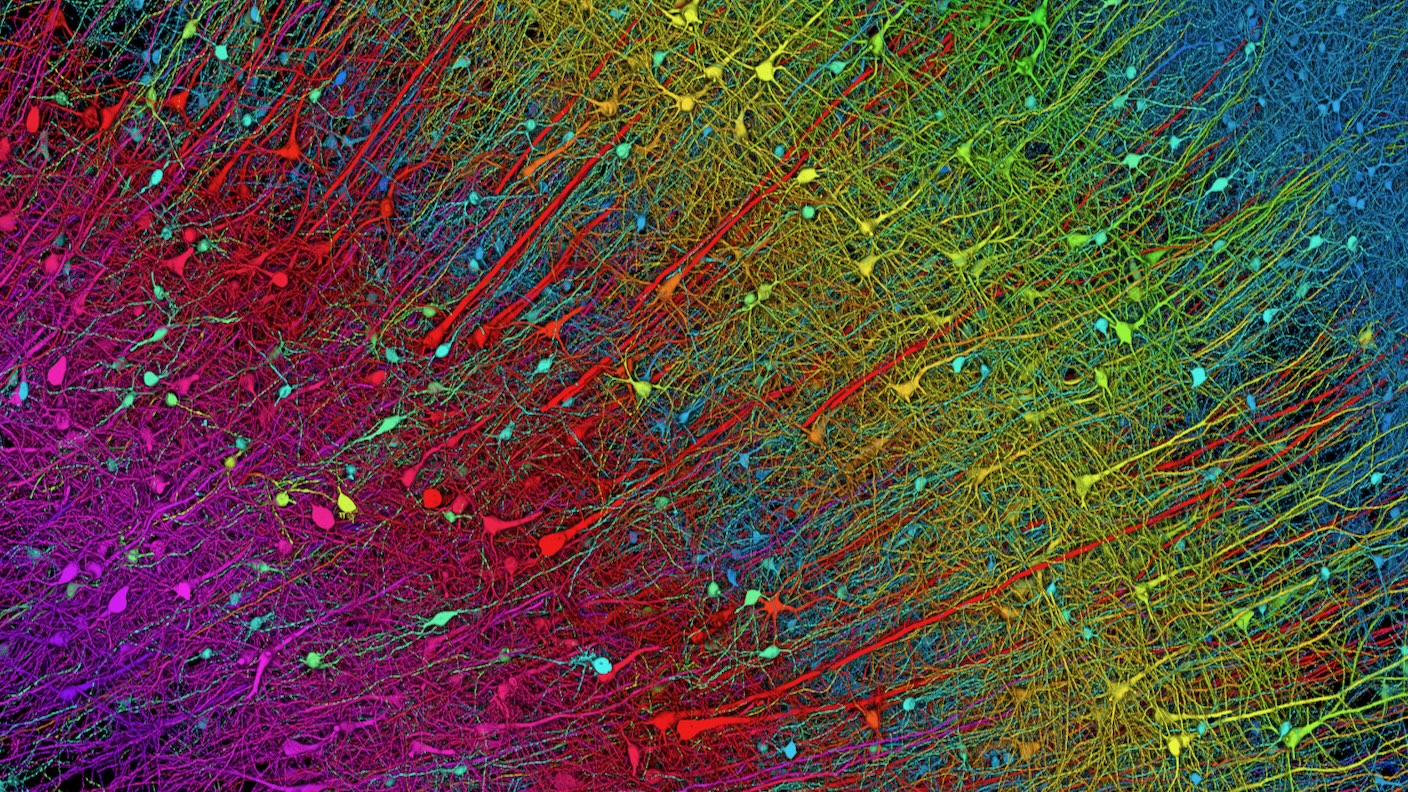
Google and Harvard Map a Tiny Piece of the Human Brain With Extreme Precision. Source: Singularity Hub by Shelly Fan. Quote from article: “Using a machine like a deli-meat slicer armed with a diamond knife, the Harvard team, led by connectome expert Dr. Jeff Lichtman, meticulously sliced the sample into 5,019 cross sections. Each was roughly 30 nanometers thick—a fraction of the width of a human hair. They imaged the slices with an electron microscope, capturing nanoscale cellular details, including the “factories” inside cells that produce energy, eliminate waste, or transport molecules.”

Google and Harvard Map a Tiny Piece of the Human Brain With Extreme Precision

By Shelly Fan

May 13, 2024

Scientists map a cubic millimeter of the human cortex with extreme precision

Scientists just published the most detailed map of a cubic millimeter of the human brain. Smaller than a grain of rice, the mapped section of brain includes over 57,000 cells, 230 millimeters of blood vessels, and 150 million synapses.

The project, a collaboration between Harvard and Google, is looking to accelerate connectomics—the study of how neurons are wired together—over a much larger scale.

Our brains are like a jungle.

Neuron branches crisscross regions, forming networks that process perception, memories, and even consciousness. Blood vessels tightly wrap around these branches to provide nutrients and energy. Other brain cell types form intricate connections with neurons, support the brain’s immune function, and fine-tune neural network connections.

In biology, structure determines function. Like tracing wires of a computer, mapping components of the brain and their connections can improve our understanding of how the brain works—and when and why it goes wrong. A brain map that charts the jungle inside our heads could help us tackle some of the most perplexing neurological disorders, such as Alzheimer’s disease, and decipher the origins of emotions, thoughts, and behaviors.

Aided by machine learning tools from Google Research, the Harvard team traced neurons, blood vessels, and other brain cells at nanoscale levels. The images revealed previously unknown quirks in the human brain—including mysterious tangles in neuron wiring and neurons that connect through multiple “contacts” to other cells. Overall, the dataset incorporates a massive 1.4 petabytes of information—roughly the storage amount of a thousand high-end laptops—and is free to explore.

“It’s a little bit humbling,” Dr. Viren Jain, a neuroscientist at Google and study author, told Nature. “How are we ever going to really come to terms with all this complexity?” The database, first released as a preprint paper in 2021, has already garnered much enthusiasm in the scientific field.

“It’s probably the most computer-intensive work in all of neuroscience,” Dr. Michael Hawrylycz, a computational neuroscientist at the Allen Institute for Brain Science, who was not involved in the project, told MIT Technology Review.

Why So Complicated?

Many types of brain maps exist. Some chart gene expression in brain cells; others map different cell types across the brain. But the goal is the same. They aim to help scientists understand how the brain works in health and disease.

The connectome details highways between brain regions that “talk” to each other. These connections, called synapses, number in the hundreds of trillions in human brains—on the scale of the number of stars in the universe.

Decades ago, the first whole-brain wiring map detailed all 302 neurons in the roundworm Caenorhabditis elegans. Because its genetics are largely known, the lowly worm delivered insights, such as how the brain and body communicate to increase healthy longevity. Next, scientists charted the fruit fly connectome and found the underpinnings of spatial navigation.

More recently, the MouseLight Project and MICrONS have been deciphering a small chunk of a mouse’s brain—the outermost area called the cortex. It’s hoped such work can help inform neuro-inspired AI algorithms with lower power requirements and higher efficacy.

But mice are not people. In the new study, scientists mapped a cubic millimeter of human brain tissue from the temporal cortex—a nexus that’s important for memory, emotions, and sensations. Although just one-millionth of a human brain, the effort reconstructed connections in 3D at nanoscale resolution.

Slice It Up

Sourcing is a challenge when mapping the human brain. Brain tissues rapidly deteriorate after trauma or death, which changes their wiring and chemistry. Brain organoids—”mini-brains” grown in test tubes—somewhat resemble the brain’s architecture, but they can’t replicate the real thing.

Here, the team took a tiny bit of brain tissue from a 45-year-old woman with epilepsy during surgery—the last resort for those who suffer severe seizures and don’t respond to medication.

Using a machine like a deli-meat slicer armed with a diamond knife, the Harvard team, led by connectome expert Dr. Jeff Lichtman, meticulously sliced the sample into 5,019 cross sections. Each was roughly 30 nanometers thick—a fraction of the width of a human hair. They imaged the slices with an electron microscope, capturing nanoscale cellular details, including the “factories” inside cells that produce energy, eliminate waste, or transport molecules.

Piecing these 2D images into a 3D reconstruction is a total headache. A decade ago, scientists had to do it by hand. Jain’s team at Google developed an AI to automate the job. The AI was able to track fragments of whole components—say, a part of a neuron (its body or branches)—and stick them back together throughout the images.

In total, the team pieced together thousands of neurons and over a hundred million synaptic connections. Other brain components included blood vessels and myelin—a protective molecular “sheath” covering neurons. Like electrical insulation, when myelin deteriorates, it causes multiple brain disorders.

“I remember this moment, going into the map and looking at one individual synapse from this woman’s brain, and then zooming out into these other millions of pixels,” Jain told Nature. “It felt sort of spiritual.”

A Whole New World

Even a cursory look at the data led to surprising insights into the brain’s intricate neural wiring.

Cortical neurons have a forest-like structure for input and a single “cable” that delivers output signals. Called axons, these are dotted with thousands of synapses connecting to other cells.

Usually, a synapse grabs onto just one spot of a neighboring neuron. But the new map found a rare, strange group that connects with up to 50 points. “We’ve always had a theory that there would be super connections, if you will, amongst certain cells…But it’s something we’ve never had the resolution to prove,” Dr. Tim Mosca, who was not involved in the work, told Popular Science. These could be extra-potent connections that allow neural communications to go into “autopilot mode,” like when riding a bike or navigating familiar neighborhoods.

More strange structures included “axon whorls” that wrapped around themselves like tangled headphones. An axon’s main purpose is to reach out and connect with other neurons—so why do some fold into themselves? Do they serve a purpose, or are they just a hiccup in brain wiring? It’s a mystery. Another strange observation found pairs of neurons that perfectly mirrored each other. What this symmetry does for the brain is also unknown.

The bottom line: Our understanding of the brain’s connections and inner workings is still only scratching the surface. The new database is a breakthrough, but it’s not perfect. The results are from a single person with epilepsy, which can’t represent everyone. Some wiring changes, for example, may be due to the disorder. The team is planning a follow-up to separate epilepsy-related circuits from those that are more universal in people.

Meanwhile, they’ve opened the entire database for anyone to explore. And the team is also working with scientists to manually examine the results and eliminate potential AI-induced errors during reconstruction. So far, hundreds of cells have been “proofread” and validated by humans, but it’s just a fraction of the 50,000 neurons in the database.

The technology can also be used for other species, such as the zebrafish—another animal model often used in neuroscience research—and eventually the entire mouse brain.

Although this study only traced a tiny nugget of the human brain, the atlas is a stunning way to peek inside its seemingly chaotic wiring and make sense of things. “Further studies using this resource may bring valuable insights into the mysteries of the human brain,” wrote the team.

Image Credit: Google Research and Lichtman Lab

Posted in Uncategorized | Tagged , , , , | Leave a comment

“Gifted Children”… What can we learn? What Does it Mean to Be Gifted? w/ Ellen Winner | The Psychology Podcast. Podcast Scott Barry Kaufman

16 May 2024 The Psychology Podcast This week Scott is joined by developmental psychologist Ellen Winner. Scott and Ellen discuss Ellen’s views on IQ and giftedness, the myth that gifted children are gifted in all subject areas, and the importance of artistic giftedness.

Subscribe to The Psychology Podcast: https://itunes.apple.com/us/podcast/p…

Facebook: https://www.facebook.com/thepsycholog…

Posted in Uncategorized | Leave a comment