Vladimir Putin couldn’t attend last year’s Brics summit in Johannesburg in person; his hosts would have had to arrest him under an international warrant for alleged war crimes. This year, he’s hosting the event in the Russian city of Kazan.
So what? It’s a chance for Putin to show he still has friends, and an opportunity to flog his fantasy of building an alternative to the dollar-based global order.
When Russia took over leadership of Brics at the beginning of this year four new countries joined – Egypt, Ethiopia, Iran, and the UAE – meaning its members now account for over 37 per cent of global GDP compared to 29 per cent for the G7;roughly 40 per cent of the world’s population; and 30 per cent of its land surface.
With over 32 delegations scheduled to attend – including Algeria, Azerbaijan, Belarus, Indonesia, Palestine and Mexico – the meeting on the banks of the Volga is an attempt to showcase Putin, ironically, as an “anti-imperialist” in solidarity with the Global South. He is due to hold 17 bilateral meetings as well as the group gatherings.
Electric scooters and alcohol sales have been banned in the city for the duration, while potential agenda items include: developing a rival international payment system called “Brics Bridge”, which would allow countries to make cross-border payments on digital platforms run by central banks (and help Russia skirt round global payments issues because of sanctions);bolstering the New Development Bank – the Brics’ alternative to the IMF; and launching a new “friends of” tier for countries that aren’t fully-fledged members.
Jim O’Neill, who first coined the term ‘Bric’ in a bank report in 2001, says the proposals distort the original idea. Initially, the pitch was to “reform global governance to give them [Brazil, Russia, India and China] a bigger space”, rather than to create alternatives to the G20, the IMF and the World Bank. But the project has evolved due to:
– Dollar dissatisfaction. Several Brics leaders, most notably Brazil’s Lula da Silva, are opposed to the dollar’s dominance in the world economy. For Russia and Iran, an explosion of US sanctions (up 900 per cent in two decades) has further boosted the appeal of alternative currencies that don’t require US banks to monitor transactions.
– Banking blunders.Whether by chance or design, Kazan is happening in the same week the IMF and World Bank hold meetings. Both institutions, founded in 1944 under the Bretton Woods agreement, have been stubbornly resistant to reform that would give the Brics more voting power.
– War weariness.Three of the most recent Brics members are Middle Eastern states that view the West’s support for Israel with revulsion. “Iran is sure to help push the rhetoric to become more radical within Brics, certainly on issues like Gaza,” says Steven Gruzd, analyst at the South African Institute of International Affairs.
All that said, those predicting the demise of the dollar and the Washington-focused financial system shouldn’t hold their breath. In a recent survey of 73 central banks more than half concluded the dollar’s share of reserves will remain above 50 per cent over the next decade. Meanwhile, appetite for Chinese renminbi – regarded as the most viable alternative – “has soured”.
Brics or bricolage?As Brics expands, it grapples with competing interests of its members. Border disputes between India and China have been a brake on progress – although they reached a deal on army patrols on Monday.Saudi Arabia’s position towards potentially joining has been one of calculated ambivalence (Mohammed bin Salman was invited but will not attend Kazan).Two of the group’s most recent members – Egypt and Ethiopia – are currently embroiled in a major dispute over a dam on the Nile.
Serbia’s president said on Monday he won’t attend the summit, as the Balkan country tries to balance its relationship with Russia and its bid to join the EU.
What’s more…After 15 years of meetings, Brics has achieved remarkably little. O’Neill notes it has never fully articulated the case for reducing trade barriers as a bloc, or sought to grapple with common problems like drug-resistant tuberculosis. Until Brics proves it can tackle real issues, the dream of de-dollarisation will remain just that.
Niall Ferguson (@nfergus) posted at 6:11 pm on Sun, Oct 20, 2024:
“At least 14,000 minors have been transed either chemically or surgically in the last five years.” Read this by @sullydish to understand the true depravity of the woke pseudo-religion that the Biden-Harris promotes. Genital mutilation as government policy.
Professor Mearsheimer explains why the Ukraine War wouldn’t have happened under a Trump Presidency. Biden and DC’s instincts are ones of a warmonger. They risk warfare 24/7 while Trump wants peace which is why no new wars happened. He’s aware of the risks.pic.twitter.com/DOQjw6bXdNhttps://t.co/pSJtSPvdpg
The first anniversary of the October 7 Hamas attack on Israel and the beginning of conflict in Gaza left UK schools with a dilemma: how to mark the event. It has affected many around the world, including school children and their families in the UK.
Earlier in 2024, government adviser on social cohesion, Sara Khan, suggested that schools were not supporting reasonable debate about the Israel-Gaza conflict because teachers are nervous about handling such a sensitive topic in the classroom.
But if schools shut down the topic they risk encouraging mistrust, anger, hate and polarisation. Not least because students will instead seek out information online – and are quite likely to stumble upon fake news and conspiracy theories.
The leader of the UK’s biggest education union, Daniel Kebede, recently noted that there simply isn’t enough space in the curriculum for students to discuss such difficult issues. He claims the solution is to embed philosophy as a subject across England’s school curriculum.
Fight back against disinformation. Get your news here, direct from experts
Get newsletter
The subject of philosophy is specifically set up to promote critical thinking skills and teach people how to have difficult conversations about controversial issues.
Teaching controversial topics
Controversial and sensitive topics are unavoidable. We encounter them discussed in the media, on the news, in the street and in our homes. Yet we are not always sure what to think, especially when the issue is complex, or how to talk to people we disagree with. And the skills of reasonable dialogue can be even harder when emotions are running high.
Young people need to learn how to discuss controversial issues like the Israel-Gaza war. The best way to do this is by including philosophy on the curriculum. Philosophy has an excellent toolkit designed to explore various points of view in a critically engaged way and, when taught dialogically – through discussion between students and teachers – students become seekers of shared knowledge and wisdom.
A key aspect of a democracy involves welcoming different ideas. Such diversity is a strength because it allows for many claims to be scrutinised, with only the best arguments gaining traction. Yet this process of sharing ideas requires our citizens to be able to hold reasoned discussions and to think critically.
The ability to hold reasoned, critical discussion is a valuable skill. fizkes/Shutterstock
To avoid aggression or chaos, people need to engage charitably with one another, being respectful of various experiences and perspectives while also being critical of the ideas presented.
The dialogical skills of philosophy
Philosophy, more than any other subject, encourages students to think about the reasons why they think something, and entertain the possibility that there are other points of view.
Philosophy is inherently dialogical. The most common teaching approach is to think about the steps in an argument, and then to consider the weaknesses in each of these.
Philosophy does this by teaching students to check: What assumptions am I making? Are the premises of my position sound? Does the conclusion logically follow from my starting point? What is a counterargument or counterexample to which I need to reply? Could I be wrong about this? What additional information do I need to draw a conclusion?
These kinds of questions encourage intellectual humility: the idea that I, like anyone else, could be wrong. Intellectual humility goes hand in hand with open-mindedness, ensuring we remain open to relevant new information.
Such skills of critical thinking and respectful disagreement are vital in a time of disinformation and fake news. Not only do we need young people to learn how to fact check and be critical of what they see and hear, but we also need them to learn that it is OK to disagree.
Being open-minded
The influential American philosopher Daniel Dennett, who died earlier this year, wrote about the importance of criticising with kindness and seeking the most charitable version of your opponent’s position. This is so important when discussing controversial topics, because reasonable people will disagree.
Criticising with kindness means staying humble and open to different points of view when having difficult conversations. And it means creating space for the airing of diverse arguments and examples.In this way, teachers who are trained in philosophy are able to remain politically neutral while helping students converse with one another about important issues that affect them and those they care about.
Philosophy is about learning to be respectful of others whose views differ from one’s own and to accept reasonable disagreement. It also teaches us to be comfortable with unsettled questions and complex answers. Teaching philosophy in the classroom leads to students engaging with ideas charitably and critically, encouraging open-mindedness and intellectual humility.
It is the skills of dialogue that we need as our society faces increasing polarisation and violent disagreement. These skills are some of the defining characteristics of a democracy. Happily, teachers are uniquely positioned to embrace the subject of philosophy and the skills it has to offer.
Following the news should not be all doom and gloom. Because there are millions of people who are ingeniously working to find solutions to our biggest problems, there are so many wonders on this planet (and beyond). In The Conversation’s daily email, which I help curate, you will get a balanced news diet that doesn’t leave you exhausted … but energised and hopeful.
If you listen to anyone this morning, let it be Gideon Levy. A phenomenal Israeli journalist who has been speaking truth to power for decades. Share his words. Far and Wide. pic.twitter.com/cyEQxrpWvc
ELON MUSK: "I would prefer not to be in politics. I stepped into the arena because I think the stakes are extremely fundamental. I fear if Trump does not win, we are going to have a single-party state that is going to be worse than California.
CERN trains AI models to revolutionize cancer treatment
The advances developed at the European Organization for Nuclear Research have already been applied to 10,000 stroke patients in hospitals in Germany and Belgium
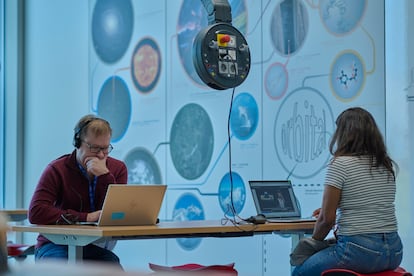
Two people participate in an interactive positron emission tomography workshop at CERN’s new education and outreach center, Science Gateway.IUCC2024.
Lourdes Velasco
The artificial intelligence-based innovations that CERN initially developed to improve the maintenance of its particle accelerator have revolutionary applications in the field of health.Reducing the size of radiotherapy machines and optimizing them for ease of use — especially in countries with fewer resources —, designing a smart program for breast cancer prevention and improving the monitoring of stroke patients are some of the promising projects that the European nuclear research laboratory is working on, in collaboration with European hospitals.
The European Organization for Nuclear Research — which is known as CERN — offers hospitals its experience in managing huge amounts of data in a secure and decentralized way, which is key to ensuring the privacy and security of the private patient information used to feed the algorithm. This institution — which is best known for building the Large Hardron Collider (LHC) — uses a system to process data locally without sending it to central storage. This helps protect privacy and make better use of resources when different hospitals work together to create reliable AI-based models for analyzing and predicting diseases.
“It is a new paradigm. Before, there was a huge amount of data that was centralized and stored. Now we do the processing at the place where the data is acquired, for example in a hospital. If we guarantee privacy, data protection and the robustness of the model, we have something that is of great interest for medical applications,” explains CERN scientist Luigi Serio during a visit to the laboratory’s facilities organized by the International Union for Cancer Control (UICC) on the occasion of the World Cancer Congress in Geneva.
Luigi Serio — responsible for developing AI applications in healthcare — acknowledges that the laboratory known for discovering antimatter — which also created the world’s first website — isn’t the only one using this data processing model. However, he emphasizes, “What sets us apart is the strength, expertise, and reputation of CERN, along with the assurance that our services are backed by our nonprofit, impartial status.”
How AI helps improve stroke patient monitoring
One of the applications based on this system is Truckstroke, which is already improving stroke treatment with artificial intelligence in around 10,000 patients in hospitals in Germany and Belgium and in the Vall d’Hebron Stroke Unit in Barcelona.
By comparing images of the brain of a stroke patient with models trained by CERN in the so-called Truststroke Project, the algorithm predicts how the patient might evolve, what therapy should be administered and the follow-up required. Most importantly, the tool predicts the risk of recurrence.
Every year, 1.1 million people in Europe have a stroke, half a million die, and there are almost 10 million survivors who need long-term care.“Professionals are overwhelmed by stroke patients and need ever more new tools to support their work,” explains Serio.
Hospitals have all the data configured locally, but by exchanging the parameters with the main server they obtain prediction models capable of measuring the severity of the stroke.“The doctor can use these models to decide what type of treatment to give to the patient. They also know the probable outcome and the follow-up required, how long the patient must remain in hospital, when they can be discharged, etc.,” explains the researcher.
The algorithm knows who should undergo a mammogram
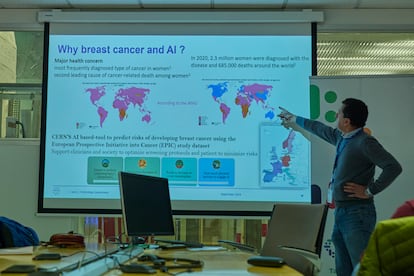
CERN plans to complete a cancer detection program next year that promises to be 50% more accurate than the current screening model, GAIL. In addition to age factors and medical history, the CERN model will determine the risk of developing breast cancer by combining multiple factors, such as consumption of certain foods or alcohol, lifestyle and physical activity, the age of the woman at her first pregnancy or menopause, among other parameters.
The current screening system does not take into account all risk factors.“The idea is to have a tool that can analyze several factors beyond those currently taken into account to decide whether a mammogram should be done earlier, even if it can be delayed and for what reasons,” explains Serio.
Use of AI in medicine. Images provided by the NGO.Thomas Omondi (Union for International Cancer Control)
The data to train the tool comes from the European Prospective Study on Diet, Cancer and Health (EPIC), which contains information collected over more than 20 years. Once the model is finalized next year, it will need to be tested and regulated, so there are still steps to be taken before the promising breast cancer screening system replaces the current protocol.
CERN aims to enhance linear radiotherapy accelerators (LINACs) with artificial intelligence to make them easier to use and more accessible in low- and middle-income countries. In these regions, access is limited not only by the high cost, but also by a shortage of experts trained to operate the equipment. “The machines are difficult to acquire, install, operate and maintain,” explains Serio.The use of artificial intelligence in this field could significantly improve the quality of care, as it allows the machine to be operated and diagnoses to be made even in the absence of an expert, he explains.
New AI-based software will help predict failures, speed up maintenance and guide users, while reducing downtime at radiotherapy facilities, which are now often unused due to a lack of skilled personnel. This model could even open the door to automating treatment planning.
The project, called STELLA, is initially designed to improve radiation therapy treatment in some African countries, where there is one radiation therapy device for every 3.5 million people, compared with one for every 80,000 to 100,000 people in the U.S. and most European countries.
Predicting the evolution of tumors or Alzheimer’s
Another medical application developed by CERN is capable of determining defects, abnormalities or pathologies in the brain and indicating to doctors the exact point at which a pathology, for example a tumor, could be developing, thanks to a complex system based on the one CERN created to prevent failures in the operation of the particle accelerator.
“Interestingly, the brain is a complex system that can be modelled as a graph. You have neurons in different parts of the brain that are connected to each other, and you can set up a matrix of nodes and vectors that connect the different parts,” explains the CERN researcher. By processing images of the brain obtained by magnetic resonance imaging, the algorithm is able to detect with a certain degree of precision where a pathology might be present.
“The algorithm would extract the image saying that there is some irregularity, and it can even actually predict where the anomaly is and where it spreads,” explains Sergio. This technology is being tested clinically at the Kapodistrian University Hospital in Greece. For the moment, explains Serio, it has been used for tumors or strokes, but CERN also plans to use this system to monitor the evolution of Alzheimer’s or dementia.
Sign up for our weekly newsletter to get more English-language news coverage from EL PAÍS USA Edition


 We believe in the free flow of information