
https://x.com/i/status/1853765632472322374

The Nobel Prize (@NobelPrize) posted at 8:05 am on Mon, Nov 04, 2024:
“Ideas do not always come in a flash, but by diligent trial-and-error experiments that take time and thought.”
Electrical engineer Charles Kao pioneered the development of fibre optics in telecommunications. He was awarded the 2009 physics prize.
https://t.co/myTKS9APZ7
(https://x.com/NobelPrize/status/1853347724533350709?t=DmOfE5uLqhloXYJpES9EDQ&s=03)
Big tech goes nuclear to feed AI’s ravenous appetite for energy.
Some estimates suggest training an AI model in 2030 could take as much as 6 gigawatts—enough electricity to power a few million homes. In anticipation, and mindful of green pledges, tech companies are going nuclear. In mid-October, Amazon signed three deals supporting development of small modular nuclear reactors, a new technology that, if it passes regulatory scrutiny, may prove safer and quicker to build. In addition, Google agreed to buy 500 megawatts from Kairos Power, a startup also aiming to build small reactors, while Microsoft signed up with Constellation to reopen a reactor at Three Mile Island (the one that didn’t partially melt down and was still operational five years ago). Nuclear is pricey, takes years to build, and the new approaches aren’t a sure bet. Still, big-tech cash could reverse nuclear power’s fortunes.
Basil

(@Basil_TGMD) posted at 1:15 pm on Sat, Nov 02, 2024:
Geert Wilders announces the STRICTEST m!gration policies in the history of THE NETHERLANDS.
– If you have ever applied for Asylum elsewhere you will be REJECTED
– All failed Asylum Seekers will be DEPORTED
– Family Reunification rules RESTRICTED
– Right to rent REFUSED
– Anyone from a SAFE COUNTRY will be REFUSED
https://t.co/cHeRj7lGdK
(https://x.com/Basil_TGMD/status/1852700940887064581?t=LfroHPacBPCGFJ6uH7DXqg&s=03)
3rd November 2024
14 hours ago 3rd November 2024
Michael Sheils McNamee
BBC News

Details about the Royal Family’s finances including rent received from the NHS, schools and the armed forces have been revealed as part of a new documentary.
In the investigation by Channel 4’s Dispatches and the Sunday Times, it is reported that the private estates of King Charles and Prince William have received millions of pounds of income from contracts with public bodies and charities.
Over the past year these deals with the Duchies of Lancaster and Cornwall have been worth almost £50 million, it has been claimed.
A spokesperson for the Duchy of Lancaster, the private estate of King Charles, said it “complies with all relevant UK legislation and regulatory standards applicable to its range of business activities”.
The Duchy of Lancaster, established in 1399, and Prince William’s Duchy of Cornwall, established in 1337, both hold large amounts of land and commercial property in England and Wales.
Their contracts with public bodies are said to include a £37 million agreement between the Duchy of Cornwall and the Ministry of Justice to lease Dartmoor Prison, and a £11.4 million deal between Guy’s and St Thomas’ NHS Trust and the Duchy of Lancaster to rent a London warehouse over 15 years.
The programme, Dispatches’ The King, The Prince and Their Secret Millions, reports that details of the rental agreements have not been given to Parliament.
The documentary raises concerns about the environmental impact of some of the estates’ contracts, including those with mining companies.
The two private estates are separate to the Crown Estate.
The taxpayer-funded Sovereign Grant will rise to £132m next year, after profits from the Crown Estate increased to £1.1 billion.
A Duchy of Cornwall spokesperson said it is “a private estate with a commercial imperative which we achieve alongside our commitment to restoring the natural environment and generating positive social impact for our communities”.
On the issue of mining, the spokesperson said that the duchy was “acting responsibly and in a sustainable way” to the government’s industrial strategy.
A spokesperson for the Duchy of Lancaster said it operates “as a commercial company, managing a broad range of land and property assets across England and Wales”.
They said that the duchy “delegates certain functions, particularly those regarding asset management, to the Duchy Council” and while the King “takes a close interest” in the work of the duchy, day-to-day management of the portfolio is the responsibility of the council and executive team.
It added it had made “a number of key environmental improvements in recent years”.
Lourdes Velasco
Geneva – OCT 05, 2024 – 06:05 CEST
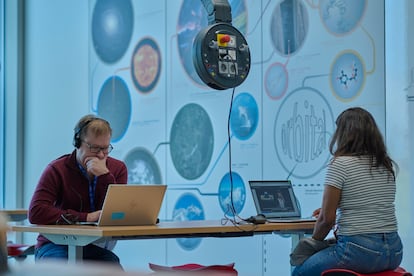
The artificial intelligence-based innovations that CERN initially developed to improve the maintenance of its particle accelerator have revolutionary applications in the field of health. Reducing the size of radiotherapy machines and optimizing them for ease of use — especially in countries with fewer resources —, designing a smart program for breast cancer prevention and improving the monitoring of stroke patients are some of the promising projects that the European nuclear research laboratory is working on, in collaboration with European hospitals.
The European Organization for Nuclear Research — which is known as CERN — offers hospitals its experience in managing huge amounts of data in a secure and decentralized way, which is key to ensuring the privacy and security of the private patient information used to feed the algorithm. This institution — which is best known for building the Large Hardron Collider (LHC) — uses a system to process data locally without sending it to central storage. This helps protect privacy and make better use of resources when different hospitals work together to create reliable AI-based models for analyzing and predicting diseases.
Luigi Serio — responsible for developing AI applications in healthcare — acknowledges that the laboratory known for discovering antimatter — which also created the world’s first website — isn’t the only one using this data processing model. However, he emphasizes, “What sets us apart is the strength, expertise, and reputation of CERN, along with the assurance that our services are backed by our nonprofit, impartial status.”
One of the applications based on this system is Truckstroke, which is already improving stroke treatment with artificial intelligence in around 10,000 patients in hospitals in Germany and Belgium and in the Vall d’Hebron Stroke Unit in Barcelona.
Every year, 1.1 million people in Europe have a stroke, half a million die, and there are almost 10 million survivors who need long-term care. “Professionals are overwhelmed by stroke patients and need ever more new tools to support their work,” explains Serio.
Hospitals have all the data configured locally, but by exchanging the parameters with the main server they obtain prediction models capable of measuring the severity of the stroke. “The doctor can use these models to decide what type of treatment to give to the patient. They also know the probable outcome and the follow-up required, how long the patient must remain in hospital, when they can be discharged, etc.,” explains the researcher.
CERN plans to complete a cancer detection program next year that promises to be 50% more accurate than the current screening model, GAIL. In addition to age factors and medical history, the CERN model will determine the risk of developing breast cancer by combining multiple factors, such as consumption of certain foods or alcohol, lifestyle and physical activity, the age of the woman at her first pregnancy or menopause, among other parameters.
The current screening system does not take into account all risk factors. “The idea is to have a tool that can analyze several factors beyond those currently taken into account to decide whether a mammogram should be done earlier, even if it can be delayed and for what reasons,” explains Serio.
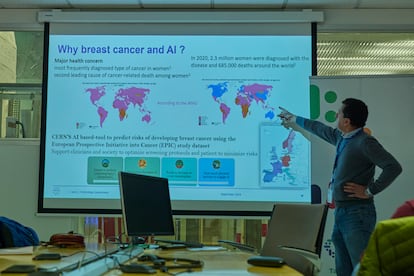
The data to train the tool comes from the European Prospective Study on Diet, Cancer and Health (EPIC), which contains information collected over more than 20 years. Once the model is finalized next year, it will need to be tested and regulated, so there are still steps to be taken before the promising breast cancer screening system replaces the current protocol.
CERN aims to enhance linear radiotherapy accelerators (LINACs) with artificial intelligence to make them easier to use and more accessible in low- and middle-income countries. In these regions, access is limited not only by the high cost, but also by a shortage of experts trained to operate the equipment. “The machines are difficult to acquire, install, operate and maintain,” explains Serio. The use of artificial intelligence in this field could significantly improve the quality of care, as it allows the machine to be operated and diagnoses to be made even in the absence of an expert, he explains.
New AI-based software will help predict failures, speed up maintenance and guide users, while reducing downtime at radiotherapy facilities, which are now often unused due to a lack of skilled personnel. This model could even open the door to automating treatment planning.
The project, called STELLA, is initially designed to improve radiation therapy treatment in some African countries, where there is one radiation therapy device for every 3.5 million people, compared with one for every 80,000 to 100,000 people in the U.S. and most European countries.
Another medical application developed by CERN is capable of determining defects, abnormalities or pathologies in the brain and indicating to doctors the exact point at which a pathology, for example a tumor, could be developing, thanks to a complex system based on the one CERN created to prevent failures in the operation of the particle accelerator.
“Interestingly, the brain is a complex system that can be modelled as a graph. You have neurons in different parts of the brain that are connected to each other, and you can set up a matrix of nodes and vectors that connect the different parts,” explains the CERN researcher. By processing images of the brain obtained by magnetic resonance imaging, the algorithm is able to detect with a certain degree of precision where a pathology might be present.
“The algorithm would extract the image saying that there is some irregularity, and it can even actually predict where the anomaly is and where it spreads,” explains Sergio. This technology is being tested clinically at the Kapodistrian University Hospital in Greece. For the moment, explains Serio, it has been used for tumors or strokes, but CERN also plans to use this system to monitor the evolution of Alzheimer’s or dementia.
Sign up for our weekly newsletter to get more English-language news coverage from EL PAÍS USA Edition
Sign up to EL PAÍS US Edition bulletin
Enrique Alpañés | Madrid
Adheres to

If you are interested in licensing this content, please contact ventacontenidos@prisamedia.com
Sponsored Content
Expert reveals: Solar panels are only worthwhile if your roof…The Eco Experts Solar Quotes|
Co-Founder of Google Brain, Andrew Ng, Recommends: 5 Books For Turning Your Life AroundBlinkist: Andrew Ng’s Reading List|
Play this game for 1 minute and see why everyone is addicted.CombatSiege|
And Also…
Terence Trent D’Arby’s downfall: How the singer tipped to be ‘the new Prince’ fell from graceEl País
These are the drugs found in Liam Payne’s body at the time of death: Toxicology test results publishedAS
Here’s what we know about Tiffany Trump and her mother Marla Maples: The former president’s “other” daughterAS
21:38
20:05
19:04
19:03
Genius Thinking (@GeniusGTX) posted at 3:03 pm on Tue, Oct 29, 2024:
This man was Nikola Tesla’s “mentor” and called the Da Vinci of his time.
His ideas influenced Einstein, Hawking, Terrence Howard, and the New Age Movements.
Sadly, his forgotten legacy is a heartbreaking tragedy. Here’s his story…


https://t.co/ykqjShY1x7
https://x.com/GeniusGTX/status/1851278578748727494?t=HDTKhR7wVabSGwidjQPg5g&s=03)
Visegrád 24 (@visegrad24) posted at 5:39 pm on Thu, Oct 31, 2024:
1.Before the modern state of Israel (established in 1948), there was the British Mandate (1920-1948), not a Palestinian state.
2.Before the British Mandate, there was the Ottoman Empire (1517-1917), not a Palestinian state.
3.Before the Ottoman Empire, there was the Islamic Mamluk Sultanate of Egypt (1250-1517), not a Palestinian state.
4.Before the Islamic Mamluk Sultanate of Egypt, there was the Ayyubid Dynasty (1171-1260), not a Palestinian state. Godfrey of Bouillon conquered it in 1099.
5.Before the Ayyubid Dynasty, there was the Christian Kingdom of Jerusalem (1099-1291), not a Palestinian state.
6.Before the Christian Kingdom of Jerusalem, there was the Fatimid Caliphate (909-1171), not a Palestinian state.
7.Before the Fatimid Caliphate, there was the Byzantine Empire (330-636), not a Palestinian state.
8.Before the Byzantine Empire, there was the Roman Empire (27 BCE – 476 CE), not a Palestinian state.
9.Before the Roman Empire, there was the Hasmonean Dynasty (140-37 BCE), not a Palestinian state.
10.Before the Hasmonean Dynasty, there was the Seleucid Empire (312-63 BCE), not a Palestinian state.
11.Before the Seleucid Empire, there was the Empire of Alexander the Great (334-323 BCE), not a Palestinian state.
12.Before the Empire of Alexander the Great, there was the Persian Empire (c. 550-330 BCE), not a Palestinian state.
13.Before the Persian Empire, there was the Babylonian Empire (c. 1894-539 BCE), not a Palestinian state.
14.Before the Babylonian Empire, there were the Kingdoms of Israel and Judea (c. 1050-586 BCE), not a Palestinian state.
15.Before the Kingdoms of Israel and Judea, there was the Kingdom of Israel (c. 1040-722 BCE), not a Palestinian state.
16.Before the Kingdom of Israel, there was the theocracy of the Twelve Tribes of Israel (c. 1400-1050 BCE), not a Palestinian state.
17.Before the theocracy of the Twelve Tribes of Israel, there was the individual state of Canaan (c. 3000-1200 BCE), not a Palestinian state. In fact, in this corner of the earth, there was everything but a Palestinian state!

·
75K View
https://t.co/fORuZPEI61
(https://x.com/visegrad24/status/1852042687416877138?t=p9n3UB3PsWLZUbCqnFeOIw&s=03)


