By Fr Shay Cullen: Yahya Sinwar’s killing will not end the Gaza war

Yahya Sinwar’s killing will not end the Gaza war

We may already know this, but it’s worth repeating: the Palestinian militant group Hamas launched attacks on southern Israel on Oct. 7, 2023, which resulted in the deaths of more than 1,200 people, mostly civilians, and 120 others being taken hostage and brought to the Gaza Strip. The unprecedented attacks caught Israel by surprise. In retaliation, the country’s forces launched a military campaign in Gaza that has devastated the coastal enclave and left tens of thousands of Palestinian dead, civilians and Hamas fighters alike.

2024 10 18 yahya sinwar 1233191879 0

Now among those killed is Hamas leader Yahya Sinwar, the chief architect of the October 7 attacks. His death, however, will not end the war. Israeli forces continue to pound Gaza and Lebanon, where Hamas ally Hezbollah is based. Hundreds of Hezbollah fighters have been killed. Hundreds of Israeli troops have been killed since the Gaza war began. A year after the October 7 attacks, and despite the killing of Sinwar and his predecessor Ismail Haniyeh, Hamas remains undefeated and is still firing rockets at Israel. War will not end the threat against Israel; only political and social justice for the aggrieved Palestinians will bring lasting peace.

A retired Israeli general has said starvation is the only way to bring Hamas to surrender, telling Palestinian civilians to leave or starve. Thanks to a blockade, only 30 food trucks have managed to enter northern Gaza. The United States threatened to withhold delivering munitions to Israel unless food aid was allowed in. This seemed hypocritical of President Joe Biden’s administration. It’s as if it’s saying: feed them first, then we will give you more bombs to kill them.

“The situation is desperate. We have no shelter supplies, very little food and zero assurances from Israel on getting anything into [the] Jabalia [refugee camp,] where more than 100,000 people are trapped,” Georgios Petropoulos, head of the United Nations Office for the Coordination for Humanitarian Affairs in Gaza, was quoted by the BBC as saying. The siege strategy, “surround and starve them,” seems to be the Israeli plan.

Long history

The conflict between Israel and the Palestinians has a long history. In 1922, when the Ottoman Empire was defeated by the Allied powers after it sided with Germany in World War I, Palestine was put under British administration by the League of Nations. The British decided to establish in Palestine a homeland for Jews living abroad then. Hundreds of Jews began migrating to Palestine, and violence soon erupted between the Jews and the Palestinians.

Tensions between them grew worse. After the Allies’ victory in World War II, Jewish migration to Palestine increased, helped by a Europe that felt guilty about the Holocaust. Amid growing violence, the United Nations proposed dividing Palestine into two states: one for Jews and the other for Palestinians. The Palestinians and their Arab neighbors said no; the Jewish migrant community said yes.

In 1948, the British ended its administration of Palestine and withdrew. The large Jewish community declared independence and founded the State of Israel. Neighboring Arab nations rejected that and invaded but were defeated by the new state, which grabbed much more territory than it had already occupied.

About 800,000 Palestinians were driven out of their lands and became refugees in neighboring countries. This event is known as “Nakba,” or the “Catastrophe.” Only the West Bank and Gaza remained in Palestinian control.

In 1967, the Six-Day War erupted, with Israel emerging victorious over Egypt and Syria and capturing and occupying the West Bank and Gaza. In July 2024, the International Court of Justice (ICJ) declared illegal Israel’s occupation and establishment of Jewish settlements in those territories and its annexation and use of natural resources there. This came after the ICJ alleged on May 17 that Israel’s war on Gaza was “genocidal.” It ordered Israel to stop it, but the country ignored it and denied the allegation.

The Palestinians have been caged in Gaza and the West Bank since the Six-Day War. Eventually, they were allowed some degree of autonomy under Israeli control and close monitoring. Some Palestinians in Lebanon formed Hezbollah, while those in Gaza established Hamas to oppose Israel. Iran supports both groups.

Brutal retaliation

A year after October 7, Israeli forces, supplied with weapons from the US and Germany, continued their campaign of brutal retaliation: the nonstop bombing of homes, clinics, schools and hospitals in Gaza. Allegations of multiple war crimes and genocide continue to surface, which Israel repeatedly denies.

As many as 42,000 Palestinians have been killed, almost half of them women and children. Those still living are on the edge of famine. Nonstop bombing drove at least 2 million Gazans from their homes, and have been told repeatedly by Israel to evacuate elsewhere in the territory. But where? There are really no safe spaces in Gaza. Countless buildings there have been totally destroyed. Scores of Palestinian bodies still lie under the rubble.

Israeli troops have already entered the West Bank, and hundreds more Palestinians have been killed. Jewish settlers continue to illegally grab land there, with the military’s backing. Hezbollah has been firing hundreds of rockets at northern Israel for many months, hitting villages there and causing thousands of Israelis to evacuate.

Despite the US warning him not to escalate the conflict, Israeli Prime Minister Benjamin Netanyahu sent troops to Lebanon, anyway. Several Hezbollah leaders have been assassinated, and dozens of the group’s fighters have been killed or seriously injured by exploding pagers and hand-held radios planted by Israeli intelligence operatives. About 2,000 Lebanese have been killed, and an untold number more were driven from their homes.

Israeli tanks have shelled the United Nations peacekeeping force in Lebanon and broke into the UN compound, injuring several UN troops. An arrogant Netanyahu has ordered the UN to withdraw its peacekeepers from Lebanon, but the UN command has vowed to stay, prevent atrocities and monitor attacks by Israeli forces.

The US supplies more than $3 billion every year, as well as tons of bombs and other munitions, to Israel. New US air defense systems are being delivered. As the US presidential approaches, it is not politically expedient for Biden to pressure Netanyahu to stop the fighting or to halt delivering bombs. Netanyahu is backed by a powerful Israeli lobby and the military-industrial Nations complex that wants more war.

The politically powerful Christian evangelical lobby that backs Donald Trump wants Israel to possess all of Palestine. It believes that, once that happens, Jesus will return to Earth, and believers will ascend with him to heaven in the “rapture.”

In the meantime, Netanyahu is apparently blocking a ceasefire deal, delaying the release of Israeli hostages held by Hamas. It seems the hostages have been used as pawns in his plan to stay in power, emerge as his country’s savior, and avoid facing corruption and fraud charges in an Israeli court.

The legacy of the ongoing war in Gaza will haunt Israel for generations to come. There is so much deep hatred on both sides that peace seems impossible. It seems Israel would not defeat Hamas or Hezbollah. For every fighter killed, two more will replace him. What the endgame will be, no one knows. Who will rule Gaza after the war is over is unknown. The only long-term solution is the two-state solution, but that is impossible right now. Meanwhile, the killings and human suffering continue.

END


This column was first published in The Sunday Times (www.manilatimes.net) on October 20, 2024. Print, digital, and online republication of this column without the written consent of the author and of The Manila Times is strictly forbidden.

Facebook

WhatsApp

Twitter

LinkedIn

Pinterest

Fr. Shay Cullen

Read more articles written by Fr. Shay Cullen

View All Posts >

PrevPreviousUN says ‘trickle’ of aid reaches north Gaza, as Israel denies blocking access

NextGazans describe fresh horror in north as Israel renews offensiveNext

About the Founder
Profile photo of Fr Shay Cullen
Fr. Shay Cullen

Shay Cullen is a Missionary priest from Ireland, a member of the Missionary Society of St. Columban and Founder and President of Preda Foundation since 1975.

Facebook Whatsapp Envelope Instagram Wikipedia-w

Recent posts

Negros Occidental palm oil project under fire over missing environmental clearance

November 4, 2024

Backlash after comedian at Trump rally calls Puerto Rico ‘island of garbage’

November 4, 2024

10 inspiring quotes from Pope Francis in his encyclical ‘Dilexit Nos’

October 31, 2024

Live in the Spirit with me

October 31, 2024

Share this post

Facebook

Pinterest

WhatsApp

LinkedIn

Twitter

You can help u

Posted in Uncategorized | Tagged , , , , | Leave a comment

Ireland is the 2nd most peaceful country in the world, according to the Institute for Economics and Peace. Only Iceland is rated as a more peaceful nation in their 2024 Global Peace Index.  See link below

Mark Henry (@Mark_J_Henry) posted at 8:14 am on Tue, Nov 05, 2024:


Ireland is the 2nd most peaceful country in the world, according to the Institute for Economics and Peace. Only Iceland is rated as a more peaceful nation in their 2024 Global Peace Index. 

🇮🇪
😇

https://t.co/YMUsKW9OIahttps://t.co/8izSgj0tTt
(https://x.com/Mark_J_Henry/status/1853712498219696288?t=nfwHn1BbjZOH5M2-Kuuqsg&s=03) 

Posted in Uncategorized | Leave a comment

Never under-estimate North Korea. Source: Japan Defence.

Visegrád 24 (@visegrad24) posted at 11:12 am on Tue, Nov 05, 2024:


NORTH KOREA LAUNCHES AT LEAST 7 BALLISTIC MISSILES 

🇰🇵

Early Tuesday morning, North Korea fired seven ballistic missiles with a flight altitude of approximately 100 kilometers and a range of 400 kilometers.

All missiles landed outside Japan’s exclusive economic zone, according 

https://t.co/437YZVR5WO
(https://x.com/visegrad24/status/1853757235739975753?t=WABLBhjGTjvtqcyLLNPu5w&s=03) 

Posted in Uncategorized | Leave a comment

Ireland hosts 9 of top pharmaceutical companies in World, most connected with US. Robert F. Kennedy has plans for “MAHA”, here is his foundation which we in Ireland need to have in our armoury. See link

Robert F. Kennedy Jr (@RobertKennedyJr) posted at 9:56 pm on Wed, Nov 06, 2024:


President Trump has asked me to do three things:


1. Clean up the corruption in our government health agencies.


2. Return those agencies to their rich tradition of gold-standard, evidence-based science.


3. Make America Healthy Again by ending the chronic disease epidemic. 

https://t.co/WHMOsD0CiI
(https://x.com/RobertKennedyJr/status/1854281809464529384?t=HP0kSB2-SvAtZOIwU1RxcA&s=03) 

Posted in Uncategorized | Leave a comment

Video link Tony Blair: Warning to UK about their non existent economy and to new Labour leadership and rethink membership of the EU.


Brendan May (@bmay) posted at 9:18 am on Wed, Nov 06, 2024:


Never has this been truer. Labour needs to step up, wake up, show up, and get us back on the path to EU membership, in whatever form can be agreed. Blair was right then and is right now. Come on, sort yourselves out. Your economic growth doesn’t exist.  

https://t.co/DeM737N7SP
(https://x.com/bmay/status/1854090940459159956?t=SbK2GeMpWkcfhW4c7EmxKQ&s=03)

Posted in Uncategorized | Leave a comment

“FDI” We can longer sit on our laurels. President Trump is introducing tariffs, reducing corporate tax rate and we all know the term “MAGA” and “MAHA”. We have been home for decades now to what gave us the “Tech Tiger” now we have to up our negotiations if we intend to get these companies to remain in Ireland. See X from esteemed economist Dan O’Brien, Note our reliance on the Pharmaceutical business.

Dan O’Brien

@danobrien20

Here are Irish goods exports by category last year. Note: export earnings from pharmachem were 25 times those of food and drink (including the booming whiskey industry).

Image

Quote

Dan O’Brien

@danobrien20

6th November 2024

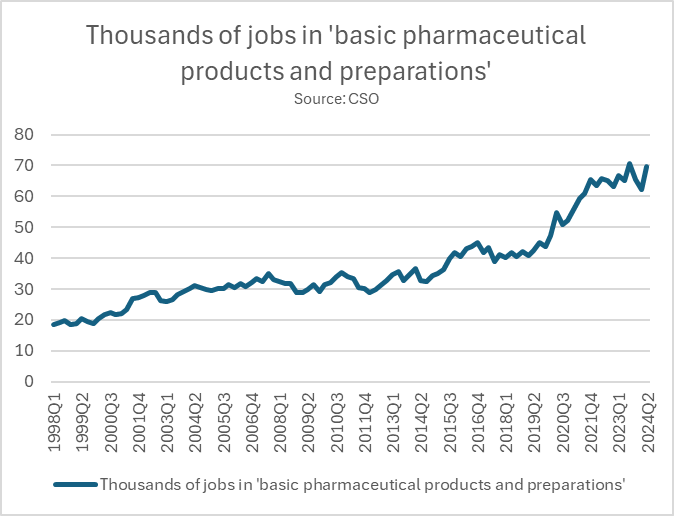
Irish trade numbers are inflated by transfer pricing, but 70,000 people are currently employed in what @CSOIreland calls ‘basic pharma products and preparations’ alone. 75% of Irish goods exports to the US are accounted for by the pharmachem sector. x.com/danobrien20/st…

Show more

Posted in Uncategorized | Leave a comment

Cognitive Superposition: Human Multitasking Meets AI (John Nosta @JohnNosta)

John Nosta (@JohnNosta) posted at 7:31 pm on Tue, Nov 05, 2024:
🧠Cognitive Superposition: Human Multitasking Meets AI

⚡️Large language models transcend human task-switching with parallel multitasking.

Conversation

John Nosta

@JohnNosta

Cognitive Superposition: Human Multitasking Meets AI Large language models transcend human task-switching with parallel multitasking.

@PsychToday

https://t.co/tDtDuqXcQV
(https://x.com/JohnNosta/status/1853882751239283131?t=RuxsjPpl9HY8Kt-1tjGw0g&s=03) 

Post

Reply

See new posts

Conversation

John Nosta

@JohnNosta

Subscribe

@PsychToday

Post

Reply

See new posts

Conversation

John Nosta

@JohnNosta

Subscribe

🧠Cognitive Superposition: Human Multitasking Meets AI ⚡️Large language models transcend human task-switching with parallel multitasking. Imagine a mind that can juggle multiple tasks seamlessly, solving complex math problems while translating languages—all at once and without missing a beat. Today, it’s becoming clear that artificial intelligence (AI)—especially large language models (LLMs)—has developed an impressive ability to handle multiple distinct tasks at once, a phenomenon detailed in a recent study with a rather fitting title, “Everything Everywhere All at Once: LLMs Can In-Context Learn Multiple Tasks in Superposition.” Researchers reveal that LLMs can engage in what they call “superposition,” allowing them to tackle multiple tasks concurrently. For example, when provided a prompt containing both arithmetic and translation exercises, the model doesn’t need to choose; it processes both in a single response. This capacity creates a kind of parallel cognitive state, where two distinct tasks coexist and function independently. But can our human brain do the same? The answer isn’t straightforward, but exploring it sheds light on the fascinating contrasts and parallels between human and machine intelligence in the context of cognitive multitasking. ⚡️Superposition in AI: A New Kind of Cognitive Multitasking Superposition in LLMs represents a unique form of cognitive flexibility. Unlike the human brain, which typically switches between tasks rather than holding them in parallel, these AI models can perform multiple tasks in one inference. This phenomenon arises from the model’s architecture: transformers, a powerful structure in AI, hold patterns of information in “layers,” allowing them to work on different contexts or objectives simultaneously. Imagine asking an LLM to analyze both the structure and the meaning of a sentence. Instead of breaking down the tasks in sequence, the model holds each in a shared “cognitive space,” drawing from each layer to deliver an integrated response. Larger models, like GPT-4, show enhanced capacity in task superposition, scaling their ability to handle complex, multilayered instructions without the risk of cognitive overload. This task superposition suggests that AI might one day take on intricate, multifaceted roles without explicit training, a development with substantial implications for real-world applications like healthcare, law, and creative industries. But, to understand the broader implications, it’s important to compare it to how the human brain manages multiple tasks. ⚡️The Human Brain’s Approach to Multitasking: Soft Superposition While the human brain doesn’t hold multiple complex tasks in a literal “superposition” like AI, it does exhibit a unique form of multitasking through mechanisms such as cognitive fluidity, background processing, and distributed attention. These mechanisms allow us to manage multiple streams of information without the direct, simultaneous execution that we see in LLMs. 🧠Cognitive fluidity: Cognitive fluidity refers to our brain’s ability to rapidly switch between different thoughts or tasks. Imagine working on a creative project while answering emails. While you may appear to multitask, the brain actually shifts back and forth between tasks, relying on memory and focus to blend both in a seamless experience. It’s more of a juggling act than true parallel processing. 🧠Working memory and cognitive load: Our working memory serves as a kind of mental workspace, holding a limited number of items in focus. This mechanism is critical for problem-solving, allowing us to process ideas, concepts, and information in real time. Unlike an AI, however, our brain’s working memory capacity is limited, typically capped at about three to five items. The more we try to focus on simultaneously, the more cognitive load we experience, often leading to diminished efficiency and accuracy. 🧠Default mode network and task switching: Unlike the AI model’s superposition, the human brain has a default mode network that operates in the background, holding ideas, concerns, and potential solutions without active focus. This network is why solutions to complex problems often come to us in relaxed moments, such as during a walk or in the shower. It’s not true superposition, but it’s our brain’s way of “parking” tasks, waiting for the right moment to bring them into active thought. 🧠Synesthetic and layered thinking: In unique cases like synesthesia or creative flow, the brain blends different senses or ideas into a single experience. For instance, someone with synesthesia may “see” colors when hearing music, hinting at a form of mental superposition where distinct cognitive layers overlap. Creative flow states offer a similar effect, where multiple thoughts and inspirations synthesize without conscious effort. ⚡️AI Superposition and Human Cognition This comparison opens intriguing possibilities in how we think about intelligence itself. AI’s superposition capabilities highlight a structured, explicit multitasking that could redefine “thought efficiency” in industries from healthcare to creative production. It suggests a future in which machines can handle layered tasks seamlessly, with fewer human inputs. Imagine an AI in healthcare that can simultaneously interpret medical scans, analyze a patient’s history, and draft a personalized treatment plan in a single step—no task switching, no compromise in quality. But while AI excels in structural multitasking, human cognition offers something distinctly adaptive. Our “soft superposition” allows us to blend experience, intuition, and emotion into complex decisions. We’re not constrained to narrow, literal interpretations. Even our limitations—the need to pause, reflect, and sometimes fail—bring a depth that shapes our thoughts and decisions with nuance. ⚡️Reexamining Intelligence The existence of superposition in AI forces us to reexamine what intelligence means. Is intelligence the ability to execute tasks in parallel with precision or does it lie in the ability to integrate tasks meaningfully over time, as humans do? Philosophically, AI’s task superposition raises questions about consciousness, self-awareness, and identity. If an AI can hold multiple tasks simultaneously and build on each experience, is it evolving toward a more complex form of thought? Perhaps AI’s structured superposition complements the human brain’s adaptive multitasking. As AI models continue to advance, we may see them as cognitive mirrors, helping us understand our own cognitive processes better. In this sense, AI superposition not only enhances productivity but also reveals what makes our own minds unique: a complexity born of experience, intuition, and the often unpredictable pathways of human thought. https://psychologytoday.com/intl/blog/the-digital-self/202411/cognitive-superposition-human-multitasking-meets-ai… #AI #LLMs
@PsychToday

https://psychologytoday.com/intl/blog/the-digital-self/202411/cognitive-superposition-human-multitasking-meets-ai… #AI #LLMs

Posted in Uncategorized | Leave a comment

Neuroscience News: Does Additional Education Protect the Brain?


Does Additional Education Protect the Brain?

Featured Neuroscience

·November 5, 2024

Summary: A recent study explored whether additional years of education lead to long-term changes in brain structure, especially in protecting against brain aging. Analyzing data from a unique natural experiment involving nearly 30,000 individuals, researchers found no detectable impact on brain structure from an additional year of education.

Although education is linked to better cognitive skills and health, it does not appear to alter the brain’s physical structure in the long run. Researchers suggest that any initial structural impact may be temporary or too small to detect with MRI technology. These findings highlight the need for caution when linking education directly to brain structure based on correlations alone.

Key Facts:

  • Education correlates with cognitive and health benefits but shows no lasting effect on brain structure.
  • The study used a natural experiment, comparing brain scans from individuals with and without an additional year of school.
  • The impact of education on brain structure may be temporary or microscopic, evading MRI detection.

Source: Radboud University

It is well-known that education has many positive effects. People who spend more time in school are generally healthier, smarter, and have better jobs and higher incomes than those with less education.

However, whether prolonged education actually causes changes in brain structure over the long term and protects against brain aging, was still unknown.

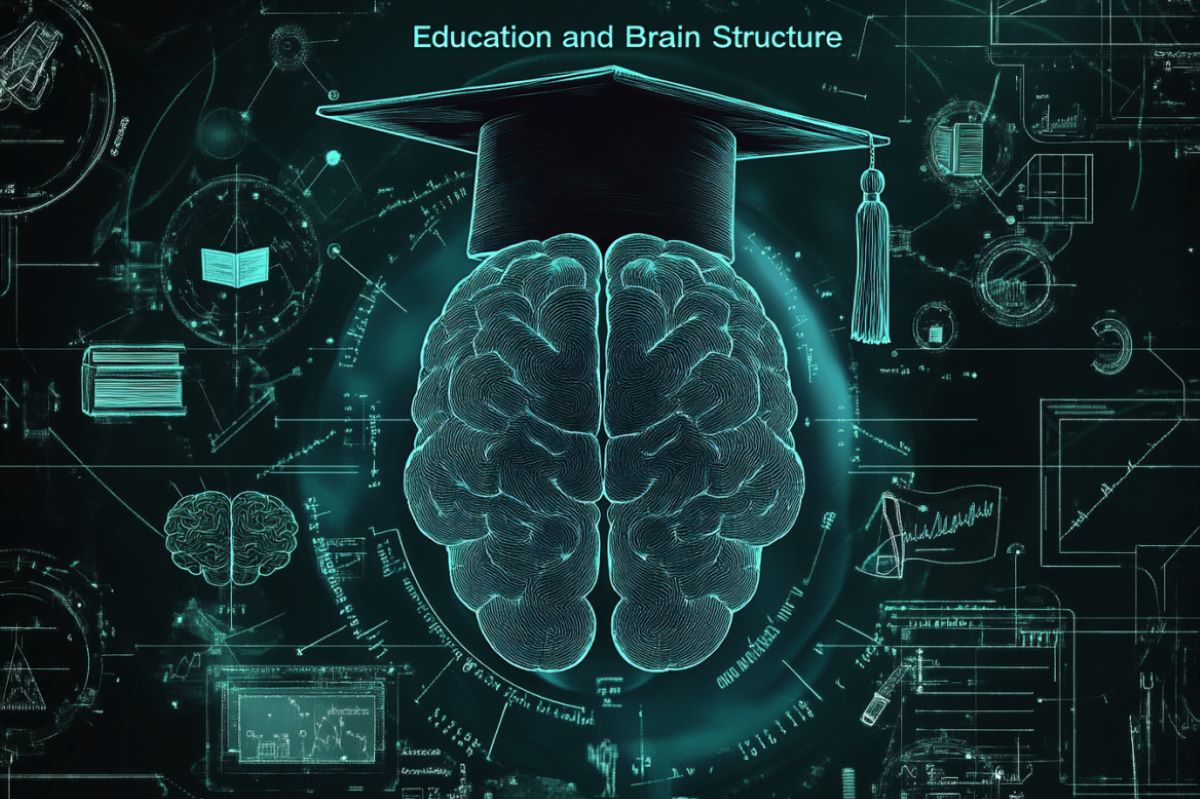
This shows a brain and a graduation cap.
The researchers examined the MRI scans for the structure of various brain regions, but they found no differences between those who attended school longer and those who did not. Credit: Neuroscience News

It is challenging to study this, because alongside education, many other factors influence brain structure, such as the conditions under which someone grows up, DNA traits, and environmental pollution.

Nonetheless, researchers Rogier Kievit (PI of the Lifespan Cognitive Dynamics lab) and Nicholas Judd from Radboudumc and the Donders Institute found a unique opportunity to very precisely examine the effects of an extra year of education.

Aging

In 1972, a change in the law in the United Kingdom raised the number of mandatory school years from fifteen to sixteen, while all other circumstances remained constant. This created an interesting ‘natural experiment’, an event not under the control of researchers which divides people into an exposed and unexposed group.

Data from approximately 30,000 people who attended school around that time, including MRI scans taken much later (46 years after), is available. This dataset is the world’s largest collection of brain imaging data.

The researchers examined the MRI scans for the structure of various brain regions, but they found no differences between those who attended school longer and those who did not.

‘This surprised us’, says Judd.

‘We know that education is beneficial, and we had expected education to provide protection against brain aging. Aging shows up in all of our MRI measures, for instance we see a decline in total volume, surface area, cortical thickness, and worse water diffusion in the brain. However, the extra year of education appears to have no effect here.’

Brain structure

It’s possible that the brain looked different immediately after the extra year of education, but that wasn’t measured.

‘Maybe education temporarily increases brain size, but it returns to normal later. After all, it has to fit in your head’, explains Kievit.

‘It could be like sports: if you train hard for a year at sixteen, you’ll see a positive effect on your muscles, but fifty years later, that effect is gone.’

It’s also possible that extra education only produces microscopic changes in the brain, which are not visible with MRI.

Both in this study and in other, smaller studies, links have been found between more education and brain benefits. For example, people who receive more education have stronger cognitive abilities, better health, and a higher likelihood of employment. However, this is not visible in brain structure via MRI.

Kievit notes: ‘Our study shows that one should be cautious about assigning causation when only a correlation is observed. Although we also see correlations between education and the brain, we see no evidence of this in brain structure.’

About this brain aging and cognition research news

Author: Pauline Dekhuijzen
Source: Radboud University
Contact: Pauline Dekhuijzen – Radboud University
Image: The image is credited to Neuroscience News

Original Research: Open access.
“No effect of additional education on long-term brain structure – a preregistered natural experiment in thousands of individuals” by Rogier Kievit et al. eLife


Abstract

No effect of additional education on long-term brain structure – a preregistered natural experiment in thousands of individuals

Education is related to a wide variety of beneficial health, behavioral, and societal outcomes. However, whether education causes long-term structural changes in the brain remains unclear.

A pressing challenge is that individuals self-select into continued education, thereby introducing a wide variety of environmental and genetic confounders. Fortunately, natural experiments allow us to isolate the causal impact of increased education from individual (and societal) characteristics.

Here, we exploit a policy change in the UK (the 1972 ROSLA act) that increased the amount of mandatory schooling from 15 to 16 years of age to study the impact of education on long-term structural brain outcomes in a large (n∼30.000, UK Biobank) sample.

Using regression discontinuity – a causal inference method – we find no evidence of an effect from an additional year of education on any structural neuroimaging outcomes.

This null result is robust across modalities, regions, and analysis strategies. An additional year of education is a substantial cognitive intervention, yet we find no evidence for sustained experience-dependent plasticity.

Our results provide a challenge for prominent accounts of cognitive or ‘brain reserve’ theories which identify education as a major protective factor to lessen adverse aging effects.

Our preregistered findings are one of the first implementations of regression discontinuity on neural data – opening the door for causal inference in population-based neuroimaging.

Posted in Uncategorized | Tagged , , , , | Leave a comment

The wonder that is your brain: How and why we study it?

The human brain, despite its small size at just one and a half kilograms, is a remarkable powerhouse that controls everything from sensing to thinking. With 100 billion interconnected neurons, it processes visual information in a mere tenth of a second and requires 20% of our daily energy intake. Studying the brain through various methods, including animal models, is essential for unraveling its mysteries, from understanding behavior to treating diseases and unlocking the potential for medical breakthroughs like helping paralyzed patients regain mobility and speech.

See our T&Cs: https://sciani.com/terms-conditions/

Additional Information ────────────────────────────

https://www.fens.org/

Posted in Uncategorized | Leave a comment

A Soviet poster from 1953 about the perception of the United States. Nothing’s changed. (Olga Bazova)

Posted in Uncategorized | Leave a comment