
Brain’s Working Memory Limits Tied to Learning, Not Just Capacity

Neuroscience News Logo

Brain’s Working Memory Limits Tied to Learning, Not Just Capacity

FeaturedNeuroscience

·February 25, 2025

Summary: A new study reveals that working memory limitations stem from learning challenges rather than storage capacity. Using a computer model of the basal ganglia and thalamus, researchers showed that holding too much information at once confuses the brain, impairing its ability to learn and use stored data effectively.

The model demonstrated that the brain compensates for this limitation by strategically “chunking” related information together, improving efficiency. These findings also shed light on dopamine-related disorders like Parkinson’s and ADHD, suggesting new treatment approaches targeting the basal ganglia and thalamus.

Key Facts

  • Learning Shapes Memory Limits: The brain restricts working memory capacity to prevent overload and optimize learning.
  • Chunking Strategy: To conserve space, the brain compresses related information, improving recall efficiency.
  • Dopamine’s Role: Disruptions in dopamine delivery impair memory efficiency, linking working memory deficits to conditions like Parkinson’s and ADHD.

https://29267a488e5ab5348f2a79b593ae9dc5.safeframe.googlesyndication.com/safeframe/1-0-41/html/container.html

Source: Brown University

Working memory is what allows humans to juggle different pieces of information in short-term scenarios, like making a mental grocery list and then going shopping or remembering and then dialing a phone number. 

While scientists agree that the capacity of working memory is limited, they offer competing theories about how and why this is true. But new research from scientists at the Carney Institute for Brain Science at Brown University shows why limits on working memory exist.
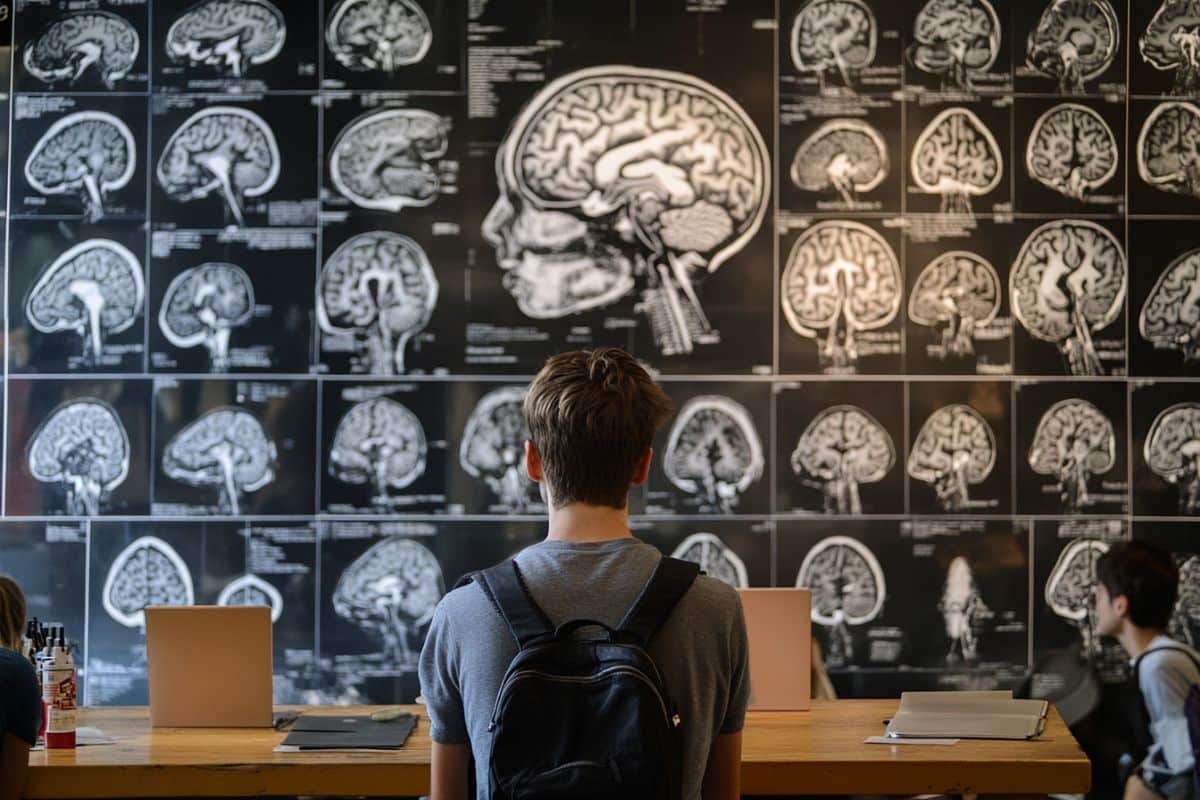
This shows brain scans.
When she challenged the model to the same series of trials, the results showed that without a healthy dopamine delivery system, the model did not learn how to use its storage space as efficiently and did not chunk items as often. Credit: Neuroscience News

https://29267a488e5ab5348f2a79b593ae9dc5.safeframe.googlesyndication.com/safeframe/1-0-41/html/container.html

Michael Frank, a professor of cognitive and psychological sciences affiliated with the Carney Institute, and Aneri Soni, a graduate student in his lab, developed a new computer model of the basal ganglia and the thalamus — the parts of the brain relevant to working memory — that shows why limits on working memory exist.

According to their study published in eLife, the answer has to do with learning.

“The simulations we ran show that if we did hold more than just a few items at a time, it becomes too difficult to learn how to manage so many pieces of information at once, such that the brain gets confused and can’t use the information it does store,” Soni said. “At the same time, our research demonstrates that when faced with these limitations, the brain responds by learning to strategically tap into a mechanism to help conserve space.”

Because the neurotransmitter dopamine plays an important role in how learning relates to working memory, the researchers said these findings shed new light on dopamine-related disorders such as Parkinson’s disease, attention deficit-hyperactivity disorder (ADHD) and schizophrenia.

The team arrived at their discovery by building and testing a new computer model of the brain that replicated the results of an experiment with humans conducted in 2018 by researchers in Frank’s lab and researchers in the lab of Matt Nassar, a Carney Institute assistant professor of neuroscience and cognitive and psychological sciences.

https://29267a488e5ab5348f2a79b593ae9dc5.safeframe.googlesyndication.com/safeframe/1-0-41/html/container.html

That study established that humans are capable of “chunking” information by compressing related pieces of information together in working memory to conserve space. 

Soni knew she’d successfully built a brain-like computer model capable of compressing information when she challenged her model to a version of the 2018 experiment. She showed the model a screen with colored blocks oriented in different directions and then asked it to recall which colored block was pointing in which direction.

Over the course of a number of trials, the model learned how to strategically compress information and began chunking together similar colors, such as blue and light blue. 

The lab’s simulations with the new model point to learning, rather than capacity, as the real driver of working memory, Soni said. She established this by running the trials on a model without the ability to chunk but with plenty of space to store items.

She found that while the model with the chunking mechanism was able to strategically store information to its full storage capacity, the model without the chunking mechanism did not seem to realize it had access to such a large amount of storage and was worse at both storing and retrieving the items.

A component critical to the model’s learning process is a mechanism that emulates the human brain’s dopamine delivery system, Soni said. When the model was doing a better job of recalling the orientation of a larger number of blocks because it had chunked similar colors together to save space, the dopamine delivery system kicked in, telling the model to continue to use this strategy when faced with the same set of constraints in subsequent trials.

https://29267a488e5ab5348f2a79b593ae9dc5.safeframe.googlesyndication.com/safeframe/1-0-41/html/container.html

In another part of the experiments, Soni altered the model’s dopamine delivery system to emulate what is known about dopamine levels in patients with Parkinson’s disease, schizophrenia and ADHD. When she challenged the model to the same series of trials, the results showed that without a healthy dopamine delivery system, the model did not learn how to use its storage space as efficiently and did not chunk items as often. 

New findings like this show how computational brain science can advance psychiatry, said Frank, who directs Carney’s Center for Computational Brain Science. 

“Take Parkinson’s disease as an example,” Frank said. “Most people think of it as a movement disorder because changes in movement are so obvious. But it turns out that Parkinson’s patients also have changes in working memory. They are generally treated with drugs that target the prefrontal cortex, but our findings suggest that we should be testing whether drugs that target the basal ganglia and thalamus help to improve symptoms.”

Frank said that an increased understanding of what takes place within the basal ganglia and thalamus for people diagnosed with dopamine-related disorders may spur clinicians to adopt different treatment options. 

Funding: This research was supported by the Department of Defense (ONR MURI Award N00014-23-1-2792) and the National Institute of Mental Health (R01 MH084840-08A1, T32MH115895). Computing hardware was supported by the National Institutes of Health (S10OD025181).

https://29267a488e5ab5348f2a79b593ae9dc5.safeframe.googlesyndication.com/safeframe/1-0-41/html/container.html

About this memory and learning research news

Author: Corrie Pikul
Source: Brown University
Contact: Corrie Pikul – Brown University
Image: The image is credited to Neuroscience News

Original Research: Open access.
“Adaptive chunking improves effective working memory capacity in a prefrontal cortex and basal ganglia circuit” by Michael Frank et al. eLife


Abstract

Adaptive chunking improves effective working memory capacity in a prefrontal cortex and basal ganglia circuit

How and why is working memory (WM) capacity limited? Traditional cognitive accounts focus either on limitations on the number or items that can be stored (slots models), or loss of precision with increasing load (resource models).

Here we show that a neural network model of prefrontal cortex and basal ganglia can learn to reuse the same prefrontal populations to store multiple items, leading to resource-like constraints within a slot-like system, and inducing a trade-off between quantity and precision of information.

Such “chunking” strategies are adapted as a function of reinforcement learning and WM task demands, mimicking human performance and normative models.

Moreover, adaptive performance requires a dynamic range of dopaminergic signals to adjust striatal gating policies, providing a new interpretation of WM difficulties in patient populations such as Parkinson’s disease, ADHD and schizophrenia.

These simulations also suggest a computational rather than anatomical limit to WM capacity.

Join our Newsletter

 I agree to have my personal information transferred to AWeber for Neuroscience Newsletter ( more information )

Sign up to receive our recent neuroscience headlines and summaries sent to your email once a day, totally free.

We hate spam and only use your email to contact you about newsletters. You can cancel your subscription any time.

Tags

brain researchBrown UniversityMemoryneurobiologyNeuroscienceworking memory

Posted in Uncategorized | Tagged , , , , | Leave a comment

SPIRE is a new research repository to communicate and share research from St Patrick’s Mental Health Services (SPMHS). Comment: I cannot highly enough recommend this for people like me diagnosed bipolar and anxiety. Decades seeking answers or tips for improvement have been lessened by bibliotherapy and tracking research via the internet. Spire and its links to training universities (Trinity College Dublin, UCD and Cork University) is worth following. In the early days of diagnosis I used to attend the lectures given in St. Patrick’s on a monthly basis. Education and knowledge are no load to carry.

SPIRE is a new research repository to communicate and share research from St Patrick’s Mental Health Services (SPMHS).

SPIRE (St Patrick’s Institutional Repository) is an online space designed to store, catalogue, preserve our academic outputs. It aims to make the published research work of our staff as widely available as possible.

SPIRE is a central hub for mental health research, with a wealth of valuable resources to enhance the quality of mental healthcare and inform future developments in mental health treatment.

We hope that SPIRE will benefit our service users, their carers, staff and healthcare professionals, and the wider mental health research community. It represents our commitment to fostering a culture of knowledge-sharing, collaboration, and continuous improvement in the field of mental healthcare.

How to use SPIRE

SPIRE has been developed by our Academic Institute.

SPIRE includes the full text of journal articles, conference presentations, book chapters, technical reports, working papers, reviews, and other scholarly contributions.

Where material has already been published by external sources, it is made available subject to the open-access policies of the original publishers.

At SPIRE, you can discover collections relating to each discipline, as well as search by issue date, author, title, and subject.

SPIRE is a living resource, and will continue to grow on an ongoing basis to include all research by our staff.

If you have any questions about SPIRE, you can contact our Academic Institute Programme Manager, Gráinne Donohoe, by emailing gdonohue@stpatricks.ie.

See our research repository

Visit SPIRE here 

Continue to…Research Projects

Posted in Uncategorized | Leave a comment

jns (Jewish News Syndicate): Head of DOJ antisemitism task force: We’ll put Hamas supporters in jail ‘for years’

Fighting Israel’s Media War

Help JNS get the facts out

Donate

update desk

Head of DOJ antisemitism task force: We’ll put Hamas supporters in jail ‘for years’

“Not for 24 hours, but for years,” civil rights attorney Leo Terrell warned.

Akiva Van Koningsveld

Civil rights attorney Leo Terrell speaks alongside U.S. President Donald Trump and golf legend Tiger Woods during a reception honoring Black History Month in the East Room of the White House, Feb. 20, 2025. Photo by Win McNamee/Getty Images.

Civil rights attorney Leo Terrell speaks alongside U.S. President Donald Trump and golf legend Tiger Woods during a reception honoring Black History Month in the East Room of the White House, Feb. 20, 2025. Photo by Win McNamee/Getty Images.

(Feb. 26, 2025 / JNS)

The U.S. Department of Justice-led Task Force to Combat Antisemitism will soon file federal hate crime indictments against campus activists “supporting Hamas and trying to intimidate Jews,” Leo Terrell, who leads the efforts, told Israel’s Channel 12 News on Wednesday.

“You see all these disorderly demonstrations, supporting Hamas and trying to intimidate Jews? We are going to put these people in jail—not for 24 hours, but for years,” Terrell, senior counsel to the assistant U.S. attorney general for civil rights, said in remarks translated to Hebrew.

Under the Biden administration, “local prosecutors did not take action to file hate crime charges,” the civil rights lawyer said. “In major cities like New York and Los Angeles, Jews have been harassed and denied access to universities. They [prosecutors] did nothing and failed at their job. We are about to do more in a month than Biden and Harris did in four years.”

The first indictments are expected to be filed in the next week and a half, he said, adding that other “aggressive” moves would also be announced.

“A lot is going to happen in the next four to five weeks,” Terrel said. “My message to Jews in the United States and around the world—help is on the way.”

When protesters face jail time, “it will stop,” said the official. “When you see universities start losing millions of dollars in federal funding, you’re going to see a change in their behavior. When you see court orders protecting Jewish students, visas of antisemitic students being revoked—you will see a major change,” he added, announcing a tour of 10 universities accused of “harming Jewish students and allowing harassment.

The Trump administration’s message to the colleges is “protect Jewish students like you protect all other students, or we’ll sue you and take away your funding,” he explained. “We’re going to make sure they don’t get a penny, we’re going to financially attack any university that doesn’t protect students, and if it’s public, we’re going to take away the funding.”

Since the Hamas-led Oct. 7, 2023, attacks, “There has been a tremendous increase in antisemitism worldwide. Our fight is not just here in the United States; we are trying to set an example for the entire world,” he concluded.

On Feb. 3, the Justice Department announced that following President Donald Trump’s executive order on “Additional Measures to Combat Antisemitism,” it had formed the task force to counter Jew-hatred.

Trump’s order called on every federal agency to submit a report to the president within 60 days about efforts to combat Jew-hatred following the Oct. 7 attacks.

“The department takes seriously our responsibility to eradicate this hatred wherever it is found,” Terrell explained at the time. “The Task Force to Combat Antisemitism is the first step in giving life to President Trump’s renewed commitment to ending antisemitism in our schools.”

Terrell, who is black and Christian, is a civil rights attorney and former talk radio host who has repeatedly spoken out in the media about the failure of the federal government to properly defend Jews after Oct. 7.

Posted in Uncategorized | Tagged , , , , | Leave a comment

Mother Jones: Trump Wants Zelenskyy to Buy US Protection With “Rare Earths.” Is That Even Possible? Quote: “Mines also require lots of energy, and the war has mauled Ukraine’s power grid. Ditto for roads and other transportation infrastructure. Plus there’s the inevitable environmental damage to be considered. Critical metal mining in Ukraine “has the potential to impact wetlands and rivers, old-growth forest and steppe,” cautions the Conflict and Environment Observatory.”

Donate MonthlyDonate

Smart, Fearless Journalism

25th February 2025

Trump Wants Zelenskyy to Buy US Protection With “Rare Earths.” Is That Even Possible?

Ukraine has no active rare earth mines—and relies on outdated Soviet mineral surveys.

https://66566b6bb99c479225b0cbc2ccc840b1.safeframe.googlesyndication.com/safeframe/1-0-41/html/container.html

Advertise with Mother Jones

Zelenskyy and Trump during a meet at Trump Tower last September. Julia Demaree Nikhinson/AP

This story was originally published on Vince Beiser’s Substack, Power Metal, to which you can subscribe here.

Just days before President Trump called Ukrainian president Volodymyr Zelenskyy a “dictator” who was somehow to blame for Russia’s invasion of his country, Trump floated the only slightly less controversial idea that Kyiv should pay the US for protection, in the form of Ukrainian minerals. “I told them I want the equivalent of like, $500 billion worth of rare earth, and they’ve essentially agreed to do that,” he said on Fox News on February 10. “We have to get something.”

Besides the glaring moral questions this proposal raises, there’s a practical one: Can Ukraine actually deliver what Trump wants?

Breaking China’s critical metal dominance “is one of the main geopolitical drivers in Washington right now.”

First, as the author of a recent book that covers the global trade and geopolitics of metals, I’m sure Trump is not talking only about rare earths. This is a term that confuses many people; it’s often mistakenly applied to all the critical metals we need for the Electro-Digital Age. In fact, rare earths are a subset of those critical metals.

Rare earths are a group of 17 obscure, esoterically named elements, like praseodymium and yttrium, that are crucial for electric car motors, cellphones, wind turbines, and a range of health and military technologies. The more familiar-sounding critical metals, like lithium, cobalt, nickel, and copper, are not rare earths.

MOTHER JONES TOP STORIES

symbol

Anyway, Ukraine does have some rare earths. But no one knows exactly how much, or even where they are. Ukraine’s claims about its mineral riches are based on Soviet-era exploration that was carried out decades ago. “Unfortunately, there is no modern assessment” of rare earth reserves in Ukraine, the former director general of the Ukrainian Geological Survey told S&P Global. And there aren’t any active rare earth mines, either.

We do know that Ukraine holds sizable deposits of several other important metals and minerals, including:

  • Lithium, graphite, and to a lesser extent nickel and cobalt, all of which are needed for the batteries that run EVs, cell phones and other cordless electronics
  • Titanium, important for many military technologies
  • Gallium and germanium, essential for semiconductors, TV and phone screens, solar panels, and military gear

In theory, gaining access to Ukraine’s minerals could not only make America money but help it reduce its dependence on China for these substances. The danger of that dependence was highlighted in December when Beijing banned exports of gallium and germanium. Breaking China’s critical metal dominance “is one of the main geopolitical drivers in Washington right now,” Bryan Bille, a policy expert at Benchmark Mineral Intelligence, tells me.

And Ukraine is willing to cut some kind of deal. Kyiv has been courting American investment since 2023. According to the New York Times, that push included a Trump-Zelensky meeting and visits to the US from Ukrainian officials pitching deals for lithium and titanium. The US and Ukraine are still discussing some kind of metals-for-security deal.

Advertise with Mother Jones

Whatever happens at the abstract heights of international diplomacy, however, there are major obstacles on the ground. Ukraine’s metals aren’t piled up in a treasure chamber somewhere. They’re in the ground—often in ground that Russian troops are standing on.

As much as half of Ukraine’s total mineral resources are estimated to be in the four eastern regions largely occupied by Russia. At least two established lithium deposits are in Russian-held territory, and another is just a few miles from the current front line. Few investors want to put their cash into mines within artillery range of a war zone.

Mines also require lots of energy, and the war has mauled Ukraine’s power grid. Ditto for roads and other transportation infrastructure. Plus there’s the inevitable environmental damage to be considered. Critical metal mining in Ukraine “has the potential to impact wetlands and rivers, old-growth forest and steppe,” cautions the Conflict and Environment Observatory.

“Given these barriers to mining and investment, we don’t expect any new substantial critical mineral supply anytime soon,” says Bille. Nor, it seems, should Ukraine expect any substantial new help from America anytime soon. Indeed, amid the negotiations over Ukraine’s future, Russian president Vladimir Putin, eager to reciprocate America’s newly friendly attitude toward his country, has extended a metallic olive branch.

Advertise with Mother Jones

On Monday, the Times reported, Putin bragged on state TV that “Russia’s deposits of rare earth minerals used in high-tech manufacturing were ‘orders of magnitude’ greater than Ukraine’s. He said Russia could work with American companies to help develop those deposits, even inside Russian-occupied Ukraine.” 

BEFORE YOU CLICK AWAY!

Mother Jones was founded to do journalism differently. We stand for justice and democracy. We reject false equivalence. We go after stories others don’t. We’re a nonprofit newsroom, because the kind of truth-telling investigations we do doesn’t happen under corporate ownership.

And the essential ingredient that makes all this possible? Readers like you.

It’s reader support that enables Mother Jones to devote the time and resources to report the facts that are too difficult, expensive, or inconvenient for other news outlets to uncover. Please help with a donation today if you can—even a few bucks will make a real difference. A monthly gift would be incredible.Donate Nowpayment methods

Related

Posted in Uncategorized | Tagged , , , , | Leave a comment

Fast Company Impact: … need more math, logic and grammar skills. Quote: “During middle school, students learn set definitions, notation, and representations (listing elements, Venn diagrams), set operations (union, intersection, difference, and complements), and relationships between sets (subsets, empty sets, disjointed sets, universal sets).”. Comment: ***Because of TBI and damage to Brocas, this is of interest to me and others who have suffered TBI

02-25-2025 IMPACT COUNCIL

Why today’s youth need more math, logic, and grammar skills

To develop and optimize AI use, our educational system needs to promote these basics.Why today’s youth need more math, logic, and grammar skills

[Photo: Getty Images]

BY Rodrigo Magnago5 minute read Share

The Fast Company Impact Council is a private membership community of influential leaders, experts, executives, and entrepreneurs who share their insights with our audience. Members pay annual membership dues for access to peer learning and thought leadership opportunities, events and more.


Most ordinary people know little about the calculus, statistics, linear algebra, logic, and programming languages required to design projects and products to leverage artificial intelligence.

However, we are not exempt from using products and services that rely on AI. If we do not learn how to maximize these tools, our organizations—businesses, schools, and governments—will have less ability to generate income and a lower quality of life compared to those who do.

What is most unsettling is the general lack of knowledge about logic, mathematics, and grammatical syntax that may affect AI’s creation and usage.

Set theory

Consider set theory in mathematics, introduced indirectly in elementary school. Basic concepts like classification, grouping, and counting objects, form its foundation.

During middle school, students learn set definitions, notation, and representations (listing elements, Venn diagrams), set operations (union, intersection, difference, and complements), and relationships between sets (subsets, empty sets, disjointed sets, universal sets).

By high school, students face set theory with greater complexity. Applications are presented in discrete mathematics, relationships between sets and probabilities, numerical sets and related algebraic operations, and advanced concepts to introduce mathematical logic.

You might be wondering where this is going.

Logical reasoning

Set theory feeds into logic: the science and art of reasoning correctly. Logic studies the principles of valid thought, structuring rules and methods that help evaluate the consistency and validity of arguments, deductions, and propositions.

Modern mathematics is built on set theory, itself a logical system. Logic provides the structure and principles underpinning mathematical reasoning. Concepts such as implication, equivalence, negation, and quantification are fundamental logical tools used in mathematics.

Logical reasoning uses symbols and formulas to represent propositions and inferences. It is essential for solving mathematical problems. In mathematics, logic explores topics like set theory and computability theory.

We’re circling back to the topic again.

Logic helps children (and adults) break problems into smaller, more manageable parts and tackle them systematically. When solving a puzzle, logical reasoning helps them identify patterns, rules, or constraints. Chess, Sudoku, mazes, and building blocks simultaneously develop logical thinking and problem-solving skills. In math and science, solving problems logically is intrinsic to solving equations, understanding patterns, and conducting experiments.

Grammar

And what about grammar? Although the proposition might seem counterintuitive, grammatical syntax has a direct relationship with mathematics, particularly set theory and logic.

In traditional grammar, syntax refers to the set of rules dictating how words and phrases are organized to form sentences. Grammatical classes (nouns, verbs, adjectives) combine according to rules, and sentences have hierarchical structures (clauses, phrases). Syntax rules determine whether a sentence is grammatically correct, and in linguistic analysis (parsing), understanding sentences involves breaking them into parts.

Noam Chomsky’s generative grammar theory describes the implicit rules and principles underlying natural language structure. It demonstrates how sentences are generated from a finite set of rules to create infinite possible expressions in a language.

Programming languages also have syntax—rules determining the correct structure of commands and expressions. Code elements (variables, functions, loops) combine using the specific rules of the language to form programs, which also have hierarchical structures (functions, blocks, modules). Like linguistic analysis, compilers and interpreters analyze code by breaking it into tokens (parts) and examining its structure.

Algorithms and AI

You might think this article was supposed to be about using artificial intelligence, not creating computational models. And you’re right.

One important concept for using AI’s capabilities is the notion of intervals. Defining intervals enable users to separate, structure, search, and manipulate information in databases or directly within documents.

This concept, widely used in set theory, is fundamental to logic, and connects logic to computer science, artificial intelligence, and dynamic systems. It also plays a critical role in syntax, particularly in structural analysis, grammatical hierarchy, and even natural language processing.

Ultimately, mathematics, logic, and grammatical syntax are fundamental to structuring algorithms.

It’s worth emphasizing the classical definition of an algorithm, originating in the 9th century: a finite set of well-defined, step-by-step instructions for completing a task or solving a problem.

Develop natural algorithms

The brain has specialized areas for numerical and logical processing (parietal lobe) and specific regions dedicated to grammar and syntax (Broca’s and Wernicke’s areas).***

These regions integrate their functions to create dynamic problem-solving strategies that mimic algorithmic thinking, unconsciously generating “natural algorithms” to tackle everyday challenges, such as planning a route or making decisions based on available data, evaluating options, and predicting outcomes.

The correlation between mathematics, grammar, and the brain’s ability to create natural algorithms for solving daily problems reveals a shared reliance on structured logical thinking and generative creativity.

This interconnectedness highlights the brain’s remarkable ability to abstract rules, recognize patterns, and develop natural algorithms to navigate the complexities of daily life.

A logical proposition is that our young people must be well-versed in fundamental mathematics and written language proficiency for a single purpose: to train their cognitive engines to develop natural algorithms, and then artificial ones, which increasingly mimic the human brain.

This way they can keep up with the times, which are being radically reshaped by humanity’s computational capabilities.

For parents, a logical takeaway is the idea of increasing their children’s instructional time in this cognitive set.

What skills are most important?

Calibrating the educational curriculum and workload has been a persistent challenge for educators. The current technological revolution makes this challenge even more pronounced. What is the correct workload for each subject to keep young people in step with evolution? Will mathematics, logic, and grammar gain more importance than subjects like history, geography, or chemistry?

A realistic perspective considers these skills as foundational as others, which are also taught in knowledge blocks—lessons, sections, chapters, numbered exercises, and, ultimately, structured intervals. Indeed, this structure is what students use globally, with tools like Google and now ChatGPT to support their studies (in best-case scenario).

Value creation

We are not looking for passive users if we aim for a better world. Technologies based on set theory, grammar, and logic were the foundation for social media and other revolutionary applications in recent years. Billions around the world improved their cultural awareness and their daily life, but we can’t exactly say that these applications created value for all of them.

The common usability of AI, such as addressing everyday inquiries, solving household essentials, drafting texts, creating videos, or using preset tools in the workplace, will certainly deliver significant benefits to the general population, much like its predecessor technologies did. However, this time, technology should go further by driving value creation that is more equally distributed, enhancing economic output for people around the world.

Rodrigo Magnago is the director of rere.eco.

The super-early-rate deadline for Fast Company’s Innovation by Design Awards is Friday, February 28, at 11:59 p.m. PT. Apply today.

Posted in Uncategorized | Tagged , , , , | Leave a comment

Mother Jones: Trump Officials Remind Federal Employees That Elon Musk Is Not Their Boss

February 23, 2025

Trump Officials Remind Federal Employees That Elon Musk Is Not Their Boss

Even Kash Patel pushes back against a DOGE inquiry emailed to workers across government.

Advertise with Mother Jones

Julia Mineeva/TheNEWS2/Zuma

Fight disinformation: Sign up for the free Mother Jones Daily newsletter and follow the news that matters.

Early Saturday morning, President Donald Trump took to Truth Social to make a seemingly unprompted post egging on Elon Musk.

“ELON IS DOING A GREAT JOB,” the post says. “BUT I WOULD LIKE TO SEE HIM GET MORE AGGRESSIVE. REMEMBER, WE HAVE A COUNTRY TO SAVE, BUT ULTIMATELY, TO MAKE GREATER THAN EVER BEFORE. MAGA!”

“Will do, Mr. President!” Musk replied in a post on X.

Within hours, the unelected tech billionaire looked to be eagerly complying, by seemingly ordering the sending of an email to untold numbers of federal employees demanding they promptly respond with “approx. 5 bullets of what you accomplished last week and cc your manager.” The email, which is similar to one Musk sent to employees at X after he bought that company, was unsigned and came from a human resources account at the Office of Personnel Management. It told recipients the deadline was Monday at 11:59 p.m. ET.

“Failure to respond will be taken as a resignation,” Musk said in a post on X announcing the directive.

The email itself does not say that, and as a federal employment law expert told CNN, Musk doesn’t have the authority to force federal employees to resign—and if he tried to, they would have ample legal recourse. And on Sunday afternoon, a spokesperson for the Office of Personnel Management seemed to walk back Musk’s threat of firings, telling Mother Jones that “[a]gencies will determine any next steps.”

But predictably, the email created even more mass chaos across a federal workforce that Musk has already thrown into disarray through mass layoffs prompted by his so-called Department of Government Efficiency (DOGE).

The biggest surprise may have been the federal officials—including a couple of Trump loyalists—who sought to guard their own turf from Musk, even by quickly telling their staff to essentially ignore the email, because Musk is not their boss.

Among them are newly-confirmed FBI Director Kash Patel, who wrote to staff Saturday night telling them to “please pause any responses” to the OPM email, while reminding them that the FBI will conduct its own internal reviews, NBC News reported. Interim US attorney for the District of Columbia Ed Martin, who was one of three people appointed by the RNC and the Trump campaign to run the party’s 2024 platform committee, wrote to employees to undermine the email, telling them to “be general” in their responses, and adding, “If anyone gives you problems, I’ve got your back,” CNN reported.

Ambassador Tibor Nagy, acting under secretary of management at the State Department, told staff that the department would respond on behalf of employees, adding, “No employee is obligated to report their activities outside of their Department chain of command,” NBC also reported. CNN reported, citing an anonymous source, that employees of the National Security Agency were told they should not respond until they get further guidance from the Department of Defense.

So far, it seems the only official who has publicly ordered employees to comply was Secret Service Director Sean Curran, who told employees that the email “requires your response,” according to CNN. Spokespeople for the White House and the Office of Personnel Management did not immediately respond to questions.

All of this—Musk’s overstepping of his authority and upending the federal workforce with uncertainty—is part of why GOP voters have turned out to recent town halls in droves to demand their Republican congresspeople answer how they would respond to how DOGE has accessed sensitive data and mass firings of federal workers, the Washington Post reported Friday.

As I have previously reported, polls keep showing that many Americans want Musk and DOGE out of government; new polls out this week from CNN and the Washington Post, for example, show far more Americans disapprove of Musk’s role in government than approve of it.

Update, Feb. 23: This post was updated with a comment from a spokesperson from the Office of Personnel Management.

BEFORE YOU CLICK AWAY!

Mother Jones was founded to do journalism differently. We stand for justice and democracy. We reject false equivalence. We go after stories others don’t. We’re a nonprofit newsroom, because the kind of truth-telling investigations we do doesn’t happen under corporate ownership.

And the essential ingredient that makes all this possible? Readers like you.

It’s reader support that enables Mother Jones to devote the time and resources to report the facts that are too difficult, expensive, or inconvenient for other news outlets to uncover. Please help with a donation today if you can—even a few bucks will make a real difference. A monthly gift would be incredible.Donate Now

Posted in Uncategorized | Tagged , , , , | Leave a comment

Every U.S state has now introduced right to repair legislation, a milestone fueled by fed-up Americans. Comment: On the shoulders of Giants – time for Ireland to engage in “right to repair”

Mario Nawfal (@MarioNawfal) posted at 8:16 am on Tue, Feb 25, 2025:

🚨
🇺🇸

ALL 50 STATES NOW BACK RIGHT TO REPAIR Every U.S state has now introduced right to repair legislation, a milestone fueled by fed-up Americans. These rules force companies to sell parts, share manuals, and ditch software locks, empowering folks to fix everything themselves from phones to tractors. iFixit’s Kyle Wiens calls it a “tipping point”—a shift from niche activism to a national roar against throwaway tech. Source: Slashdot, 404 Media

https://t.co/sj8c14IfCD
(https://x.com/MarioNawfal/status/1894300299403432229?t=xjl-g8palho422UwhnB4nA&s=03) 

Posted in Uncategorized | Leave a comment

Professor Jeffrey Sachs … “The War is Ending…”

Mick Wallace (@wallacemick) posted at 8:46 am on Tue, Feb 25, 2025:


A pathetic bunch of Politicians went to Kiev and continued the lie about the US #NATO Proxy War in Ukraine, continued to talk about throwing the money of EU citizens at Ukraine – It took the best Democracy that money can buy to get these Warmongers into positions of Power…

https://twitter.com/i/status/1894261129561387334

Posted in Uncategorized | Leave a comment

“Regime Change” … where are the successes? Elon Musk

Elon Musk reposted

Mario Nawfal

@MarioNawfal

Subscribe

ELON: WE SPENT FAR TOO MUCH ON REGIME CHANGE IN VARIOUS COUNTRIES

“I do think we interfere too much in what other countries do. The success of the State Department in achieving regime change is terrible. There’s this effort spent, all this money spent trying to affect regime change in various countries but failed in Cuba, failed in Iran, failed in North Korea, failed in Russia. Where are the successes? A lot of people died, and a lot of money was spent. What good has come of it? I think we should interfere a lot less with other countries.” Source: Harrisburg, Pennsylvania, October 2024

https://twitter.com/i/status/1894399452879958397

Posted in Uncategorized | Leave a comment

Ireland … you need to awaken!! Thomas Sowell quote below

Thomas Sowell Quotes

@ThomasSowell

“Europe is belatedly discovering how unbelievably stupid it was to import millions of people from cultures that despise Western values and which often promote hatred toward the people who have let them in.” — Thomas Sowell

Posted in Uncategorized | Leave a comment
