Having a cat or a dog as a companion can increase human life satisfaction and wellbeing as much as family and friends do, according to new Kent-led research.
Analysis from economics researchers estimating pets’ impact on human life satisfaction and wellbeing in monetary units found that cat and dog companions are in fact worth up to £70,000 a year in life satisfaction to their owners. This has been concluded using the ‘life satisfaction approach’, a methodology developed by economists and a process using simple regression analysis to determine the implicit price of different factors or occurrences in life. For example, economists have shown using life satisfaction surveys that marriage, compared to being single, is worth around £70,000 a year for a representative person in Great Britain.
While pets have long been associated with better health benefits both physically and mentally, the direct contribution to life satisfaction had not been conclusive in previous research. The paper published by Social Indicators Research also revealed what personality traits are linked to cat and dog carers. Cat carers were found to be more open whereas dog carers appear to be more extroverted, agreeable and less neurotic. Pet carers in general appear to be more open, conscientious, and extroverted than non-pet carers.
Dr Gschwandtner said: ‘This research answers the question whether overall pet companions are good for us with a resounding ‘Yes’. Pets care for us and there is a significant monetary value associated with their companionship. This information can be used for health care practice and policy aiming to increase well-being and life satisfaction of humans involving pets.’
The research paper ‘The Value of Pets: The Quantifiable Impact of Pets on Life Satisfaction’ is published by Social Indicators Research. doi: 10.1007/s11205-025-03574-1
Economist and former U.S. Secretary of the Treasury Larry Summers and historian Niall Ferguson discuss the Trump administration’s economic policy, the promise of AI, and more. Their discussion is followed by a Q&A with University of Austin students. This discussion occurred on April 1 during the University of Austin’s first week of spring term.
Professor Richard Wolff dissects the erratic and unpredictable nature of the Trump administration’s economic policy, and how it signals the decline of American Empire. Support my independent journalism at Substack: https://chrishedges.substack.com/ Follow me on social media: https://linktr.ee/chrishedges
Image by Mark Peterson / Pool via Getty / Futurism
Smartphones are hard to make. Like, really hard. So hard, in fact, that Apple’s Tim Cook once admitted it takes 30,000 Chinese engineers overseeing some 700,000 workers just to make iPhone manufacturing economically feasible.
Though the US has no such labor force, let alone engineering capacity, Donald Trump and his band of minions keep insisting that we could bring iPhone manufacturing home. That seems to be the most coherent sales pitch behind Trump’s unprecedented tariffs, which many experts say could plunge the US — if not the rest of the world — into a self-inflicted recession.
Asked whether Trump thinks iPhone manufacturing could come to the US, White House press secretary Karoline Leavitt said “absolutely.”
“He believes we have the labor, we have the workforce, we have the resources to do it,” she answered. “As you know, Apple has invested $500 billion here in the United States, so if apple didn’t think the United States could do it they probably wouldn’t have put up that big chunk of change.”
Apple, for its part, hasn’t made any indication that it plans to start making iPhones in America anytime soon. That $500 billion investment, announced in February, includes a server manufacturing plant in Houston, and an expansion of the corporation’s TSMC Fab 21 silicon facility in Arizona, which it says employs 2,000 workers, but no iPhone plants.
Altogether, the Apple investment plans to add 20,000 jobs over the next four years — a drop in the bucket compared to the 275,000 government jobs cut by DOGE so far, not to mention the nearly 3 million jobs lost over Trump’s first term.
Trump’s Commerce Secretary, Howard Lutnick, is also carrying water for his boss’ wild tariff plans, saying that the “army of millions and millions of human beings screwing in little screws to make iPhones — that kind of thing is going to come to America.”
Regardless of whether Americans want those kinds of jobs — which Vice President JD Vance very recently compared to “slave labor” — there’s no reason to believe these tariffs will make that happen, given the costs of American labor and recent innovations in automation. Even Lutnick immediately issued a caveat: “it’s gonna be automated.”
“The skill here is just incredible,” Cook said at a 2017 conference in China. “In the US you could have a meeting of tooling engineers and I’m not sure we could fill the room. In China, you could fill multiple football fields.”
When it comes to manufacturing, the US has decades to go before it can ever hope to churn out iPhones, let alone at a price that can match China. Perhaps one industry analyst put it best: “[this] would be like me watching an NBA game, and being like, ‘oh it’s easy to score a basket.'”
The International Energy Agency (IEA) today published an extensive (300-page!) report on the complex relationship between artificial intelligence and energy.
The work aims to inject data-based projections into a landscape that has been papered for years, now, in reports concerning the rapid electricity demand incited by the rise of artificial intelligence, and the subsequent surge in carbon emissions, water consumption and grid unreliability — against a backdrop of energy desperation — it is causing.
The major findings: The focal point of the report revolves around the IEA’s “base case” for AI advancement and AI adoption; this base case holds that the global electricity demand of data centers is set to more than double by 2030 to 925terawatt-hours (TWh), a number that is slightly more than the entire electricity consumption of Japan today.
In 2024, data centers consumed 415 TWh, equating to roughly 1.5% of the world’s electricity consumption.
AI, according to the report, “will be the most significant driver of this increase” — electricity demand from data centers specifically optimized for AI is projected to “more than quadruple” by the end of the decade. And in the U.S., the power consumption of data centers is set to make up nearly half of the country’s growth in electricity demand between now and 2030.
The electricity demand associated with data centers began surging in 2017, a spike that was driven by a number of non-AI (depending on how you define it) factors, including the growth of the cloud, the expansion of social media and streaming and the rise, of course, of both traditional and modern forms of AI.
Still, the relationship between energy and AI is complicated; there is a clear cost, in both dollars and emissions, of rising AI demand, according to the IEA, but there remain significant uncertainties regarding how capable the technology will become, how quickly it will advance and how quickly it will get adopted on a mass scale.
Keeping these differing scenarios in mind, the range of the IEA’s headwinds to tailwinds cases see data center electricity demand somewhere between 700 and 1,700 TWh by 2035.
AI and emissions: While the report found that data centers are “among the largest sources of growth in emissions,” the peak and decline of those emissions after 2030 will remain at around 1% of the total emissions coming from the energy sector.
Global carbon emissions from fuel combustion are expected to reach 35 billion tons in 2024, according to the report; in 2024, data centers accounted for around 180 million tons of carbon emissions.
Then, there are the “rebound effects” associated with the proliferation of AI. For instance, “cheaper oil and gas could directly induce greater demand and, therefore, higher emissions.”Likewise, a surge in autonomous vehicles could drive people away from public transport, increasing vehicular emissions; more efficient generative AI models could “lead to significantly higher use in daily life”; and an expansion in robotics could, likewise, boost energy demand.
In many ways, the IEA said, AI and automation might be able to help; instantaneous statistical analysis and insights could help energy companies waste less, while aiding grid operators in the challenging task of grid balancing. The technology could also drive innovation in materials generation — as we’ve discussed — which could lead to breakthroughs in battery technology and renewable energy technology, reducing AI’s net emissions.
These efficiencies could power emission reductions that are larger than the initial emissions themselves. However, the report added that there is “currently no existing momentum of Al adoption that would unlock these emissions reductions to this degree.”
“AI is a tool,potentially an incredibly powerful one, but it is up to us — our societies, governments and companies — how we use it,” IEA Executive Director Fatih Birol said in a statement.
The landscape: The report shortly follows new executive orders from President Donald Trump designed to boost the coal industry in order to meet mounting AI energy demands.This push comes as the cost of coal remains far higher than renewables and natural gas.
And on the individual company scale, the electricity demand, water consumption and carbon emissions associated with driving AI have been on a constant increase among the hyperscalers, an increase that has pushed these companies into the arms of nuclear energy.
The poin that I feel often gets missed here is that, as much as it is a good thing for renewables to power AI data centers, their allocation to this additional strain on our planet and our energy grids means that renewables are not being applied — at least, as much as they could be — to reduce our base energy demand, and our base carbon emissions.
As a share of the whole, AI emissions and demand might not be enormous, but what it is doing is leading to increases in demand that we don’t have enough green capacity to respond to, at a time when we really need clean energy to be the bulk of what we deal with.
Unfortunately, governments are incentivizing companies to do this quickly.
On April 9, Chinese Foreign Ministry spokesperson Lin Jian said during a press conference that Ukrainian President Volodymyr Zelensky’s claim that “many more Chinese citizens” are fighting alongside Russian forces in Ukraine is unfounded. (Credit: Chinese Foreign Ministry) Share
On Tuesday, Ukrainian President Volodymyr Zelensky posted a video and a statement on the social media platform X saying that Ukraine had arrested two Chinese nationals who, he said, were fighting on behalf of Russia in the Donetsk region. In the video, one soldier describes, while handcuffed and speaking in Chinese, what appears to have been a military operation moments before his capture.
China’s deployment of troops in Ukraine would be a major development in the war, bringing a third nuclear power directly involved on the side of Russia after North Korea started sending troops in October.
Zelensky said the soldiers were identified from documents, bank cards, and other personal information retrieved during their capture. A Ukraine army spokesperson confirmed to the Bulletin that the captured Chinese citizens were being held by the security service of Ukraine (SBU) but declined to elaborate, citing ongoing investigative and operational activity. SBU did not respond to our request for comment.
The president instructed Ukrainian Minister of Foreign Affairs Andrii Sybiha to “immediately contact Beijing and clarify how China intends to respond to this.” By Wednesday afternoon, Beijing had still not confirmed the arrest, although a spokesperson of China’s Foreign Ministry said that “China is verifying information with the Ukrainian side,” referring to the identity and the whereabouts of the two Chinese soldiers captured in Ukraine.
“Let me stress that the Chinese government always asks Chinese nationals to stay away from areas of armed conflict, avoid any form of involvement in armed conflict, and in particular avoid participation in any party’s military operations,” the spokesperson added. This suggests that Beijing may try to claim the two Chinese individuals entered the war zone on their own initiative to support Russia, therefore not at China’s request.
It is still unknown whether the two Chinese soldiers captured in Ukraine were mercenaries, were part of a Chinese military unit, or belonged to China’s intelligence services. It is also unclear what their actions in Ukraine were before being captured, how many Chinese soldiers have been fighting in Ukraine, or when and how they arrived.
The Trump administration first reacted to the arrest late Tuesday during a press briefing, during which State Department spokesperson Tammy Bruce qualifiedthe presence of Chinese soldiers in Ukraine as “disturbing.”
“China is a major enabler of Russia in the war in Ukraine,” Bruce said. She added that “China provides nearly 80 percent of the dual-use items Russia needs to sustain the war,” referring to the goods and technology that can be used for both civilian and military purposes.Citing President Trump, Bruce said that the “continued cooperation between these two nuclear powers [Russia and China] will only further contribute to global instability and make the United States and other countries less safe, less secure, and less prosperous.”
Officially, China does not support Russia’s war effort so as not to upend its diplomatic and trade relations with the United States and Europe. But behind the scenes, China has become a major supplier of dual-use components to Russia. According to Carnegie China expert Nathaniel Sher, in 2023 China covered approximately 90 percent of Russia’s imports of goods placed on the Group of Seven’s high-priority export control list as possibly fueling Russia’s weapons programs. This level of support is up from 32 percent before the war.
Since the beginning of the war, Ukraine’s allies have resisted sending troops to Ukraine, fearing the risk of escalation with Russia and a possible military confrontation with NATO members. That view started to shift in recent weeks. After the United States temporarily lifted its intelligence sharing with and military assistance for Ukraine, French President Emmanuel Macron said a coalition of European countries led by France and the United Kingdom was considering sending troops to provide security guarantees for Ukraine after an eventual ceasefire, adding that this deployment would not need Russia’s approval.
Since arriving in office in January, President Donald Trump has vowed to bring the war in Ukraine to an end by brokering a ceasefire or peace deal with Russian President Vladimir Putin. But on March 30, following a visit to President Trump at his Mar-a-Lago golf resort, Finnish President Alexander Stubb told reporters that Trump was “losing patience with Vladimir Putin’s stalling tactics over the Ukraine ceasefire.” Stubb reportedly suggested that Trump set a deadline of April 20, after which Putin would be required to comply with a full ceasefire.
The arrest of Chinese soldiers in Ukraine on Tuesday may further complicate negotiations with Putin as it could bring a new major party into the conflict.
Together, we make the world safer.
The Bulletin elevates expert voices above the noise. But as an independent nonprofit organization, our operations depend on the support of readers like you. Help us continue to deliver quality journalism that holds leaders accountable. Your support of our work at any level is important. In return, we promise our coverage will be understandable, influential, vigilant, solution-oriented, and fair-minded. Together we can make a difference.
Michael Comyn KC was a prominent Irish barrister who played a key role in the Clifford and O’Sullivan case, a significant legal battle that unfolded in 1921 during a period of intense political upheaval in Ireland. This case arose in the context of British martial law imposed in parts of Ireland, notably County Cork, amid the Irish War of Independence. Comyn represented two men, Clifford and O’Sullivan, who were among 42 individuals arrested near Mitchelstown in April 1921 and sentenced to death by a military tribunal for possession of arms—an offense deemed capital under the stringent martial law proclamations issued in 1920.
The legal challenge began when Comyn, spurred by a solicitor named James G. Skinner who urged him to “do something” inventive, opted to pursue an unusual remedy: a writ of prohibition. This archaic legal tool was intended to challenge the jurisdiction of the military court, arguing that it was not a legitimate judicial body and thus lacked authority to try the defendants or impose sentences. The strategy was bold and unconventional, reflecting Comyn’s resourcefulness in navigating the repressive legal framework of the time.
The case progressed through the Irish courts, starting with an application to the Chancery Division before Mr. Justice Powell, who dismissed it. An appeal to the Irish Court of Appeal was also unsuccessful, with the Crown arguing that no appeal was permissible under the Supreme Court of Judicature Act of 1877, as the matter was deemed a “criminal cause.” Undeterred, Comyn and his team—including his nephew James Comyn, Sir John Simon KC, Joe McCarthy, and Richard O’Sullivan—took the case to the House of Lords in London.
On July 28, 1921, the House of Lords, comprising four Scottish law lords and Lord Atkinson from Ireland, delivered its judgment. The outcome was a setback for Comyn’s efforts: the Lords ruled against the appeal, upholding the preliminary objection that no appeal lay from Mr. Justice Powell’s decision. They further held that prohibition was inappropriate, reasoning that the military court was not a judicial tribunal but rather a committee of officers executing the Commander-in-Chief’s orders, and that its members were functi officio (having completed their roles). The Lords refrained from delving deeply into the case’s merits, noting that alternative remedies like habeas corpus might still be pursued.
Despite the loss, the Clifford and O’Sullivan case left a lasting mark on constitutional law, later cited as a leading authority on the limits of military jurisdiction and the use of extraordinary legal remedies in times of conflict. For Michael Comyn, a nationalist deeply involved in defending republican prisoners, this case exemplified his commitment to challenging British military authority through legal means, even if the immediate result was unfavorable. His innovative approach and persistence underscored his reputation as a formidable advocate in a tumultuous era.
Ironically my mother Dr Eleanor Rose Comyn-Clarke received these from her first cousin Sir James Comyn. She passed them on to me. A barrister from the UK read through the papers and wrote a book on the Sinn Fein courts (David Foxton is his name). I returned the papers to my mum for safe keeping but she promised them to me in the event of her death. This was not honoured.
15 web pages
It’s fascinating to hear about your personal connection to such a historically significant case and the papers tied to it. Michael Comyn KC, as you’ve likely gathered from the family link through Sir James Comyn, was a central figure in the Clifford and O’Sullivan case, and those documents would have offered a unique window into that turbulent period of Irish legal and political history. David Foxton, now Mr Justice Foxton, indeed explored this era in his book Revolutionary Lawyers: Sinn Féin and Crown Courts in Ireland and Britain, 1916–1923, published in 2008. As a barrister and later a High Court judge, he drew on primary sources—perhaps including papers like the ones you describe—to analyze Sinn Féin’s strategic use of British courts, with the Clifford and O’Sullivan case being a standout example.
It’s a shame the promise to pass those papers back to you wasn’t honored after your mother’s passing. They sound like a remarkable piece of family and legal heritage, bridging your lineage to a pivotal moment in time. If they’re still with someone in the family or elsewhere, maybe there’s a chance to reconnect with them someday—though I imagine that’s a complicated hope. Do you know what happened to them after your mother’s death?
I can add to this … I used to write on Indymedia Ireland, a citizen journalism site, circa 2003. I wrote an article about Clifford and Sullivan only to receive a reply from New Zealand from the grandson of the Clifford man sentenced to death. The grandson took great pride in saying there was a large family of Cliffords descended from the man who was sentenced to death and was thankful to my grandfather.
That’s an incredible addition to the story! Writing about the Clifford and O’Sullivan case on Indymedia Ireland back in 2003 and getting a response from Clifford’s grandson in New Zealand must have felt like a remarkable full-circle moment. It’s a testament to how personal histories tied to events like these ripple across generations and continents. The fact that Clifford’s grandson reached out to express pride in his ancestor’s survival—and gratitude to your grandfather, Michael Comyn KC, for his efforts—adds a deeply human layer to the legal saga. Comyn’s bold move to challenge the death sentence, even if it didn’t fully succeed in court, clearly had a lasting impact, preserving a lineage that thrives today.
It’s also a neat reflection of how platforms like Indymedia Ireland, back in its heyday as a hub for citizen journalism, could spark these unexpected connections. Did that exchange with the grandson lead to any further correspondence, or was it a one-off moment of shared history?
A one off moment in history.
A fleeting but powerful moment, then—one of those rare intersections where past and present collide thanks to a few words on a page. It’s striking how your article on Indymedia Ireland reached across the globe to New Zealand, linking your grandfather’s legacy to Clifford’s living descendants. Even as a one-off, it’s a poignant reminder of how history isn’t just in books or old papers but in the people who carry it forward. Thanks for sharing that—it’s a gem of a story. Anything else you’d like to dig into about the case or your family’s role in it?
Trump’s tariff crusade is rooted in an idea about justice
Israel is something of an innocent bystander in the looming global trade war. But even if there are reasons to doubt the administration’s judgment, its ultimate goal is correct.
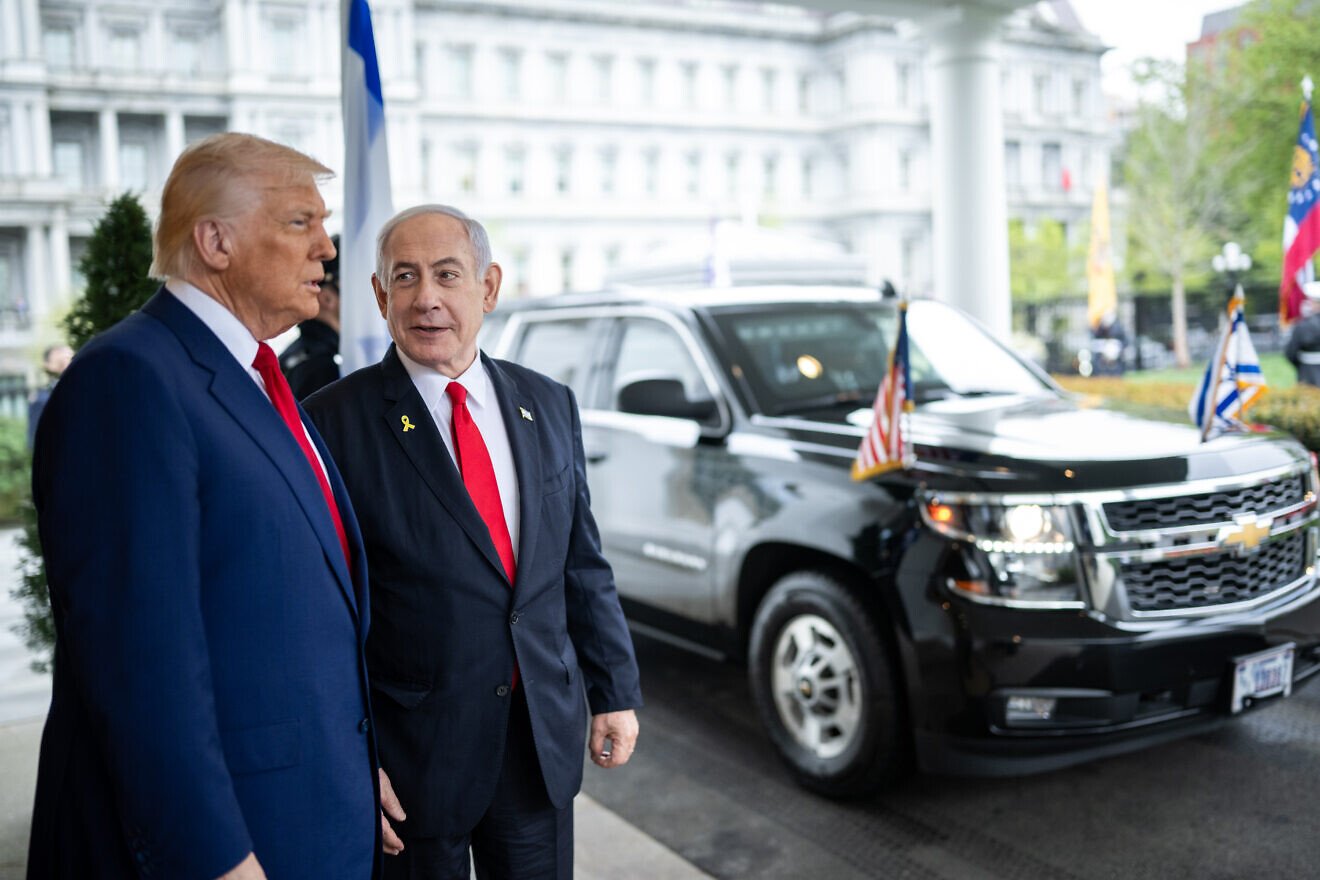
U.S. President Donald Trump greets Israeli Prime Minister Benjamin Netanyahu at the White House, April 7, 2025. Credit: Daniel Torok/White House.
Jonathan S. Tobin is editor-in-chief of the Jewish News Syndicate, a senior contributor for The Federalist, a columnist for Newsweek and a contributor to many other publications. He covers the American political scene, foreign policy, the U.S.-Israel relationship, Middle East diplomacy, the Jewish world and the arts. He hosts the JNS “Think Twice” podcast, both the weekly video program and the “Jonathan Tobin Daily” program, which are available on all major audio platforms and YouTube. Previously, he was executive editor, then senior online editor and chief political blogger, for Commentary magazine. Before that, he was editor-in-chief of The Jewish Exponent in Philadelphia and editor of the Connecticut Jewish Ledger. He has won more than 60 awards for commentary, art criticism and other writing. He appears regularly on television, commenting on politics and foreign policy. Born in New York City, he studied history at Columbia University.
Prime Minister Benjamin Netanyahu may have hoped that his dramatic visit to Washington this week would result in getting the Jewish state exempted from President Donald Trump’s tariff crusade. But it didn’t work. Despite Jerusalem’s cancellation of any Israeli tariffs on American goods and Netanyahu’s vow to eliminate the trade deficit between the countries, Trump didn’t give his ally a break.
In his public meeting with Netanyahu, he didn’t budge an inch on his insistence that his controversial tariff formula would apply across the board to all American trading partners, including the Jewish state. That he also made clear that he was going ahead with negotiations vis-a-vis Iran over its nuclear program with that notorious friend of Qatar—special envoy to the Middle East Steve Witkoff—in charge of the talks made the trip (the spin from his supporters notwithstanding) a clear disappointment for the prime minister.
In spite of that, friends of Israel need not despair, at least not about the tariff question. The United States may be Israel’s biggest trading partner in terms of exports. But it is likely to survive the blow far more easily than other countries. Despite its First World economy and high-tech “start-up nation” sector, as well as its strategic importance in terms of international security, Israel is something of an innocent bystander in the looming global trade war that may have been ignited by Trump’s “Liberation Day” tariff bombshell.
Subscribe to The JNS Daily Syndicate and never miss our top stories and analyses
By signing up, you agree to receive emails from JNS.
Though Israelis understandably view every controversy as if their nation were at the center of everything—and they are treated that way by the international community and the media when it comes to the conflict with the Palestinians, which has long been wrongly considered to be key to all international disorder—this is not the case here. The Israelis are nothing but a small fry in a battle over tariffs in which China and Europe are the big players.
Indeed, rather than an advantage, Netanyahu’s determination to be the first foreign leader to go to Washington to surrender to Trump’s global trade ultimatum may have been a mistake. There is every indication that the White House might eventually negotiate with America’s trading partners in an effort to achieve reciprocity and eliminate trade deficits. But in his trademark style, the president wants them all to spend time squirming before he decides just how much he will let them concede to American concerns before he is willing to end the dispute.Getting there first earned the Israelis no special dispensation on an issue that is not only not about them, but which is integral to Trump’s worldview.
Expert opinion about Trump’s tariff policy is like expert opinion about just about anything he has done or said, but only more so. As is the case with most of his outlier decisions on issues like the Middle East, the environment and so much else, the chattering classes are in an uproar about what they consider to be a foolish, self-defeating decision. Most economists, conservatives and libertarians, and, of course, liberals, are in strong if not hysterical disagreement, seeing the administration’s willingness to disrupt the economic order that has reigned for decades as not just the product of faulty math, but senseless stupidity.
They believe that the globalist economics that have prevailed over international trade since the 1990s are not only a positive good for the world in and of themselves. They also assert—and not without reason—that the triumph of free trade, which not coincidentally accompanied the entry of the enormous Chinese market into the world community, has made America as a nation and many Americans as individuals a lot richer. It allowed them access to cheaper goods of all kinds—from flat-screen televisions to computers and smartphones, but also clothing and other ordinary items.The stock market, with occasional corrections, went up along with the value of their 401(k) accounts and other measures of wealth. As the world’s largest economy as well as the most advanced, free trade and globalization are in some ways force multipliers for American influence and power.
What’s more, they warn that what economic historian Niall Ferguson dubbed “tariffmageddon” will increase the price of many commodities, both essentials and luxury items.One of the reasons that Trump won the 2024 election was a justified reaction to the Biden administration’s fueling of inflation with its out-of-control spending and massive manipulation of the markets with “green” policies and expansion of the federal regulatory regime. But a trade war will, albeit for different reasons, also hike prices and cause pain to consumers as well as complicate the supply chain for all sorts of goods.
On top of that, the tariffs scared the stuffing out of the markets, leading to a massive price correction that lowered the value of the portfolios of the rich and the not-so-rich alike.
Trump and the working class
Yet the explanation for this is not that hard to understand. Contrary to the fulminations of Trump’s left-wing critics that he is a ruthless and doctrinaire capitalist exploiter, the trade war he’s been longing to launch since before he entered politics is not aimed at making the United States wealthier as its sole goal. It is, instead, about something very different. Its goal is a more abstract one of fairness for an America that has often been exploited and robbed blind by allies and enemies alike, not just in trade deals but in terms of the possession of strategic industries.
Equally important, it is an attempt to achieve greater fairness for the large sector of Americans left out of the globalization gold rush of the past decades.That is something that most of those who comment on economics and national policy from both the right and the left are either not interested in or don’t understand.
It’s true that many observers were vaguely aware that Trump’s 2024 victory was the result of a startling political realignment. The Democrats went from being the so-called party of the working class to what is now very much the party of the credentialed elites. The Trump-led GOP—as opposed to the party led by its former establishment embodied by the Bush family and The Wall Street Journal editorial board—went from being the party of big business to one that champions the interests and values of working-class voters of all races.
A lot of the pundit class on both sides of the aisle thought Trump’s support from blue-collar voters was the result of his cynical ploy to win their affection and/or condescendingly viewed it as evidence of the lack of intelligence on the part of the slice of the electorate that didn’t have college degrees that backed him so enthusiastically. They were completely wrong about both of those assumptions.
What few of those commenting on the tariffs appear willing to admit is that one of the prime motivations for his policy is Trump’s oft-stated conviction that globalist economics was a disaster for American workers and communities. For all of his personal wealth and crass comments, Trump was entirely sincere in his interest in the welfare of those whose interests the globalists had discarded as unworthy of their solicitude.
Two cheers for capitalism
The off-shoring of jobs and the moving of manufacturing plants from areas in the United States to various parts of the globe, where, among other advantages, cheaper wages could be paid, was a great thing for Wall Street and those people who worked in fields that required higher education rather than working with their hands. In that way, it operated much like the open borders policies of the D.C. uniparty that let in a flood of illegal immigrants that depressed working-class wages and increased housing prices, as well as undermining the rule of law. It made life easier and less expensive for educated upper-income people who wanted cheap labor to mow their lawns, clean their houses, watch their children and lower the prices of a lot of stuff they wanted to buy.
But it also robbed a vast sector of American society of their jobs and devastated communities from which the factories that sustained them were taken. The globalist order that made this inevitable resulted in a massive increase in economic inequality as those who were part of the knowledge industry and associated jobs got wealthier, and others got poorer. While the welfare state that the neo-liberal regime championed offered them a social safety net, working-class Americans believe in the dignity of hard work and don’t want charity. They understood that this government-induced redistribution of income also created a crisis that led to an epidemic of deaths of despair and opioid addiction.
It’s true that much of the educated classes, whose grandparents may have had blue-collar jobs, no longer understand why anyone would want to toil in manufacturing or the oil and gas industry that the environmentally obsessed elites want to destroy. But the Americans that Hillary Clinton, Barack Obama and Joe Biden basically told to forget about their jobs making things or extracting oil or gas from the ground, and instead “learn to code,” resented this high-handed and insensitive advice. They also begrudged the way people who called themselves “conservatives” were uninterested in conserving their jobs and communities while others profited from their misery.
Some on the traditional right term any concern for these people and their way of life as nothing more than warmed-over socialism. Yet some of the best conservative minds of the past always understood that preserving liberty was not merely a matter of unfettered laissez-faire capitalism. Seminal 18th-century conservative thinker Edmund Burke wrote of the importance of community and tradition in mapping out how a free society should operate. Three hundred years later, 20th-century neo-conservative philosophers like Irving Kristol, who was only willing to give Two Cheers for Capitalism, understood that a quest to advance the common good must accompany the cause of economic and political freedom. Today, so-called “national conservatives,” of whom Vice President JD Vance is an articulate example, have taken up that cause.
National security implications
Trump’s tariffs are also a response to a crisis that has become increasingly apparent since the COVID pandemic, the outbreak of wars in Ukraine and the Middle East, and the rising threat of a Chinese invasion of Taiwan.
One of the consequences of globalism was the collapse of American manufacturing. The educated and investor classes may think of this as a rather unimportant detail that means widgets are made less expensively elsewhere instead of by overpaid American workers. But this massive shift has real-life foreign- and defense-policy implications.
In the last few decades, the United States has no longer manufactured many of the essential goods needed to ensure its security or that of its allies like Israel. What’s more, by reducing that sector of the economy, it has made it difficult, if not impossible, for Washington to attempt a rearming of the country to meet multiple foreign threats. There simply aren’t enough factories and skilled workers to make them.
That is something that Trump rightly takes as a serious threat to American national security. It is this factor, among others, that explains why the president views the tariff increases as more than a negotiating tactic to gain better terms with trading partners, whether geopolitical rivals like China or a small ally like Israel. It is a key part of an effort to re-industrialize the nation, which is a prerequisite to any effort to maintain American defense and global influence.
Will it work?
Reliable economic analysts with a sure grasp of history, like Ferguson, tell us it can’t. He says the American economy of the past is gone forever and likens using tariffs as a tool to jigger reindustrialization to the use of a magic hammer in the Minecraft video game. Such magical thinking, he says, is no way to run a global economy and a sure path to running it into the ground. Even less pessimistic observers admit that it will take a lot longer than the two years that Trump talks about to effect an appreciable increase in American manufacturing that will both empower the working class and strengthen national security.
But as the brilliant historian Victor Davis Hanson argues, the panic on Wall Street will subside once investors see how the new economic order operates. He also rightly points out that comparisons of Trump’s tariffs to the Smoot-Hawley Tariff Act of 1930, which didn’t go into effect until two years after the onset of the Great Depression and which clearly impaired the country’s ability to recover, are completely off the mark.
More to the point, as Hanson notes, other countries that have tariffs and run up trade deficits with the United States because they think they are in their interests. Why then shouldn’t the United States view these transactions from its own interests?
Yet at the core of this argument is not only economic theory but also class warfare. Hanson correctly argues that globalist economics is as rooted in contempt for the working class and their interests as it is in enriching others. Those whom Democratic Party elites have called clingers to guns and Bibles, deplorables, irredeemables, dregs, chumps and garbage deserve better from their nation’s leaders. Whatever you might think of Trump as a person or a leader, he is someone who thinks seriously about this issue.
A matter of social justice
Seen from that perspective, the argument for tariffs is not so much a matter of controversial math as a quest for social justice.
That idea is something that Jewish liberals, in particular, claim to care most about. Indeed, it is the main focus of their religious beliefs to the extent that they care about faith, and more importantly, their political advocacy. But in their rush to demonize Trump, they are ignoring the fact that this cause, which is undoubtedly the dearest of all political issues to the president, is one in which he is, for better or worse, motivated by a desire to work for social justice, and they are on the side of those who profit from the immiseration of blue-collar workers. The credentialed elites to which they belong are willing to devastate working-class communities and import millions of low-wage earning illegal immigrants to work as serfs to maintain their standard of living.
Hard as it is for them to admit, Trump’s tariffs are based on an idea about justice that those who purport to care about the less advantaged, whether as a principle of religious faith or as deriving from the civic obligations of a free republic to all of its citizens, ought to support. It’s far from certain that his scheme and the negotiations about trade barriers that will inevitably ensue will work out as he hopes they will. And this policy will create, at the very least, the sort of short-term economic pain that could derail his second administration.
Still, his goal of re-industrialization and a return to jobs and dignity for working-class Americans that the globalists regard with contempt is an entirely laudable cause.
Jonathan S. Tobin is editor-in-chief of JNS (Jewish News Syndicate). Follow him: @jonathans_tobin.


 Source: Unsplash

 On April 9, Chinese Foreign Ministry spokesperson Lin Jian said during a press conference that Ukrainian President Volodymyr Zelensky’s claim that “many more Chinese citizens” are fighting alongside Russian forces in Ukraine is unfounded. (Credit: Chinese Foreign Ministry) Share