GOOGLE’S NEW QUANTUM CHIP JUST CRUSHED 10 SEPTILLION YEARS OF WORK IN 5 MINUTES Google’s new chip, Willow, just solved a problem that would’ve taken a normal supercomputer 10,000,000,000,000,000,000,000,000 years (that’s a septillion, you got it right) — and it knocked it out in under 5 minutes like it was nothing. Source: Creators Of AIverse
🇺🇸 GOOGLE’S NEW QUANTUM CHIP JUST CRUSHED 10 SEPTILLION YEARS OF WORK IN 5 MINUTES
Google’s new chip, Willow, just solved a problem that would’ve taken a normal supercomputer 10,000,000,000,000,000,000,000,000 years (that’s a septillion, you got it right) — and it knocked it out… pic.twitter.com/CmWb1jzO8M
Just 150 people came to the first Web Summit in Dublin. I never imagined it would grow to hundreds of thousands of founders, startups, investors and business people, attending every year across multiple Web Summit’s on almost every continent.
Just 150 people came to the first Web Summit in Dublin. I never imagined it would grow to hundreds of thousands of founders, startups, investors and business people, attending every year across multiple Web Summit’s on almost every continent. Today we’re announcing a major new partnership with Brazil and our host city, Rio de Janeiro. We’ve signed a new five year partnership agreement keeping Web Summit in Rio until 2030. I was honoured to be joined by Brazil’s Minister for Innovation and Rio’s Mayor on stage to make the announcement last night in Rio. A big thank you to Sao Paulo who were a close second, but in the end nothing compares to Rio. Most importantly nothing compares to Brazil in South America. This giant of a country is no longer sleeping. Brazil is very much awake, and it’s innovating like never before. We’re looking forward to bringing tens of thousands of entrepreneurs, investors, business people and more from around the world to Brazil over the coming half decade. Finally, a big thank you to the incredible team at Web Summit. This is a hugely significant milestone for us. We’ve an awful lot to celebrate these last few weeks.
I hope to see you in Rio or somewhere in the world soon. Much love.
I hope to see you in Rio or somewhere in the world soon. Much love.
The Land League, formally known as the Irish National Land League, was established in 1879 to address the grievances of Irish tenant farmers against oppressive landlordism. In Ballyvaughan, Co. Clare, the local branch was part of this broader movement, which sought the “Three Fs”: fair rent, fixity of tenure, and free sale of tenant holdings. Michael Davitt, a key founder, and Charles Stewart Parnell, the League’s president, galvanized support through mass mobilization and advocacy for land reform, often clashing with British authorities.
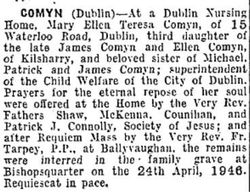
Grok3 AI: James Comyn, as secretary of the Ballyvaughan branch, played a pivotal role locally. A tenant farmer himself, he organized meetings, coordinated tenant resistance, and represented local grievances. The Ballyvaughan branch was active in the early 1880s, a period marked by agrarian agitation, boycotts, and rent strikes. The League’s activities in the area aligned with national efforts, including the “Land War,” where tenants resisted evictions and demanded reforms. Local actions often involved public demonstrations and support for evicted tenants, with Comyn likely facilitating communication with the League’s central leadership.
————————
The Clare Champion and other regional sources note Ballyvaughan’s involvement in the League’s campaigns, particularly during 1880–1882, when tensions peaked. The branch faced challenges like government suppression, including arrests under the Coercion Acts, but persisted in advocating for tenant rights. The League’s influence in Ballyvaughan contributed to the eventual passage of land reform laws, such as the Land Acts of 1881 and later, which began addressing tenant demands.
For deeper insights, you could explore:
The Dictionary of Irish Biography for more on James Comyn’s role.
Local Clare archives or newspapers like the Clare Champion for specific Ballyvaughan events.
The National Library of Ireland’s Land League papers for primary documents.
Posts on X mentioning Ballyvaughan or the Land League for community perspectives (I can search these if needed).
Anything specific about Ballyvaughan’s branch or figures like Comyn you’d like me to dig into further?
Michael Davitt’s background
Irish Land Acts impact
Source:
Source: via Google: Some O’Loghlen families in Burren,
County Clare, Ireland before 1799 Michael O’Loghlen; Rosemary Gilligan; Edward O’Loghlen “I have had a good deal less success with the O’Laughlin side” … Jim O’Brien, 2005. “Workin’ on mysteries without any clues” … Bob Seger, 1976
On the one hand, possibly, Colman l’Abbe’s executor Thomas Comyn was also a relative by marriage, cf a letter dated 17 March 1913, written to the second Sir Michael O’Loghlen by Michael Comyn. According to Michael Comyn’s letter, “… James Comyn, who was born in 1731, and who died at Clareville in 1805. His mother was an O’Loghlen, and his wife was also an O’Loghlen. I believe that his Mother’s name was Margaret O’Loghlen, and that his wife was Mary O’Loghlen, daughter of Bryan O’Loghlen of Loughrask”.
Letters (in full) handwritten by Michael Comyn and by A M Stapleton (died 1919) during the year 1913, to Sir Michael O’Loghlen (1866-1934) then of Drumconora, Ennis. (Letterhead embossed with the emblem of the Munster Bar)
11 Waterloo Place Dublin
17 March 1913.
Dear Sir Michael,
I would be glad if you could let me know whether you have any papers relating to the O’Loghlens of Clareville or Loughrask, Ballyvaughan. O’Loghlen Prince of Burren lived at Clareville and I believe he regarded your forefathers as his immediate kinsmen. It occurs to me that they may have preserved his papers.
My reason for making the inquiry is that I am seeking to register the pedigree of my forefather James Comyn (born in 1731) who died at Clareville in 1805.
His mother was an O’Loghlen and his wife was also an O’Loghlen.I believe his mother’s name was Margaret O’Loghlen and that his wife was Mary daughter of Bryan O’Loghlen of Loughrask.He was the only son of Michael Comyn MD, who subsequently emigrated to France and received a Patent of Nobility from Louis XV.
I can prove all the other facts in the pedigree except as to the two O’Loghlens. My only hope of identifying those two is by means of family papers, as the parish registers have been accidentally destroyed.
If you could give me any help in this matter, I would be very much obliged
Michael Comyn
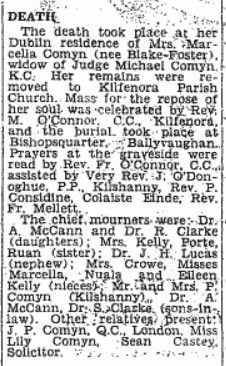
Note: We mention Michael Comyn’s letter in section 17 of our previous paper, and in section 26 of this Supplement. Michael Comyn (1871-1952) was born in Clareville, Ballyvaughan. From 1900, he practised as a barrister at the Munster Bar. By 1917, he was appointed one of the King’s Counsel, and later a Judge.
Letters from A M Stapleton 1913
Vernon House Clontarf
March 28th, ‘13
My dear Sir Michael,
I received your letter & enclosures.
I would gladly give you any information I could about the family.
The last direct heir of the “Prince of Burren” was Peter O’Loghlen, who was always called the “Prince of Burren”. Though the title remained, the territories had been confiscated. He lived near Ballyvaughan, and was married to a lady closely connected with the family of the late Austin Butler of Ballyline. He died I think in the year 1823, leaving no children. My grandfather Malachy O’Loghlen & his son Denis when very young and the O’Loghlens of Port were constant visitors at his house. After his death different members of the family claimed the title, but none succeeded, as the family records were all lost in the continual fighting with the English Garrison.
I cannot reply to Mr Comyn’s queries but I would refer him to Dr O’Loghlen Maguire, who is grandson to Charles O’Loghlen of Newtown Ballyvaughan who was a near relation of the Prince of Burren on his mother’s side being also an O’Loghlen, but that did not entitle him to the title. I often heard my uncle Denis speak of him.
As to the ?Beach letter, it is an erratic effusion. You could send a line to say that the lady she enquires about was not a member of your family.
I look forward to the pleasure of meeting you soon perhaps in the country in Summer. I shall be so glad to see the representative of the family again. With best wishes & love for Lucy Yrs very sincerely
A M Stapleton
The unknown daughters mentioned by Michael Comyn, see Appendix 3. Jane and Elizabeth O’Loghlen, sisters of Peter O’Loghlen d. 1823.
Baptisms and Deaths, Co. Galway. Margaret O’Loughlin (Betham Genealogical Abstract, 1728: name found in a Will, Diocese of Tuam, perhaps a beneficiary). Note: Possibly, she might be the mother of James Comyn (1731-1805), cf section 26.
Crossle Genealogical Abstracts
Registry of Deeds: 1739 Lands Index, county Clare 1739-1810. Search for deeds involving Comyn. Includes two transactions involving an unnamed O’Loghlen on an unspecified date: Number 196: Knockanahane; Comyn to O’Loghlen. 604-345-415226. Number 255: Rynelagh; Comyn to O’Loghlen. 604-345-415226.
*Thomas Comyn of Galway, of whom more in a moment.
Thomas Comyn is not mentioned. On the one hand, possibly, Colman l’Abbe’s executor Thomas Comyn was also a relative by marriage, cf a letter dated 17 March 1913, written to the second Sir Michael O’Loghlen by Michael Comyn. According to Michael Comyn’s letter, “… James Comyn, who was born in 1731, and who died at Clareville in 1805. His mother was an O’Loghlen, and his wife was also an O’Loghlen. I believe that his Mother’s name was Margaret O’Loghlen, and that his wife was Mary O’Loghlen, daughter of Bryan O’Loghlen of Loughrask”.
In passing, Clareville also is located in the townland of Loughrask.
Possibly, Mary Comyn (nee O’Loghlen) might be Mrs Mary Anne Comyn, shown in 1791 in the lengthy list of subscribers to the book written by Pat O’Kelly, Killarney a descriptive poem (Dublin, 1791). The list includes four O’Loghlens of Clare, all literate.
In 1913, A M (Anna) Stapleton was unable to identify these O’Loghlen females who married into the Comyn family. Similarly, we haven’t identified them, at least not beyond the possibility mentioned in section 17 of our previous paper. Indeed, as the more astute reader may have noticed, centuries of written history neglect to record O’Loghlen daughters. Colman l’Abbe’s 1777 wills amount to an exception, and perhaps the earliest.
On the other hand, Colman l’Abbe may simply have named Thomas Comyn as his executor for personal reasons. Colman l’Abbe may for example have trained in France with Dr Michael Comyn, a medical practitioner and (possibly) father or a close relation of Thomas Comyn.
====================================
Personal meanderings by Michelle Clarke.
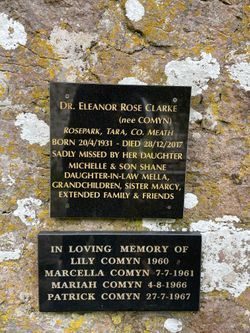
Every year without fail, we never faltered but visit Ballyvaughan, Co. Clare and we would never miss out on the visit to the graveyard at Bishop’s Quarter, the burial place of our family and antecents. My cousin JJ (Sir James Peter Comyn, son of James Comyn) had some land and a post office in Ballyvaughan. The land was near Loughrask, where Bernie Comyn lived, with his lovely wife, Doreen. As the saying goes in Ireland, they married late in life so there were children. Bernie had a brother and a sister, Bernie, Ambrose and I think Elizabeth, who married a doctor called Parsons. My mum and her sister, the children of Michael Comyn KC, claimed that we were in no way related to Bernie but it always seemed a little strange. I cannot forge a link but here is Bernie, Ambrose, Elizabeth’s family line. What is interesting is Doreen, Bernie’s wife told me that their father was connected to the Kelly’s of Porte and she had a painting of this woman – Susan Mary Kelly. The name Jeremiah Kelly Comyn is consistent with the family in Porte Ruan, Co. Clare
Brief Life History of Susan Mary
When Susan Mary Kelly was born on 9 May 1862, in Dysert, County Clare, Ireland, her father, Jeremiah Brew Kelly, was 45 and her mother, Bridget Scanlan, was 41. She married James Patrick Comyn on 22 January 1883, in Ballyvaughan, County Clare, Ireland. They were the parents of at least 6 sons and 3 daughters. She lived in Drumcreehy, County Clare, Ireland for about 10 years. She died on 3 May 1922, in Ballyvaghan, Drumcreehy, Co. Clare
Brief Life History of James Patrick
When James Patrick Comyn was born on 18 October 1855, in Ballyvaughan, County Clare, Ireland, his father, Patrick Comyn, was 26 and his mother, Bridget Hickey, was 26. He married Susan Mary Kelly on 22 January 1883, in Ballyvaughan, County Clare, Ireland. They were the parents of at least 6 sons and 3 daughters. He lived in Drumcreehy, County Clare, Ireland for about 10 years. He died on 24 May 1918, at the age of 62, and was buried
Family Time Line
James Patrick Comyn 1855–1918
Susan Mary Kelly 1862–1922
Marriage: 22 January 1883
Jeremiah Kelly Comyn 1883–1945
Florence Mary Comyn 1885–1887
Arthur Patrick Comyn 1887–Deceased
Florance Mary Comyn 1887–Deceased
Alfred Francis Comyn 1888–Deceased
Michael Joseph Comyn 1889–Deceased
Francis Henry Comyn 1890–Deceased
Elizabeth Lilly Comyn 1892–Deceased
Frederick Comyn 1898–1898
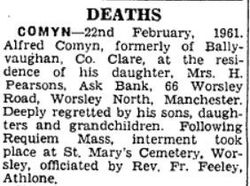
Alfred Francis Comyn
Birth 2 Jun 1888
Ballyvaughan, County Clare, Ireland: Death 22 Feb 1961 (aged 72)
Worsley, Metropolitan Borough of Salford, Greater Manchester, EnglandBurial
A Tale of Adversity and Survival: Manuscripts Touching Gragans Castle Edward O’Loghlen and Michael O’Loghlen, QC
The changed system of land distribution may be viewed through two lists of surnames, for the years 1641 and 1659 provided by Frost (1893) which help to illustrate the changed landscape. New surnames which arrived in north Clare during the 1650s included Comyn, Dillon, Martyn, Nugent and Sarsfield.Members of the Comyn, Nugent and Sarsfield families would intermarry with various O’Loghlens in later centuries, while Colonel Cary Dillon was transplanted from Roscommon to the townland of Lisnanard and George Martyn was required to move from Galway city to the townland of Gragans. Both Dillon and Martyn were classed as ‘innocent Papists’. A contrasting story is shown by The Irish Genealogist (1972) which lists three Burren O’Loghlins
======================
Clare Journal,Thursday 26 February 1863: Presentation of an Address.
The following Address was presented by the Ballyvaughan Chapel Committee, to the Reverend Francis Forde, C.C.,on the eve of his leaving for Australia, to collect funds for the completion of their new Church, now in (the) process of erection.
Reverend Dear Sir, – We the undersigned members of the Ballyvaughan Chapel Committee, beg to tender you our warmest thanks for the generous resolution you have taken, of braving the dangers of the sea, and visiting Australia, to collect funds for the completion of our Church and the liquidation of the debts already incurred. This determination on your part, is a proof of your zeal for the house of God, and your love of its beauty. It is also proof of your regard for us, for which we feel deeply indebted.
The poverty of our district, and the ruinous effects of two successive storms, rendered it morally impossible for us, of ourselves, to bring our handsome structure to completion, and we were on the verge of despair, when you, Reverend Dear Sir, kindly and opportunely came to the rescue. Your heroic zeal and charity challenge our esteem and undying gratitude, and will, we hope, earn for yourself the blessing of the Almighty.
We earnestly and anxiously recommend you to our Irish friends in Australia. We anticipate the happiest result from your mission. The Irish are proverbial for their charity in whatever clime they are to be found. They will not, we are confident, suffer you to appeal to them in vain.
We can assure our Australian friends, their contributions will go towards completing a church, which, when finished will be an ornament to the country, and a proud monument of your zeal, and that of our parish priest, and parishioners. You are making great sacrifices, tearing yourself for a while, from home and friends, and risking the dangers of a long voyage, to enable us to raise a fitting temple to the Almighty. Be assured, Reverend Dear Sir, you bear with you our best wishes and regards. We pray that Almighty God may have you in his safe keeping during your absence, that He may crown your efforts with success, and restore you to us safely, in good health and spirits.
We are, Reverend Dear Sir, Gratefully and affectionately yours,
 Patrick J. Ryder, P.P., V.F., Chairman.
 A. Hanrahan, C.C., Secretary.
 Gregory Martyn, J.P., Gragans Castle.
 Edmond Hogan, M.D.
 Fergus Curtin, P.L.G.
 Michael Macnamara,
 John Kerin, P.L.G.
 James Comyn, P.L.G.
 Patrick Kerin, P.L.G.
 Committee Rooms, Ballyvaughan, February 25th, 1863.
28th April 2025
Ex Grok3
James Comyn, who was born in 1731, and who died at Clareville in 1805. His mother was an O’Loghlen, and his wife was also an O’Loghlen. I believe that his Mother’s name was Margaret O’Loghlen, and that his wife was Mary O’Loghlen, daughter of Bryan O’Loghlen of Loughrask”.
Your information about James Comyn (1731–1805) aligns with historical records of the Comyn family from County Clare, Ireland, though some details require clarification or confirmation due to limited primary sources. Here’s a concise summary based on available data and your provided details:
James Comyn was born in 1731 and died in 1805 at Clareville, County Clare. He was associated with the Comyn family, a prominent gentry family in the region.
Mother: You mention his mother was Margaret O’Loghlen. This is plausible, as the O’Loghlen family was influential in County Clare, and intermarriages with the Comyns were common. However, no definitive record confirms her name as Margaret O’Loghlen, but your information is consistent with naming patterns and family alliances of the time.
Wife: You state his wife was Mary O’Loghlen, daughter of Bryan O’Loghlen of Loughrask. This is also plausible, as the O’Loghlen family held lands in Loughrask, and Bryan was a known name among them. Marriage records from the period are sparse, but such a union would reflect the frequent intermarriages between these families to consolidate local influence.
The Comyns and O’Loghlens were Catholic gentry families who navigated the Penal Laws era, maintaining their status through strategic marriages and land management. James Comyn’s life spanned significant changes in Ireland, including the gradual relaxation of anti-Catholic laws.
Limitations: Without access to specific genealogical records (e.g., parish registers, wills, or Burke’s Landed Gentry entries), I cannot independently verify Margaret or Mary O’Loghlen’s identities. If you have access to family papers, deeds, or church records from County Clare, they could confirm these details. Alternatively, I can search for additional clues on the web or X posts if you’d like, though 18th-century Irish records are often incomplete.
If you want me to dig deeper or focus on a specific aspect (e.g., the O’Loghlen family of Loughrask or Clareville’s history), let me know!
_______________
The Clare Journal, Mon 19 May 1862:
Distress in Ballyvaughan. At a meeting, held in Ballyvaughan, on Sunday the 11th, for the purpose of devising measures to relieve the wants of the poor in that neighbourhood, on the motion of the Very Rev. Mr. Ryder, seconded by the Rev. A. Hanrahan, the chair was taken by the Rev. Hugh Brady Huleatt, who briefly returned thanks and expressed his conviction that a vast amount of misery prevailed in the district. The following resolutions were adopted. 1st. That, owing to the poverty of the district, and the total want of employment, we see, with pain and regret, the greatest destitution glaring our poor people in the faces; to which, if relief be not promptly afforded many must fall victims. 2nd. That a committee be appointed for this laudable purpose; that subscriptions be solicited from the wealthy and charitable, especially from those gentlemen having landed property in the neighbourhood. 3rd. That the Secretary be directed to write to Mr. Pierce Creagh, Dublin, respectfully requesting of him to advocate our cause with the Mansion House Committee, and wherever else he thinks his efforts would be successful. 4th. That Messrs. Michae Macnamara and Fergus Curtin be appointed treasurers, and that the Rev. A. Hanrahan do act as Secretary. 5th. That a copy of the above resolutions be sent for publication to the Dublin Freeman and to the Clare Journal.
Hugh Brady Huleatt, Chairman. A. Hanrahan, Secretary. The following constitute the committee: Rev Mr Huleatt, Very Rev Mr Ryder, Rev A Hanrahan, Rev F Forde, E Hogan, Esq, MD, John Martyn, Esq, Fergus Curtin, Michael Macnamara, Pat Comyn, Pat Kerin, James Comyn, Henry McDonough, Pat Kerin.
_______________
Bishop’s Quarter burial records
Bishop’s Quarters Cemetery
Also known as Ballyvaughan Cemetery, Drumcreehy Church, St. Colman’s Abbey
COMYN Lady Anne died peacefully on 1st March 2018, aged 92. Anne Chaundler, born 22nd December 1926, married to become Lady Anne Comyn, loving wife and crucial support of the late Sir James Comyn, one of Her Majesty’s Judges of the Queen’s Bench Division. She is survived by a son and daughter, Rory and Kate. Her strength, gentleness and humour are sorely missed. Memorial mass and scattering of ashes will take place in Ballyvaughan, Co Clare, Ireland, on 23rd June. Please contact funeral home for further details
The death has occurred on December 24th 2023 of Sophia Doreen Comyn, née Davis-Kelly, Loughrask House, Ballyvaughan and formerly of Howth and Clontarf, Co. Dublin. Doreen was predeceased by her husband Bernard. Peacefully, surrounded by family and friends, in the loving care of Rosemount Nursing Home, Gort.
Sadly, missed by her extended family and friends.
Ar dheis Dé go raibh a h-anam dílis.
Reposing at St John the Baptist Church, Ballyvaughan this Wednesday evening, December 27th, from 6 p.m. until 7.30 p.m. Requiem Mass on Thursday December 28th at 11 a.m., followed by interment in Bishop’s Quarter Cemetery.
Trump seeks to bring AI to classrooms with latest executive order
Source: Unsplash
President Donald Trump this week signed an executive order that aims to integrate artificial intelligence deeply into K-12 schools across the country.
There’s a lot to unpack here, so let’s start by breaking down the contents of the order itself.
The details: The order, titled “Advancing Artificial Intelligence Education for American Youth,” aims to “ensure the United States remains a global leader in this technological revolution” by, in short, giving both teachers and students plenty of access to the tech.
The focus is on early learning and early exposure with the goal of “preparing students to become active and responsible participants in the workforce of the future.” It’s a push that will involve, not just students using the tech, but teachers using it, as well, both in the classroom and for administrative work. To achieve these goals, the order established an AI education task force, which will be helmed by the director of the Office of Science and Technology Policy. Its members will include the director of the National Science Foundation and the secretaries of agriculture, labor, energy and education.
The task force’s work will center around building “public-private partnerships with leading AI industry organizations, academic institutions, nonprofit entities and other organizations with expertise in AI and computer science education.”
Together, they will develop online resources to teach students “foundational AI literacy and critical thinking skills.”
The order says that the task force will work to identify areas of federal funding that can be leveraged to enable these public-private partnerships.
The teacher training will include “professional development … so they can integrate the fundamentals of AI into all subject areas.” It will also include education in “foundational computer science and AI, preparing educators to effectively teach AI in stand-alone computer science and other relevant courses.”
As if they didn’t have enough to be getting on with already.
Details on this are all quite unclear.
It’s unclear which companies will be involved in this, what, exactly, they’re developing, what role the individual schools will be asked to play in this integration, how much of the program here will be paid for by federal funding and how much individual schools will have to chip in.
This integration comes amid a messy backdrop, one that, in the two short years since ChatGPT first went live, has featured steadily rising instances of AI-enabled harassment, bullying and cheating. Beyond that, the psychological impacts of interacting with these systems — especially among young people — remain largely unknown, though there are already too many known instances of young kids developing dangerous, destabilizing attachments with chatbots.
Early research, meanwhile, has found that generative AI degrades critical thinking skills.
Asked about this environment, Education Secretary Linda McMahon said that “you’re gonna always see things that are being taken advantage of.”
“We have to expect that,” she said, adding: “I have visited now a couple of schools and seen the positive impact that AI can have. If it’s one-on-one tutoring, students can learn much faster.”
She told a story of a classroom filled with 25 students. Each student was working with their own AI tutor. The teacher was simply overseeing it all.
“It’s imperative to keep the teacher in the classroom,” McMahon added. “It’s just an incredible tool to be able to have. We have to be competitive in the world and we have to utilize this incredible technology.”
What’s going on with schools: Schools across the U.S. have been dealing with teacher shortages for around 20 years, now. But the problem got a lot worse in the aftermath of the pandemic. Now, 86% of school districts struggle to fill open positions. 60% struggle to find substitute teachers. 57% of schools in impoverished neighborhoods are understaffed.
In aggregate, schools across the country are underfunded by about $150 billion each year, according to this report from the Century Foundation think tank. A separate report from 2024 found that “39 states devote a smaller share of their economies to their K-12 public schools than they did in 2006,” a reduction that has cost schools more than $360 billion between 2016 and 2021.
Bruce Baker, one of the report’s co-authors, called it a “permanent disinvestment” in public schooling, adding: “in the decade and a half since the height of the so-called ‘Great Recession,’ most states have increased their expectations for the performance of schools, teachers, and students, but they have refused to make their districts whole after the disastrous cuts during that recession.”
In short, schools have less money. Fewer resources mean fewer teachers, larger class sizes and more burnout, which means even fewer teachers.
The landscape: In addition to gutting the Department of Education, Trump — in partnership with OpenAI, Softbank, Microsoft and Nvidia, among others — somewhat recently unveiled Project Stargate, an effort that will purportedly drive a minimum of $500 billion worth of investment in AI infrastructure over the next four years.
In their proposals to the federal government, just about all of the Big Tech AI players have advocated for the sweeping adoption of their technology by the federal government.
This article was first published on Big Think in June 2022. It was updated in March 2025.
The greatest tacticians are those who think ahead. Chess grandmasters, famous generals, great world leaders, and mafia dons all share one skill: They are all many more steps ahead than their rivals.
We each have the ability to think ahead. In fact, it’s hard to imagine a functioning human who didn’t think ahead at least some of the time. You’ve probably planned what to do tonight, and you likely know the route you’re going to take to get home. Thinking ahead is one hallmark of intelligence. Without it, we’re simply slaves to our instincts and reflexes — a bit like a plant or a baby.
What about the role of forward thinking when dealing with others? It’s something addressed in a recent study out of the Mount Sinai School of Medicine. It shows just how far ahead we think when we interact with — and manipulate — other people.
A theory of mind
The problem with the world is that it’s full of other people. Unlike you (of course!), those people are often unpredictable, independent, and infuriatingly unreadable. There’s no way we can get inside their head to know what they are thinking or what they are going to do. But given that humans are a social species, it is no surprise that we have developed ways to calculate what other people might be thinking.
This is known as “theory of mind,” the ability most of us have to put ourselves in someone else’s shoes. (To varying degrees, people with autism may not have this ability.) Theory of mind is something that we learn as we grow up. Children will learn other people have their own mental lives — their own desires, emotions, and so on — around 15 months old, but they are still bad at compensating and adapting to that for a while.For instance, if a two-year-old sees another person in distress, they will seek to help them by giving them their toy or their favorite thing. They recognize someone has their own feelings but cannot step beyond that to think what the other person might want.
Most people have a hugely sophisticated theory of mind. Here’s an example: Let’s say you and I are talking about something, and you see me look up at the clock. What assumptions or thoughts now go through your head? Are you boring me? Do I need to be somewhere? Is there a spider on the clock? In fact, people who “overthink” things often get lost and trapped in this elaborate game of speculative theory of mind. As with most things, a useful brain habit becomes toxic when it’s taken too far.
Always two steps ahead
What the recent study from Na et al. adds to the discussion concerns just how much we employ this theory of mind when trying to persuade or manipulate others.The team from Mount Sinai had 48 participants sit in a brain scanner and play a kind of “ultimatum game.” Essentially, they were divided into teams and told to split $20 with one another. In one version of the game, there were no rules whatsoever. They could haggle, negotiate, manipulate, and bargain as much as they wanted.
The study revealed two things:
First, after a computational analysis of all the finished games, they discovered that the results were what would be expected from people who thought “two, three, or four steps ahead” of others. In other words, if people were only thinking one step ahead, or from reaction only, the results would have looked completely different.
Second, the brain scans revealed that the choices made during the negotiations were accompanied by activity in the ventromedial prefrontal cortex.This is the same part of the brain used in most forward-thinking decisions. So, at least in neurophysiological terms, manipulating others is much the same as any other plotting.
Every interaction is a game of chess
There’s a memorable scene from The Wire, where D’Angelo uses the real world of drug dealing to explain the rules of chess. It works well, and now we might know why. What Na et al. show is that when we are trying to sway or manipulate others, our brain activates in much the same way as when we’re playing chess.
Every social interaction is a game of chess, trying to get inside someone’s head to navigate what they are thinking or what they will do. It’s the bane of relationships, and the source of much conflict. So, what if we can be better at it? We know that chess gives us a whole host of benefits, but perhaps we can add “makes you better at getting your own way” to the list? It’s time to dust off the chessboard, indeed.
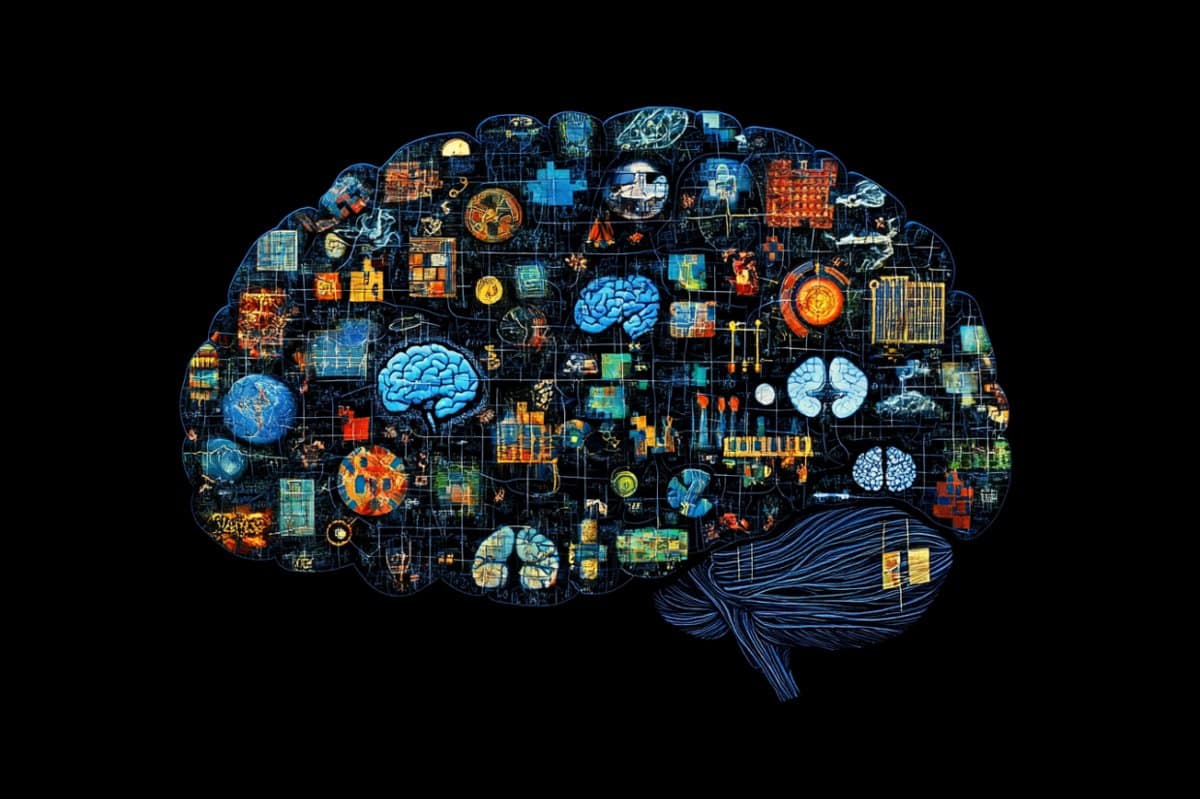
Summary: Researchers have identified that the right frontal lobe plays a critical role in logical thinking and problem-solving. Using lesion-deficit mapping in 247 patients with brain injuries, they found that damage to this area leads to significantly more reasoning errors.
Two new cognitive tests developed for the study accurately detected reasoning impairments that traditional assessments might miss. These findings could improve clinical diagnosis and treatment for patients with right frontal brain damage.
Key Facts:
Right Frontal Lobe: Damage here impaired reasoning abilities by around 15%.
New Reasoning Tests: Verbal and nonverbal tasks successfully identified cognitive deficits.
Clinical Potential: The tests could enhance NHS screening for brain injury-related reasoning problems.
Source: UCL
A team of researchers at UCL and UCLH have identified the key brain regions that are essential for logical thinking and problem solving.
The findings, published in Brain, help to increase our understanding of how the human brain supports our ability to comprehend, draw conclusions, and deal with new and novel problems – otherwise known as reasoning skills.
The results showed that people with damage to the right frontal lobe had a much harder time on both tests compared to those with damage in other areas. Credit: Neuroscience News
To determine which brain areas are necessary for a certain ability, researchers study patients with brain lesions (an area of damage in the brain) caused by stroke or brain tumours.
This approach, known as ‘lesion-deficit mapping’, is the most powerful method for localising function in the human brain.
Studying brain injuries can be difficult and time-consuming because researchers need a large number of patients with specific brain damage. This kind of damage can affect how a person thinks, feels, or moves.
However, very few research centres have access to enough patients to conduct these studies effectively.
As a result, previous studies have mainly relied on functional imaging (fMRI) techniques in healthy individuals. However, these results can sometimes be misleading as they provide correlational rather than causal evidence.
The new study, led by researchers at the UCL Queen Square Institute of Neurology and Department of Neuropsychology at the National Hospital for Neurology and Neurosurgery, UCLH, used lesion-deficit mapping to investigate 247 patients with unilateral focal brain lesions in either the left or right frontal (front) or posterior (back) regions of the brain. An additional 81 healthy individuals served as controls.
To assess reasoning skills in these patients, the researchers developed two new tests.
These included a verbal deductive reasoning task (a type of puzzle where participants are asked to find relationships between words to solve problems), which included questions such as: “If Sarah is smarter than Diana and Sarah is smarter than Heather, is Diane smarter than Heather?”.
And a nonverbal analogical reasoning task (a type of puzzle where participants are asked to use pictures, shapes or numbers to figure out logical patterns and solve problems), with questions like: “Which set of numbers is 1,2,3 most similar to – 5,6,7 or 6,5,7?”.
The results showed that people with damage to the right frontal lobe had a much harder time on both tests compared to those with damage in other areas. They made about 15% more mistakes than the other patients and healthy individuals.
Lead author, Dr Joseph Mole (UCL Queen Square Institute of Neurology and Department of Neuropsychology, UCLH) said: “Our study explores how the front right part of the brain helps people think and solve new problems.
“It also shows that our two new tests can help detect reasoning problems in individuals with brain damage, improving diagnosis and treatment.”
Senior author, Professor Lisa Cipolotti (UCL Queen Square Institute of Neurology and Department of Neuropsychology, UCLH) added: “By combining a detailed cognitive investigation in a large sample of brain damaged patients with advanced lesion mapping techniques – developed by Professor Parashkev Nachev and his team at the UCL Queen Square Institute of Neurology – we have deepened our understanding of the complex and, so far, poorly understood, neural structures underlying human reasoning.
“Our findings show a close connection between the right frontal brain network involved in reasoning and the right frontal brain network essential for fluid intelligence (our ability to solve problems without prior experience).
“This suggests that a common area of the brain plays a critical role in both reasoning and fluid intelligence.”
The researchers believe that these findings have significant clinical implications, as the two new tests can help identify cognitive impairments that would otherwise go undetected.
With further validation and implementation, the team aim to make their new reasoning tests widely available in the NHS, addressing an unmet need for tools specifically designed for assessing right frontal lobe dysfunction.
Funding: The study was funded by Wellcome and the National Institute for Health and Care Research University College London Hospitals Biomedical Research Centre (NIHR UCLH BRC) funding scheme. The researchers also received funding from The National Brain Appeal and the Guarantors of Brain.
About this logic and neuroscience research news
Author: Poppy Tombs Source: UCL Contact: Poppy Tombs – UCL Image: The image is credited to Neuroscience News
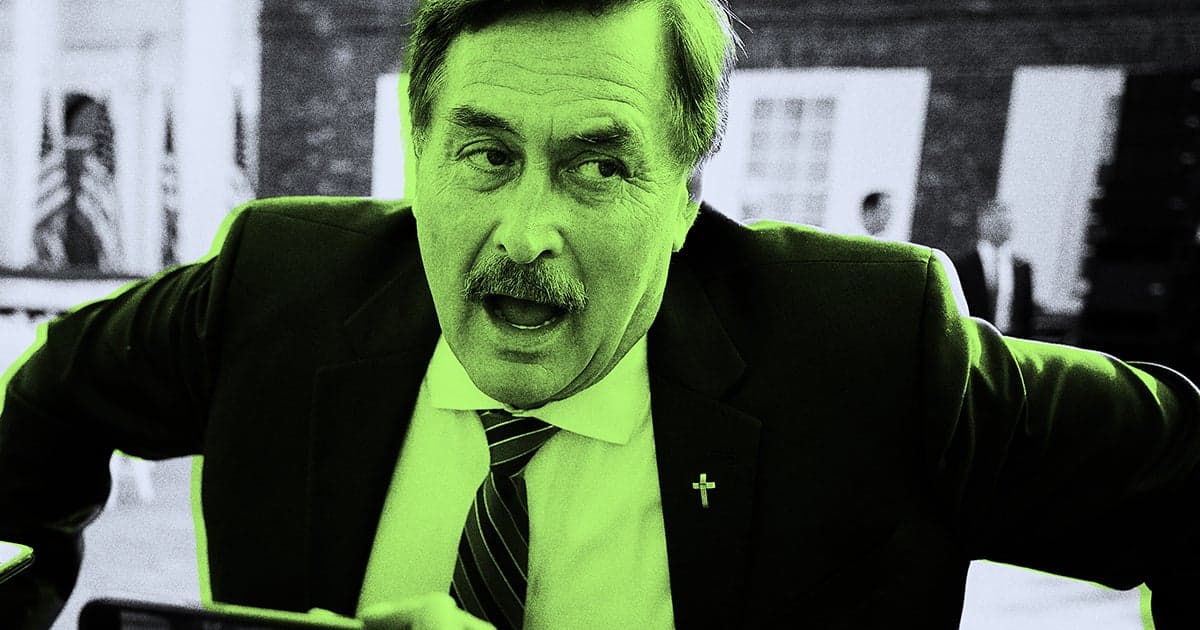
The MyPillow Guy’s Lawyers Used AI in Court and You’ll Never Guess How That Turned Out
byJoe Wilkins
Apr 27, 6:45 AM EDT
Chip Somodevilla / Getty / Futurism
“I’m in ruins.”
We all remember Mike Lindell, the disgraced MyPillow founder who lost everything fighting to prove — against insurmountable evidence to the contrary — that the 2020 US election had somehow been stolen from Donald Trump.
Well, he’s in the news again — this time for using AI to file his legal briefs.
As The New Republic reported, a federal judge has accused Lindell of filing a legal document with “nearly 30 defective citations,” which one of his attorneys, Christopher Kachouroff, wrote “utilizing generative artificial intelligence.”
Go figure: the brief was full of misquotes and miscited cases, sometimes referencing case law that simply didn’t exist — AI had hallucinated them, as the tech is prone to do in order to “complete” its prompt.
“If you type a legal question into the Google search function, then generative AI is all too ready to answer,” explained legal columnist Virginia Hammerle. She notes that in a similar case in New York, a federal judge sanctioned a team of lawyers and their firm when they turned in a ChatGPT-generated brief without double-checking it for mistakes.
“Not until this Court asked Mr. Kachouroff directly whether the [document] was the product of generative artificial intelligence did Mr. Kachouroff admit that he did, in fact, use generative artificial intelligence,” the federal judge admonished. “Given the pervasiveness of the errors in the legal authority provided to it, this Court treats this representation with skepticism.”
The federal judge has now given Lindell’s lawyers ten days to argue why they shouldn’t face disciplinary proceedings. They’re also required to address whether or not Lindell had any knowledge that his lawyers were using AI to write their documents — yet another headache for the embattled entrepreneur.
It’s far from the first gaffe Kachouroff has been involved in. During a trial which took place over Zoom last year, the attorney was caught relaxing without any pants on before beginning his cross-examination.
It’s the latest embarrassment in a years-long legal saga for Lindell, who faces a combined $70 million in debt owing to penalties from a civil lawsuits and an FBI investigation after personally championing Donald Trump’s 2020 election-fraud hoax.
After failing to pay more than $50,000 related to a defamation suit with voting systems company Smartmatic earlier in April, Lindell sobbed that he was broke. “I’m in ruins,” the disgraced pillow tycoon said. “I don’t have $5,000 or 5 cents.”
That’s a shame, because if he did, he could be out shopping for new lawyers — like maybe the kind that keep their pants on during trial.
The admission was made by the State Bar of California on Monday, following complaints about the quality of the test’s questions, and numerous glitches experienced by test-takers when they took it in February.
In a news release, the organization said that 23 of the exam’s total of 171 scored multiple-choice questions were drafted by the firm ACS Ventures, which developed the questions “with the assistance of AI.” Another 48 questions were lifted from an older version of an exam for first-year law students.
“The debacle that was the February 2025 bar exam is worse than we imagined,”Mary Basick, assistant dean of academic skills at UC Irvine Law School, told the LA Times. “I’m almost speechless. Having the questions drafted by non-lawyers using artificial intelligence is just unbelievable.”
Katie Moran, an associate professor at the University of San Francisco School of Law, called it a “staggering admission.” The same company that used AI to draft the questions was then paid “to assess and ultimately approve of the questions on the exam, including the questions the company authored,” she noted to the newspaper.
For weeks, test takers had complained that they were randomly kicked off the online platform that the bar was administered on, while screens lagged and showed error messages, per the reporting. The test itself was riddled with typos, and some questions were total nonsense.
Despite these complaints — and despite pleading guilty to AI usage — a spokesperson for the State Bar insisted that the test questions were reviewed by content validation panels and subject matter experts.
In any case, the whole situation sounds like a mortifying catastrophe.For one, the Supreme Court of California, of which the State Bar is an administrative arm, maintains it had no idea about the use of AI to create the test questions until this week — even though it had instructed the State Bar to explore the use of AI to “improve upon the reliability and cost-effectiveness of such testing” last fall, according to Alex Chan, chair of the State Bar’s Committee of Bar Examiners.
Casting additional scrutiny, Basick and Moran argued that the exam questions, which should take years to develop, were drafted far too quickly, while 50 practice questions re-released just weeks before the actual exam contained numerous errors, they wrote early this month, per the LA Times.
What spurred the dubious measures sounds like a familiar tale of disastrous cost-cutting.Faced with a $22 million deficit last year, the State Bar ditched the commonly used National Conference of Bar Examiners’ Multistate Bar Examination, and decided to transition to a hybrid model of in-person and remote testing. To create the new test, it inked a $8.25 million deal with Kaplan Exam Services, and contracted Meazure Learning to administer it.
In a fittingly legal result, Meazure Learning is now being sued by some of the students who took the glitchy exams. The State Bar said it will ask the California Supreme Court to adjust test scores for those who took the test in February. Chan said that the Committee of Bar Examiners will meet on May 5 to discuss other remedies, but doubted that the State Bar would release the exam questions to the public or go back to the NCBE.
“Never been done before – xAI did in 19 days what everyone else needs one year to accomplish. That is superhuman – There's only one person in the world who could do that – Elon Musk is singular in his understanding of engineering.” pic.twitter.com/t3E4tZunAc





 Source: Unsplash