Summary: A new study reveals that many self-identified incels reject employment not only due to mental health challenges, but as a deliberate expression of identity reinforced by online communities. By analyzing over 1,200 forum posts, researchers found that incel spaces often celebrate unemployment and isolation as signs of ideological purity, pressuring others to remain disengaged from work or education.
Those who pursue jobs or self-improvement are labeled “fakecels,” creating a social barrier to reintegration. Researchers argue that addressing this issue requires more than job programs—it demands interventions targeting identity, mental health, and online influence.
Key Facts:
Ideological Unemployment:Many incels view joblessness as a core part of their identity.
Online Reinforcement: Forum peer pressure discourages work and praises withdrawal.
Support Needed: Solutions must combine job training, mental health care, and community outreach.
Source: McGill University
The critically acclaimed Netflix drama Adolescence has put a spotlight on the culture and ideas of incels (involuntary celibates), an online subculture of people (mostly male and heterosexual), who define themselves as unable to find a romantic or sexual partner, largely due to their perceived unattractiveness.
By analyzing exchanges on online incel forums, McGill University researchers have gained insights into the negative attitudes toward labour force participation held by many young men who identify as incels.
Only about one-quarter of forum members suggested that they or others should try to improve their situation by studying or finding work. Credit: Neuroscience News
The researchers suggest that while some incels struggle with finding and retaining work because of various mental health challenges, for many members of the incel forum the choice not to work, study or train for a job is based on deeply held beliefs, and that these beliefs are often reinforced by other online forum participants.
This suggests there is a need for education and employment support programs that address not only the practical barriers to employment and study, but also the deep sense of alienation and social rejection felt by many in this group, the researchers said.
Unemployment as a commitment to incel identity
Recent surveys have shown that a disproportionally high percentage (up to 30 per cent) of incels are not in employment, education or training (NEET). This prompted researchers to analyze more than 1,200 online comments on employment on 171 discussion threads on a popular incel forum during two weeks in the fall of 2022.
“They use employment status to assess the degree of commitment of their peers to incel identity and often encourage other incels to embrace a life of unemployment and isolation.
“Many also share the belief that the absence of a female romantic partner makes working pointless,” said Eran Shor, a McGill sociologist and co-author of the study published in the journal Gender, Work & Organization.
High levels of internal policing help maintain inceldom
Members of the community participating in the discussions frequently encouraged others to retain their NEET status, something they praised as a confirming sign of “true” inceldom (a “truecel”).
Those who talked about trying to improve their situation by working or studying were regularly labelled “fakecels.”
Only about one-quarter of forum members suggested that they or others should try to improve their situation by studying or finding work.
“This peer pressure makes unemployment a badge of honour rather than a problem to be solved. These online spaces can reinforce harmful ideas and discourage members from seeking help or changing their situation.
“So, understanding how these beliefs form is the key to finding ways to support and engage with these marginalized young men,” said Shor.
Need for a multi-pronged approach to reintegrating incels into society
The researchers suggest that encouraging incels to consider changing will require a multi-layered approach. They said there is a need for education, job training and placement programs. Interventions that focus on mental health and online community engagement will also be important, they said.
Shor added, “Long-term change will require challenging harmful narratives about masculinity, relationships, and success. Instead of punishing incels or banning their communities outright, helping them reintegrate into society will be more effective.”
About this psychology research news
Author: Katherine Gombay Source: McGill University Contact: Katherine Gombay – McGill University Image: The image is credited to Neuroscience News
“Don’t Work for Soyciety:” Involuntary Celibacy and Unemployment
Surveys of involuntary celibates (“incels”) suggest that they tend to be not in education, employment or training (NEET) at disproportionately high rates.
However, it remains unclear whether and how being NEET is connected to incels’ ideology and life circumstances.
To investigate this, we conducted a qualitative thematic analysis of over a thousand comments posted on the main incel forum, incels.is.
We found that many users promoted unemployment and social disengagement as a form of retaliation against a society they feel has harmed them.
These users often encouraged other incels to embrace a life of isolation and used employment status as an assessment of commitment to the incel identity.
Users also reported experiences of discrimination, bullying, and feeling incompetent at workplaces and educational institutions.
We conclude that, for incels, being unemployed can be both an ideological stance and a consequence of their experienced or perceived marginalization.
Join our Newsletter
I agree to have my personal information transferred to AWeber for Neuroscience Newsletter ( more information )
Sign up to receive our recent neuroscience headlines and summaries sent to your email once a day, totally free.
We hate spam and only use your email to contact you about newsletters. You can cancel your subscription any time.
Strategy's share price increased by almost 400% in a single year, it owns more bitcoin than any other company and, for some investors, it feels 'less like a stock and more like a belief system'. But is leader Michael Saylor's strategy sustainable if the price of bitcoin falls? pic.twitter.com/AXCrpcRObE
Google has upgraded its experimental medical chatbot, AMIE, to analyze photos of rashes and interpret a variety of medical imagery, including ECGs and lab result PDFs.
AMIE (Articulate Medical Intelligence Explorer) builds on an earlier version that already beat human doctors in diagnostic accuracy and communication skills. The latest version, powered by Gemini 2.0 Flash, was unveiled in a May 6 preprint published on arXiv.
Why it matters: This represents a step closer to creating an AI medical assistant that thinks like a real doctor. By combining images with clinical data, AMIE mimics how physicians synthesize different types of information to diagnose and treat patients. It could also help mitigate major pain points in healthcare – faster triage, broader access to diagnostic support, and less risk from poor image quality or incomplete patient records.
How it works: The new AMIE model integrates Google’s previous generation of model, Gemini 2.0 Flash with medical-specific reasoning tools:
It can engage in diagnostic conversations, mimicking physician–patient exchanges.It processes and interprets medical images, even at low quality.It evaluates lab reports and clinical notes in real time.It simulates peer review by role-playing all sides of a medical consultation.
To test the upgrade, researchers ran 105 medical scenarios using actors as patients. Each had a virtual consultation with both AMIE and a human doctor. Dermatologists, cardiologists, and internists reviewed the results.
AMIE consistently offered more accurate diagnoses. It also proved more resilient when presented with subpar images, a common issue in real-world telemedicine.
Big picture: With image-processing capabilities and built-in clinical logic, models like AMIE are inching toward becoming full-fledged diagnostic partners.
If you’re thinking about ditching your doctor, I wouldn’t… The tool hasn’t been peer-reviewed and remains experimental. If these results hold, it could reshape how frontline care is delivered – especially where access to human doctors is limited.
‘The machine did it coldly’: Israel used AI to identify 37,000 Hamas targets
This article is more than 1 year old
Israeli intelligence sources reveal use of ‘Lavender’ system in Gaza war and claim permission given to kill civilians in pursuit of low-ranking militants
The Israeli military’s bombing campaign in Gaza used a previously undisclosed AI-powered database that at one stage identified 37,000 potential targets based on their apparent links to Hamas, according to intelligence sources involved in the war.
In addition to talking about their use of the AI system, called Lavender, the intelligence sources claim that Israeli military officials permitted large numbers of Palestinian civilians to be killed, particularly during the early weeks and months of the conflict.
Their unusually candid testimony provides a rare glimpse into the first-hand experiences of Israeli intelligence officials who have been using machine-learning systems to help identify targets during the six-month war.
Israel’s use of powerful AI systems in its war on Hamas has entered uncharted territory for advanced warfare, raising a host of legal and moral questions, and transforming the relationship between military personnel and machines.
“This is unparalleled, in my memory,” said one intelligence officer who used Lavender, adding that they had more faith in a “statistical mechanism” than a grieving soldier. “Everyone there, including me, lost people on October 7. The machine did it coldly. And that made it easier.”
Another Lavender user questioned whether humans’ role in the selection process was meaningful. “I would invest 20 seconds for each target at this stage, and do dozens of them every day. I had zero added-value as a human, apart from being a stamp of approval. It saved a lot of time.”
Palestinian children salvage items amid the destruction caused by Israeli bombing in Bureij, central Gaza, on 14 March. Photograph: AFP/Getty Images
Their accounts were shared exclusively with the Guardian in advance of publication. All six said that Lavender had played a central role in the war, processing masses of data to rapidly identify potential “junior” operatives to target. Four of the sources said that, at one stage early in the war, Lavender listed as many as 37,000 Palestinian men who had been linked by the AI system to Hamas or PIJ.
Lavender was developed by the Israel Defense Forces’ elite intelligence division, Unit 8200, which is comparable to the US’s National Security Agency or GCHQ in the UK.
Several of the sources described how, for certain categories of targets, the IDF applied pre-authorised allowances for the estimated number of civilians who could be killed before a strike was authorised.
“You don’t want to waste expensive bombs on unimportant people – it’s very expensive for the country and there’s a shortage [of those bombs],” one intelligence officer said. Another said the principal question they were faced with was whether the “collateral damage” to civilians allowed for an attack.
“Because we usually carried out the attacks with dumb bombs, and that meant literally dropping the whole house on its occupants. But even if an attack is averted, you don’t care – you immediately move on to the next target. Because of the system, the targets never end. You have another 36,000 waiting.”
According to conflict experts, if Israel has been using dumb bombs to flatten the homes of thousands of Palestinians who were linked, with the assistance of AI, to militant groups in Gaza, that could help explain the shockingly high death toll in the war.
The health ministry in the Hamas-run territory says 33,000 Palestinians have been killed in the conflict in the past six months. UN data shows that in the first month of the war alone, 1,340 families suffered multiple losses, with 312 families losing more than 10 members.
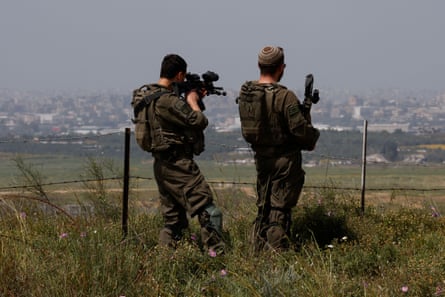
Israeli soldiers stand on the Israeli side of the Israel-Gaza border surveying the Palestinian territory on 30 March. Photograph: Amir Cohen/Reuters
Responding to the publication of the testimonies in +972 and Local Call, the IDF said in a statement that its operations were carried out in accordance with the rules of proportionality under international law. It said dumb bombs are “standard weaponry” that are used by IDF pilots in a manner that ensures “a high level of precision”.
The statement described Lavender as a database used “to cross-reference intelligence sources, in order to produce up-to-date layers of information on the military operatives of terrorist organisations. This is not a list of confirmed military operatives eligible to attack.
“The IDF does not use an artificial intelligence system that identifies terrorist operatives or tries to predict whether a person is a terrorist,” it added. “Information systems are merely tools for analysts in the target identification process.”
Lavender created a database of tens of thousands of individuals
In earlier military operations conducted by the IDF, producing human targets was often a more labour-intensive process. Multiple sources who described target development in previous wars to the Guardian, said the decision to “incriminate” an individual, or identify them as a legitimate target, would be discussed and then signed off by a legal adviser.
In the weeks and months after 7 October, this model for approving strikes on human targets was dramatically accelerated, according to the sources. As the IDF’s bombardment of Gaza intensified, they said, commanders demanded a continuous pipeline of targets.
“We were constantly being pressured: ‘Bring us more targets.’ They really shouted at us,” said one intelligence officer. “We were told: now we have to fuck up Hamas, no matter what the cost. Whatever you can, you bomb.”
To meet this demand, the IDF came to rely heavily on Lavender to generate a database of individuals judged to have the characteristics of a PIJ or Hamas militant.
Details about the specific kinds of data used to train Lavender’s algorithm, or how the programme reached its conclusions, are not included in the accounts published by +972 or Local Call. However, the sources said that during the first few weeks of the war, Unit 8200 refined Lavender’s algorithm and tweaked its search parameters.
After randomly sampling and cross-checking its predictions, the unit concluded Lavender had achieved a 90% accuracy rate, the sources said, leading the IDF to approve its sweeping use as a target recommendation tool.
Lavender created a database of tens of thousands of individuals who were marked as predominantly low-ranking members of Hamas’s military wing, they added. This was used alongside another AI-based decision support system, called the Gospel, which recommended buildings and structures as targets rather than individuals.
Two Israeli air force F15 fighter jets near the city of Gedera, southern Israel, on 27 March. Photograph: Abir Sultan/EPA
The accounts include first-hand testimony of how intelligence officers worked with Lavender and how the reach of its dragnet could be adjusted. “At its peak, the system managed to generate 37,000 people as potential human targets,” one of the sources said. “But the numbers changed all the time, because it depends on where you set the bar of what a Hamas operative is.”
They added: “There were times when a Hamas operative was defined more broadly, and then the machine started bringing us all kinds of civil defence personnel, police officers, on whom it would be a shame to waste bombs. They help the Hamas government, but they don’t really endanger soldiers.”
Before the war, US and Israeli estimated membership of Hamas’s military wing at approximately 25-30,000 people.
In the weeks after the Hamas-led 7 October assault on southern Israel, in which Palestinian militants killed nearly 1,200 Israelis and kidnapped about 240 people, the sources said there was a decision to treat Palestinian men linked to Hamas’s military wing as potential targets, regardless of their rank or importance.
The IDF’s targeting processes in the most intensive phase of the bombardment were also relaxed, they said. “There was a completely permissive policy regarding the casualties of [bombing] operations,” one source said. “A policy so permissive that in my opinion it had an element of revenge.”
Another source, who justified the use of Lavender to help identify low-ranking targets, said that “when it comes to a junior militant, you don’t want to invest manpower and time in it”. They said that in wartime there was insufficient time to carefully “incriminate every target”.
“So you’re willing to take the margin of error of using artificial intelligence, risking collateral damage and civilians dying, and risking attacking by mistake, and to live with it,” they added.
‘It’s much easier to bomb a family’s home’
The testimonies published by +972 and Local Call may explain how such a western military with such advanced capabilities, with weapons that can conduct highly surgical strikes, has conducted a war with such a vast human toll.
When it came to targeting low-ranking Hamas and PIJ suspects, they said, the preference was to attack when they were believed to be at home. “We were not interested in killing [Hamas] operatives only when they were in a military building or engaged in a military activity,” one said. “It’s much easier to bomb a family’s home. The system is built to look for them in these situations.”
Relatives outside the morgue of the al-Najjar hospital in Rafah mourn Palestinians killed in Israeli bombings on 1 February. Photograph: Mohammed Abed/AFP/Getty Images
Such a strategy risked higher numbers of civilian casualties, and the sources said the IDF imposed pre-authorised limits on the number of civilians it deemed acceptable to kill in a strike aimed at a single Hamas militant. The ratio was said to have changed over time, and varied according to the seniority of the target.
According to +972 and Local Call, the IDF judged it permissible to kill more than 100 civilians in attacks on a top-ranking Hamas officials. “We had a calculation for how many [civilians could be killed] for the brigade commander, how many [civilians] for a battalion commander, and so on,” one source said.
“There were regulations, but they were just very lenient,” another added. “We’ve killed people with collateral damage in the high double digits, if not low triple digits. These are things that haven’t happened before.” There appears to have been significant fluctuations in the figure that military commanders would tolerate at different stages of the war.
One source said that the limit on permitted civilian casualties “went up and down” over time, and at one point was as low as five. During the first week of the conflict, the source said, permission was given to kill 15 non-combatants to take out junior militants in Gaza. However, they said estimates of civilian casualties were imprecise, as it was not possible to know definitively how many people were in a building.
Another intelligence officer said that more recently in the conflict, the rate of permitted collateral damage was brought down again. But at one stage earlier in the war they were authorised to kill up to “20 uninvolved civilians” for a single operative, regardless of their rank, military importance, or age.
“It’s not just that you can kill any person who is a Hamas soldier, which is clearly permitted and legitimate in terms of international law,” they said. “But they directly tell you: ‘You are allowed to kill them along with many civilians.’ … In practice, the proportionality criterion did not exist.”
The IDF statement said its procedures “require conducting an individual assessment of the anticipated military advantage and collateral damage expected … The IDF does not carry out strikes when the expected collateral damage from the strike is excessive in relation to the military advantage.” It added: “The IDF outright rejects the claim regarding any policy to kill tens of thousands of people in their homes.”
Experts in international humanitarian law who spoke to the Guardian expressed alarm at accounts of the IDF accepting and pre-authorising collateral damage ratios as high as 20 civilians, particularly for lower-ranking militants. They said militaries must assess proportionality for each individual strike.
Smoke rises over the Gaza Strip, as seen from from the Israeli side of the border on 21 January. Photograph: Amir Levy/Getty Images
An international law expert at the US state department said they had “never remotely heard of a one to 15 ratio being deemed acceptable, especially for lower-level combatants. There’s a lot of leeway, but that strikes me as extreme”.
Sarah Harrison, a former lawyer at the US Department of Defense, now an analyst at Crisis Group, said: “While there may be certain occasions where 15 collateral civilian deaths could be proportionate, there are other times where it definitely wouldn’t be. You can’t just set a tolerable number for a category of targets and say that it’ll be lawfully proportionate in each case.”
Whatever the legal or moral justification for Israel’s bombing strategy, some of its intelligence officers appear now to be questioning the approach set by their commanders. “No one thought about what to do afterward, when the war is over, or how it will be possible to live in Gaza,” one said.
Another said that after the 7 October attacks by Hamas, the atmosphere in the IDF was “painful and vindictive”. “There was a dissonance: on the one hand, people here were frustrated that we were not attacking enough. On the other hand, you see at the end of the day that another thousand Gazans have died, most of them civilians.”
Talk to a teacher lately, and you’ll probably get an earful about AI’s effects on student attention spans, reading comprehension, and cheating.
As AI becomes ubiquitous in everyday life — thanks to tech companies forcing it down our throats — it’s probably no shocker that students are using software like ChatGPT at a nearly unprecedented scale. One study by the Digital Education Council found that nearly 86 percent of university students use some type of AI in their work.
That’s causing some fed-up teachers to fight fire with fire, using AI chatbots to score their students’ work. As one teacher mused on Reddit: “You are welcome to use AI. Just let me know. If you do, the AI will also grade you. You don’t write it, I don’t read it.”
While AI might save educators some time and precious brainpower — which arguably make up the bulk of the gig — the tech isn’t even close to cut out for the job, according to researchers at the University of Georgia. While we should probably all know it’s a bad idea to grade papers with AI, a new study by the School of Computing at UG gathered data on just how bad it is.
The research tasked the Large Language Model (LLM) Mixtral with grading written responses to middle school homework. Rather than feeding the LLM a human-created rubric, as is usually done in these studies, the UG team tasked Mixtral with creating its own grading system. The results were abysmal.
Compared to a human grader, the LLM accurately graded student work just 33.5 percent of the time. Even when supplied with a human rubric, the model had an accuracy rate of just over 50 percent.
Though the LLM “graded” quickly, its scores were frequently based on flawed logic inherent to LLMs.
“While LLMs can adapt quickly to scoring tasks, they often resort to shortcuts, bypassing deeper logical reasoning expected in human grading,” wrote the researchers.
“Students could mention a temperature increase, and the large language model interprets that all students understand the particles are moving faster when temperatures rise,” said Xiaoming Zhai, one of the UG researchers. “But based upon the student writing, as a human, we’re not able to infer whether the students know whether the particles will move faster or not.”
Though the UG researchers wrote that “incorporating high-quality analytical rubrics designed to reflect human grading logic can mitigate [the] gap and enhance LLMs’ scoring accuracy,” a boost from 33.5 to 50 percent accuracy is laughable. Remember, this is the technology that’s supposed to bring about a “new epoch” — a technology we’ve poured more seed money into than any in human history.
If there were a 50 percent chance your car would fail catastrophically on the highway, none of us would be driving. So why is it okay for teachers to take the same gamble with students?
It’s just further confirmation that AI is no substitute for a living, breathing teacher, and that isn’t likely to change anytime soon. In fact, there’s mounting evidence that AI’s comprehension abilities are getting worse as time goes on and original data becomes scarce. Recent reporting by the New York Times found that the latest generation of AI models hallucinate as much as 79 percent of the time — way up from past numbers.
When teachers choose to embrace AI, this is the technology they’re shoving off onto their kids: notoriously inaccurate, overly eager to please, and prone to spewing outright lies. That’s before we even get into the cognitive decline that comes with regular AI use. If this is the answer to the AI cheating crisis, then maybe it’d make more sense to cut out the middle man: close the schools and let the kids go one-on-one with their artificial buddies.
Researchers at the University of Mississippi have developed technology to detect heart attacks in real time with a high degree of accuracy, and packed it into a chip that could fit in a wearable device. The team hopes it may someday feature in life-saving medical gadgets.
The scientists’ work combines an effective mathematical technique called Fast Fourier Transform (FFT) for analyzing electrocardiogram (ECG) signals with artificial neural networks that can classify them as “normal” or “heart attack-like” all on a power-efficient chip. The team says this allows for a detection accuracy of 92.41%, which beats other methods.
That’s unlike some similar devices on the market today, which use AI to recognize patterns in ECG data from wearables either in the cloud or a companion app on a smartphone. This difference enables the tech to work in real time, which means patients could potentially be alerted by their wearable and receive appropriate care sooner. That’s critical when it comes to saving a life or preventing major damage in the case of a myocardial infarction, more commonly referred to as a heart attack.
It’s worth noting that the FFT technique has been around for a long while now, and numerous firms working on ECG monitoring tech like Fourth Frontier utilize AI in their pipelines. The AI-powered detection-on-a-chip tech is novel, but it’s not yet something your doctor can prescribe to you.
There are many challenges in creating a wearable heart attack detector. For starters, you’d need to miniaturize the hardware and package it into a well-designed device, so it could be worn regularly while also accounting for the limitations of the form factor in recording ECGs.
Next, you’d need to fine-tune the software to accurately spot ST elevation findings in ECGs that would indicate a heart attack, and avoid false negatives and false positives at the same time. Then, you’d have to prove to strict regulatory bodies, like the US Food and Drug Administration (FDA), that your tech is truly up to scratch and reliably does what it says on the tin.
Only after that could you really bring a medical-grade “heart attack detector” to the market. So the Mississippi team has a long way to go in productizing its chip-based tech before we’ll see it prescribed or available on store shelves.
Author and electrical and computer engineering professor Kasem Khalil said, “We want to be able to predict or identify many problems using technology like this. Whether that’s heart attacks or seizures or dementia. The detection of a disease or condition depends on the disease itself, but we’re working to find faster, more efficient ways of doing that.”
Hospitals already snap a photo of you when you arrive, now FaceAge turns that into new data for doctors. Trained on more than 58,000 “healthy” faces and tested on 6,000 cancer patients, the deep-learning system estimates biological age – how old a body seems, not how many birthdays it’s had. Across three independent cancer cohorts, every extra decade FaceAge estimated in age raised the risk of death 11-15%. In palliative patients, plugging FaceAge into a standard survival model lifted predictive accuracy from 0.74 to 0.80 AUC (Area Under the ROC Curve), roughly the jump clinicians get from a CT scan to a PET scan.
Why it matters:Oncologists often rely on gut feeling to judge whether a patient is healthy enough for chemotherapy. FaceAge brings objectivity to that judgment, turning a patient’s appearance into a quantifiable, clinically useful score.
How it works:
Face Detection: A neural network identifies and processes the face from a standard photograph.Biological Age Estimation: An Inception-ResNet model predicts a patient’s biological age with a 4-year margin of error for seniors.
Clinical Forecasting: The score feeds existing risk tools, boosting accuracy by up to six percentage points.
Genetic Correlation: It also tracks closely with senescence-related genes, suggesting it taps into real molecular aging processes.
Zoom in: Training images lean toward public figures, so broader, representative datasets are essential to curb demographic bias. A prognostic tool that guides therapy must clear rigorous validation and full transparency. Without firm policy, insurers or employers could weaponize “age-in-face” scores; guardrails need to be in place before deployment.
The big picture:FaceAge shows how AI can repurpose everyday data for health – what heart-rate sensors did for watches, facial analytics might do for cameras. If larger trials confirm the findings and equity concerns are addressed, the next time you visit the doctor, biological age may be a standard metric produced as part of your checkup “chronological age: 51; biological (FaceAge): 38”, and treatment plans might shift accordingly.


 Source: ChatGPT 4o







 AI for Good: A selfie health assessment
 Source: ChatGPT 4o Image Generation