The British Member of Parliament @danny__kruger has just given a speech in front of Parliament about the need for a Christian restoration in the UK pic.twitter.com/btDXWG16GW
Wall Street was bristling earlier this month as the chipmaker Nvidia behind the AI boom hit a record market value of $3.92 trillion, narrowly eclipsing Apple’s record of $3.915 trillion set last December.
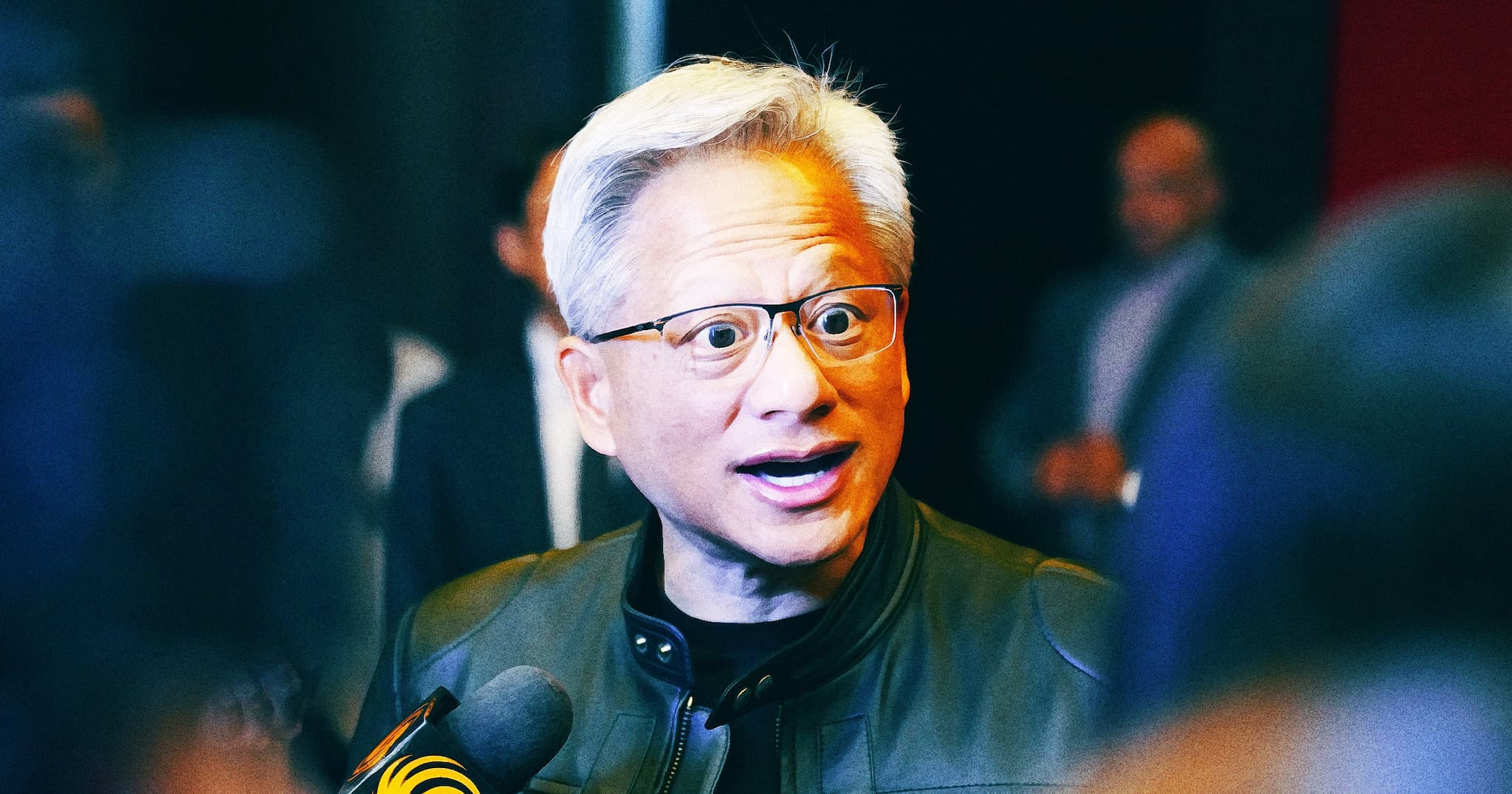
Just days later, Nvidia became the most valuable company in history, breaking the $4 trillion value ceiling and pushing CEO Jensen Huang up to being the world’s sixth richest person, with a net worth of over $143 billion.
With his bag safely secured for the next several dozen generations, Huang celebrated his dynasty with an ominous warning: “everybody’s jobs will be affected.”
Speaking with CNN‘s Fareed Zakaria, Huang repeated the spooky threat, which the broader tech sector has been dining out on for years.
At the center of Huang’s prediction is productivity — the idea that AI will soon produce more market value than human workers, in less time and for a lower cost — though, like many of his peers, he also mixed in the confusing claim that there will still be room for human jobs, which will take as-yet-undisclosed new forms.
“Some jobs will be lost,” Huang said. “Many jobs will be created and what I hope is that the productivity gains that we see in all the industries will lift society.”
What “lifting society” means in practice remains to be seen. For all the billions of dollars poured into AI, our tech overlords have refused to use their fortunes to prepare us for the coming AI job apocalypse they insist is right around the corner. Instead, they’ve aligned with politicians bent on the destruction of the social safety net and the privatization of public services for the direct benefit of the ultra-wealthy.
Case in point, while Nvidia’s stock price soared following Huang’s headline-grabbing interview, the reality for workers is much less green. Were the CEO to ever talk to one of them, he might find that “productivity” is the last thing on anyone’s mind.
In mid-2024, a study of 2,500 workers found that 77 percent reported decreased productivity and even higher workloads when using AI. Just under 40 percent of workers reported increased workloads caused explicitly by AI’s sloppy mistakes, while 47 percent of respondents “didn’t know how to achieve the expected productivity” gains with AI.
More recently, a survey of 25,000 employees across 7,000 workplaces by the National Bureau of Economic Research in Denmark found that enterprise AI contributed to paltry productivity gains overall compared to typical productivity growth over time.
For workers, “AI chatbots have had no significant impact on earnings or recorded hours in any occupation” — meaning that if AI is about to take everyone’s jobs, it’s being awfully quiet about it.
While loads of startup grifters and cynical PR spinsters have spent years pushing the AI automation story, the Nvidia CEO’s forecast marks a noteworthy departure from his previous take on the issue.
Earlier in June, Huang pushed back hard on Anthropic CEO and fellow tech billionaire Dario Amodei’s hairbrained statement that AI could automate half of all entry-level office jobs within five years — a claim so out of line with the tech’s current abilities that it’s almost meaningless.
“One, he believes that AI is so scary that only they [Anthropic] should do it,” Huang said at the time. “Two, [he believes] that AI is so expensive, nobody else should do it… and three, AI is so incredibly powerful that everyone will lose their jobs, which explains why they should be the only company building it.”
It was a harsh repudiation of Amodei’s obnoxious AI fearmongering, and a seemingly sober take from someone in Huang’s position — at least at the time.
Nvidia, it should be noted, currently controls 90 percent of the datacenter chip market, holding an immense position of power over the tech industry, the Fortune 500, and US military interests. Unlike the companies relying on his hardware, Huang’s Nvidia depends less on an AI automation sales pitch, and more on a constant line of chip buyers.
… ex Bureau of Military History…“I can only surmise that I made them aware of my views such as they were. I do not remember any meeting of the four Judges to consider the Minister’s decree abolishing the Courts. I am practically certain that we did not meet. I was aware that Clery was opposed to the Treaty. I cannot now remember what Crowley’s or Meredith’s views were at the time, but I think that Meredith accepted; if he did not like myself welcome, the decree as a fait accompli. Apparently Clery and Crowley did not. Dorothy McArdle, in Chapter 78 of her book, mentions an application moved by Michael Comyn, on behalf of Mrs. Tom Clarke as a member of the Dáil, for a conditional order of mandamus directed to Eoin McNeill as Speaker to compel him to summon the Dáil to meet. She stated that Crowley granted the Conditional Order on August 4th and that Clery de it absolute on August 11th. It is hardly necessary to state that the orders made for the release of George Plunket, for the attachment of Mulcahy and Ó Murchadha, and for the assembly of the Dáil, were never complied with and could not be executed. Source Bureau of Military history search Michael Comyn KC
The passage you provided offers a glimpse into the complex legal and political dynamics in Ireland during the early 1920s, specifically around the abolition of the Dáil Courts and the broader context of the Anglo-Irish Treaty. Below, I’ll address the key points raised, clarify the events, and provide context based on the Bureau of Military History and other relevant historical information, while critically examining the narrative.
Context: Dáil Courts and the Treaty: The Dáil Courts were a system of courts established by the First Dáil (the revolutionary Irish parliament) in 1919 as an alternative to the British judicial system during the Irish War of Independence (1919–1921). These courts, rooted in Sinn Féin’s push for self-governance, handled civil and criminal matters and were a symbol of Irish sovereignty. However, following the Anglo-Irish Treaty of December 1921, which established the Irish Free State, the Dáil Courts became a point of contention. The Treaty split the republican movement into pro-Treaty (supporting the Free State) and anti-Treaty (opposing the Treaty’s compromises, particularly the oath of allegiance to the British Crown) factions, leading to the Irish Civil War (1922–1923). In 1922, the Provisional Government of the Irish Free State, led by figures like Michael Collins and Richard Mulcahy, sought to consolidate its authority.A ministerial decree was issued to abolish the Dáil Courts, as they were seen as tied to the anti-Treaty republican movement and incompatible with the new Free State’s legal framework. This decree was controversial, as it effectively dismantled a key institution of the revolutionary period.
The Passage: Key Points and Analysis: The passage appears to be a recollection (likely from a Bureau of Military History witness statement) by one of the four judges of the Dáil Courts, reflecting on the decree abolishing the courts and related legal actions. Let’s break it down:
Lack of Formal Meeting Among Judges:
The speaker notes that they do not recall any meeting of the four Dáil Court judges (presumably themselves, Clery, Crowley, and Meredith) to discuss the Minister’s decree abolishing the courts. They are “practically certain” no such meeting occurred.
This suggests a lack of formal coordination or resistance among the judges to the decree. The absence of a meeting could indicate that the decree was imposed swiftly, leaving little room for judicial consultation, or that the judges were divided in their responses.
Differing Views on the Treaty:
The speaker indicates that Judge Clery was opposed to the Treaty, while they are unsure of Crowley’s and Meredith’s stances. They believe Meredith likely accepted the decree as a “fait accompli” (a done deal), possibly without enthusiasm, and the speaker themselves may have shared this pragmatic view.
The division among the judges reflects the broader split within Irish society and institutions over the Treaty. Clery’s opposition aligns with the anti-Treaty stance, which viewed the Free State’s actions (including the abolition of the Dáil Courts) as a betrayal of the republic declared in 1916.
Legal Action by Michael Comyn, KC:
Dorothy Macardle, in her book The Irish Republic (Chapter 78), describes a legal action initiated by Michael Comyn, a prominent barrister and King’s Counsel (KC), on behalf of Mrs. Tom Clarke (Kathleen Clarke), a member of the Dáil and widow of executed 1916 leader Tom Clarke.
Comyn applied for a conditional order of mandamus directed at Eoin MacNeill, the Speaker of the Dáil, to compel him to summon the Dáil to meet. A mandamus is a court order compelling a public official to perform a duty.
According to Macardle, Judge Crowley granted the conditional order on August 4, 1922, and Judge Clery made it absolute (final) on August 11, 1922.
This legal maneuver was likely an attempt by anti-Treaty republicans to assert the legitimacy of the Second Dáil (elected in 1921), which anti-Treatyites argued was the true government of the Irish Republic, as opposed to the Provisional Government established under the Treaty.
Other Orders and Non-Compliance:
The passage mentions additional orders issued by the Dáil Courts, including one for the release of George Plunkett (likely George Noble Plunkett, a prominent republican and father of Joseph Plunkett, executed in 1916) and for the “attachment” (arrest or holding accountable) of Richard Mulcahy and Ó Murchadha (likely Seán Ó Murthuile, a pro-Treaty figure).
These orders, along with the mandamus to summon the Dáil, were never complied with and “could not be executed.” This reflects the reality that the Dáil Courts, by mid-1922, lacked enforcement power under the Free State’s authority. The Provisional Government, backed by the National Army, was consolidating control, and anti-Treaty forces (including the Dáil Courts) were increasingly marginalized during the Civil War.
Dorothy Macardle’s Account:
Dorothy Macardle, a republican historian and anti-Treaty sympathizer, documented these events in The Irish Republic (1937), a key text on the revolutionary period from a republican perspective. Her account in Chapter 78 highlights the anti-Treaty efforts to use the Dáil Courts to challenge the Free State’s legitimacy.
However, Macardle’s work is not neutral; it reflects her anti-Treaty bias. Her depiction of the mandamus action and the judges’ roles should be cross-referenced with primary sources, such as the Bureau of Military History, to assess its accuracy.
Historical Context and Critical Analysis
Abolition of the Dáil Courts:
The decree abolishing the Dáil Courts was part of the Free State’s effort to establish a unified legal system under its control. The Dáil Courts were seen as a remnant of the revolutionary republic, and their continued operation was untenable for a government seeking to assert sovereignty.
The lack of resistance from some judges (e.g., the speaker and possibly Meredith) suggests that pragmatic acceptance of the Free State’s authority was common, even among those involved in republican institutions. Clery and Crowley’s apparent refusal to accept the decree aligns with the anti-Treaty stance, which rejected the Free State’s legitimacy.
Michael Comyn’s Role:
Michael Comyn, KC, was a skilled lawyer and a committed republican. His involvement in the mandamus application reflects the anti-Treaty strategy of using legal mechanisms to challenge the Provisional Government. By seeking to compel Eoin MacNeill to summon the Dáil, Comyn and Kathleen Clarke were asserting that the Second Dáil remained the legitimate government, a key anti-Treaty argument.
The failure of these orders to be enforced underscores the Dáil Courts’ declining authority by mid-1922, as the Free State’s military and political power grew.
Eoin MacNeill, Richard Mulcahy, and Ó Murchadha:
Eoin MacNeill, as Speaker of the Dáil, was a pro-Treaty figure and a member of the Provisional Government. His refusal to comply with the mandamus order reflects the Free State’s rejection of the Dáil Courts’ authority.
Richard Mulcahy, a key pro-Treaty leader and Minister for Defence, was a central figure in the National Army. The order for his “attachment” likely stemmed from his role in suppressing anti-Treaty forces during the Civil War.
Ó Murchadha (Seán Ó Murthuile) was a pro-Treaty politician and administrator, also targeted by anti-Treaty legal actions. The failure to enforce these orders highlights the Free State’s dominance by August 1922.
Bureau of Military History:
The Bureau of Military History (BMH) collection, referenced in the passage, is a critical source for understanding Ireland’s revolutionary period (1913–1921). It includes 1,773 witness statements, documents, and photographs collected between 1947 and 1957. However, as noted in the web results, the BMH has limitations: it lacks detailed statements from prominent anti-Treaty figures (e.g., Tom Barry) due to their perception of it as a “Free State” project, and it was reluctant to collect material on the Civil War due to the political sensitivities of the 1940s and 1950s.
The passage you provided likely comes from a BMH witness statement, possibly by one of the Dáil Court judges (e.g., Cahir Davitt or another figure). Such statements are valuable but must be critically evaluated, as they reflect personal recollections decades after the events and may be influenced by the witness’s political stance.
Limitations and Gaps
Incomplete Information on Judges’ Views:
The speaker’s uncertainty about Crowley’s and Meredith’s views suggests a lack of clear documentation or coordination among the judges. This could reflect the chaotic circumstances of the Civil War, where communication was disrupted, or it may indicate the speaker’s limited involvement in anti-Treaty efforts.
Non-Execution of Orders:
The passage notes that the orders (for Plunkett’s release, Mulcahy’s and Ó Murchadha’s attachment, and the Dáil’s assembly) were unenforceable. This highlights the practical limitations of the Dáil Courts in 1922, as the Free State’s military and political control rendered republican institutions powerless.
Bias in Sources:
Macardle’s account, while detailed, is sympathetic to the anti-Treaty cause. The BMH, while a rich primary source, is skewed toward pro-Treaty perspectives due to its collection process. Cross-referencing with other archives (e.g., UCD Archives, which hold Richard Mulcahy’s papers) or contemporary records is necessary for a balanced view.
Conclusion
The passage illustrates the tension between the revolutionary institutions (like the Dáil Courts) and the emerging Free State in 1922. The abolition of the Dáil Courts by ministerial decree was a pivotal moment in consolidating Free State authority, but it was met with resistance from anti-Treaty judges like Clery and Crowley, who supported legal actions to challenge the government. Michael Comyn’s mandamus application, backed by Kathleen Clarke, was a symbolic effort to assert the Second Dáil’s legitimacy, but its failure reflects the Free State’s dominance during the Civil War. The Bureau of Military History provides valuable context, but its limitations and Macardle’s bias require careful consideration. For further details, the Military Archives at Cathal Brugha Barracks or UCD Archives (Mulcahy papers) are key resources.
If you’d like me to search for specific BMH witness statements, analyze related documents, or clarify any details (e.g., the identities of Crowley or Meredith), let me know!
Claude has big plans to shape the future of finance
Source: Anthropic
Financial analysts spend countless hours jumping between platforms, hunting down source documents and manually cross-checking data — a workflow that hasn’t fundamentally changed in decades.
Anthropic is betting it can change that. The company unveiled Claude for Financial Services, a specialized AI platform designed to streamline research, automate financial modeling and verify data with source-level tracking.
Unlike general-purpose AI chatbots, this isn’t a standalone tool. Claude integrates directly with live market data feeds and connects to financial databases including PitchBook, S&P Capital IQ, Morningstar and FactSet. The system can analyze company performance, generate investment memos, conduct peer comparisons and summarize earnings calls while maintaining traceable links to every source.
The platform also leverages cloud data warehouses, such as Databricks and Snowflake, to perform Monte Carlo simulations and risk modeling through Claude’s code-generation capabilities.
Norway’s sovereign wealth fund uses Claude embedded in Snowflake queries to monitor thousands of companies in real timeAIA Labs deploys Claude to help analysts write Python code and create visualizationsBridgewater, Commonwealth Bank of Australia and AIG have integrated Claude for due diligence and regulatory reviews
The move puts Anthropic in direct competition with established players like Bloomberg Terminal and specialized fintech AI companies already serving Wall Street. It also comes as AI tools targeting financial workflows are gaining traction — we’re currently testing Shortcut, an Excel-focused AI agent that recently went viral for completing spreadsheet tasks in minutes rather than hours.
Financial services represent a massive opportunity for AI companies. They’re firms that can afford enterprise-grade solutions and have workflows ripe for automation. But the sector also demands extreme accuracy and regulatory compliance, areas where AI has historically struggled.
Why it matters: If Claude can deliver on its promises of speed and accuracy without compromising compliance, it could reshape how financial analysis gets done.
The Rundown: In Shenzhen, a fleet of 41 penguin-shaped delivery bots now zips through the subway stations and boards trains autonomously, ferrying drinks and snacks to more than 100 7-Eleven locations.
The details:
The fleet of robots, each a meter tall with glowing LED “faces,” can navigate stations, elevators, and train carriages autonomously.VX Logistics, a Vanke subsidiary, manages the operation, with the fleet serving over 100 7‑Eleven stores located within the city’s vast subway network. Robots operate only during non‑peak hours to minimize congestion, replacing human couriers who otherwise need to park on the street and unload stock. Equipped with panoramic lidar and smart chassis design, the bots reportedly avoid collisions, handle subway platform gaps, and maneuver crowded spaces.
Why it matters: Shenzhen’s “Embodied Intelligent Robot Action Plan” has flipped the script on city logistics — robots now ride the rails, delivering straight to subway shops and skipping the curbside chaos. In the race for robotic dominance, this is a serious flex: In Shenzhen, even the subway has joined the robot workforce.
The Rundown: Hyundai’s shipyards are getting a major robotic upgrade — not from its own robotics division or Boston Dynamics (which it owns), but from Germany’s Neura Robotics, whose humanoids will power next-generation robotic shipbuilders.
The details:
Hyundai signed a deal with Neura Robotics to develop four-legged bots and specialized humanoids for shipbuilding, leveraging its humanoid platform 4NE1.HD Hyundai Samho will provide the hands-on testing environments at its shipbuilding facilities to get the robots up to speed.The 4NE1 robots are designed for advanced manipulation, adaptability, and teamwork, making them well-suited for complex assembly on the shipyard floor.Neura also recently announced a partnership with GFT Technology for its humanoids and raised $123M in Series B funding earlier this year.
Why it matters: This deal is a big shift in industrial automation, with one of the world’s top shipbuilders choosing cutting-edge, foreign-made humanoids over its own in-house solutions. The result of this team-up could push the arrival of truly intelligent, adaptable robots on some of the industry’s toughest front lines.
Researchers from OpenAI, Google DeepMind, and Meta have joined forces to warn about what they’re building.
In a new position paper, 40 researchers spread across those four companies called for more investigation of AI powered by so-called “chains-of-thought” (CoT), the “thinking out loud” process that advanced “reasoning” models — the current vanguard of consumer-facing AI — use when they’re working through a query.
As those researchers acknowledge, CoTs add a certain transparency into the inner workings of AI, allowing users to see “intent to misbehave” or get stuff wrong as it happens. Still, there is “no guarantee that the current degree of visibility will persist,” especially as models continue to advance.
Depending on how they’re trained, advanced models may no longer, the paper suggests, “need to verbalize any of their thoughts, and would thus lose the safety advantages.” There’s also the non-zero chance that models could intentionally “obfuscate” their CoTs after realizing that they’re being watched, the researchers noted — and as we’ve already seen, AI has indeed rapidly become very good at lying and deception.
To make sure this valuable visibility continues, the cross-company consortium is calling on developers to start figuring out what makes CoTs “monitorable,” or what makes the models think out loud the way they do. In this request, those same researchers seem to be admitting something stark: that nobody is entirely sure why the models are “thinking” this way, or how long they will continue to do so.
Zooming out from the technical details, it’s worth taking a moment to consider how strange this situation is. Top researchers in an emerging field are warning that they don’t quite understand how their creation works, and lack confidence in their ability to control it going forward, even as they forge ahead making it stronger; there’s no clear precedent in the history of innovation, even looking back to civilization-shifting inventions like atomic energy and the combustion engine.
In an interview with TechCrunch about the paper, OpenAI research scientist and paper coauthor Bowen Baker explained how he sees the situation.
“We’re at this critical time where we have this new chain-of-thought thing,” Baker told the website. “It seems pretty useful, but it could go away in a few years if people don’t really concentrate on it.”
“Publishing a position paper like this, to me, is a mechanism to get more research and attention on this topic,” he continued, “before that happens.”
Along with its 40-researcher author list that includes DeepMind cofounder Shane Legg and xAI safety advisor Dan Hendrycks, the paper has also drawn endorsements from industry luminaries including former OpenAI chief scientist Ilya Sutskever and AI godfather and Nobel laureate Geoffrey Hinton.
Though Musk’s name doesn’t appear on the paper, with Hendrycks on board, all of the “Big Five” firms — OpenAI, Google, Anthropic, Meta, and xAI — have been brought together to warn about what might happen when and if AI stops showing its work.
In doing so, that powerful cabal has said the quiet part out loud: that they don’t feel entirely in control of AI’s future. For companies with untold billions between them, that’s a pretty strange message to market — which makes the paper all the more remarkable.



 Source: Anthropic
 Image source: Vanke
 Image source: Neura Robotics