
-
Archives
- October 2026
- September 2026
- August 2026
- July 2026
- June 2026
- May 2026
- April 2026
- March 2026
- February 2026
- January 2026
- December 2025
- November 2025
- October 2025
- September 2025
- August 2025
- July 2025
- June 2025
- May 2025
- April 2025
- March 2025
- February 2025
- January 2025
- December 2024
- November 2024
- October 2024
- September 2024
- August 2024
- July 2024
- June 2024
- May 2024
- April 2024
- March 2024
- February 2024
- January 2024
- December 2023
- November 2023
- October 2023
- September 2023
- August 2023
- July 2023
- June 2023
- May 2023
- April 2023
- March 2023
- February 2023
- January 2023
- December 2022
- November 2022
- October 2022
- September 2022
- August 2022
- July 2022
- June 2022
- May 2022
- April 2022
- March 2022
- February 2022
- January 2022
- September 2021
- August 2021
- July 2021
- June 2021
- May 2021
- April 2021
- February 2021
- January 2021
- December 2020
- November 2020
- October 2020
- September 2020
- August 2020
- July 2020
- June 2020
- May 2020
- April 2020
- March 2020
- February 2020
- January 2020
- December 2019
- November 2019
- October 2019
- September 2019
- August 2019
- July 2019
- June 2019
- May 2019
- April 2019
- March 2019
- February 2019
- January 2019
- December 2018
- November 2018
- October 2018
- September 2018
- July 2018
- June 2018
- May 2018
- April 2018
- March 2018
- February 2018
- January 2018
- December 2017
- November 2017
- October 2017
- September 2017
- August 2017
- July 2017
- June 2017
- May 2017
- April 2017
- March 2017
- February 2017
- January 2017
- December 2016
- November 2016
- October 2016
- September 2016
- August 2016
- July 2016
- June 2016
- May 2016
- April 2016
- March 2016
- February 2016
- January 2016
- December 2015
- November 2015
- October 2015
- September 2015
- August 2015
- July 2015
- June 2015
- March 2015
- January 2015
-
Meta
Why the Empath’s Intuition Unravels the Narcissist’s Illusion Faster Than Words | Carl Jung Original
Posted in Uncategorized
Leave a comment
The global refugee crisis is at breaking point | GZERO World … Ian Bremmer
Posted in Uncategorized
Leave a comment
El PAIS: Data centres use of energy – Port of Marseille
Data centers are drying up the Port of Marseille: ‘They consume enormous amounts of electricity’
The proliferation of these centers in France’s second-largest city threatens the energy supply for projects aimed at improving the lives of residents

Marseille – AUG 24, 2025 – 06:00 CEST
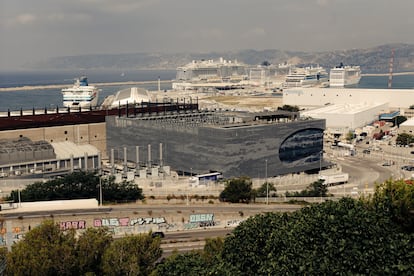
At the Marseille Provence Cruise Terminal, almost five miles from the charming Old Port that marks the center of the city, four enormous ships are docked. Behind them, following the coast to the north, another can be seen in the shipyards.
The silhouettes of these floating hotels are familiar sights from some of the homes in the humble Saint-André neighborhood. Located in the northwest of the city, it’s the closest to the port area. Residents have to live with the constant roar of the engines of these steel hulks, which must remain running to provide onboard services. The sea breeze makes the smoke spewing from their chimneys barely perceptible today… but locals tell EL PAÍS that, on some days, the air is very cloudy.
City Hall has a plan to make the presence of cruise ships more bearable: electrify them and connect them to the grid, so they can shut down their engines and still continue operating. The idea is that shipyard repairs — as well as loading and unloading operations at the dock — will also use this energy. But it’s unclear whether there will be enough electricity to make this feasible. This is because data centers in the port area, active since 2021, have priority when it comes to the energy that’s available.
“They consume enormous amounts of electricity and reserve electrical power in a speculative and monopolistic manner. This raises the prospect of future usage conflicts regarding the electricity supply,” Sébastien Barles, the city’s deputy mayor, tells EL PAÍS.
In the last meeting between port authorities, regional authorities and residents, it was reported that the ship electrification project was being postponed until 2029. “Currently, the data centers only have negative effects on the residents of Marseille,” the politician emphasizes.
The opinion expressed by Barles, a member of the Greens, contrasts with that of Mayor Benoît Payan. A member of the Socialist Party, Payan has led the coalition that has governed the City Council since 2020. He views the digital wave as an opportunity for Marseille’s economic growth.
Barles’ perspective also clashes with the vision of President Emmanuel Macron, who in February announced foreign investments of more than €100 billion ($116 billion) in artificial intelligence (AI). Much of this money will be dedicated to building data centers… the key infrastructure for the operation and development of this technology.
In the last decade, Marseille has gone from irrelevance to becoming the seventh-largest city in the world in terms of data traffic. The American company Digital Realty has four data centers operating in the city. Three of them are in the port, literally next to the cruise terminal. Particularly striking is the one that occupies a former submarine base resembling a giant bunker, built by the Germans during World War II.

The facilities have a futuristic appearance and heavy security measures. To enter the power transformer substation built to support these data centers — a modern and seemingly deserted building on the side of the road, with no signage — you have to scan your fingerprints, under the watchful eye of several video cameras.
This high-level technology contrasts with the rather chaotic atmosphere of the place. A few clueless tourists passing by these cold buildings in search of their cruise ship mingle with port workers, who wear hard hats and yellow vests. While wandering around, you can spot a line of cars, their roofs overflowing with luggage, waiting to board ferries to Algeria or Morocco. These boat rides can be accessed just a few feet from Digital Realty’s servers.
Not even half-a-mile away, the company is building a fifth complex where a sugar factory once stood, its large silos reflecting the city’s colonial history. “It will go from storing food to storing data,” Anti, a 30-year-old Marseille native, mutters sarcastically. “The work is progressing quickly,” he sighs, pointing at the structures. The data center is clearly visible from the hill that Anti climbs. He shows EL PAÍS how these industrial warehouses, packed with sophisticated processors, are replacing metalworking and canning factories.
Anti is part of a collective. Named Le nuage était sous nos pieds (translated as “the cloud was under our feet”), it seeks to raise awareness about “technology’s socio-environmental destruction.” He and his colleagues are concerned about how data centers are changing the city. They’ve reported continued leaks of fluorinated gases, which are used in computer cooling in the port’s data centers. And they’re concerned that these facilities are hogging energy in a city that produces only 16% of its own energy needs.

The location of data centers in the port is no coincidence: 17 submarine cables currently extend to the facility, with four more planned. “The seabed near Marseille has been well-known since the 19th century, when the first cables were laid to connect African colonies by telegraph,” Max explains. She’s Anti’s fellow activist, who, like him, prefers not to give her full name.
Today, fiber optic cables are reaching the city, which has a strategic advantage over other major ports, such as Barcelona or Genoa: it has no large mountains separating it from the heart of Europe. Cables can reach Paris, Frankfurt, Amsterdam, or London, without having to cross the Pyrenees or the Alps.
A question of energy
In some places, the main criticism that residents have about data centers has to do with the amount of water they consume to cool servers. This isn’t the case in Marseille, however, which is well-supplied with this resource. The authorities have even given Digital Realty access to water from the former underground drainage channels of the Gardanne coal mines, located north of Marseille. The water flows into the port, so the firm can use it to cool its systems. This means that only 10% of the energy consumed by this infrastructure is dedicated to cooling processors, while between 80% and 85% is used to power servers, according to data from a public consultation conducted by Le nuage était sous nos pieds. EL PAÍS hasn’t been able to verify this information with Digital Realty.
In Marseille, the main concern of those protesting against the proliferation of data centers is about energy, as illustrated by the case of the failed electrification of cruise ships. “The deputy director general of the Grand Port Maritime de Marseille estimates the electrical power required for dock electrification activities [to be] at 100 to 120 MW. The total power of the five data centers already operating in Marseille is 77 MW!” Patrick Robert exclaims. He’s president of the federation of neighborhood interest committees for Marseille’s 16th arrondissement.

When the complex being built next to the port becomes operational next year, Digital Realty’s facilities will have an installed capacity of 98 MW. And, in 2028, the company plans to open a much larger sixth center with a capacity of 50 MW in Bouc Bel Air, on the outskirts of the city.
Digital Realty, which declined to respond to this newspaper’s questions, is one of the largest operators of colocation data centers, which lease out server space or computing capacity to third parties. Its Marseille facilities serve Alphabet, Google’s parent company, as well as a French sovereign data project involving Google, Thales, Orange and Microsoft, among other firms. Disney+ was launched in France from these facilities.
Barles — the city’s deputy mayor for environmental affairs — recites the figures without hiding his concern. “Current data centers represent the equivalent of the electricity consumption of 200,000 inhabitants. But if we add the projects underway, we’re talking about the equivalent of the consumption of the entire population of Marseille: 850,000 inhabitants.” The environmentalist politician explains that this is stretching infrastructure to its limits, while requiring public investment to supply a private business. He also stresses that this compromises the city’s ability to develop “activities that generate more employment” in the future.
The specter of shortages has loomed since the 2022 energy crisis, when Russia cut off gas supplies to Europe. “To get through that winter, the authorities established a plan for local power outages in case of supply problems. Neighborhood outages were planned… but cutting off power to the data centers was never considered,” Barles notes. At the time, he was already a member of the City Council. “This raises questions about the priorities of our society,” he warns.
Translated by Avik Jain Chatlani.
Sign up for our weekly newsletter to get more English-language news coverage from EL PAÍS USA Edition
Courage.Media: “Erasing the Enemy Within” … Muslim Brotherhood. Quote “They spoke to American ideals while quietly serving the Brotherhood’s agenda.” Comment: Ireland should follow: The Muslim Brotherhood are supposed to be involved in the Mosque in Clonskeagh, which has been closed for 6 months now.
Commentary
Ending The Muslim Brotherhood’s American Experiment
Erasing the Enemy Within
16 Aug 2025
Marco Rubio announced this week what should have been obvious years ago: the Muslim Brotherhood will be designated a terrorist organization. The only question now is how long it takes to cut through the red tape that has protected this network for far too long.
America has been played, outmaneuvered by men in suits who speak our language while subverting our way of life. They needed no bombs or bullets, only patience, legal cover, and a nation too polite to call evil by its name.
Become a Free Member
Enjoy independent, ad-free journalism – delivered to your inbox each week
The Brotherhood’s American infiltration reads like a textbook case of ideological warfare. In 1993, Hamas operatives gathered in Philadelphia to discuss propaganda strategy. Within months, the Council on American-Islamic Relations (CAIR) established its presence in Washington. CAIR became the Brotherhood’s public face in America — clean, articulate, and fluent in the language of civil rights. They spoke to American ideals while quietly serving the Brotherhood’s agenda. For thirty years, this charade worked perfectly. CAIR leaders testified before Congress. They met with presidents. They helped craft the counterterrorism policy built to stop organisations like theirs. The audacity is staggering; it’s like commissioning the fox to design the locks on the henhouse.
Audacity was never their weakness, but patience was their weapon. While Americans obsessed over quarterly earnings and election cycles, the Brotherhood thought in decades. They built networks within networks; organizations that appeared independent yet shared the same funding, leadership, and objectives. The Muslim Brotherhood’s terror, drug, and cash operations run through a disciplined, interlocking system.
As Middle Eastern political expert Amjad Taha points out, the North American Islamic Trust (NAIT) controls mosque properties and financial assets. The Islamic Society of North America (ISNA) lends the Brotherhood a degree of religious legitimacy. The American Muslim Council (AMC) works the political front, cutting deals and building alliances. The Muslim American Society (MAS) runs operations on the ground, embedding itself firmly in local communities.
These schools, mosques, and cultural centers are far more than community spaces. They operate as recruitment hubs, training grounds, and engines of extremist influence.
In universities, the International Institute of Islamic Thought (IIIT) shapes the narrative. On campuses, the Muslim Students’ Association (MSA) targets the next wave of recruits. The Islamic Circle of North America (ICNA) and Young Muslims (YM) focus on families and youth. Then come the neighborhood strongholds — the Universal School in Bridgeview, Illinois, the Noor Islamic Cultural Center in Columbus, Ohio, and the Islamic Society of Baltimore (ISB). These schools, mosques, and cultural centers are far more than community spaces. They operate as recruitment hubs, training grounds, and engines of extremist influence.
The strategy was and remains both simple and brutally effective. Don’t attack the American system. Take it over. Don’t fight American values. Bend them. Don’t oppose democracy. Use it. Every lawsuit, media appearance, political alliance, and community initiative pulled in the same direction: make the unthinkable look inevitable.
And it worked with unsettling precision. Critics who warned of Brotherhood influence were quickly dismissed as bigots. When intelligence agencies traced the links to terrorist networks, they were met with charges of Islamophobia. The Brotherhood weaponized America’s own tolerance against itself, turning our strength into their shield.
At the same time, the evidence kept piling up steadily. Court documents revealed CAIR’s founders emerged from organizations that federal judges determined supported Hamas. Intelligence reports traced funding flows from Gulf states to American Brotherhood affiliates. Former FBI officials testified about the organization’s true nature. But none of it mattered and the machine kept rolling.
Political leaders preferred comfortable lies to uncomfortable truths, bureaucrats mistook civil rights for moral relativism, and a media establishment treated legitimate security concerns as racist paranoia.
The most damning indictment is not what the Brotherhood did but what America allowed. We had the intelligence, legal authority, and every right to take meaningful action, but lacked backbone. Political leaders preferred comfortable lies to uncomfortable truths, bureaucrats mistook civil rights for moral relativism, and a media establishment treated legitimate security concerns as racist paranoia.
Meanwhile, Egypt, Saudi Arabia, and the UAE – three nations that know the Brotherhood’s threat firsthand – designated them as terrorists years ago. When countries that live under the shadow of Islamist terrorism act decisively while America, the self-proclaimed leader in counterterrorism, stalls, something is deeply and deliberately broken.
Now, however, things are changing. Rubio’s announcement concedes the scale of the failure; we’ve been asleep while our enemies built and fortified their networks. Waking up won’t be easy, but it’s necessary. The Brotherhood’s network was engineered for endurance: a multi-headed hydra — multiple organisations sharing resources while maintaining separate legal identities, overlapping leadership to coordinate strategy while concealing accountability, and financial arteries running beneath layers of charitable fronts. Redundancy is built into every tier, ensuring that if one head is cut off, the others strike back faster and more fiercely.
The designation process will face serious legal challenges designed to delay and deflect: political pressure from allies who cling to the fiction that these are civil rights organizations, and media narratives that frame enforcement as persecution. The Brotherhood will fight back using every tool America’s open society provides. They will leverage their alliances with progressive movements and institutions. The reckoning won’t be gentle. Thirty years of institutional capture doesn’t disappear overnight. Organizations that have positioned themselves as legitimate voices of American Muslims will fight to preserve their influence. Political allies who accepted their support will resist admissions of error. Academic institutions that host the conferences and endorse the scholarship will move quickly to defend their reputations.
But none of that changes the fundamental reality. America has been harboring networks built to advance “a grand Jihad to eliminate and destroy Western civilization from within and sabotage its miserable house by their hands and the hands of the believers”. They have pursued this mission on a global scale. The evidence was always in plain sight, and the legal authority was always there, but the only thing missing was the political will to act.
Marco Rubio just provided it. The Brotherhood’s American experiment is ending, and its architects won’t survive the fallout. Whether Britain and the rest of Europe follow America or learn the hard way remains to be seen.
MalayNews: TikTok to cut UK moderation jobs in shift to AI-based content review
TikTok to cut UK moderation jobs in shift to AI-based content review


TikTok said it plans to reshape content moderation “with the benefit of technological advancements. — Reuters pic
Stay updated on the latest news and insights. Subscribe to our newsletter here
Saturday, 23 Aug 2025 9:48 AM MYT
LONDON, Aug 23 — Social media platform TikTok announced yesterday it will restructure its UK trust and safety operations, putting several hundred jobs at risk as it shifts to AI-assisted content moderation.
The move is part of global restructuring plans by TikTok, owned by China-based ByteDance, which also affects moderator jobs in South and Southeast Asia, notably in Malaysia.
“We are continuing a reorganisation that we started last year… concentrating our operations in fewer locations globally,” a TikTok spokesperson told AFP.
TikTok added that it plans to reshape content moderation “with the benefit of technological advancements.”
Content moderators are tasked with keeping content such as hate speech, misinformation and pornography off the platform, which has more than 1.5 billion users worldwide.
But, globally, there is a trend of social media companies reducing their use of human fact-checkers and turning to AI instead.
Moderation technologies, including AI, take down over 85 percent of content removed for violating TikTok’s guidelines, according to the company.
It also said it uses AI to help reduce the amount of distressing content moderators are exposed to.
Under the proposed plans, the work of employees affected by layoffs will be relocated to other European offices and some third-party providers.
“TikTok workers have long been sounding the alarm over the real-world costs of cutting human moderation teams in favour of hastily developed, immature AI alternatives,” said Communication Workers Union national officer John Chadfield.
He added that the layoffs “put TikTok’s millions of British users at risk.”
TikTok in June announced plans to increase investment in the UK, its biggest community in Europe, with the creation of 500 more jobs.
Around half the UK population, more than 30 million people, use TikTok each month.
The video-sharing platform has been in the crosshairs of Western governments for years over fears personal data could be used by China for espionage or propaganda purposes.
AFP, among more than a dozen other fact-checking organisations, is paid by TikTok in several countries to verify videos that potentially contain false information. — AFP
Posted in Uncategorized
Tagged ai, digital-marketing, marketing, social-media, technology
Leave a comment
Col Doug Macgregor: What Trump should Tell NATO & Europe
Aug 24, 2025
Daniel Davis Deep Dive Merch: Etsy store https://www.etsy.com/shop/DanielDavis…
The discussion argues that President Trump seeks to end U.S. involvement in the Ukraine conflict and reset relations with Russia. Key points: Trump’s stance: He sees no threat from Russia and believes there’s no reason for U.S.-Russia hostility. He wants to declare the war over, withdraw U.S. forces from Ukraine, suspend aid to Zelensky, and push for a neutral Ukrainian rump state outside NATO. Message to Europe: European states can continue supporting Ukraine if they choose, but without U.S. backing. Trump expects Europe to take responsibility for its own security and reduce reliance on NATO, which he views as obsolete. Strategic inflection point: NATO is described as a “terminal patient,” and the EU as weak. The West must acknowledge that Russia doesn’t seek to conquer Eastern Europe. Persisting with the war serves only the political survival of certain European leaders who fear admitting past mistakes. Zelensky conflict: Zelensky refuses territorial concessions due to Ukraine’s constitution, clashing with Trump’s view that some land swaps are inevitable (especially in Donetsk and Luhansk). Domestic resistance: U.S. politicians and defense interests want to prolong the war for budgetary and political reasons. Underlying reality: Ukraine is “practically destroyed,” and the postwar state will be chaotic. Trump believes Europe—not the U.S.—should handle rebuilding. Geopolitical shift: Trump respects Russia’s legitimate security interests, which previous U.S. leaders ignored. His warm approach to Putin contrasts sharply with his dismissive tone toward Zelensky. Future uncertainty: While Trump’s intentions are clear, it’s uncertain whether he’ll hold firm against pressure from Washington and NATO allies. Signals elsewhere: U.S. naval deployments to the Caribbean and talk of targeting Venezuela suggest Trump prioritizes the Western Hemisphere as a genuine security concern, unlike Eastern Europe.
Invisible People: Homelessness … where next?
Trump Deploys Troops to Clear Homeless Encampments in D.C.
By Robert Davis | August 16, 2025 | Washington DC | Criminalization

Credit Image: © Mehmet Eser/ZUMA Press Wire
Advocates are condemning President Trump’s deployment of federal troops and threats to arrest unhoused people in Washington, D.C., warning that the sweeps will violate rights, worsen homelessness, and fail to address the housing crisis.
Federal Agents Destroy Encampments in D.C. as Trump Signals Plans to Expand Sweeps to Cities Nationwide
Advocates are pushing back against President Donald Trump’s actions to clear homeless encampments from the nation’s capital.
On Monday, Trump issued a statement on Truth Social where he threatened people who are homeless in Washington, D.C., that they need to “move out immediately” or face arrest and institutionalization.
“We will give you places to stay, but FAR from the Capital,” the post reads in part. “The Criminals, you don’t have to move out. We’re going to put you in jail where you belong.”
A day later, Trump deployed more than 1,000 federal troops to D.C. The administration has said the effort is meant to address local crime, although several experts are skeptical of this claim. Instead, they suggest Trump is trying to make Americans used to seeing military troops and police officers working together as part of his administration’s authoritarian push.
Advocates say encampment clearings are imminent and worry that Trump’s moves to clear the camps swiftly will result in several people being imprisoned. More than 900 people are experiencing unsheltered homelessness in D.C., and advocates say there are not enough shelter beds to accommodate them.
“Making it a crime to be homeless does nothing to solve homelessness, wastes money, and strips homeless D.C. residents of their rights and dignity,” advocates with the National Homelessness Law Center, the Washington Legal Clinic for the Homeless, and Miriam’s Kitchen, said in a joint statement.
“This announcement comes on the heels of President Trump’s recent order on homelessness, which paves the way for increased arrests, ticketing, forced detention, segregation, and institutionalization of people who are homeless, sick, or disabled,” they continued.
Federal Troops Deployed Amid Rising Homelessness Nationwide
The efforts to clear D.C. encampments are happening at a time when homelessness is increasing across the country. Federal data shows that more than 771,000 people experienced homelessness in 2024, an 18% increase from the previous year. The two fastest-growing subpopulations of homeless people are senior citizens and families with children, which speaks to the devastating impacts that America’s lack of affordable housing is having on vulnerable households.
At the same time, cities are responding to the crisis by passing laws that criminalize acts associated with homelessness, such as eating, sleeping, or lying down in public. According to data from the National Homelessness Law Center, more than 300 cities across the country have passed new laws criminalizing homelessness over the last year.
Those laws were inspired by a Supreme Court decision in Grants Pass v. Johnson from June 2024. The decision said arresting or fining homeless people for living outside when no other shelter options are available is not considered cruel and unusual punishment, which is prohibited under the Eighth Amendment of the Constitution.
Some people experiencing homelessness in D.C. have expressed frustration with Trump’s move. Henry Johnson, a vendor for the D.C.-based street paper Street Sense, told Mother Jones that Trump’s order lumps together people trying to survive and violent criminals.
“Keep the violent people away,” Johnson told the outlet.
“But don’t throw the baby out with the bathwater,” he continued. “Deal with the ones who are dangerous. Let everybody else be.”
An unhoused woman named G told Street Sense that there is a cruel irony behind Trump’s move.
“He’s much more of a criminal than I am,” G told Street Sense.
Escalation in D.C.: Police and Federal Agencies Conduct Sweeps
For several days, officers from the FBI, Secret Service, Homeland Security, and D.C.’s Metropolitan Police patrolled areas near the White House where unhoused residents live. By Friday morning, that presence escalated into full-scale sweeps, with officers destroying tents and personal belongings across multiple encampments. Although the city has opened hundreds of emergency shelter beds without federal support, advocates warn the supply still falls far short of the need.
“The past 24 hours have been chaos,” said Jesse Rabinowitz of the National Homelessness Law Center, who witnessed the sweeps. “Today’s actions are inhumane, a staggering waste of taxpayer dollars, and do nothing to solve homelessness. If Donald Trump really wanted to help people, he would use his power to lower rents and help people make ends meet. Instead, taxpayers are spending over $400,000 a day for photo ops.”
Advocates also note that the administration has signaled plans to expand these efforts to other major cities, including New York, Chicago, and Baltimore.
Encampment Sweeps Hurt, Not Help: What the Research Shows
Decades of research show that clearing encampments is dangerous, traumatizing, and a waste of money. For instance, a study from the University of Colorado Anschutz Medical Center found that clearing encampments can increase overdose rates for people with substance misuse challenges because of the trauma the practice inflicts.
Another study found that encampment clearings do not reduce local crime rates. A study by the Urban Institute found that cities waste millions of taxpayer dollars every year to continue the practice despite a lack of evidence that it reduces homelessness.
“People sleep outside in D.C. for the same reason people sleep outside across America—rents are too damn high,” Rabinowitz said, noting that Trump’s policies make housing even more unaffordable.
There are also legal implications for clearing encampments, said Amber Harding, executive director of the Washington Legal Clinic for the Homeless.
“People without homes have the same legal and constitutional rights as anyone else in this country—to be free from unlawful search and seizure, to have due process, to have the right to travel, and the right to choose which jurisdiction to live in,” Harding said. “Arresting people for no reason other than the fact that they have no home is inhumane and unjust.”
“The solution to homelessness is always housing first, with supportive services when necessary,” Dana White, director of advocacy at Miriam’s Kitchen, said in a statement. “Fines, arrests, and encampment evictions make homelessness worse, further traumatize our homeless neighbors while disconnecting them from community and support.”
Will We Choose Compassion or Continue Failed Policies?
President Trump’s efforts to clear homeless encampments from D.C. are cruel and unjust. And the danger is not limited to Washington, D.C. Trump has already signaled his intent to expand these operations to other cities, raising the stakes nationwide. While the president rages about crime, he forgets that there are innocent human beings who are just trying to survive and will be impacted by the clearings.
Criminalization is not the answer to this issue. It never has been and never will be. Cities across the country have shown that progress is possible when communities invest in housing, outreach, and compassionate engagement. Their success stories offer a roadmap: fund affordable housing, strengthen service networks, and prioritize human dignity over criminalization.
The question now is whether other cities will follow their lead. The choice is ours—to keep repeating the failed cycle of sweeps and displacement or to invest in real, lasting solutions. The time to act is now. Stand with our vulnerable neighbors, support Housing First policies, and demand that our leaders expand programs that work. Ending unsheltered homelessness isn’t just possible—it’s within reach. Contact your representatives and urge them to take meaningful action to address homelessness.

Robert Davis
Robert is a freelance journalist based in Colorado who covers housing, police, and local government.
Capitalism is over | Yanis Varoufakis on digital dictators and techno-feudal economics
Aug 23, 2025
IAI Interviews Renowned economist and politician Yanis Varoufakis dissects the modern era of economics, analysing everything from Donald Trump’s trade wars to the end of capitalism as we know it. Have we handed over power and control to Tech Bros like Jeff Bezos, Elon Musk, and Mark Zuckerberg? With a free trial, you can watch Yanis debate war crimes and international law with Jeremy Corby, Malcolm Rifkind, and Bronwen Maddox. Use this link: https://iai.tv/video/the-rules-of-war…
Capitalism has ended, and seemingly no one noticed – at least that’s what renowned economist Yanis Varoufakis believes. In this new era of technofeudalism, companies enclose their fiefdoms within which they decide how people enter the market and how sellers advertise their wares. In this interview, Yanis covers the method behind Donald Trump, how Trump’s understanding of global power makes some sense, whether a trade war with China can be won, and the massive opportunity Europe is about to miss. #capitalism#technofeudalism#trump#democracy#economics#politics Yanis Varoufakis is a leading critic of the economic establishment. He was the former Finance Minister of Greece, a professor, bestselling author, and current chair of the Democracy in Europe Movement 2025. Interviewed by the host of The Why Curve podcast and BBC presenter Roger Hearing. The Institute of Art and Ideas features videos and articles from cutting edge thinkers discussing the ideas that are shaping the world, from metaphysics to string theory, technology to democracy, aesthetics to genetics. Subscribe today! https://iai.tv/subscribe?utm_source=Y…00:00 Technofeudalism explained 01:11 Has capitalism really ended? 03:12 How would you define “cloud capital”? 05:42 Are we returning to the economic system that existed before capitalism? 07:00 How can we challenge the threat of technofeudalism? 09:54 What are the chances of a complete switch to technofeudalism? 10:53 How do you assess the early months of the new Donald Trump presidency? 14:29 Are Trump’s tariffs deepening the economic crisis? 16:34 How will Trump’s tariffs impact the United States’ relationship with China? 19:47 Can Europe take advantage of the Trumpian chaos and the economic changes it brings? 22:47 Would you go back into politics? For debates and talks: https://iai.tv For articles: https://iai.tv/articles For courses: https://iai.tv/iai-academy/courses

