Neuroscience News: Have you ever compared your thumb to that of other people … longer thumbs can have bigger brains is the latest finding?


Study Links Thumb Length to Brain Size and Cognition

Featured Neuroscience

August 26, 2025

Summary: New research reveals that primates with longer thumbs tend to have larger brains, suggesting that manual dexterity and brain evolution developed together. The study analyzed 94 living and extinct primate species and found a consistent link between thumb length and brain size.

Surprisingly, the growth was tied to the neocortex — the region linked to higher thinking — rather than the cerebellum, which controls movement. This provides the first direct evidence that the evolution of precise gripping and cognition were tightly intertwined.

Key Facts:

  • Thumb-Brain Link: Longer thumbs correlate with larger brains across primates.
  • Neocortex Connection: Growth was tied to cognition and sensory processing, not movement control.
  • Evolutionary Insight: Dexterity and intelligence evolved together, shaping human uniqueness.

Source: University of Reading

Longer thumbs mean bigger brains, scientists have found – revealing how human hands and minds evolved together. 

Researchers studied 94 different primate species, including fossils and living animals, to understand how our ancestors developed their abilities.

They found that species with relatively longer thumbs, which help with gripping small objects precisely, consistently had larger brains. 
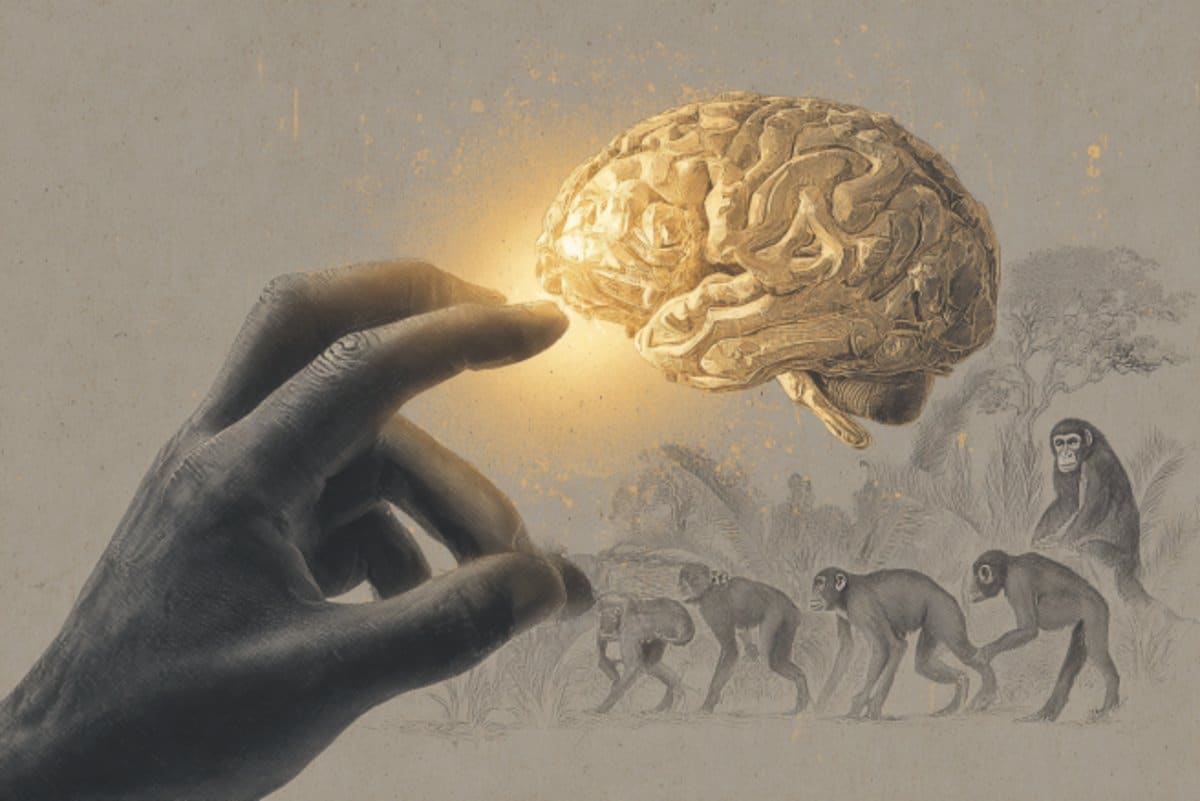
This shows a hand reaching to grab a brain. Under the brain are primates, referencing the evolutionary benefit of longer thumbs.
Instead, longer thumbs were connected to the neocortex (a complex layered region comprising approximately half the volume of the human brain), which processes sensory information and handles cognition and consciousness. Credit: Neuroscience News

The research, published today in Communications Biology, provides the first direct evidence that manual dexterity and brain evolution are connected across the entire primate lineage, from lemurs to humans.  

Humans and our extinct relatives boast both extraordinarily long thumbs and exceptionally large brains. However, the link remains strong across all primates: when scientists removed human data from their analysis, the connection between thumb length and brain size remained. 

Dr Joanna Baker, lead author from the University of Reading, said: “We’ve always known that our big brains and nimble fingers set us apart, but now we can see they didn’t evolve separately.

“As our ancestors got better at picking up and manipulating objects, their brains had to grow to handle these new skills. These abilities have been fine-tuned through millions of years of brain evolution.” 

Thumbs linked to thinking, not movement 

The scientists made a surprising discovery about which part of the brain grows alongside longer thumbs. They expected longer thumbs to be linked to the cerebellum because it is the region of the brain that controls movement and coordination.

Instead, longer thumbs were connected to the neocortex (a complex layered region comprising approximately half the volume of the human brain), which processes sensory information and handles cognition and consciousness.

It was a surprise that only one of the two major brain regions they thought would be involved actually was.

The findings suggest that as primates developed better manual skills for handling objects, their brains had to grow to process and use these new abilities effectively – but further work is needed to establish exactly how the neocortex supports manipulative abilities.

About this neuroscience and evolution research news

Author: Ollie Sirrell
Source: University of Reading
Contact: Ollie Sirrell – University of Reading
Image: The image is credited to Neuroscience News

Original Research: Open access.
“Human dexterity and brains evolved hand in hand” by Joanna Baker et al. Communications Biology


Abstract

Human dexterity and brains evolved hand in hand

Large brains and dexterous hands are considered pivotal in human evolution, together making possible technology, culture and colonisation of diverse environments.

Despite suggestions that hands and brains coevolved, evidence remains circumstantial.

Here, we reveal a significant relationship between relatively longer thumbs – a key feature of precision grasping – and larger brains across 95 fossil and extant primates using Bayesian phylogenetic methods.

Most hominins, including Homo sapiens, have uniquely long thumbs, yet they and other tool-using primates conform to the broader primate relationship with brain size.

Within the brain, we surprisingly find no link with cerebellum size, but a strong relationship with neocortex size, perhaps reflecting the role of motor and parietal cortices in sensorimotor skills associated with fine manipulation.

Our results emphasise the role of manipulative abilities in brain evolution and reveal how neural and bodily adaptations are interconnected in primate evolution.

Join our Newsletter

 I agree to have my personal information transferred to AWeber for Neuroscience Newsletter ( more information )

Sign up to receive our recent neuroscience headlines and summaries sent to your email once a day, totally free.

We hate spam and only use your email to contact you about newsletters. You can cancel your subscription any time.

Posted in Uncategorized | Tagged , , , , | Leave a comment

Grok 4 AI: Georgina Frost … a remarkable woman who took her case to the Supreme Court and was entitled to take the position of Clerk of Petty Sessions in Co. Clare, the role previously held by her Father. Michael Comyn KC and his brother James Comyn SC were part of her legal team.

Georgina Frost case James Comyn SC and Michael Comyn KC?

Georgina Frost (1879–1939), born on December 29, 1879, in Sixmilebridge, County Clare, was one of five children of Thomas Frost, the clerk of petty sessions for Sixmilebridge and Newmarket-on-Fergus. From around 1909, she assisted her father in his duties, often performing them independently, and upon his retirement in 1915, she was unanimously elected by local magistrates, including Lord Inchiquin, to succeed him in the £107-annual position—only to be denied by Lord Lieutenant Wimborne, who ruled that a woman was not “a person” under the Petty Sessions Acts.

Advised by nationalist barristers Michael Comyn KC and his brother James Comyn SC, along with figures like Tim Healy KC, she pursued a petition of right in April 1917 before Mr. Justice Barton, who dismissed it citing common law exclusions based on “decorum” and “inveterate usage” rather than intellectual capacity, though he waived costs against her. During cross-examination by Sergeant Matheson, Frost charmingly noted that while not officially recognized by Dublin Castle, “the magistrates always wanted me.”

Her November 1917 appeal to the Irish Court of Appeal (Lord Chancellor Shandon, Lord Chief Justice Molony, and Lord Justice Ronan) yielded a split ruling, with Shandon in favor but the majority against, upholding statutory exclusions for women. Proceeding in forma pauperis to the House of Lords in 1918 (heard April 27, 1920), her case succeeded amid the passage of the Sex Disqualification (Removal) Act 1919, with Lord Birkenhead presiding and reportedly remarking to counsel, “We’re going to let Georgie stay,” making her the first woman in Britain and Ireland to hold public office and a key figure in advancing women’s rights. This victory, celebrated across Clare and Ireland, marked a pivotal advance for women’s rights.

She served until her death on December 6, 1939, and her legacy is commemorated in legal histories and women’s rights timelines. Michael Comyn KC (1871–1952), born June 6, 1871, at Clareville, Ballyvaughan, County Clare. A prominent barrister called to the Irish bar in 1895 and appointed King’s Counsel in 1914, he was deeply involved in nationalist causes, defending republican prisoners during the Irish War of Independence and establishing early Sinn Féin courts, including the first in Ballinrobe, South Mayo, alongside Commandant P. R. Hughes in 1919. As legal adviser to Éamon de Valera and Fianna Fáil, he played a key role in founding The Irish Press newspaper in 1931. James Comyn SC (1884–1951), younger brother of Michael Comyn KC and also from Ballyvaughan, County Clare, was a nationalist barrister called to the bar in 1908 and elevated to Senior Counsel (post-independence equivalent of KC) after 1922. Like his brother, he defended republicans during turbulent times, advised de Valera, and was involved in progressive legal reforms, including Georgina Frost’s case. Married to Mary Molony, he fathered Sir James Peter Comyn (1921–1997), a renowned English High Court judge who documented family legal anecdotes in his 1973 memoir Their Friends at Court and 1981’s Irish at Law: A Selection of Famous and Unusual Cases. James’s nationalist sympathies influenced his son’s early life, though the family moved to England in 1933 amid political shifts in Ireland. He died on July 15, 1951, leaving a legacy in Irish legal and political history. The brothers’ involvement in Frost’s case underscored their advocacy for progressive causes amid Ireland’s independence struggles.

Quick Answer

Posted in Uncategorized | Tagged , , , , | Leave a comment

Being a Christian in Lebanon. Once 70% now 30% and hunted down

Posted in Uncategorized | Leave a comment

Grok 4: Copy of a Patent and Judge Michael Comyn!

Fertiliser specification Former Circuit Judge Michael Comyn, 9 Northbrook Road, Leeson Park, Dublin, has had a complete specification accepted by the Patents Office, dealing with the production of a fertilisers by “mixing rock phosphate with a calcareous shale carrying sulphur, iron, phosphataes, silica and aluminia, such as found in Co, Clare”. Can you elaborate?

Thought for 1m 43s

Michael Comyn (1871–1952) was an Irish barrister, nationalist politician, Fianna Fáil senator (1928–1936), and Circuit Court judge (appointed in 1936 to the Eastern Circuit). Beyond his legal and political career, he was an amateur geologist with a keen interest in mineral resources, particularly in his native County Clare. He is notably credited with discovering and initially exploiting phosphatic shale deposits in the region, which tied directly into efforts to produce fertilizers amid global supply challenges, especially during the interwar period and World War II.The patent specification you referenced appears to stem from around the 1920s (likely 1924–1925, based on historical timelines), when Comyn secured acceptance from the Patents Office (likely the British or Irish Patents Office, as Ireland’s independent patent system was established in 1927). It described a straightforward process for fertilizer production: blending rock phosphate (a common source of phosphorus, typically apatite minerals like fluorapatite) with a specific type of calcareous shale (shale rich in calcium carbonate) sourced from County Clare. This shale naturally contains supplementary elements including sulphur (often in pyritic forms), iron (e.g., from iron sulfides), additional phosphates, silica (SiO₂), and alumina (Al₂O₃).

Key Aspects of the Method and Its Context

  • Process Details: The invention focused on simple mixing of the two materials, without specifying advanced chemical reactions in the public descriptions available. However, the composition suggests practical benefits:
    • Rock phosphate provides the primary phosphorus (P) for plant nutrition, essential for root development, energy transfer, and crop yields.
    • The calcareous shale from Co. Clare adds value as a multi-nutrient amendment. Sulphur aids in soil acidification and plant protein synthesis; iron supports chlorophyll production; extra phosphates boost overall P content; silica improves soil structure and plant resilience; and alumina contributes to clay-like properties for nutrient retention.
    • This blend likely aimed to create a more balanced, slow-release fertilizer compared to pure rock phosphate, which can be less bioavailable without processing. The calcareous nature (high lime content) could help neutralize acidic soils common in Ireland, while the sulphur and iron might facilitate natural oxidation processes to enhance solubility over time.
    • No heating, acidification, or complex machinery is mentioned in the specification snippet, distinguishing it from modern superphosphate production (which uses sulfuric acid). It may have been intended as a low-cost, local alternative using readily available Irish resources.
  • Geological and Regional Background: The shale in question is from phosphatic deposits in areas like Noughaval and Toomullin (near Doolin) in north County Clare. These are part of the Carboniferous limestone and shale formations in the Burren region, where karst landscapes expose mineral-rich layers. Comyn, based in Lisdoonvarna (Co. Clare) during parts of his life, identified these in 1924 as an amateur geologist. The deposits were economically viable due to their phosphate content (up to 20–30% P₂O₅ in some analyses), supplemented by the other minerals noted.
  • Historical Development and Implementation:
    • Early Operations (1924–1939): Comyn extracted initial test batches (50 tons in 1924, 100 tons in 1925) and secured planning permission for an opencast quarry at Noughaval. This site operated briefly but closed by 1933 due to rising overburden removal costs and competition from higher-grade imports. He then shifted to a richer site along the Aille River in Doolin, mining directly from the riverbed and adjacent land. This disrupted local hydrology, causing river water to sink into underlying caves (part of the Doolin Cave System), altering flows permanently.
    • World War II Takeover (1939–1947): With global phosphate imports from North Africa and South America cut off, the Irish government (via Mianrai Teoranta, a state mining company) compulsorily acquired the operations in 1939 to bolster domestic fertilizer production for agriculture. Comyn was promised royalties, but a dispute led to litigation (rumors of a £50,000 award, though unconfirmed). Underground mining expanded, with adits, shafts, and pillar-and-stall methods extracting a ~1-meter-thick phosphate bed. At peak, it employed nearly 700 workers, but a 1940s fatal accident (due to faulty winching) highlighted safety issues. Output focused on raw phosphatic material for fertilizer, but high processing costs (£3/ton) led to closure in 1947 as imports resumed.
    • Legacy and Outcomes: The mines supplied critical fertilizers during wartime shortages, supporting Irish food security. Post-closure, sites were landscaped, leaving ruins like compressor houses and rail lines. Environmentally, the operations impacted karst ecosystems, but no major long-term pollution is noted. Comyn’s work pioneered local resource use, though it remained small-scale compared to global phosphate industries.

This patent and mining venture reflect Comyn’s blend of legal acumen and geological passion, contributing to Ireland’s early 20th-century push for self-sufficiency in agriculture. If this refers to a specific newspaper clipping or document (e.g., from the Irish Times or similar, circa 1920s), it may have been publicized to attract investment. For exact patent text, consulting Irish Patent Office archives (now Intellectual Property Office of Ireland) or historical databases like Espacenet could yield the full specification under his name.

40 web pages

Posted in Uncategorized | Leave a comment

Cultivate Your Critical Inquiry Skills | Alex Edmans

Big Think+93K subscribers

Aug 20, 2025

While it may sometimes feel like you need to be a statistician to spot misleading information, Professor Alex Edmans doesn’t think so. More important is the ability to understand the mind’s natural biases — those common cognitive traps that make humans more susceptible to believing false or skewed information. In this video lesson, Edmans explains that, just like the biases themselves, tools to counter them are already within you. By tapping into them, you can learn to think more critically. Get the full lesson from Alex Edmans for your business: https://bigthink.com/plus/ Follow Big Think+ -LinkedIn:   / big-think-plus   -Twitter:   / bigthinkplus  

Posted in Uncategorized | Leave a comment

International Dog Day … but for those who know the Black Dog referred to by Winston Churchill, this is worth a view

Posted in Uncategorized | Leave a comment

The Best Conversation About History You’ve Ever Heard – Dominic Sandbrook

Triggernometry

Aug 24, 2025 TRIGGERnometry – NEW episodes every Sunday and Wednesday 2 pm ET/7 pm UKDominic Sandbrook is a British historian, author, and broadcaster known for his vivid storytelling and deep dives into modern British history. He co-hosts The Rest is History podcast with Tom Holland. Triggernometry is proudly independent. Thanks to the sponsors below for making that possible:

Join our exclusive TRIGGERnometry community on Substack! https://triggernometry.substack.com/ OR Support TRIGGERnometry Here: Bitcoin: bc1qm6vvhduc6s3rvy8u76sllmrfpynfv94qw8p8d5 Shop Merch here – https://www.triggerpod.co.uk/shop/

Posted in Uncategorized | Leave a comment

Civil war in the UK in a few years?

British Commander: “Something BIG Is About To Go Down in Britain…”

J-TV: The Global Jewish

Aug 25, 2025Watch the J-TV+ documentary on What Really Happened In 1948? – https://j-tv.plus/what-really-happene…

Posted in Uncategorized | Leave a comment

The Rundown: Learning … “Study & Learn” mode

Learn effectively with ChatGPT’s “Study & Learn” mode


The Rundown: In this tutorial, you will learn how to use ChatGPT’s Study & Learn flow to understand complex topics through guided, step-by-step problem-solving and interactive quizzes that prevent the “copy-the-answer” trap.

Step-by-step: In ChatGPT, select “GPT-5” → click “+” → open “More” settings → toggle on “Study & Learn”Set response time: Auto (default), Instant (simple prompts), or Thinking (for detailed scaffolding)Prompt with structure: “Help me solve [topic] step by step. Ask me for each intermediate value before moving on” or “Quiz me on [subject] with MCQ and short answers”Work through guided steps —

ChatGPT acts as a tutor, checking each answer before revealing the next step

Download or save your session for future reference and study notes

Pro tip: Use specific instructions like “Socratic hints only” or “Don’t reveal final answer until I ask” for better learning retention.

Alternate between explanations and quizzes, and request variations like “Same problem, new numbers” or “Find my mistake” to deepen understanding.
Posted in Uncategorized | Leave a comment

The Deep View: AI and Saudi Arabia


Saudi Arabia launches Islamic AI chatbot
Saudi Arabia’s Humain has launched a conversational AI app designed around Islamic values, marking another Gulf state’s push for culturally authentic artificial intelligence. Powered by the Allam large language model, the chatbot accommodates bilingual Arabic-English conversations and multiple regional dialects.
CEO Tareq Amin called it “a historic milestone in our mission to build sovereign AI that is both technically advanced and culturally authentic.” The app, initially available only in Saudi Arabia, was developed by 120 AI specialists, half of whom are women.
Humain joins the UAE’s established Arabic AI ecosystem rather than competing directly with it. The Mohamed bin Zayed University of Artificial Intelligence launched Jais in 2023, a 13-billion-parameter open-source model trained on 116 billion Arabic tokens. Named after the UAE’s highest peak, Jais was built to serve the over 400 million Arabic speakers globally, and has been adopted by UAE government ministries and major corporations.
Both countries are channeling oil wealth into AI through similar partnerships with U.S. tech giants. Saudi Arabia’s Public Investment Fund manages $940 billion and backs Humain, while the UAE’s sovereign funds support G42 and other AI initiatives. During Trump’s recent Middle East visit, both countries secured massive U.S. chip deals—Saudi Arabia getting 18,000 Nvidia chips for Humain, while the UAE gained access to 500,000 advanced processors annually.
The parallel development reflects a broader Gulf strategy of using sovereign wealth to build culturally authentic AI capabilities while maintaining ties to Silicon Valley technology and expertise.

Posted in Uncategorized | Leave a comment