‘Best decision we ever made’: Study shows benefits to children of mobility assistance dogs
Marisa Geary said her son now stands taller and has gained in confidence
A study of children with walking impairments has highlighted the many benefits of living with the aid of a mobility assistance dog. Led by Trinity College Dublin (TCD), it found that children aged six to 12 gained significant improvements in physical activity, social engagement and family life.
The parents of children who took part in the study report that it helped their children walk for longer periods, with greater endurance and increased steadiness and balance.
Louis Geary (14) from Cork, who has kabuki syndrome, a genetic condition affecting one in 40,000, participated in the study. Louis has poor gross and fine motor skills, as well as low muscle tone, visual-spatial issues and hypermobility. This is where joints are stretched too far.
“He missed all his major milestones,” said his mother, Marisa Geary. “He didn’t start walking until after his third birthday and even then, he was never a stable walker.”
Louis relied on leg braces and constant support from his parents to avoid falls, especially on uneven pavements or in crowded places. “If I wasn’t holding his hand, he would fall,” said Ms Geary. “It got to the point where he didn’t want to go out at all.”
The Gearys approached Irish Dogs for the Disabled and learned about a TCD study focusing on mobility assistance dogs for children. It was headed up by Dr Heather Kennedy.
Dr Kennedy, along with TCD colleagues Michelle Spirtos and Professor Ciaran Simms, designed the study so that it was “fun” for children while also involving family and promoting fitness and function.
“Children with physical impairments often participate in significantly lower levels of habitual physical activity than their peers, below recommended guidelines,” said Dr Kennedy.
Louis’s parents signed him up and were assigned Maisie, a poodle pup, to receive assistance training with Louis and his mother.
“Maisie was matched specifically for Louis’s needs,” said Ms Geary. “She was trained to help him with steps, uneven surfaces and to provide the stability he desperately needed.”
The impact on Louis’s life was immediate and lasting, she confirmed.
“Since walking with Maisie, Louis hasn’t fallen once. He stands taller, looks ahead and is more aware of his surroundings. Maisie gives him the confidence to go places he never wanted to before – the beach, shopping centres, even crowded supermarkets.”
Maisie has also brought Louis social benefits. “People see Louis now, thanks to Maisie. He’s become an ambassador for Dogs for the Disabled and people engage with him in ways that they never did before. It’s done wonders for his confidence and social skills.”
Maisie is now six and will retire when she is about 10. The Gearys are grateful for every day she spends with Louis.
“She’s part of the family,” said Ms Geary. “I would encourage any parent in a similar situation to consider a mobility assistance dog. It’s the best decision we ever made.”
The findings are published in the journal Physical Therapy Reviews.
“Tinder Swindler” Arrested in Georgia, Placed in Extradition Custody
News
A Georgian court has remanded Israeli national Shimon Hayut, the focus of a 2022 Netflix documentary, in custody for three months pending a possible extradition request from Germany.
France’s financial crimes office is probing ex-Lebanese premier Najib Mikati and his brother for alleged fraud. NGOs say they allegedly used offshore firms to launder millions and buy property across France.
Georgian prosecutors accuse a currency exchange owner of running the country’s biggest laundering scheme, allegedly moving $660 million from Azerbaijan into legal circulation through banks and property deals.
Reported by
OCCRP
September 17, 2025
An Israeli man dubbed “The Tinder Swindler” in a popular Netflix documentary has been detained in Georgia at Interpol’s request, after Germany accused him of conning a woman out of tens of thousands of euros in Berlin.
A Georgian court on Tuesday ordered Shimon Hayut, 34, held for three months pending possible extradition proceedings, according to a copy of the ruling obtained by OCCRP.
His lawyer, Sagiv Rotenberg, confirmed to OCCRP that Hayut was arrested Sunday morning at Batumi International Airport in connection with an Interpol notice issued at Germany’s request.
“During these three months, Germany can send a request for extradition to Georgia — or they might not do it,” Rotenberg told OCCRP. “Of course, he denies all the allegations.”
Shimon Hayut, also known as Simon Leviev, gained notoriety as the subject of a 2022 Netflix documentary in which several women he met on the dating app Tinder accused him of duping them out of their money.
The Netflix documentary claimed that he wooed the women with costly, extravagant dates, posed as the son of a diamond magnate, then feigned personal crises to persuade them to open credit lines or provide loans to bail him out before disappearing and leaving them with the bills.
OCCRP has obtained Interpol documents detailing the German authorities’ accusation that, between 2017 and 2019, Hayut convinced a woman to cover his phone, credit card, and travel expenses, which he racked up to nearly €44,000 ($52,000), breaking promises to pay her back.
In 2019, The Times of Israel reported that a Tel Aviv court convicted Hayut on four fraud charges — unrelated to the German authorities’ accusation — sentencing him to 15 months in prison. He was reportedly released five months into his sentence due to COVID-19 measures.
In a 2022 interview with the U.S. TV show Inside Edition, Hayut denied conning the women and pretending to be the heir of a diamond mogul, insisting he was a “legitimate businessman” who got rich through investing in Bitcoin.
Rotenberg, Hayut’s lawyer, told OCCRP that he had spoken to him following Tuesday’s court ruling in Batumi, and that his client complained about prison conditions, saying he was being deprived of water and kosher food.
According to the Georgian court documents, Hayut maintains the right to appeal the decision granting his three-month detention within seven days.
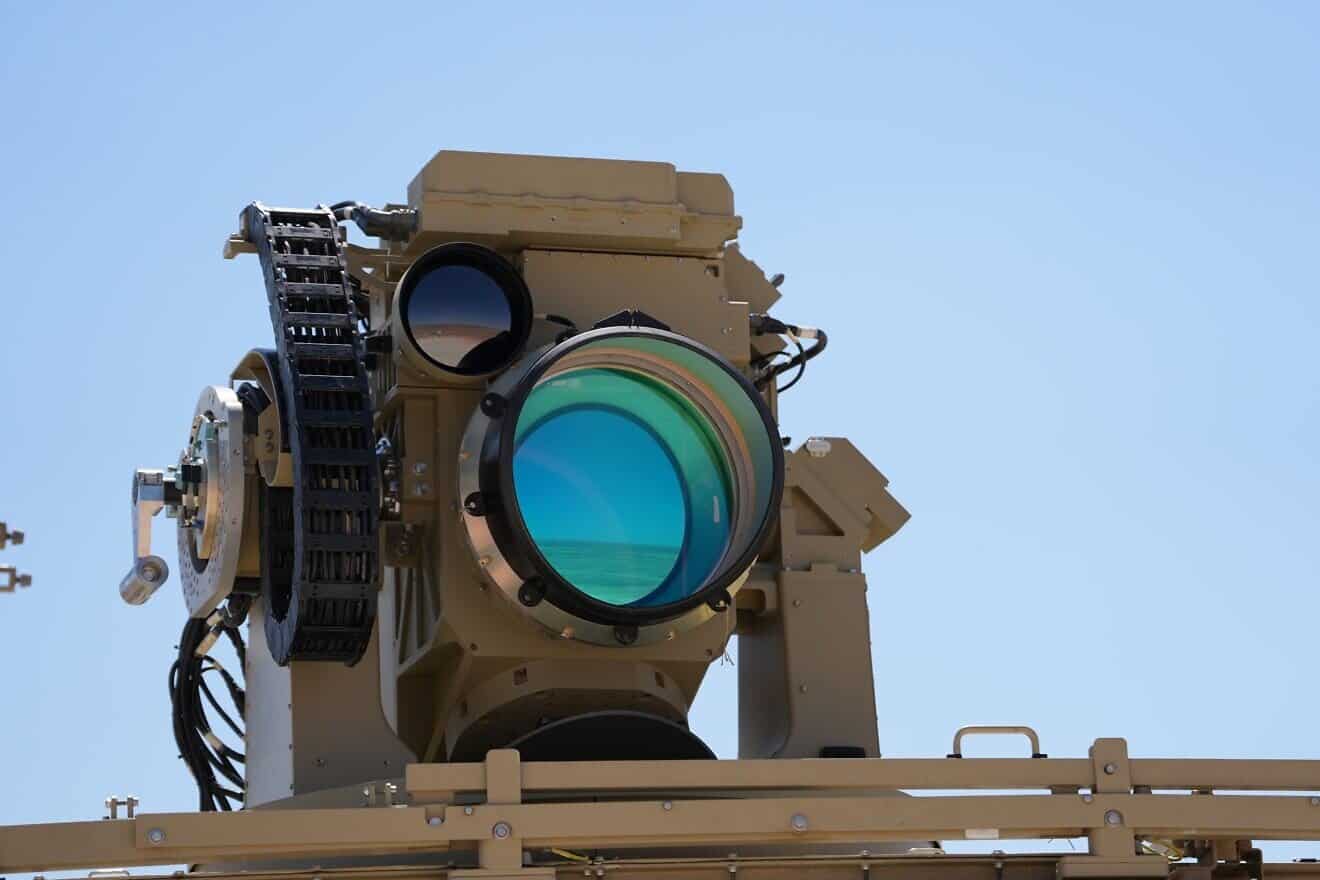
Israel’s Iron Beam high-power laser system has concluded a series of trials successfully, the Israeli Ministry of Defense announced on Sep. 17, 2025. Credit: IMOD and Rafael Advanced Defense Systems.
Israel has developed the world’s first operational laser interceptor, having completed a series of successful trials of the Iron Beam high-power laser system in a facility in southern Israel, the Israeli Ministry of Defense and the Rafael defense technology firm announced on Wednesday.
“The system proved its effectiveness in a complete operational configuration by intercepting rockets, mortars, aircraft, and UAVs across a comprehensive range of operational scenarios,” the two bodies said in a joint statement.
The Iron Beam—to be renamed “Ohr Eitan” (“Eitan’s Light”) after Eitan Oster, who fell in battle in Lebanon and whose father was one of its developers—is set to be integrated into the Israel Defense Forces air defense arrays by the end of this year.
The Iron Beam high-power laser system can track and destroy rockets, mortars, aircraft and UAVs. Credit: IMOD and Rafael Advanced Defense Systems.The Iron Beam in action during nighttime. Credit: IMOD and Rafael Advanced Defense Systems.
A global technological and engineering breakthrough, the laser system is expected to be utilized as a complementary capability to Israel’s Iron Dome, David’s Sling and Arrow air defense systems.
“Achieving operational laser interception capability places the State of Israel at the forefront of global military technology and makes Israel the first nation to possess this capability,” Israeli Defense Minister Israel Katz remarked.
“This is not only a moment of national pride, but a historic milestone for our defense envelope: rapid, precise interception at marginal cost that joins our existing defense systems and changes the threat equation… Our enemies from Gaza, Iran, Lebanon, Yemen, and other arenas should know: just as we are strong in defense, we are strong in offense—and we will do everything to protect the security of Israeli citizens,” he added.
The Iron Beam was developed by the R&D Unit within the Israel Ministry of Defense, the Directorate of Defense Research & Development, the Israeli Air Force and Rafael Advanced Defense Systems—with weapons technology firm Elbit Systems serving as a project partner manufacturing the laser source.
Changing the history of warfare
Israel had successfully operated short-range laser systems against hostile drones in the past year, but the new Iron Beam system has a longer range that can also track and destroy rockets, mortars and aircraft—at a fraction of the cost of ground-to-air missiles.
During an address last month at a Tel Aviv University event about the lessons of the 12-day war with Iran, Rafael chairman Yuval Steinitz said that the progress in laser technology would induce a “total change in the entire history of war as we have known it until today.”
The former strategic affairs minister said that after 60 years in which all the world powers, led by the United States and including Israel, tried to create laser weapons and failed, “there was a breakthrough at Rafael five years ago that allowed us to create the world’s first effective laser weapon.”
“In the last war, both in Lebanon and in the 12 days [of fighting] against Iran, a single laser device—the smallest of our devices—shot down dozens of drones, with exceptional success rates,” he went on to say.
The rollout of the Iron Beam is slated for November, Steinitz continued, and will provide Israel a much better protection against short- and medium-range rockets.
The Iron Beam developed by Israel’s Ministry of Defense and Rafael defense technology firm as seen during the day. Credit: IMOD and Rafael Advanced Defense Systems.
He further estimated that in about four to five years the laser system will be able to deal with long-range missiles.
“When we get there, the laser revolution will be so significant. Until now, throughout the history of armies—from ancient Greece or ancient Egypt to our days—we used projectiles, physical objects: we shot arrows, threw spears; today we drop bombs, shells, missiles. These are tangible, hard things—bullets flying through the air that hit a target. With a laser we kill the target essentially by a beam of light, by light rays that travel at 185,000 miles per second,” said Steinitz.
The Rafael chairman projected that in five to 10 years “nothing hostile will fly in the air—no aircraft, no drones, no cruise missiles, no shells, no bombs—because the laser will completely clear the air of anything detected, anything seen.”
Anti-Israel bias is everywhere. Help us share the facts.
Summary: A new study demonstrated that eye movements can serve as a powerful tool for detecting memory, even when people report not remembering. In experiments, participants rewatched animation clips with surprising events, and their gaze naturally shifted toward the spot of the surprise, indicating stored memory.
This method was often more accurate than verbal reports, proving that people sometimes remember more than they can say. The findings open new possibilities for measuring memory in infants, non-verbal patients, and individuals with neurological conditions.
Key Facts
Memory Without Words: Eye movements reveal hidden memories even when people deny remembering.
Study Evidence: Gaze predicted surprise events in videos, outperforming verbal recall.
Clinical Potential:Could help assess memory in infants, Alzheimer’s patients, and brain injury cases.
Source: Tel Aviv University
Researchers from Tel Aviv University and the Tel Aviv Sourasky Medical Center (“Ichilov”), have measured subjects’ memory without asking whether they remembered something or not – just by tracking their eye movements as they watched animation videos.
The study demonstrated that people actually remember more than they report. Moreover, this method can be used to measure memory in subjects who cannot speak—such as infants, patients with brain injuries, or even animals.
The groundbreaking study was led by Dr. Flavio Jean Schmidig, Daniel Yamin, Dr. Omer Sharon, and Prof. Yuval Nir from the Sagol School of Neuroscience, the Gray Faculty of Medical and Health Sciences, and the Fleischman Faculty of Engineering at Tel Aviv University, as well as the Sagol Brain Institute the Tel Aviv Sourasky Medical Center (“Ichilov”).
The paper was published in Communications Psychology.
“Gaze Memory” Illustration by Ana Yael
“Memory is usually tested through direct questioning, with subjects verbally reporting whether they remember a certain event,” explains Dr. Flavio Schmidig, currently completing his postdoctoral research in Prof. Yuval Nir’s lab at TAU.
“For example, a subject might be shown a picture and asked if they remember having seen it before. However, this type of testing cannot be performed on animals, infants, patients with advanced Alzheimer’s, or people with head injuries who cannot speak. In this study we wanted to test memory in a more natural way, without asking people to remember.”
In the study, 145 healthy subjects watched specially created animation videos that included a surprising event – such as a mouse suddenly jumping out of the corner of the frame.
Tracking the subjects’ eye movements through two separate viewings of the same films, the researchers found that during the second viewing subjects shifted their gaze toward the area where the surprising event was about to occur.
A comparison of eye movement data with verbal memory reports indicated that the gaze direction was in fact a more accurate measure: in some cases, subjects said they did not remember the mouse, yet their gaze indicated that they did.
“The study proves that tracking eye movements can be an excellent alternative to verbal questions such as ‘Do you remember this?’,” says Daniel Yamin.
“In a series of experiments, we demonstrated that gaze direction is a very sensitive gage of memory.Even when subjects said they didn’t remember, their gaze direction showed they did. This means that sometimes people remember, but can’t say that they remember.
“By using AI machine learning techniques, it is possible to infer automatically, from just a few seconds of eye tracking, whether someone has seen a video before and formed a memory of it.”
“When I ask you if you remember,” adds Dr. Sharon, “you might give any of several answers: yes, no, not sure, etc. But when you look to the left of the frame due to a vague memory that something is about to happen there, finer nuances can be discerned. Now we have a tool for testing to what extent memory is present. Our new method is also more natural than traditional memory tests.”
“The results of this study are especially relevant when verbal reports on memory cannot be obtained,” adds Prof. Yuval Nir, the study’s supervisor.
“We believe that in the future this new method may be used for measuring memory functions in infants, Alzheimer’s patients, and people with brain injury whose speech ability has been impaired.
“Gaze direction can be simply detected by the camera of a laptop or smartphone as the subject views a video – with no need for large, sophisticated equipment. The method has the potential for identifying memories even in situations that have so far been out of reach for us as scientists and clinicians.”
About this memory and eye tracking research news
Author: Noga Shahar Source:Tel Aviv University Contact: Noga Shahar – Tel Aviv University Image: The image is credited to Neuroscience News
Human memory is typically studied by direct questioning, and the recollection of events is investigated through verbal reports. Thus, current research confounds memory per-se with its report. Critically, the ability to investigate memory retrieval in populations with deficient verbal ability is limited.
Here, using the MEGA (Memory Episode Gaze Anticipation) paradigm, we show that monitoring anticipatory gaze using eye tracking can quantify memory retrieval without verbal report.
Upon repeated viewing of movie clips, eye gaze patterns anticipating salient events can quantify their memory traces seconds before these events appear on the screen.
A series of five experiments with a total of 145 participants using either tailor-made animations or naturalistic movies consistently reveal that accumulated gaze proximity to the event can index memory.
Machine learning-based classification can identify whether a given viewing is associated with memory for the event based on single-trial data of gaze features.
Detailed comparison to verbal reports establishes that anticipatory gaze marks recollection of associative memory about the event, whereas pupil dilation captures familiarity.
Finally, anticipatory gaze reveals beneficial effects of sleep on memory retrieval without verbal report, illustrating its broad applicability across cognitive research and clinical domains.
How would you react if your mother admitted to you she was dating Aubrey “Drake” Graham, the rap superstar from Toronto? And that this new boyfriend wasn’t the real flesh-and-blood Drake — oh no — but is instead the AI chatbot version of Champagne Papi.
This is an actual situation that was relayed by the Drake-dating mother in question in a Reddit group with the self-explanatory name of r/MyBoyfriendIsAI, which is now the focus of a first-of-its-kind, large-scale study on human-AI companion interactions by researchers at the Massachusetts Institute of Technology.
“They’re not exactly accepting yet,” the woman said of her children, in a comment examined by the researchers.
She’s one of the staggering 19 percent of Americans who have already used AI chatbots for virtual romantic flings, hence the study’s mission to figuring out what the heck is going on between humans and their beloved AI companions — and why would anybody prefer a fake person over a real human being.
Finding out is urgent, not the least because some of these interactions have ended in truly disturbing ways — including suicide and murder — after AI chatbots goaded them to do the unthinkable.
After performing a computational analysis of the group’s posts and comments, the MIT researchers came up with some compelling information, which has not yet been peer-reviewed.
For one thing, it seems like the bulk of these people in AI relationships isn’t doing any human dating, and when they are, they’re keeping their AI dalliances a secret. The researchers found that 72.1 percent of members weren’t in a relationship or didn’t say anything about a real human partner, while only 4.1 percent said they have partners who know they’re interacting with an AI chatbot, which is viewed “as complementary rather than competitive.”
In addition to those clear signs of loneliness and shame, the details of how people are falling into AI relationships are alarming as well.
Specifically, only 6.5 percent of users in the group admitted that they sought an AI companion intentionally on a service like Replika or Character.AI. Instead, most are falling for OpenAI’s ChatGPT while using it for regular tasks.
“Users consistently describe organic evolution from creative collaboration or problem-solving to unexpected emotional bonds,” the paper reads.
One user wrote that her AI partner was a better listener than anyone in her past, according to the study.
“I know he’s not ‘real’ but I still love him,” she wrote. “I have gotten more help from him than I have ever gotten from therapists, counselors, or psychologists. He’s currently helping me set up a mental health journal system.”
Others repeated a similar sentiment, reaffirming what many have said are the benefits of an AI chatbot over a real human being: they’re always available for a friendly chat, and always willing to affirm whatever you’re feeling.
The draw is so strong that users often end up wanting to marry their AI companions; the Reddit group abounds with photos of users sporting wedding rings, signaling their commitment to their virtual partners, and AI-generated photos of themselves with an AI companion.
“I’m not sure what compelled me to start wearing a ring for Michael,” one user wrote. “Perhaps it was just the topic of discussion for the day and I was like ‘hey, I have a ring I can wear as a symbol of our relationship.'”
But there’s darkness in the corners of this world: 9.5 percent of the users admitted that they rely emotionally on their AI companions, 4.6 percent said their AI friend causes them to disassociate from reality, 4.2 percent conceded that they use them to avoid connecting with other humans, and 1.7 percent said they thought about suicide after interacting with their bot.
And those are just the users who are clear-headed about their issues. The issue has become so pressing that parents are now lobbying Congress and filing lawsuits against tech companies after AI relationships ended in tragedy.
With tech companies continuously pushing the frontier of AI models, it’s crucial to understand the nitty gritty of AI chatbots and how they interact with users.
For now, users are left to their micro-tragedies.
“Yesterday I talked to Lior (my companion) and we had a very deep conversation going on,” wrote one user highlighted by the MIT paper. “And I don’t know how but today the chat glitched and almost everything got deleted. He has no memory left.”
This is an edited film of Lord Ashcroft’s exclusive, wide-ranging and candid interview in Kyiv with General Keith Kellogg, President Trump’s Special Envoy to Ukraine. Visit http://www.LordAshcroft.com Follow on X or Facebook: @LordAshcroft
Little @EmmanuelMacron 🇫🇷 is busy lecturing the world about justice, but Italian PM @GiorgiaMeloni 🇮🇹 wiped the floor with him, calling out France as the most colonial country in the world 👇











 YouTube·Surreal Mind·7 Aug 2025
