– Syria and Lebanon would be Aramaic speaking and partly Phoenician
– Iraq would be Mesopotamian
– Assyrian, Babylonian
– Sudan would be Nubian
– Tunisia would be Carthaginian Punic or Amazigh
– Iran would be Persian, Zoroastrian – Kurdistan would be Median, Zoroastrian
– Somalia would be Kosherik
“The Arab conquests erased civilizations and destroyed many cultures. Without Arab imperialism, the Middle East would still remember its own name. They are the colonizers.”
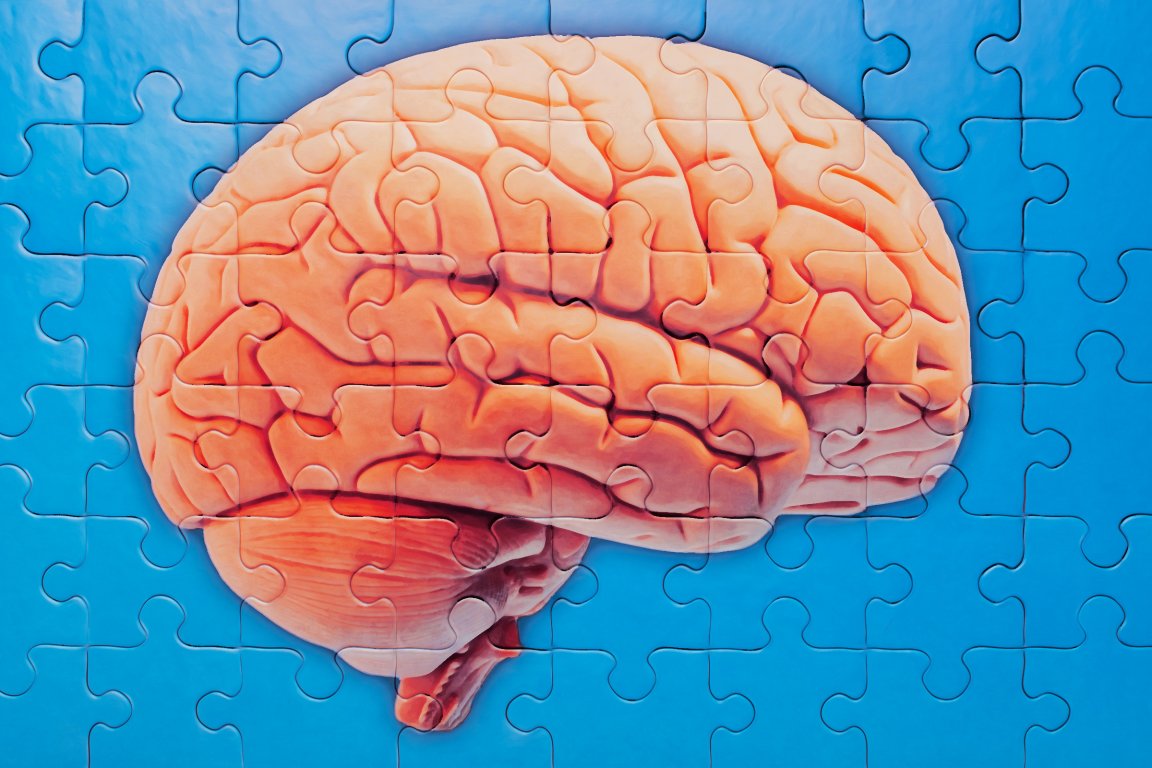
Scientists at Northwestern University used a novel compound to arrest early stages of Alzheimer’s disease in mice — setting the stage, if all goes well, for a groundbreaking treatment in which the debilitating condition can be controlled like high cholesterol.
The researchers discovered an unknown subtype of a protein in the brain which can lead to Alzheimer’s disease, according to a new paper the team published in the journal Alzheimer’s & Dementia: The Journal of the Alzheimer’s Association, and they demonstrated that their new novel compound, dubbed NU-9, can attack this brain protein and stop the disease from taking hold — in mice, at least.
“Most people are used to monitoring their cholesterol levels,” said Richard Silverman, a chemistry professor at Northwestern who coauthored the paper and invented NU-9, in a university statement. “If you have high cholesterol, it doesn’t mean that you will have a heart attack soon. But it’s time to take drugs to lower your cholesterol levels to prevent that heart attack from happening down the road. NU-9 could play a similar role. If someone has a biomarker signaling Alzheimer’s disease, then they could start taking NU-9 before symptoms appear.”
For this particular experiment, the team took lab mice that were predisposed to develop Alzheimer’s disease but hadn’t developed the condition yet, and started giving them an oral dose of NU-9 for 60 days. They were especially curious about how NU-9 would impact the protein amyloid beta oligomers, which accumulate in the brain hand in hand with signs of Alzheimer’s.
After closely examining the mice brains, scientists observed that NU-9 essentially decreased the presence of a previously unknown subtype of amyloid beta oligomers that they dubbed ACU193+ AβOs. This specific type of protein was associated with brain inflammation that shows up before people are diagnosed with Alzheimer’s. When the team introduced NU-9 into these mice brains, they found that NU-9 tamped down the presence of this toxic protein and hence decreased inflammation.
“These results are stunning,” William Klein, a Northwestern neuroscience professor and the paper’s principal investigator, summed up in the university statement.
“There are a couple early diagnostic blood tests for Alzheimer’s disease in development,” he said. “The promise of better early diagnostics — combined with a drug that could stop the disease in its tracks — is the goal.”
The next step now is to experiment and analyze the effectiveness of NU-9 in the later stages of Alzheimer’s disease, according to the scientists.
Finland's underground data centers heat entire city blocks using server waste heat
In Finland, several data-centres now feed their waste heat into municipal district-heating networks instead of simply dumping it into the air. For example, waste heat generated by data-centre… pic.twitter.com/Q3FGVXPnjb
🚨 Here is the full 42 minutes of my crew and I exposing Minnesota fraud, this might be my most important work yet. We uncovered over $110,000,000 in ONE day. Like it and share it around like wildfire! Its time to hold these corrupt politicians and fraudsters accountable
The query “Abbeyknockmoy forsters” refers to the historical association between the Forster (later Blake-Forster) family and the Abbeyknockmoy estate and the Cistercian Abbey of Knockmoy in County Galway, Ireland. The family were significant landowners in the area for centuries.
The Blake-Forster Family and Abbeyknockmoy
Estate Ownership: The Abbeyknockmoy estate, situated in the baronies of Tiaquin and Athenry, belonged to the Blake-Forster family. In the 1830s, the estate was the property of Francis Blake Forster, Esq., of Ashfield.
Property in the Parish: Griffith’s Valuation records from the mid-19th century list a Robert Blake Forster leasing property and land in Culliagh North (also known as Knockmoy Abbey). Other townlands within the civil parish of Abbeyknockmoy were also noted as the property of “Mr. Forster of Abbey” at that time.
Family History: The Forsters were of English origin and acquired property in Galway in the 1640s. A key marriage between Francis Forster and Anastasia Blake of Menlough led to the family becoming known as Blake-Forster.
Grant of Land: The site and extensive possessions of the ancient Abbey of Knockmoy were granted by King James I to Valentine Blake in 1629, from whom the estate eventually passed to the Forster family through intermarriage.
The Abbeyknockmoy Abbey
The abbey itself is a Cistercian foundation, established circa 1190 by Cathal Croibhdhearg O’Conor, King of Connacht. It is known for its medieval frescoes and being the burial site of its founder. The ruins are now a protected heritage site managed by the Office of Public Works (OPW).
The Wreck of the Famine Ship St. John (According to Thoreau)
He encountered the tragedy while visiting Cape Cod
On Oct. 7, 1849, the brig St. John struck Grampus Ledge off the coast of Cohasset during a sudden and furious storm.
The St. Johnwas known as a famine ship because its passengers were mostly destitute Irish emigrants fleeing the great famine. An estimated 20 percent died of disease or starvation aboard the famine ships, but more than a hundred died in the wreck of the St. John.
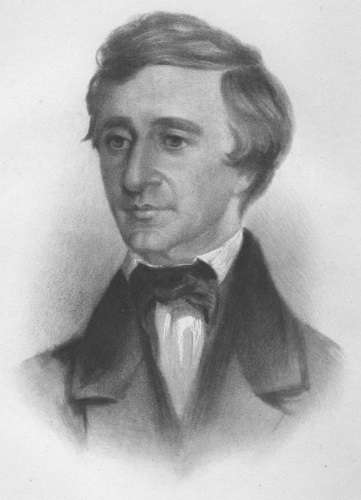
Henry David Thoreau happened to visit Cape Cod as the victims were gathered and buried. His account forms the opening chapter of his book Cape Cod.
Wreck of the St. John
Thoreau, who lived in Concord, Mass., decided he wanted to get a better view than he’d had of the ocean. He and a companion, the poet William Ellery Channing, left Concord for Boston on Oct. 9, 1849. On reaching Boston they learned the steamship to Provincetown hadn’t arrived because of a violent storm. They saw in the streets a handbill that said, “Death! 145 lives lost at Cohasset.”
Henry David Thoreau
So they decided to take the train to Cohasset.
“We found many Irish in the cars, going to identify bodies and to sympathize with the survivors, and also to attend the funeral which was to take place in the afternoon,” Thoreau wrote.
When they arrived, nearly every passenger headed to the beach and many others flocked in from the nearby countryside.
“As we passed the graveyard we saw a large hole, like a cellar, freshly dug there,” he wrote. And “we met several hay riggings and farm-wagons coming away toward the meeting house, each loaded with three large, rough deal boxes. We did not need to ask what was in them.”
Thoreau learned the St. John, from Galway, had wrecked on Sunday morning. The sea on Tuesday still broke violently on the rocks. Thoreau probably did not then know that the captain, Martin Oliver, hadn’t exactly tried to save the passengers.
Martin Oliver
According to the Boston Daily Bee, before the ship smashed against the rock,
…the jolly boat was hanging by the tackle, alongside, when the stern ringbolt broke and the boat fell into the water. The Captain, second mate and two boys jumped in to get her clear, when about 25 passengers jumped in and swamped her. The twenty-five, together with the second mate and two boys, perished. The captain caught a rope hanging over the quarter, and was drawn on board by the first mate. When the long boat was got clear, a number of passengers jumped over to swim to her, but all perished.The captain, first mate (Mr. Crawford), and seven of the crew swam to and reached the boat.
Large Boxes
On the beach in Cohasset, Thoreau noted 18 or 20 of the large boxes lying on a green hillside and surrounded by a crowd. People had collected the bodies, some 27 or 28, and brought them there. “Some were rapidly nailing down the lids, others were carting the boxes away, and others were lifting the lids, which were yet loose, and peeping under the cloths, for each body, with such rags as still adhered to it, was covered loosely with a white sheet.”
He witnessed no sign of grief, he wrote, “but there was a sober dispatch of business which was affecting.”
“I saw many marble feet and matted heads as the cloths were raised, and one livid, swollen and mangled body of a drowned girl, — who probably had intended to go out to service in some American family,–to which some rags still adhered…”
Sometimes, he wrote, he saw two or more children or a parent and child in the same box. “On the lid would perhaps be written with red chalk, “Bridget such-a-one, and sister’s child.”
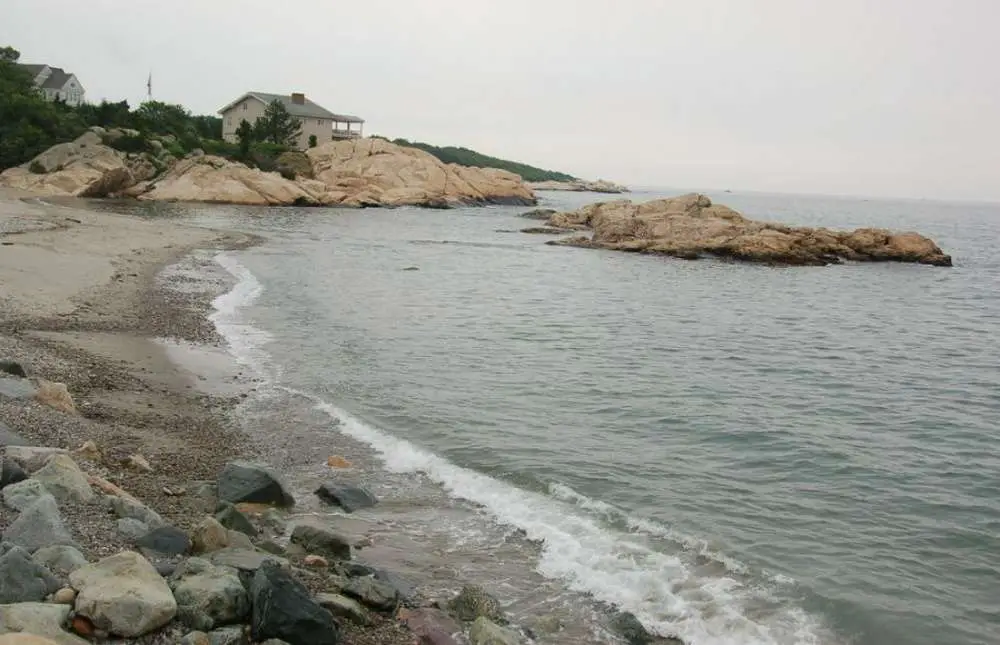
The shore along the border of Scituate and Cohasset.
The Remains of the St. John
Thoreau then walked along the beach and saw in a cove bits of a ship and a great quantity of feathers. A sailor told him that was the St. John. Then Thoreau looked out at Grampus Rock and saw part of the vessel sticking up.
In a second cove the wreckage on shore piled up several feet deep, with an occasional bonnet or jacket on it.
“In the very midst of the crowd about this wreck, there were men with carts busily collecting the seaweed which the storm had cast up,” he wrote. Sometimes they had to separate clothing fragments from the seaweed.
Thoreau then discovered a part of one side of the St. John behind some rocks. He estimated its size as 40 feet long and 14 feet wide.
“I was even more surprised at the power of the waves, exhibited on this shattered fragment, than I had been at the sight of the smaller fragments before,” he wrote. “The largest timbers and iron braces were broken superfluously, and I saw that no material could withstand the power of the waves; that iron must go to pieces in such a case, and an iron vessel would be cracked up like an egg-shell on the rocks.”
The Funeral
Then, in the afternoon, Thoreau and Channing saw the funeral procession at a distance. The captain and the other survivors of the St. John walked at the head of it.
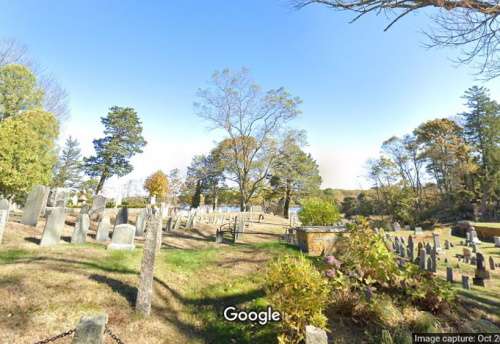
Cohasset Central Cemetery
“On the whole, it was not so impressive a scene as I might have expected,” he wrote. “If I had found one body cast upon the beach in some lonely place, it would have affected me more. I sympathized rather with the winds and waves, as if to toss and mangle these poor human bodies was the order of the day.”
Thoreau concluded his essay on the wreck of the St. John with the observation that the victims had come to the New World as Columbus or the Pilgrims had.
“[B]ut, before they could reach it, they emigrated to a newer world than ever Columbus dreamed of, yet one of whose existence we believe that there is far more universal and convincing evidence — though it has not yet been discovered by science…”
Most of the victims today lie buried in Cohasset Central Cemetery.
Threats to undersea infrastructure are now getting massive, almost daily attention. So reassuring to know from yesterday’s Sunday Times interview that Ireland’s spooks have it all under control. https://ft.com/content/98640358-c166-4f1b-a1da-b37170aabf99