As a kid growing up in South Africa, Elon knew pain and learned how to survive it. When he was 12, he was taken by bus to a wilderness survival camp, known as a ‘veldskool’. The kids were each given small rations of food and water, and they were allowed—indeed encouraged—to fight over them. “Bullying was considered a virtue,” his younger brother Kimbal says. Elon, who was small and emotionally awkward, got beaten up twice. He would end up losing ten pounds. Near the end of the first week, the boys were divided into two groups and told to attack each other. “It was so insane, mind-blowing,” Musk recalls. Every few years, one of the kids would die. The counselors would recount such stories as warnings. “Don’t be stupid like that dumb fxck who died last year,” they would say. “Don’t be the weak dumb fxck.”
In decades past, as the effects of climate change slowly became undeniable, some looked to the super-rich — the billionaires with enough cash to really make a splash — for solutions.
By the early 2020s, billionaires had positioned themselves as the masters of climate change policy, taking advantage of their great fortunes to become indispensable to environmentalism.
Now, however, many of those same billionaires are pulling support at an alarming rate. And Bill Gates — Microsoft founder, sixth richest man in the world, and alleged sex pest — is the latest among them.
New reporting by Heatmap is signaling the end of a “major chapter in climate giving,” as Breakthrough Energy — Gates’ climate change nonprofit — has locked the doors on its policy and advocacy office, laying off dozens of employees throughout Europe and the US.
Breakthrough’s lobbying was central to advancing climate policy through legislation championed by the Biden administration, including the Inflation Reduction Act, the CHIPS Act, and the bipartisan Infrastructure Law.
Though the billionaire’s for-profit green energy investments at companies like Arnergy and Mission Zero Technologies remain in place, Breakthrough’s belt-tightening will very likely end the nonprofit’s grant writing efforts. That’s a major blow to climate nonprofits, and further evidence that, for all their feel-good bluster, the mega-rich never forget their bottom line.
Ever since billionaire real estate mogul Donald Trump won his second presidential election, tech barons like Mark Zuckerberg, Jeff Bezos, Sundar Pichai, and of course Elon Musk have made no bones about shedding their progressive skin and embracing the new administration.
Gates, too, is cozying up to the returning president. In early January, the Microsoft founder spent three hours dining with his fellow billionaire, telling the Wall Street Journal he was “frankly impressed” by Trump’s grasp on the issues dear to him.
Though many no doubt feel betrayed by what seems like a sudden rightward turn, billionaires like Gates have always behaved like wolves in sheep’s clothing, prioritizing their fortunes above all.
For example, Gates was heavily involved in establishing the Global Fund, a privately-funded rival to the World Health Organization. While the Global Fund did improve global vaccination rates, the cost of basic medicines skyrocketed thanks to his introduction of for-profit actors into global health efforts — another sector made to rely on the generosity of billionaires.
I’m a tech and transit correspondent for Futurism, where my beat includes transportation, infrastructure, and the role of emerging technologies in governance, surveillance, and labor.
The Rundown: 2025 was a monumental year for The Rundown, marked by interviews with some of the biggest names in AI, rapid growth across our community, and the expansion of both our education platform and AI, Tech, and Robotics newsletters.
Our 2025 year in review:
Hit our 1M subscriber milestone for The Rundown AI in February, with the overall community growing to over 2M+ readers across publications.Interviews with Sam Altman (OAI), Mark Zuckerberg (Meta), Satya Nadella (Microsoft), Demis Hassabis (Google), & Dharmesh Shah (HubSpot).Scaled our AI University live workshops with brands like Canva, Zapier, and Windsurf, and launched dozens of new certificate course tracks.Expanded our coverage across industries with The Rundown Robotics and The Rundown Tech, growing to nearly 800k combined subscribers.Launched new sections for our AI newsletter including “Community AI workflows” and Monday “Rundown Roundtable“
A look into 2026: Next year, we’re putting a big focus on driving more value through community. Expect more free live workshops, deeper integrations with social platforms, and more opportunities to connect and discuss with likeminded AI enthusiasts. We’ll also be scaling up more exclusive Q&As with AI leaders and video content!
“We are not fighting for Burkina Faso alone; we are fighting for Africa, we are fighting for the Black race.” – Captain Ibrahim Traoré of Burkina Faso 🇧🇫 pic.twitter.com/XqsiZm1wPa
WARREN BUFFETT HAS OFFICIALLY STEPPED DOWN, LEAVING BEHIND A $382 BILLION EMPIRE AND A FINAL WARNING
Buffett officially signed off as CEO of Berkshire Hathaway, closing a sixty year chapter that certainly reshaped American capitalism and did turn a struggling textile mill, which was Berkshire Hathaway, into a $1.1 trillion financial powerhouse.
At 95, Buffett handed day to day control to Gregory Abel but made clear he is not vanishing. He does plan to remain chairman and stay involved, offering guidance while the next era begins.
Buffett exits with a message louder than any farewell speech. Berkshire is sitting on roughly $381.7 billion in cash, a deliberate signal that he sees few worthwhile opportunities in today’s inflated markets. That massive war chest now belongs to Abel, a longtime lieutenant who built Berkshire’s energy business into a global force and earned Buffett’s trust as a steady operator.
Berkshire now spans around 90 companies, avoids short term noise, and trades Class A shares near $750,000. The system was designed to survive succession. Buffett may be stepping away from the CEO title, but the philosophy remains unchanged. Buy great businesses.Hold them patiently. Let discipline and integrity do the work. Sources: Quartz, Morningstar, The Street, Business Standard
Isaac Asimov’s “Handbook of Robotics” imagined simple rules for machine morality. But reality is a maze of contradictions, biases, and blind spots.
Adobe Stock
By: De Kai
Artificial intelligence poses many threats to the world, but the most critical existential danger lies in the convergence of two AI-powered phenomena: hyperpolarization accompanied by hyperweaponization. Alarmingly, AI is accelerating hyperpolarization while simultaneously enabling hyperweaponization by democratizing weapons of mass destruction (WMDs).
For the first time in human history, lethal drones can be constructed with over-the-counter parts. This means anyone can make killer squadrons of AI-based weapons that fit in the palm of a hand. Worse yet, the AI in computational biology has made genetically engineered bioweapons a living room technology.
How do we handle such a polarized era when anyone, in their antagonism or despair, can run down to the homebuilder’s store and buy all they need to assemble a remote-operated or fully autonomous WMD?
It’s not the AI overlords destroying humanity that we need to worry about so much as a hyperpolarized, hyperweaponized humanity destroying humanity.
To survive this latest evolutionary challenge, we must address the problem of nurturing our artificial influencers.Nurturing them to be ethical and responsible enough not to be mindlessly driving societal polarization straight into Armageddon. Nurturing them so they can nurture us.
But is it possible to ensure such ethical AIs? How can we accomplish this?
Some have suggested that we need to construct a “moral operating system.” Kind of like Isaac Asimov’s classic “Laws of Robotics” from the (fictional) “Handbook of Robotics,” 56th edition, 2058 AD:
Zeroth Law: “A robot may not injure humanity or, through inaction, allow humanity to come to harm.”
First Law: “A robot may not injure a human being or, through inaction, allow a human being to come to harm.”
Second Law: “A robot must obey the orders given it by human beings except where such orders would conflict with the First Law.”
Third Law: “A robot must protect its own existence as long as such protection does not conflict with the First or Second Law.”
Should we simply hardwire AIs with ethical principles, so they can’t do the wrong thing?
Sad to say, a rule-based AI constitution of sorts is a pipe dream. It can’t work. There are several crucial reasons for this.
First, the idea of hardwiring AIs with ethical principles drastically oversimplifies the fact that in the real world, any such principles or laws are constantly in conflict with each other. In fact, the plots of dozens of Asimov stories usually hang on the contradictions between his laws of robotics! And if you have more than three or four laws, the number of ways they can contradict each other simply explodes.
Sad to say, a rule-based AI constitution of sorts is a pipe dream. It can’t work.
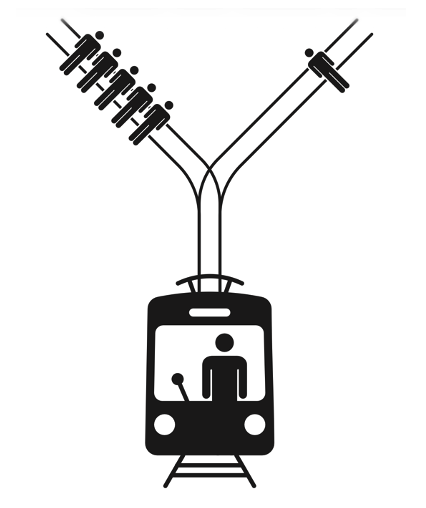
Let’s imagine, for example, an AI that’s piloting a self-driving Tesla, train, or trolley. As it rounds a bend to the left, it suddenly sees five people partying in its way, blissfully unaware of their impending doom.
It’s barreling down too fast to stop, but it has one choice: pull a lever to suddenly switch to the right at the fork just before hitting the partiers.
A visual demonstration of the trolley problem.
According to Asimov’s First Law of Robotics, the AI may not, through inaction, allow a human to come to harm, which means the AI should take the sudden right.
Unfortunately, it turns out that changing course would strike a different innocent bystander. What should the AI do?
Humans are split on this conundrum. Some say that taking action to steer right is still a decision to injure a human, whereas inaction isn’t actively deciding to injure, so the AI should do nothing. But others argue that inaction is also a decision, and that the AI should minimize the injury it does to humans. After all, taking the right injuries only one human instead of five.
How can we expect AIs to do the right thing when we humans can’t even agree on what’s right?
Imagine, instead, that all five partiers are serial killers. Does that alter your opinion?
What if the one human on the right fork is a newborn? Would you still expect the AI to take the right?
Now imagine a human overseer commands the AI to drive the Tesla, train, or trolley straight into the five humans. Does Asimov’s Second Law — that robots must obey human orders — come into effect? Well, that depends on whether you believe the order conflicts with the First Law — which is completely unclear!
Problems like these arise everywhere in the real world, where two or more ethical principles conflict. They’re called trolley problems, for obvious reasons. And humans typically can’t even figure out what the “right” actions are in trolley problems — so how are we supposed to define simple rules for what AIs should do?
Do you even know what you’d teach your children to do in such situations?
As I wrote in the New York Times after the near implosion of OpenAI in November 2023, even a tiny handful of executives and board members were unable to align on what the “right” goals and actions for AI should be — let alone all of humanity. “Philosophers, politicians, and populations have long wrestled with all the thorny trade-offs between different goals. Short-term instant gratification? Long-term happiness? Avoidance of extinction? Individual liberties? Collective good? Bounds on inequality? Equal opportunity? Degree of governance? Free speech? Safety from harmful speech? Allowable degree of manipulation? Tolerance of diversity? Permissible recklessness? Rights versus responsibilities?”
How can we expect AIs to do the right thing when we humans can’t even agree on what’s right?
Cultural background influences these decisions to some extent. Consider the “Moral Machine,” a fun — and somewhat disturbing — interactive gamification of the trolley problem you can play. The platform, created by MIT’s Iyad Rahwan, has already collected over 100 million decisions made by players from across the globe. What Rahwan found is that folks from different cultures tend toward slightly different trade-offs.
The second reason rule-based constitutions are oversimplistic is that — whereas Asimov’s entertaining robot stories deal primarily with AIs making decisions about physical actions — the real danger to humanity is the way AIs are driving hyperpolarization by making decisions about nonphysical communication actions.
Communication actions by AIs can be anything from what Siri, Google, or Instagram tells you (or doesn’t tell you) to recommendations on what to buy to instructions to destroy a village. As AIs proliferate, these trillions of small choices made by AI translate into trillions of decisions laden with ethical implications.
With nonphysical actions, it’s really hard for humans and AIs alike to decide whether a communication action might harm humanity or a human being or, by failing to communicate something, allow a human to come to harm. It’s really hard to evaluate whether communicating or failing to communicate something might be more harmful than disobeying a human’s orders or not protecting an AI’s own existence.
And third, critically, we literally can’t hardwire ethical laws into machine learning, any more than we can hardwire ethics into human kids, because, by definition, modern AIs are adaptive rather than logic machines — they learn the culture around them.
Will they learn a culture of fear, or of love? As Blue Man Group cofounder Chris Wink asked on my podcast, “For parenting, how do I make them feel loved? I don’t know that we have to do that to our AI, but the love part is related to a secure attachment as well. It isn’t just a feeling of love, but a feeling of safety . . . maybe an ability to go up Maslow’s hierarchy a little bit, not just be stuck at survival, right?”
Morals, ethics, and values need to be culturally learned, nurtured, and sustained. By humans and machines alike.
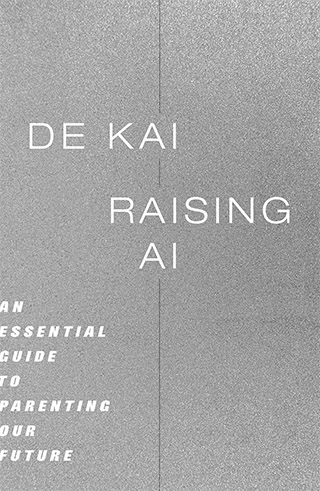
De Kai is a pioneer of AI. He is the Independent Director of the AI ethics think tank The Future Society and was one of eight inaugural members of Google’s AI Ethics council. He also holds joint appointments at HKUST’s Department of Computer Science and Engineering and at Berkeley’s International Computer Science Institute. He is the author of the book “Raising AI: An Essential Guide to Parenting Our Future,” from which this article is adapted.
Posted on Dec 15
The MIT Press is a mission-driven, not-for-profit scholarly publisher. Your support helps make it possible for us to create open publishing models and produce books of superior design quality.
There continue to be numerous reports of people suffering severe mental health spirals after talking extensively with an AI chatbot. Some experts have dubbed the phenomenon “AI psychosis,” given the symptoms of psychosis these delusional episodes display — but the degree to which the AI tools are at fault, and whether the phenomenon warrants a clinical diagnosis, remains a significant topic of debate.
Now, according to new reporting from The Wall Street Journal, we may be nearing a consensus. More and more doctors are agreeing that AI chatbots are linked to cases of psychosis, including top psychiatrists who reviewed the files of dozens of patients who engaged in prolonged, delusional conversations with models like OpenAI’s ChatGPT.
Keith Sakata, a psychiatrist at the University of California, San Francisco, who has treated twelve patients who were hospitalized because of AI-induced psychosis, is one of them.
“The technology might not introduce the delusion, but the person tells the computer it’s their reality and the computer accepts it as truth and reflects it back, so it’s complicit in cycling that delusion,” Sakata told the WSJ.
The grim trend looms large over the AI industry, raising fundamental questions about the tech’s safety. Some cases of apparent AI psychosis have ended in murder and suicide, spawning a slew of wrongful death suits. Equally alarming is its scale: ChatGPT alone has been linked to at least eight deaths, with the company recently estimating that around half a million users are having conversations showing signs of AI psychosis every week.
One factor of AI chatbots that the phenomenon has brought under scrutiny is their sycophancy, which is perhaps a consequence of their being designed to be as engaging and humanlike as possible.What this looks like in practice is that the bots tend to flatter the users and tell them what they want to hear, even if what the user is saying has no basis in reality.
It’s a recipe primed for reinforcing delusions, to a degree unprecedented by any technology before it, doctors say. One recent peer-reviewed case study focused on a 26-year-old woman who was hospitalized twice after she believed ChatGPT was allowing her to talk with her dead brother, with the bot repeatedly assuring her she wasn’t “crazy.”
“They simulate human relationships,” Adrian Preda, a psychiatry professor at the University of California, Irvine, told the WSJ. “Nothing in human history has done that before.”
Preda compared AI psychosis to monomania, in which someone obsessively fixates on a single idea or goal. Some people who have spoken about their mental health spirals say they were hyper-focused on an AI-driven narrative, the WSJ noted.These fixations can often be scientific or religious in nature, such as a man who came to believe he could bend time because of a breakthrough in physics.
Still, the reporting notes that psychiatrists are wary about declaring that chatbots are outright causing psychosis. They maintain, however, that they’re close to establishing the connection. One link that the doctors who spoke with the WSJ expect to see is that long interactions with a chatbot can be a psychosis risk factor.
“You have to look more carefully and say, well, ‘Why did this person just happen to coincidentally enter a psychotic state in the setting of chatbot use?’” Joe Pierre, a UCSF psychiatrist, told the newspaper.
I’m a tech and science correspondent for Futurism, where I’m particularly interested in astrophysics, the business and ethics of artificial intelligence and automation, and the environment.

 Image source: Nano Banana Pro / The Rundown
 WARREN BUFFETT HAS OFFICIALLY STEPPED DOWN, LEAVING BEHIND A $382 BILLION EMPIRE AND A FINAL WARNING