
-
Archives
- October 2026
- September 2026
- August 2026
- July 2026
- June 2026
- May 2026
- April 2026
- March 2026
- February 2026
- January 2026
- December 2025
- November 2025
- October 2025
- September 2025
- August 2025
- July 2025
- June 2025
- May 2025
- April 2025
- March 2025
- February 2025
- January 2025
- December 2024
- November 2024
- October 2024
- September 2024
- August 2024
- July 2024
- June 2024
- May 2024
- April 2024
- March 2024
- February 2024
- January 2024
- December 2023
- November 2023
- October 2023
- September 2023
- August 2023
- July 2023
- June 2023
- May 2023
- April 2023
- March 2023
- February 2023
- January 2023
- December 2022
- November 2022
- October 2022
- September 2022
- August 2022
- July 2022
- June 2022
- May 2022
- April 2022
- March 2022
- February 2022
- January 2022
- September 2021
- August 2021
- July 2021
- June 2021
- May 2021
- April 2021
- February 2021
- January 2021
- December 2020
- November 2020
- October 2020
- September 2020
- August 2020
- July 2020
- June 2020
- May 2020
- April 2020
- March 2020
- February 2020
- January 2020
- December 2019
- November 2019
- October 2019
- September 2019
- August 2019
- July 2019
- June 2019
- May 2019
- April 2019
- March 2019
- February 2019
- January 2019
- December 2018
- November 2018
- October 2018
- September 2018
- July 2018
- June 2018
- May 2018
- April 2018
- March 2018
- February 2018
- January 2018
- December 2017
- November 2017
- October 2017
- September 2017
- August 2017
- July 2017
- June 2017
- May 2017
- April 2017
- March 2017
- February 2017
- January 2017
- December 2016
- November 2016
- October 2016
- September 2016
- August 2016
- July 2016
- June 2016
- May 2016
- April 2016
- March 2016
- February 2016
- January 2016
- December 2015
- November 2015
- October 2015
- September 2015
- August 2015
- July 2015
- June 2015
- March 2015
- January 2015
-
Meta
GZERO everything is political: Why Space Tech Investment Matters : WEF26 : Global Stage
Posted in Uncategorized
Leave a comment
The Conversation: How Iran shut down the internet and built a sophisticated system of digital control
How Iran shut down the internet and built a sophisticated system of digital control
Published: January 29, 2026 3.58pm GMT
Author
- Gemma WareHost, The Conversation Weekly Podcast, The Conversation
Interviewed
- Amin NaeniPhD Candidate in International Relations, Deakin University; Dublin City University
Disclosure statement
Amin Naeni does not work for, consult, own shares in or receive funding from any company or organisation that would benefit from this article, and has disclosed no relevant affiliations beyond their academic appointment.
Partners
The Conversation UK receives funding from these organisations
DOI

We believe in the free flow of information
Republish our articles for free, online or in print, under Creative Commons licence.Republish this article
Share article
Print article
On January 8, as thousands of Iranians took to the streets in nationwide protests, the government cut off the internet.
Under cover of digital darkness, the Iranian regime launched a brutal and deadly crackdown against anti-government protesters. What information has got out, including testimony from morgues, graveyards and doctors who treated the injured, suggests thousands of people have been killed.
Iran has shutdown the global internet before, but never for this long. Without the internet, trading has slumped. Many entrepreneurs who rely on Instagram to do business can’t post. Lorry drivers are struggling to cross borders because they can’t access digital documents. By some estimates, internet shutdown can cost more than US$37 million a day.
Read more: Iran’s latest internet blackout extends to phones and Starlink
After three weeks of internet blackout, reports from web traffic monitor Netblocks suggest that the internet is slowly coming back online but the connection is predominantly for government-approved users.
Our mission is to share knowledge and inform decisions.
Yet for most of the shutdown, banks and some local government websites and apps still worked. And that’s because Iran is developing its own, national internet, cut off from the rest of the world.
In this episode of The Conversation Weekly podcast, we speak to Amin Naeni, a PhD candidate researching digital authoritarianism at Deakin University in Australia, about how Iran built one of the world’s most sophisticated systems of digital control.
This episode of The Conversation Weekly was written and produced by Mend Mariwany and Gemma Ware. Mixing by Michelle Macklem and theme music by Neeta Sarl. Gemma Ware is the executive producer.
Newsclips in this episode from The Guardian, Al Jazeera English, DW News, CNA, CBS News, CNN, CBC News and BBC News.
Listen to The Conversation Weekly via any of the apps listed above, download it directly via our RSS feed or find out how else to listen here. A transcript of this episode is available via the Apple Podcasts or Spotify apps.
Posted in Uncategorized
Leave a comment
Big Think: The Pursuit of Mastery – The timeless quest to go beyond competence and achieve excellence.
The Pursuit of Mastery
The timeless quest to go beyond competence and achieve excellence.
Big Think, Stephen Johnson, Rachel Barr, and Steven Ross Pomeroy
Jan 30, 2026

Big Thinkers,
Last Saturday, the American climber Alex Honnold successfully scaled the 1,667-foot Taipei 101 skyscraper in Taiwan with no ropes or safety nets.
I’m not sure why. I’m not being a smartass: The feat was wildly impressive and made for great TV. But to those of us who prefer the interiors of skyscrapers over the exteriors, it’s not immediately obvious what compels people like Honnold to risk everything, all for what turned out to be an “embarrassing” payday, as he told The New York Times.
Perhaps it’s pride, prestige, or an adrenaline addiction. Or maybe the reason is as simple as the one that British climber George Mallory offered in 1923 when a reporter asked him why he wanted to climb Mount Everest: “Because it’s there.”
We are drawn to mastery, whether it’s perfecting our own craft or watching other people push the limits of human potential.
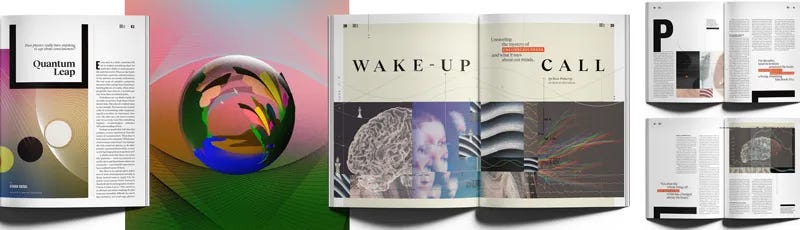
Our latest special issue brings you a collection of stories about all things mastery. Inside, we explore the science behind the “quiet eye” of elite athletes, the systems that create star performers, actor Ethan Suplee’s quest to master himself, and much more. You can catch the full issue here.
Read on,
Stephen
THE BIG SECOND ACT

From self-erasure to self-mastery: Ethan Suplee’s second act
By Mike Wehner
You’d probably recognize actor Ethan Suplee as the chubby bully on Boy Meets World, lovable Louie in Remember the Titans, and the aptly named “Tuna” (Johnny Depp’s sidekick) in Blow. But you probably wouldn’t recognize Suplee if you saw him today in the gym. Once weighing in at 550 pounds, Suplee is now down to about 250, and he’s documented his efforts to master his food addiction in his new career as a fitness influencer. Big Think recently caught up with Suplee to discuss his Hollywood career, his second act, and why eating a piece of banana bread is not the end of the world.
THE BIG GAZE

How training your gaze could help you master sports — and your own attention
By Ross Pomeroy
When thinking about what makes an athlete great, you might imagine Gretzky’s flick of the wrist, Serena Williams’ snap of the shoulder, or Messi’s blinding footwork. But the precision of these movements may be downstream from something far quieter: the movements of the eyes. In this piece, Ross Pomeroy looks at the science behind “quiet eye training,” a sustained gaze that helps the brain execute precise actions under pressure.
A new home for curious minds
Magazines, memberships, and meaning.
THE BIG RETHINK

The systems that build star performers
By Rachel Barr
Excellence rarely follows a straight line. Many top performers begin as late bloomers, developing through trial, failure, and cross-domain exploration. As neuroscientist Rachel Barr details in this interview with author David Epstein, the systems that produce stars often aren’t optimized for speed or certainty, but for adaptability over time.
More Articles
- The last masters: The international effort to preserve an ancient craft
- How a Japanese philosophy helped me improve my life
- Mastering the edge: How success raises the stakes for elite adventurers
Stephen Johnson is the executive editor at Big Think.
Posted in Uncategorized
Leave a comment
US Foreign Affairs calls the world to abandon Chinese products: “To all world leaders meeting with Xi Jinping: China sells nothing but cheap products and cheap friendships.”
BREAKING: 
 US Foreign Affairs calls the world to abandon Chinese products: “To all world leaders meeting with Xi Jinping: China sells nothing but cheap products and cheap friendships.”
Posted in Uncategorized
Leave a comment
Are you in your retirement years; do you fear being institutionalised in a nursing home, left for years not stimulated or truly cared for. Well here is Optimus to give us freedom
Posted in Uncategorized
Leave a comment
TRUMP CALLS FOR BIPARTISAN VOTE TO AVOID GOVERNMENT SHUTDOWN The president says Congress has come together on a deal to fund most of the government through September, with an extension for DHS and the Coast Guard. “The only thing that can slow our Country down is another long and damaging Government Shutdown.” He’s pushing both parties to deliver a “YES” vote without delay. Source: Truth Social

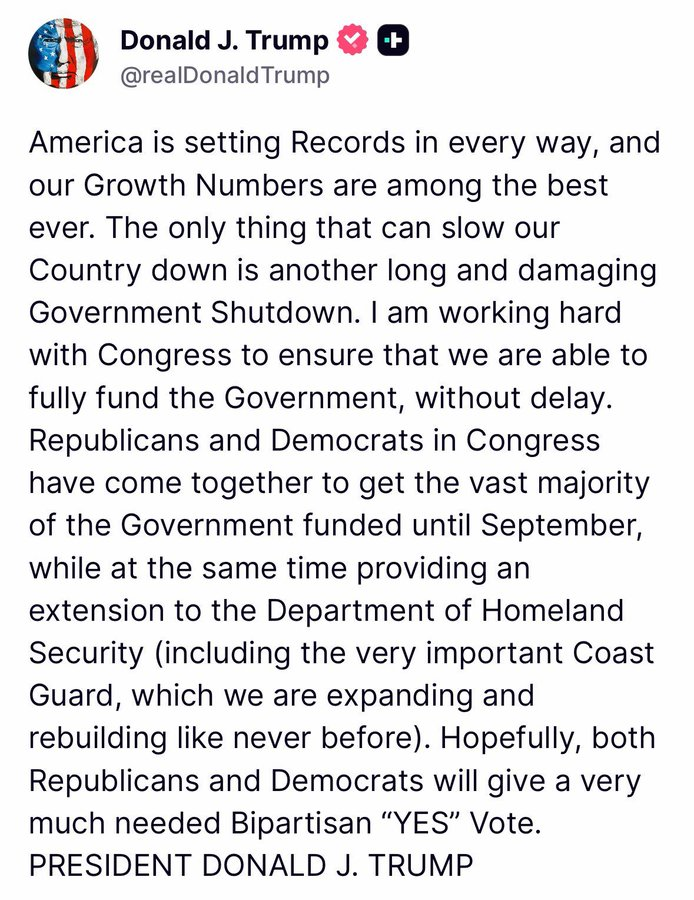
 TRUMP CALLS FOR BIPARTISAN VOTE TO AVOID GOVERNMENT SHUTDOWN The president says Congress has come together on a deal to fund most of the government through September, with an extension for DHS and the Coast Guard. “The only thing that can slow our Country down is another long and damaging Government Shutdown.” He’s pushing both parties to deliver a “YES” vote without delay. Source: Truth Social
Posted in Uncategorized
Leave a comment
Elon wants AI in Space
ELON WANTS AI IN SPACE
Because Earth is too basic for what’s coming, Elon is pushing to put AI data centers in orbit. Why? Cooler temps = less energy, less risk from Earth’s natural disasters, and it’s way more futuristic. Basically, he wants to make sure AI keeps running even if things go sideways down here. Wild idea… but very on brand. Source: Reuters
Posted in Uncategorized
Leave a comment
Neuralink: Hope and Progress. Imagine being paralysed from the neck down
Posted in Uncategorized
Leave a comment
Futurism: AI will make us all rich… any day now
Sam Altman Says AI Will Cause Massive Deflation, Making Money Worth Vastly More
AI will make us all rich… any day now.
Published Jan 29, 2026 5:21 PM EST

OpenAI is betting in the biggest way possible on a future ruled by AI. It’s committing to spending well over $1 trillion to build out enormous data centers — despite business fundamentals lagging far behind, stoking fears over troubling days ahead.
During a town hall livestreamed on Monday, CEO Sam Altman admitted that the company was looking to pump the brakes, revealing that it’s looking to “dramatically slow down” hiring as the company continues to burn through billions of dollars each quarter.
At the same time, Altman remained characteristically bullish about what his company’s tech will soon offer to the world. When asked if AI can be used to “solve economic gaps that have existed for decades,” the executive argued that it’s “going to be massively deflationary.”
“Given, certainly, progress with work you can do in front of a computer, but also what looks like it will soon happen with robotics and a bunch of other things, we’re going to have massively deflationary pressure,” he predicted.
As a result of this deflationary pressure, Altman promised that things would get “radically cheaper” and the “empowerment of individual people” will go up as money becomes more valuable — which, it’s worth noting, would be an inversion of virtually every economic system in history, which have overwhelmingly been inflationary.
Altman reasoned that these economic changes would be the result of AI allowing individuals to be vastly more productive. He argued that by the end of this year, an individual spending $1,000 on inference — essentially the cost of running an AI — could complete a piece of software in a short period of time, a task that would have previously taken a whole team a much longer period.
It’s not the first time Altman has argued that AI could make money more valuable. In March, he claimed that AI will have a deflationary impact on the global economy during a closed-door Morgan Stanley conference.
The broader argument that AI could lead to an age of “abundance” in which the cost of living starts to decrease — and that we could even choose not to work if we didn’t want to — has long been deployed by tech leaders, including Altman and xAI CEO Elon Musk, to drive the AI hype cycle.
But given the current state of the economy, such a point remains little more than a daydream. The reality is that AI is still incredibly far from boosting efficiency enough to offset inflation. Just earlier today, the US Federal Reserve held interest rates steady, citing ongoing concerns over “elevated” inflation.
In fact, AI has more frequently been linked to mass layoffs that make it harder to survive. Long-term unemployment hit a four-year high earlier this year as jobseekers struggled to find new work. The cost of living has also continued to climb, particularly in larger US cities.
Whether AI will come to the rescue and dramatically bring down prices remains to be seen, as uncomfortable questions surrounding the tech’s viability linger.
Researchers have shown that AI is largely failing to boost productivity, at least in its current form. Surveys have found that the number of people using AI at work is falling, a troubling trend that flies in the face of promises made by tech leaders. Many of these workers argue that AI is essentially useless to them, despite their employers’ insistence that it’s revolutionary, productivity-boosting tech.
To AI’s many critics, it’s a dead end. Some have argued that OpenAI itself could be a house of cards that’s one run on the banks away from collapsing in on itself.
In short, there are plenty of reasons to remain skeptical of Altman’s claims that AI will put more buying power into each of our pockets as productivity goes stratospheric. He’s also gone as far as to argue that AI could cure cancer, solve climate change, and alleviate our financial struggles with “universal extreme health.”
Musk has similarly prophesied that “there will be no poverty in the future, and so no need to save money.” Anthropic CEO Dario Amodei has also argued that we could one day work far less as a result of AI.
It’s an enormous bet — and Altman and his counterparts have plenty still to prove as reality continues to lag behind their lofty promises.
Even Altman himself isn’t entirely convinced that sudden abundance will actually be a good thing for the average person.
“Massively more abundance and access and massively decreased cost to be able to create new things, new companies, discover new science, whatever…” he said during this week’s town hall. “I think that should be an equalizing force in society and a way that people who have not gotten treated that fairly get a really good shot.”
“As long as we don’t screw up the policy around it in a big way,” he warned, “which could happen.”
More on Altman: Sam Altman Says OpenAI Is Slashing Its Hiring Pace as Financial Crunch Tightens
Victor Tangermann
Senior Editor
I’m a senior editor at Futurism, where I edit and write about NASA and the private space sector, as well as topics ranging from SETI and artificial intelligence to tech and medical policy.
Posted in Uncategorized
Tagged ai, artificial-intelligence, chatgpt, openai, technology
Leave a comment
The Rundown AI: AI Revolutionary War series
| Darren Aronofsky debuts AI Revolutionary War series |
 Image source: TIME Image source: TIME |
| The Rundown: Filmmaker Darren Aronofsky’s AI venture Primordial Soup released “On This Day… 1776”, a new series recreating the American Revolution using Google DeepMind, with each episode dropping on the 250th anniversary of the event it depicts. |
| The details: |
| The short-form series combines AI-generated visuals with SAG-AFTRA voice actors, positioning itself as “artist-led” AI rather than being fully automated.The series drops episodes on TIME’s YouTube channel timed to the 250th anniversary of each depicted event.Aronofsky partnered with DeepMind in May to collaborate on AI storytelling, releasing the Veo-assisted film ANCESTRA in June at the Tribeca Film Festival. |
| Why it matters: AI video is creeping further into real production studio workflows, and moving from simple shorts and hidden tricks to hide faces to handling the entire visual process. While it still might not be fully accepted or mainstream, the sentiment is shifting — and Hollywood’s once-uneasy use of the tech is coming more into focus. |
Posted in Uncategorized
Leave a comment

