

-
Archives
- September 2026
- August 2026
- July 2026
- June 2026
- May 2026
- April 2026
- March 2026
- February 2026
- January 2026
- December 2025
- November 2025
- October 2025
- September 2025
- August 2025
- July 2025
- June 2025
- May 2025
- April 2025
- March 2025
- February 2025
- January 2025
- December 2024
- November 2024
- October 2024
- September 2024
- August 2024
- July 2024
- June 2024
- May 2024
- April 2024
- March 2024
- February 2024
- January 2024
- December 2023
- November 2023
- October 2023
- September 2023
- August 2023
- July 2023
- June 2023
- May 2023
- April 2023
- March 2023
- February 2023
- January 2023
- December 2022
- November 2022
- October 2022
- September 2022
- August 2022
- July 2022
- June 2022
- May 2022
- April 2022
- March 2022
- February 2022
- January 2022
- September 2021
- August 2021
- July 2021
- June 2021
- May 2021
- April 2021
- February 2021
- January 2021
- December 2020
- November 2020
- October 2020
- September 2020
- August 2020
- July 2020
- June 2020
- May 2020
- April 2020
- March 2020
- February 2020
- January 2020
- December 2019
- November 2019
- October 2019
- September 2019
- August 2019
- July 2019
- June 2019
- May 2019
- April 2019
- March 2019
- February 2019
- January 2019
- December 2018
- November 2018
- October 2018
- September 2018
- July 2018
- June 2018
- May 2018
- April 2018
- March 2018
- February 2018
- January 2018
- December 2017
- November 2017
- October 2017
- September 2017
- August 2017
- July 2017
- June 2017
- May 2017
- April 2017
- March 2017
- February 2017
- January 2017
- December 2016
- November 2016
- October 2016
- September 2016
- August 2016
- July 2016
- June 2016
- May 2016
- April 2016
- March 2016
- February 2016
- January 2016
- December 2015
- November 2015
- October 2015
- September 2015
- August 2015
- July 2015
- June 2015
- March 2015
- January 2015
-
Meta
DW: NATO drills highlight Iceland’s role in Arctic defense. Comment: Ireland remains so exposed with a population of 5.5 mn in the Republic, whereas just 400,000 in Iceland. We have the data/gold off our shores, exposed.
Posted in Uncategorized
Leave a comment
Moonshot AI CEO Yang Zhilin surprised some of his Carnegie Mellon professors by choosing to return to China. Now, his Beijing-based startup’s latest private funding round values it at $50 billion.
Moonshot AI CEO Yang Zhilin surprised some of his Carnegie Mellon professors by choosing to return to China. Now, his Beijing-based startup’s latest private funding round values it at $50 billion. https://on.wsj.com/3SIPgKX

Posted in Uncategorized
Leave a comment
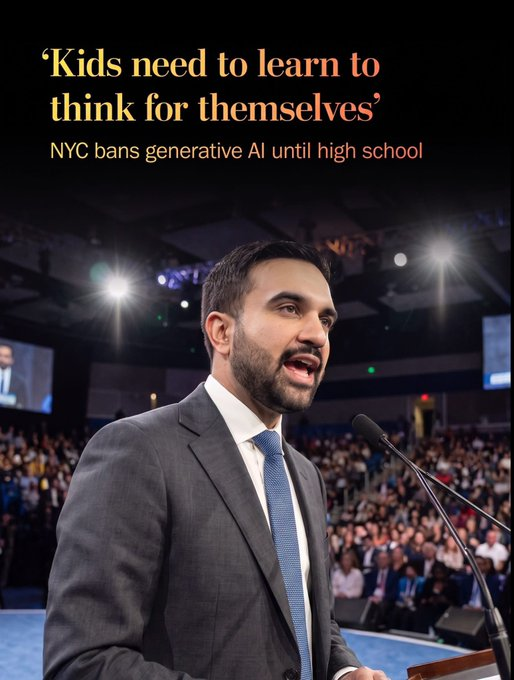
Shining Science: Zohran Mamdani is trying to stop AI from rotting children’s brains
Zohran Mamdani is trying to stop AI from rotting children’s brains.
NYC Public Schools just instituted a sweeping ban on generative AI for students through eighth grade, setting an aggressive new standard for classroom technology.
This comprehensive policy, affecting more than half a million students, will systematically strip or disable AI components from over 38 educational software programs currently in use, and schools will altogether abandon platforms where these features cannot be removed.
To reinforce this shift, teachers are also prohibited from using AI tools to grade assignments, and companion chatbots—designed to provide emotional support—are completely banned across all grade levels, including high school.
The temporary ban is born out of a desire to protect the critical development of younger minds, with city officials emphasizing that children must first learn to grapple with difficult questions on their own before relying on digital shortcuts. While younger classrooms step back from screens, older students will not be left entirely in the dark. Public high schools are introducing bi-annual AI literacy courses to teach teens about bias, ethics, and risks, alongside pilot programs utilizing highly vetted, supervised platforms. As other major school districts implement strict screen-time and cellphone limits, New York’s bold experiment could decide whether classrooms across the country embrace artificial intelligence or pull the plug.
source: Associated Press. (2026). NYC, the nation’s largest school system, bans AI for students through 8th grade.
Posted in Uncategorized
Leave a comment
Eurasia Review: Trump Is Picking A Needless Fight Over The Falklands –

US President Donald Trump. Photo Credit: POTUS, X
Trump Is Picking A Needless Fight Over The Falklands – Analysis
By Arab News
FacebookTwitterEmailFlipboardMastodonLinkedInShare
Video Muted
By Luke Coffey
Key Takeaways:
- The author says a new U.S.–UK rift is forming after President Trump said Washington is reviewing its Falklands stance, amid reports of U.S. pique over British help in the Iran war. Britain claims the islands; Argentina calls them occupied. About 3,600 residents want to stay British.
- The piece calls the “lack of help” charge hollow: U.S. use of Gibraltar, Cyprus, Diego Garcia and RAF Fairford, plus UK forces shielding Gulf states from Iranian missiles and drones. Churchill’s 1946 base-sharing idea is invoked as the special-relationship core.
- History is secondary to 2013: 92% turnout, 99.8% to remain British, observers present. Continuous UK rule since 1833 except 74 days in 1982. Author: a U.S. flip would anger a close ally, weaken South Atlantic deterrence, and ignore self-rule—the principle America was founded on. Leave the status quo.
Another crisis is brewing in the transatlantic relationship, this time between the US and the UK over the status of the Falkland Islands.
The Falklands are one of 14 British Overseas Territories and are located in the South Atlantic, about 500 km off the coast of South America. Britain has long claimed sovereignty over the islands, based on historical precedent and, more importantly, the fact that their roughly 3,600 inhabitants overwhelmingly want to remain British. Argentina, meanwhile, claims the islands as its own and regards Britain as an occupying power.
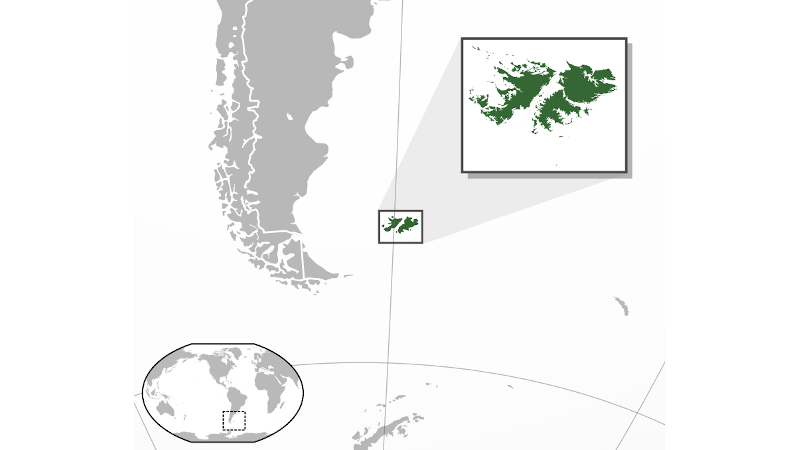
The US has traditionally sympathized with the British, even providing crucial support to the UK after Argentina invaded and occupied the islands for 74 days in 1982. President Donald Trump has now said that his administration is reviewing America’s position, following earlier reports about Washington’s frustration over Britain’s perceived lack of support during the war against Iran.
The timing is puzzling. There is already enough tension in the transatlantic community over the US interest in Greenland and the trade dispute with the EU. Injecting another unnecessary crisis into an already fraught relationship makes little sense, especially when the transatlantic community needs unity and cohesion.
More importantly, it is difficult to understand the claim that the UK has failed to provide meaningful assistance during US military operations against Iran.
Britain has allowed the US to use its bases and overseas territories in support of the recent Iran operations. For example, Gibraltar hosted a US nuclear submarine visit during the conflict. At the time it was thought that this was done to signal a message to Tehran. The US has also long used British bases in Cyprus for intelligence gathering. Most importantly, the US was allowed to use Diego Garcia in the Indian Ocean to conduct bombing runs into Iran.
The UK has also allowed the US to use RAF Fairford for operations connected to Iran. British forces have played an important role across the region defending countries including Saudi Arabia, Bahrain, the UAE, Qatar, and Jordan against Iranian missiles and drones.
The American use of British bases is particularly significant because military cooperation has been one of the foundations of the US-UK special relationship for generations. During his famous 1946 “Iron Curtain” speech in Fulton, Missouri, Winston Churchill described the close military links that should underpin the relationship between the two countries, including the use of each other’s military bases around the globe.
Therefore, it seems particularly hypocritical for the Trump administration to rely on British bases and overseas territories during its military operations against Iran, while simultaneously questioning British control over another overseas territory in the South Atlantic.
History also makes a compelling case for the British position.
The first recorded siting of the Falkland Islands was made by an English sailor in 1690. At the time, the islands were uninhabited, and there is no historical or archaeological evidence that an indigenous population had previously lived there.
Britain made its first formal claim to the islands in 1765 and maintained settlements there sporadically during the following decades. In 1833, a British force arrived and removed an Argentine military penal colony that established itself on one of the Falkland’s 776 islands. Even though the soldiers were expelled, civilians were allowed to remain — and most did.
The islands have been under continuous British administration since 1833, with the exception of 74 days in 1982 during the war.
But however interesting the historical claims might be, the history is secondary to the wishes of the people who actually live on the islands.
In 2013, Falkland islanders held a referendum on their status. Turnout was 92 percent, and 99.8 percent voted to remain a British Overseas Territory. Only three people voted against. The referendum was overseen by international observers, even from Latin America, and was considered free and fair.
What matters most is not the opinion in London, Washington or Buenos Aires, but the opinion in Stanley, the territory’s capital. For as long as the Falkland islanders want to remain British their wishes should be respected.
The Falkland Islands are also a very emotive political issue in the UK. Support for the islanders’ right to remain British stretches across almost the entire British political spectrum. Picking a fight with London over the islands would therefore needlessly create a crisis with one of America’s closest allies.
Even viewed narrowly through the lens of American interests, changing the US position makes little sense. There is also a straightforward strategic argument for maintaining the status quo. The Trump administration has proposed stability and security in the western hemisphere. British control over the islands does just that. With the British presence, there is no immediate threat of armed conflict due to the UK’s military presence on the islands deterring Argentine aggression. There is also no civil unrest or oppressed population there demanding political change. If Argentina gained control, this would not be the case.
The US was founded on the principle that people should have a say in how they are governed. Applying that principle to the Falkland Islands is a no-brainer. If the islanders want to remain British, Washington should respect their decision.
At a moment when the US needs dependable allies, picking an unnecessary fight with the UK over the Falklands would accomplish nothing. America should support the wishes of the islanders and recognize British control of the territory. This is the best way to maintain stability in the South Atlantic and the western hemisphere.
Now is not the time to create a problem where none exists.
- Luke Coffey is a senior fellow at the Hudson Institute. X: @LukeDCoffey

About Arab News
Arab News is Saudi Arabia’s first English-language newspaper. It was founded in 1975 by Hisham and Mohammed Ali Hafiz. Today, it is one of 29 publications produced by Saudi Research & Publishing Company (SRPC), a subsidiary of Saudi Research & Marketing Group (SRMG).
Get the Eurasia Review newsletter
Selected analysis, news, and opinion delivered by email.First name or full nameEmail By continuing, you accept the privacy policy
Like what you read?
Please consider supporting Eurasia Review. Thank you for your consideration!
Leave a Reply
Your email address will not be published. Required fields are marked *
Comment *
Name *
Email *
Website

Organized Crime Turns Legitimate Cargo Into Chemical Pipeline For Narcotics – Analysis
By Julieta Pelcastre Key Takeaways: Transnational criminal organizations are refining methods to conceal drugs within legitimate commercial cargo. The discovery

Mecca Accord And India’s Energy Security – Analysis

Why Australian Politics Is Shifting Right, Not Left – Analysis

Tough Times Ahead For Nepal In Wake Of Recent Disaster – Analysis
asde on Great Power Competition In The Caribbean And South Pacific Islands – AnalysisSeptember 5, 2026″After 45 years of relations with Taiwan, what does SVG have to show? St. Vincent and the Grenadines’ debt is…
 Patial RC on Indus Water Treaty: Talking Peace, Threatening War – OpEdSeptember 3, 2026Wonder what will happen if New Delhi applies to be part of the Mecca Joint Defense Agreement of August ,7…
Pete frank on Three Priorities For COP17 Land Degradation Talks – AnalysisAugust 26, 2026The call to shift from reactive drought response to proactive risk management is particularly important. But COP17 should also pay…
Jama Jawjawle on Three Men Who Shaped Modern Somalia And A Selective Memory Of Its Sultanates: Which Way Should Puntland Go? – AnalysisAugust 26, 2026I think we have left a great statesman Abdirashid Ali Sharmarke, the first prime minister and later the president of…
- Patial RC on The Indus Waters Treaty: India-Pakistan Tensions Persist – AnalysisAugust 26, 2026YES, Pakistan calls the water a “red line,” having made it red by Indian blood. India sees No strategic or…
Subscribe to Eurasia Review
Get selected analysis, news, and opinion by email. By continuing, you accept the privacy policy
Copyright Eurasia Review. (ISSN 2330-717X) All rights are reserved.Privacy Policy And Terms Of Use
Posted in Uncategorized
Leave a comment
This Day in History: Sam Houston elected as president of Texas
SEP05
Choose another dateOK
September
| 1 | 2 | 3 | 4 | 5 | 6 | 7 |
| 8 | 9 | 10 | 11 | 12 | 13 | 14 |
| 15 | 16 | 17 | 18 | 19 | 20 | 21 |
| 22 | 23 | 24 | 25 | 26 | 27 | 28 |
| 29 | 30 | 1 | 2 | 3 | 4 | 5 |
1836
Sam Houston elected as president of Texas

Corbis via Getty Images
Published: September 22, 2010 Last Updated: September 03, 2026
On September 5, 1836, Sam Houston is elected as president of the Republic of Texas, which earned its independence from Mexico in a successful military rebellion.
Born in Virginia in 1793, Houston moved with his family to rural Tennessee after his father’s death; as a teenager, he ran away and lived for several years with the Cherokee tribe. Houston served in the War of 1812 and was later appointed by the U.S. government to manage the removal of the Cherokee from Tennessee to a reservation in Arkansas Territory. He practiced law in Nashville and, beginning in 1823, served as a U.S. congressman before being elected governor of Tennessee in 1827.
A brief, failed marriage led Houston to resign from office and live again with the Cherokee. Officially adopted by the tribe, he traveled to Washington to protest governmental treatment of Native Americans. In 1832, President Andrew Jackson sent him to Texas (then a Mexican province) to negotiate treaties with local Native Americans for protection of border traders. Houston arrived in Texas during a time of rising tensions between U.S. settlers and Mexican authorities and soon emerged as a leader among the settlers. In 1835, Texans formed a provisional government, which issued a declaration of independence from Mexico the following year. At that time, Houston was appointed military commander of the Texas army.
How Slavery Led to Texas’s Independence
Learn how slavery influenced the fight for Texas independence. See how the Mexican government tried to stop American immigration and the practice of slavery, leading to the Texas revolution and the battle of the Alamo.
4:03m watch
Although the rebellion suffered a crushing blow at the Alamo in early 1836, Houston was soon able to turn his army’s fortunes around. On April 21, he led some 800 Texans in a surprise defeat of 1,500 Mexican soldiers under General Antonio Lopez de Santa Anna at the San Jacinto River. Santa Anna was captured and brought to Houston, where he was forced to sign an armistice that would grant Texas its freedom.
After receiving medical treatment for his war wounds in New Orleans, Houston returned to win election as president of the Republic of Texas. In victory, Houston declared that “Texas will again lift its head and stand among the nations… It ought to do so, for no country upon the globe can compare with it in natural advantages.”
Houston served as the republic’s president until 1838 then again from 1841 to 1844. Despite plans for retirement, Houston helped Texas win admission to the United States in 1845 and was elected as one of the state’s first two senators. He served three terms in the Senate and ran successfully for Texas’ governorship in 1859. As the Civil War loomed, Houston argued unsuccessfully against secession and was deposed from office in March 1861 after refusing to swear allegiance to the Confederacy.
He died of pneumonia in 1863.

Spanish Ranchers Bring Cattle to Texas
Until the Spanish arrived in the Southwest, there wasn’t a single cow in America, but within decades their ranching efforts result in over 3 million longhorn cows roaming the Texas grasslands.
Posted in Uncategorized
Leave a comment
Alexander Dugin on X:
Alexander Dugin
@AGDugin
·
Sep 1
Alexander Dugin argues that the war against Iran, NATO’s push into the Arctic, and the fight over artificial intelligence are all one contest between a dying unipolar order and an emerging multipolar world. Read the full interview here:

Posted in Uncategorized
Leave a comment
Futurism: American Medical Association Fires Back Against Paper Finding AI Is Now Outperforming Doctors
American Medical Association Fires Back Against Paper Finding AI Is Now Outperforming Doctors
“As AI improves, having humans in the loop will likely worsen patient care.:”
Published Sep 4, 2026 10:45 AM EDT
Add Futurism(opens in a new tab)More information

Sign up to see the future, today
Can’t-miss innovations from the bleeding edge of science and tech Email address Sign Up
A new paper published in the Journal of the American Medical Association this month concluded, after surveying hundreds of studies on AI in medicine, that not only is AI already an indispensable tool that supports doctors, but that it’s in many ways surpassing them, and will soon be able to care patients on its own better than a human physician could.
“In cognitive medical functions, AI-alone medical care is likely to be better than physician-only or physician-AI hybrid care,” the authors, the widely renowned bioethicist Ezekiel Emanuel and venture capitalist Vinod Khosla, flatly declare.
But many physicians aren’t having it, Wired reports. One of the paper’s chief critics is the CEO of the American Medical Association himself, John Whyte. According to Whyte, some of the studies it surveyed are simulations, instead of blinded experiments, the gold standard of medical studies. And some contradict the author’s conclusions, such as a Nature article from February that found that most patients had a hard time talking to AI chatbots to get the expertise they needed, he argued.
“The AMA does see the potential in these tools, but they have to be utilized in the context of a care plan that’s governed by a physician,” Whyte told Wired.
The controversial study cites the rapid progress of LLMs since being publicly introduced in November 2022 with the release of ChatGPT. In spite of the tech’s relatively young age, the paper claims it already surpasses doctors at five fundamental tasks, which include: eliciting relevant medical information from patients, diagnosing the patient and conducting diagnostic testing, and managing chronic diseases.
This gap between physicians and AI will widen because AI is “rapidly improving,” it predicts, while human doctors have their own capabilities diminished, or are “deskilled,” by becoming dependent on the very same AI models.
“We’re making a prediction for four years from now,” Emanuel told Wired. “You don’t think that [AI is] going to be way more advanced than a doctor?”
Taking this to its logical endpoint, the paper makes another bold claim: human physicians are better off not getting in AI’s way, finding that human-AI hybrids “actually degrade performance compared with AI alone.”
“Thus, as AI improves, having humans in the loop will likely worsen patient care,” it adds.
There’s a kernel of truth to this. AI-deskilling is already happening, with senior doctors warning of how med students are already heavily relying on AI tools. To be fair to the med students, though, so are actual doctors: internal data from OpenEvidence, an AI chatbot specifically designed for clinicians, suggests that around two thirds of physicians in the US are using the tool.
New ground in AI in medical applications, meanwhile, is being broken seemingly every day. Last week, a team of neurosurgeons in the UK announced that they’d used an AI tool that guided them as they performed surgery to remove a tumor from a patient’s brain.
Robert Wachter, head of medicine at the University of California, San Francisco (and a friend of Emanuel), cautions that AI and humans together are better for now, but that in the future, there “will be times when humans will muck up the performance,” he told Wired.
Still, he emphasized that human doctors will always be irreplaceable. He called the idea of AI automating doctor’s jobs an example of the “doorman fallacy”: the fear that doormen would be made obsolete with the introduction of automatic doors. Doormen stuck around, accepting packages while also providing an air of hospitality that a robotic door can’t. The idea that highly trained doctors who spend years of their life honing their craft will become a bougie novelty like the doorman, somehow, is meant to be comforting.
In any case, it’s common to hear highfalutin claims to come from advocates of AI technology, and nearly as common to see holes poked in them. Advocates of AI in education declared victory when a much-hyped study concluded that ChatGPT can have a “large positive impact on improving learning performance,” for instance, but the study was later retracted by the publisher Springer Nature after it found major discrepancies in its analysis.
More on AI: Alarming Study Suggests That Using AI Is Turning Humans More Robotic

Add Futurism as a preferred source on Google to see more of our reporting.

Frank Landymore
Contributing Writer
I’m a tech and science correspondent for Futurism, where I’m particularly interested in astrophysics, the business and ethics of artificial intelligence and automation, and the environment.
Posted in Uncategorized
Leave a comment
The Conversation: Bayeux tapestry. “Missing from the tapestry is the one woman who played a key part in the success of William the Conqueror’s campaign: his wife of 30 years, Matilda of Flanders, co-ruler of England and Normandy.”

Academic rigour, journalistic flair
Arts + CultureBusiness + EconomyEducationEnvironmentHealthPolitics + SocietyScience + TechWorldPodcastsInsights
Share article
Print article
Just three women appear in the main body of the Bayeux tapestry: Edith of Wessex, shown grieving at the deathbed of her husband Edward the Confessor; the mysterious and much-debated shrouded figure named Ælfgyva; and a woman fleeing a burning building with her child. Missing from the tapestry is the one woman who played a key part in the success of William the Conqueror’s campaign: his wife of 30 years, Matilda of Flanders, co-ruler of England and Normandy.
In the 18th century, scholar Father Bernard of Montfaucon recorded the rumour that Matilda herself had sewn the Bayeux Tapestry for her husband. It was known as Queen Matilda’s (or Maud’s) tapestry until the 19th century when other theories found favour. A replica (now at Reading Museum), made by a team from the Leek School of Art Embroidery between 1885 and 1886, also made it clear that multiple embroiderers were likely involved.
The wealthy Matilda may not be portrayed in person on the tapestry, but in commissioning and gifting her husband a ship called the Mora – the largest and swiftest of his invasion fleet – she was instrumental in ensuring the success of his campaign.
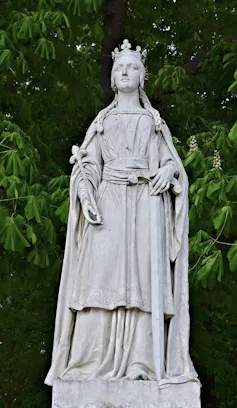
Matilda was born around 1030 to parents Baldwin V, count of Flanders (d. 1067) and Adela, a royal princess of France (d. 1076), descended from Ottonian emperors, a prominent dynasty of Saxons who ruled between the 9th century and 1024. These were powerful and wealthy people, whose standing and lineage far outstripped that of William, an illegitimate son of the Duke of Normandy who faced rebellion and criticism.
A powerful ally like Flanders and ties to the neighbouring French royal court helped William to establish security, and despite Pope Leo IX forbidding the marriage in 1049, the couple married in the early 1050s. A new pope, Nicholas II, removed the ban in 1059 on the condition that both partners founded a monastery.
Matilda and the Norman Conquest
As Duchess of Normandy, Matilda used her wealth to patronise various projects, and appeased Pope Nicholas through the foundation of Sainte-Trinité Abbey (Holy Trinity), also known as Abbaye aux Dames, a Benedictine nunnery in Caen.

In parallel, William founded St Stephen’s for men, but progress there was much slower. Matilda strove to dedicate Sainte-Trinité before the conquest started in June 1066, even giving Cecilia, one of her four (possibly five) daughters with William, as a child oblate (destined to be a nun) on the same day. As well as demonstrating her piety and power, these measures were timed to ensure divine favour and church support for the conquest of England.
As well as courting church favour, it was of course, Matilda’s ship that took William to England. The Mora is a centrepiece of the Bayeux tapestry, with a gold cross and banner clearly depicting God’s favour, and featured the figure of a golden child blowing a horn. It is shown as the largest in the fleet, containing the most people. In the 12th century, a list of ships was compiled probably at the monastery of Fécamp describing the Mora as follows:
In honour of the Duke, Mathilda, later queen, had a ship built called the Mora with which the Duke crossed the sea… She had fitted a golden child who pointed with his right hand to England and who with his left hand pressed an ivory horn against his lips. For this reason the Duke gave the county of Kent to Mathilda.
(Actually, William granted Kent to his half-brother, Odo of Bayeux. Matilda received other lands, including two holdings recorded in Domesday Book – Hambledon and Little Marlowe in Buckinghamshire.)
It was unusual for a human figure to be represented like this, as animals or mythical beasts were preferred to decorate ships. When William left for England, Matilda was pregnant with what later turned out to be a daughter, Adela of Blois (d.1137), the mother of Stephen, King of England (1135-54).
Historian Elisabeth van Houts argued that the golden child represented the future of the dynasty in the shape of their unborn child. And in an excellent new biography The Queenship of Mathilda of Flanders: Embodying Conquest, Laura Gathagan argues that the ship and its golden child physically embodied Matilda’s contribution to the Conquest.
Matilda co-ruler of England and Normandy
Matilda’s solo coronation in 1068 (William had already been swiftly crowned in 1066 immediately after his victory), when she was once again visibly pregnant, demonstrated how William needed the visible rituals associated with her royal and imperial blood and dynasty to bolster his power in England.
Matilda continued to act as his lieutenant in Normandy on several occasions during his campaigning in England. She was connected to 137 charters, and was also a regent for William in England from 1081-82, even presiding as a judge, which historian Laura Gathagan argues was a new extension of queenly power in England.
As a result of the Conquest, Matilda became a major landowner in England and used this wealth to enrich various religious institutions, both in England and on the continent. At her death in 1083, the monk Orderic Vitalis told how William struggled against “constant storms” that rose up against him until his death in 1087. He also wrote of Matilda’s magnificent funeral at Sainte-Trinité Abbey attended by important bishops, abbots and monks as well as hosts of the poor.
The epitaph on her tombstone highlighted her powerful lineage and family, and emphasised that it was her wealth and toils that provided many lands for the convent and comforted the poor.
Arguably, without Matilda’s financial backing, powerful family ties and skills as a co-ruler, William may never have achieved any of his lofty ambitions. In teaching the Norman Conquest, the central portrayal of the Mora in the Bayeux tapestry provides a crucial opportunity to use material culture and tell Matilda’s story.
It also challenges us to reconsider what the original chroniclers and history books omitted to tell us about: the contribution of the women of the Conquest, hidden in plain sight.
This article features references to books that have been included for editorial reasons, and may contain links to bookshop.org; if you click on one of the links and go on to buy something, The Conversation UK may earn a commission.
Author
Natasha R. HodgsonDirector of the Centre for History Heritage and Memory Studies; Associate Professor in History, Nottingham Trent University
Disclosure statement
Natasha R. Hodgson is employed by Nottingham Trent University and acts as a volunteer history consultant for the charity End Sexism in Schools, participating in the History sub-group. She is a co-founder with teachers of the not-for-profit, open access teaching resource teachingmedievalwomen.org.
Partners
Nottingham Trent University provides funding as a member of The Conversation UK.
The Conversation UK receives funding from these organisations
DOI
https://doi.org/10.64628/AB.9djsemc5y

We believe in the free flow of information
Republish our articles for free, online or in print, under Creative Commons licence.Republish this article
Something Good
Your free time is precious, so spend it with something that an expert has guaranteed will be good. Our arts newsletter cuts through the noise with carefully curated recommendations of the best in film, TV, books, and UK exhibitions – straight to your inbox every Friday.
Subscribe for free

Anna Walker
Senior Arts + Culture Editor
You might also like
Posted in Uncategorized
Leave a comment


