Academic rigour, journalistic flair
Arts + CultureBusiness + EconomyEducationEnvironmentHealthPolitics + SocietyScience + TechWorldPodcastsInsights
Share article
Print article
Let’s begin with a simple question that rarely gets a straight answer: what would victory over Iran actually look like? In Washington and Jerusalem, the answers tend to sound definitive: eliminate Iran’s nuclear capability, break its regional power, perhaps even force political change at the top. It’s the language of decisive war, the kind with a clear endpoint.
But shift the perspective to Tehran, and the definition changes completely. Victory, for Iran, is survival. That asymmetry shapes the entire conflict. In wars like this, the side that needs less to claim success often has the advantage – and, right now, Iran needs far less.
There is no denying the military imbalance. The US and Israel can strike with extraordinary precision and reach. They have demonstrated that repeatedly – targeting infrastructure, leadership and strategic assets.
But tactical success has yet to translate into political outcome. Iran’s state hasn’t fractured. Its governing system remains intact, and its networks – military, regional, ideological – continue to function. Even its most sensitive capabilities, including nuclear expertise, remain resilient.
The deeper miscalculation lies in assuming Tehran is playing the same game as Washington. It isn’t. Iran is not trying to defeat the US or Israel outright. It is trying to outlast them, complicate their objectives and raise the cost of progress until it becomes unsustainable.
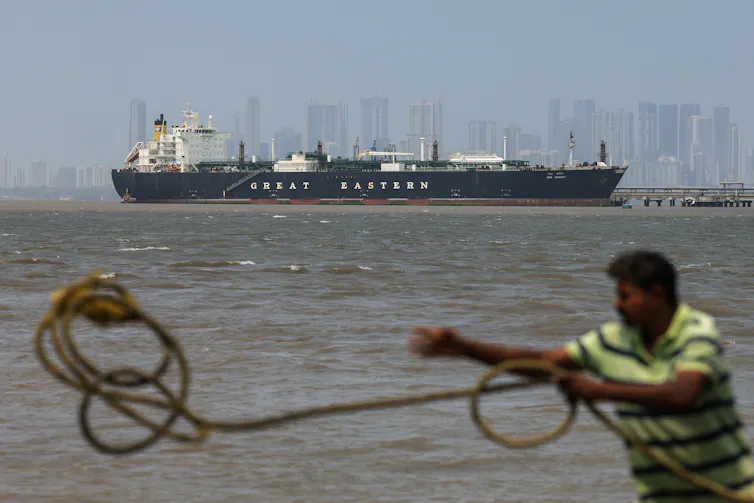
This logic is visible in how the conflict has unfolded. The battlefield extends beyond direct confrontation into shipping lanes, energy markets and regional alliances. Disruptions in the Strait of Hormuz are not incidental – they are pressure points with global consequences.
Our mission is to share knowledge and inform decisions.
About us
Iran’s strategy is not about dominance but entanglement. It doesn’t need battlefield superiority if it can draw its adversaries into a conflict that is too costly to resolve and too complex to conclude.
When wars stall, the instinct is to escalate: more bombing, strikes on energy infrastructure, even, in extremis, “boots on the ground”. The assumption is that more force will finally produce a different outcome.
But Iran is not a passive target. It has already shown a willingness to retaliate across the region, including against Saudi Arabia, the United Arab Emirates, Qatar, Kuwait, Bahrain, Oman, as well as targets in Jordan and Iraq. Strikes on Iran’s energy systems would not stay contained – they would invite retaliation against these same states, widening the conflict.
There is another constraint: American is estimated to have already used up around 45% to 50% of key missile stockpiles, including roughly 30% of its Tomahawk missile inventory. So the stark reality is that escalation is no longer just about willingness, but capacity — and in any wider war, the question may not be how far the US can go, but how much it has left.
The consequences would also extend beyond the battlefield. Iran’s response would be sustained attacks on neighbouring countries, on their power, fuel, and water systems, rendering parts of the region increasingly unlivable as temperatures soar over summer. Huge numbers of people would be forced to leave, risking another large-scale displacement crisis.
Even then, the core reality remains unchanged. Iran is built for endurance – any ground campaign would likely become prolonged and attritional. More importantly, escalation misses the point – the problem is not a lack of force, but the absence of a political objective that force can realistically achieve.
Compounding the problem is a quieter but equally significant reality; the US and Israel do not appear to be fully aligned in their end goals. Israel’s posture suggests a pursuit of maximal outcomes – deep, possibly irreversible weakening of Iran’s system, if not outright regime collapse. The US, by contrast, appears to oscillate between coercion, containment and negotiation.
These are not just differences in emphasis – they are differences in strategy. Wars fought without a shared definition of victory rarely produce victory at all. What they produce instead is sustained military activity without strategic convergence – constant movement, but little progress toward resolution.
No conclusion in sight
At some point, it becomes necessary to describe things as they are. This is no longer a war moving toward a decisive conclusion. It is a conflict settling into a pattern – strikes followed by pauses, ceasefires that hold just long enough to prevent collapse, and negotiations that advance just enough to avoid failure.
And those ceasefires tell their own story. Their repeated extension reflects not progress, but constraint. Washington, under Donald Trump, has strong incentives to keep talks alive, avoid deeper escalation, and end the war sooner rather than later. The alternatives – regional war or global economic shock – are far harder to manage. That dynamic gives Tehran leverage. It does not need to concede quickly when delay itself strengthens its position.
Time, in this sense, is not neutral. The longer the conflict drags on, the more it intersects with the most sensitive pressure points of the global economy. Energy markets are stressed, with supply routes under strain and reserves tightening. Industries that depend on stable fuel flows – aviation, shipping, manufacturing – are increasingly exposed.
What began as a regional conflict has morphed into systemic risk. Even limited disruption can ripple outward, affecting prices, supply chains and political stability. The longer the stalemate persists, the greater the cumulative strain and the closer it edges toward a broader economic shock.
Who really holds the advantage?
In purely military terms, the answer is obvious: the US and Israel retain overwhelming superiority. But wars are not decided by capability alone. They are decided by how goals, costs, and time interact.
In that equation, Iran’s position is stronger than it appears. It has set a lower threshold for success, demonstrated a higher tolerance for prolonged pressure, and shown an ability to impose costs beyond the battlefield. Most importantly, it does not need to win. It only needs to prevent its adversaries from achieving their aims. So far, it has done exactly that.
Which brings us back to the original question: can the US and Israel win this war? If winning means forcing Iran into submission or fundamentally reshaping its strategic posture, the answer is increasingly difficult to avoid – they cannot.
What they can do is continue. Manage the conflict, contain its spread and shape its margins. But that is not victory. It is endurance.
The real danger is not defeat, but the persistence of a belief that just a little more pressure, a little more escalation, or a little more time will produce a different result. If that belief is wrong, then this is not a war on the verge of being won. It is a war that cannot be won at all. A forever war.
Authors
- Bamo NouriHonorary Research Fellow, Department of International Politics, City St George’s, University of London
- Inderjeet ParmarProfessor in International Politics, City St George’s, University of London
Disclosure statement
The authors do not work for, consult, own shares in or receive funding from any company or organisation that would benefit from this article, and have disclosed no relevant affiliations beyond their academic appointment.
Partners
City St George’s, University of London provides funding as a founding partner of The Conversation UK.
The Conversation UK receives funding from these organisations
DOI
https://doi.org/10.64628/AB.wvfdnxy6t

We believe in the free flow of information
Republish our articles for free, online or in print, under Creative Commons licence.Republish this article
Get our world affairs briefing
We’re living in an era of profound and rapid global change. Old certainties are giving way to tectonic shifts in the world order. Sign up here to get the sharpest academic analysis of the big international stories delivered directly to your inbox each Thursday.
Subscribe for free

Jonathan Este
Senior International Affairs Editor
You might also like
Is Trump heading to a Pyrrhic victory in Iran?
Who is calling the shots in Iran?
Israel’s onslaught against Lebanon may strengthen Hezbollah – just when it’s at its weakest
Gulf states want no winner in the conflict between Israel and Iran
34 Comments
Events
- The Women’s Library at 100: celebrating a century of collections — London, City of
- Lynn Wilson — Glasgow, Glasgow City
- Law and Technology: Human Rights in the Digital Age — Colchester, Essex, Essex
- Human Rights Leadership Lab (Online) — Wivenhoe Park, Colchester, Essex
- Construction Humanoids Summit 2026 — London, City of
- Editorial Policies
- Community standards
- Republishing guidelines
- Friends of The Conversation
- Analytics
- Events
- Our feeds
- Donate
- Get newsletter
- Who we are
- Our charter
- Our team
- Our audience
- Our blog
- Partners and funders
- Contact us
- Member resources
- Universal Impact
Privacy policyTerms and conditionsCorrections and complaints
Copyright © 2010–2026, The Conversation Trust (UK) Limited