What happens when AI moves from cloud-only to running everywhere, including on your laptop, your phone, and other devices around you?
In this episode of Deep View Conversations, senior reporter Sabrina Ortiz sits down with Olena Zhu, who leads AI for the client computing group at Intel, to explore one of the biggest shifts underway in AI: the move toward accessible, affordable, and privacy-first AI systems.
Zhu explains why the economics and infrastructure demands of cloud-only AI may not scale indefinitely, and why on-device AI could become a critical part of the industry’s future. She also reflects on the evolution from traditional AI systems to LLMs and now to agentic AI, and why this wave feels fundamentally different from the hype cycles that came before it.
The conversation also dives into how AI is changing the way people work, learn, and experiment, including the surprising mindset Zhu believes helps people get the most value from AI tools today.
Topics covered include:
+ Why cloud-only AI has limits
+ The future of on-device and edge AI
+ AI affordability, energy use, and data sovereignty
+ How agentic AI changed Zhu’s workflow
+ Why experimentation matters more than expertise
+ Intel’s vision for privacy-first AI systems
+ The hidden infrastructure challenge behind AI growth
+ Why AI adoption may depend on trust and accessibility
If you’re concerned about the affordability, accessibility, and privacy of AI, you don’t want to miss this episode.
It’s still unclear whether AI can do the work of white-collar employees. People are losing their jobs anyway.
A recent report from Challenger, Gray and Christmas found that more than a quarter of layoffs in April were attributable to AI, with more than 21,000 cuts announced. AI was used as the leading rationale for job cuts for the second month in a row, according to the report. “Regardless of whether individual jobs are being replaced by AI, the money for those roles is,” Andy Challenger, workplace expert and chief revenue officer for the company, said in the report.
However, one White House official is challenging that narrative: On Monday, National Economic Council Director Kevin Hassett told CNBC that there is “no sign in the data” that AI has cost anyone their job just yet.Hassett said that companies that adopt AI tend to see “rapid revenue growth” and a bump in employment. “We are studying the future of AI and what it means for the workforce, so we’ve got a big task force on that,” Hassett told CNBC.
These contradictory reports add to a mountain of warring data on the effects of AI on how people work. An MIT study suggests that more than 11% of work hours in the UScan already be automated. A Gartner forecast finds that 50% of those laid off due to AI will be rehired. Meanwhile, a Harvard study found that AI actually increases the hours and scope of work, rather than reducing them.
In the meantime, the layoff toll continues to grow higher. Tech firms like Block, Atlassian, Meta, Oracle, Amazon and more have slashed thousands of employees in recent months as they ramp up spending and reorganize their workforces. These cuts are likely to continue. A survey of thousands of C-suite executives from AI agent platform Writer in April found that 60% of enterprises intend to lay off employees who can’t or won’t use AI.Despite how enticing the promise of AI may seem, the tech remains incredibly nascent. With issues such as accuracy, hallucination and data security, it’s unclear whether this tech is actuallycapable of taking over jobs entirely — or if it just looks like it can. Either way, AI is likely not the sole reason for these cuts. Rather, it’s the excuse these companies can use. By claiming to reorganize around AI, these companies stand to make themselves appear to be riding the innovation curve. Plenty of tech firms overhired during the pandemic. The reality is that these cuts are more likely AI washing, using the tech as a scapegoat for the reductions rather than admitting they miscalculated.
As the fog of war drifts even into corner offices, CEOs face questions they can’t answer.PHOTO ILLUSTRATION BY EDMON DE HARO
“Scenario planning” has become boardroom shorthand for preparation to deal with the unknowable. It’s a practice that is never more vital than in wartime, when a sea mine, cyberattack, or sanction can reroute supply chains overnight and send energy prices soaring.
Recommended Video
Trump urges China and allies to help secure Strait of Hormuz
Instead of betting on one forecast about how events will unfold, the most resilient CEOs are now rehearsing several plausible futures at once and deciding—before the missiles start dropping, the virus becomes a pandemic, or the markets seize up—what they will do in each.
It’s an approach that was pioneered by Shell precursor Royal Dutch Shell.In the 1970s the energy company began developing a set of vivid alternative futures involving potential oil-supply disruptions. Shell did not invent the idea of developing such scenarios, which had earlier roots in military and Cold War strategy, but it was the first major company to embed systematic scenario planning at the center of corporate decision-making, largely through the work of economist and planner Pierre Wack. His London-based scenarios team had Shell’s top managers rehearse what they would do if various crises arose.
The doomsday prep paid off. In the early 1970s, Shell’s leaders wondered what would happen if events in Saudi Arabia raised the price of oil. By the time the Arab oil embargo shook the world soon thereafter, sending prices rocketing, Shell knew what to do. It had already slowed refinery expansion and adapted its refineries to handle many types of crude—while competitors vacillated. The common view in the industry is that Shell came through the oil shock far better than any other major producer. The success of those exercises turned Shell into a case study for scenario planning, and the company still regularly publishes its “Shell Scenarios.”
With a war underway, corporate planning is clearly not the only urgent matter. Since the U.S. and Israeli bombardment of Iran beginning in February, thousands have been killed and millions displaced across the region. Vital shipments have been disrupted, and prices have risen worldwide. But along with the human tragedy, the war—and particularly its effect on oil supply and prices—has affected nearly every business around the world.
“This isn’t a world war explicitly,” says Rebecca Patterson, a senior fellow at the Council on Foreign Relations, “but it is a war that is affecting the globe.”
That war was still raging when this article went to press—and the conflict has underscored the importance of insights that will help guide CEOs long after the war is over.
The company war room has become a permanent fixture
Those war rooms have found no reason to disband. The tariff situation is still “changing almost on a weekly if not daily basis,” says Abe Eshkenazi, CEO of the Association for Supply Chain Management, and the Iran war “is a continuation of the uncertainty.” The only difference is that the term “war room” is no longer a metaphor.
Perhaps every generation thinks its own era is the most perplexing and unpredictable of all time. But evidence shows that what businesspeople have had to deal with in recent times is truly off the charts. Uncertainty indexes going back monthly to 1985, compiled by researchers at Stanford University and the University of Wisconsin, show that instability and jitters about U.S. economic policy rose to record levels starting in 2018—and have never dialed down. (To create the indexes, the researchers measure disagreement among economic forecasters; federal tax code provisions set to expire; and articles on policy in major newspapers.) The indexes hit a new high after Trump revealed his 2025 tariffs. (The index covering the time of the Iran war hadn’t been published when we went to press.)
Don’t expect uncertainty to decline significantly anytime soon, says Ian Bremmer, founder and president of Eurasia Group. International institutions—the United Nations Security Council, the World Trade Organization, the Group of Seven (G7)—clearly aren’t as effective as they once were at maintaining international order, he explains: “We are now living in a G-Zero world, one in which no single country or bloc of countries has the political and economic leverage—or the will—to drive a truly international agenda.”
High gas prices are just one of the risks to prep for.
Companies caught in the commercial chaos must now fend for themselves. In a tumultuous global order, “supply-chain officers are looking for inventory buffers, alternative vendors, redundancy in their supply chains,” says Eshkenazi. “That’s not compatible with long-term strategies.”
In other words: Companies’ war rooms won’t be closing up shop anytime soon.
Playing out a range of scenarios is more essential—and more difficult—than ever
“Scenario testing or stress testing: If you’re not already doing it, you need to start yesterday,” says Patterson of the Council on Foreign Relations. In addition to companies stress testing their costs and supply chains, she recommends they also test their resistance to cyberattacks. “Iran is a strong actor in the cyber world,” she says. Its successful March attack on the Stryker medical-device maker, in which its goal was apparently not to receive ransom but to destroy data, was only a recent example. Many of Iran’s previous cyberattacks have targeted crucial economic infrastructure, including hospitals, ports, power plants, and railroads.
Some of the most useful scenarios are based on second- or third-order effects of an event. With the Iran war, Patterson says, “the big one is stagflationary risk,” a second-order effect that creates slow economic growth, high unemployment, and high inflation. With gasoline prices and shipping costs already rising, “expect to see this feed into inflation expectations and possibly actual inflation,” she says. Third-order effects might include rising interest rates and borrowing costs, and a strengthening of the dollar, making it easier to buy imports and harder to sell exports.
The Iran war will likely continue to have effects long after it ends. Patterson cites an old line about gasoline prices: “They go up like a rocket and come down like a feather.”
Leaders should remember the pandemic
That’s not to say that the Iran war will be a disaster on COVID’s scale. But no one knows how it will turn out, just as no one in the pandemic’s early days knew what would happen next.
Employees, shareholders, customers, suppliers—all were frightened and looking for answers that not even CEOs had. The pandemic changed leadership in ways that still linger, and today’s executives and managers would do well to remember that transformation.
“Scenario testing or stress testing: If you’re not already doing it, you need to start yesterday.” Rebecca Patterson, Council on Foreign Relations
The overarching theme from those days was the end of the classic CEO persona—informed, prepared, firmly in charge, and invulnerable. That changed quickly. “CEOs went from being godlike to being more human,” said Jim Citrin of the Spencer Stuart executive search firm. A CEO told Fortune at the time, “I found the magic in an organization is about being super down-to-earth, letting people see you for who you are, with all the vulnerabilities that you face.”
Now, as the fog of war drifts even into corner offices, CEOs again face questions they can’t answer: How long will the war last? Will it escalate? How high will oil prices go?
It’s a good time to remember a lesson from the pandemic: Executives who confess they’re mere mortals and don’t pretend to know everything can actually become more trustworthy and more effective as leaders.
This article appears in the April/May 2026 issue of Fortune with the headline “For CEOs, it’s time for a wartime mindset.”
The Fortune 500 Innovation Forum will convene Fortune 500 executives, U.S. policy officials, top founders, and thought leaders to help define what’s next for the American economy, Nov. 16-17 in Detroit. Apply here.
China Just Made a Move in Hormuz — And No One Noticed | Prof. Jiang Analysis
This wasn’t a military headline. It was a structural shift. In this lecture, Professor Jiang analyzes the quiet but consequential developments surrounding the Strait of Hormuz — and how China’s calibrated diplomacy, energy positioning, and economic coordination may be reshaping influence in one of the world’s most critical maritime corridors. This is not about warships. This is about leverage.
In this video, Professor Jiang breaks down: 🔹 Why Hormuz matters more than headlines suggest — A substantial share of global oil and LNG shipments transit this narrow passage, making it central to global economic stability. 🔹 China’s low-visibility strategy — Rather than direct confrontation, Beijing often expands influence through energy contracts, infrastructure agreements, and diplomatic mediation. 🔹 Iran’s geographic leverage — Tehran’s position gives it structural influence over maritime security dynamics, particularly during periods of tension. 🔹 The U.S. response dilemma — Military presence does not automatically translate into economic dominance, especially when global supply chains and energy buyers are diversified. 🔹 Energy security as geopolitical currency — Control over access, stability guarantees, and long-term contracts increasingly matter more than symbolic power projection. 🔹 The broader great-power framework —
Hormuz is not an isolated theatre; it intersects with trade wars, currency competition, and multipolar realignment. Professor Jiang applies systems thinking and structural geopolitics to explain why the most important moves in global power competition are often the least dramatic. The real shift isn’t loud. It’s incremental, strategic, and embedded in long-term incentives. ⚠️ This analysis is geopolitical commentary and does not promote hostility toward any nation or people. All conclusions are open to debate. 📌 Share this lecture if you want to understand how quiet strategic positioning can reshape global power. 🔔 Subscribe for deep geopolitical analysis beyond the headlines.
Axios CEO Jim VandeHei, in his weekly C-Suite newsletter, isolates the seven most immediate risks facing companies. He asked C-Suite reader and Eurasia Group founder and president Ian Bremmer to help stress-test the list.
Why it matters: Some of these risks, like China or debt, might feel manageable now but could spike to the top with a single bad decision or day of news.
1. AI. It represents both wild opportunity and wild risk, but the risk part feels particularly acute in the short term.
Bremmer tells us: “AI is #1 in my view … because it affects literally everyone, and it’s happened faster than almost everyone thought.”
2. Middle East and its aftershocks. Even in a best-case de-escalation scenario with Iran, we’re left with oil prices structurally above prewar levels, rising Saudi-UAE competition and a persistent Israel-Hamas conflict.
Bremmer says: “The markets don’t tell the story the CEOs are focused on, which is massive supply chain disruption that is coming soon … oil shortages, plastics shortages and longer-term food inflation.”
3.Rare earth reliance. Every emerging technology — AI chips, electric vehicles, defense systems, clean energy, medical imaging devices — runs on rare earth minerals. China controls roughly 70% of mining and 90% of the processing of these materials.
4. China. It’s simultaneously our largest geopolitical rival, our most dangerous AI competitor and our biggest supply chain vulnerability.
5. Debt, both public and private. Nearly $39 trillion and counting in national debt. The Congressional Budget Office projects that interest payments will eat nearly 15% of all federal outlays by 2028. You can’t even call it a crisis. It’s an obvious slow bleed with no attempt to stop it.
6. Political volatility. Tax policy, regulatory posture, antitrust enforcement — none of it is predictable on a 12-month horizon. And it’s all happening as the federal government becomes more content to govern by executive action that can be overturned with the stroke of a pen.
7. Anti-wealth backlash. AI is making the wealth gap visibly wider, accelerating a trend that was already bad. That’s a genuine talent, retention and consumer risk constantly bubbling under the surface.Share this item.If you’re a CEO or on a CEO’s team: Apply now to join Jim’s new Axios C-Suite weekly newsletter.
Some time earlier this year, an employee at tech giant Meta built a system to track how much each staff member was using artificial intelligence (AI).
Named “Claudeonomics” after the Claude chatbot, the system created a leaderboard ranked by the number of tokens each user was exchanging with AI models, with leaders given titles such as “Token Legend”. (Tokens are tiny chunks of text, each around four characters long, that language models use for processing.)
Meta is not alone in its fascination with “tokenmaxxing”: AI labs OpenAI and Anthropic, e-commerce company Shopify, and tech investment firm Sequoia capital are all reportedly monitoring AI usage and rewarding heavy users, some of whom burn billions of tokens in a week.
Reducing a person’s performance to a single metric can be appealing for management in large corporations. But the choice of what to measure isn’t a neutral one – and if we’re not careful, it can start to rewrite our vision of what we actually value.
The score keeps the score
One of the more full-throated advocates of tokenmaxxing is Jensen Huang, chief executive of chipmaker Nvidia, who envisions a future in which tech employees negotiate high token budgets and consume tokens at rates commensurate with their salaries. Around 80% of those tokens are currently processed via Nvidia’s chips, so Huang’s enthusiasm makes sense.
But is token consumption a helpful metric for those of us who do not profit directly from AI processing volume?
Our mission is to share knowledge and inform decisions.
In a recent book, The Score, philosopher C. Thi Nguyen analyses the rise of metrics throughout modern society and offers some helpful insights.
As Nguyen emphasises, what we measure shapes our goals. We develop metrics as tools of convenience; they standardise our measurement of values so we can compare large numbers of otherwise disparate things.
This standardisation comes at the expense of variation and distinctiveness, Nguyen argues. In business, it can make workers seem interchangeable.
Determining which employees in a large organisation are consuming the most tokens in a week is fairly straightforward. But it tells us nothing about the quality or impact of their work.
Bad metrics, bad results
In the past, questionable metrics have contributed to dramatically bad outcomes.
Prior to the 2008 global financial crisis, for example, many financial institutions had sophisticated systems of measures designed to incentivise selling as many loans as possible, as quickly as possible. Perhaps unsurprisingly, many of those loans turned out to be far riskier than anyone realised.
Nguyen emphasises that these types of metrics can tempt us into thinking they are unavoidable. But one of the central lessons of moral philosophy is that we ought to pause at moments like these and ask a couple of basic questions: what is a good life, and what values are actually worth chasing?
Huang and others usually don’t present tokenmaxxing as an answer to these question. But that’s how it functions. What is worth devoting your professional and creative energy to? Simple: grinding through tokens.
A new vision of the good life?
Silicon Valley has, of late, produced a striking number of manifestos and quasi-constitutions.
Consider Anthropic’s Claude’s Constitution, published in January 2026, which sets out the company’s aspirations for its model’s values and speech. Or look at venture capitalist Marc Andreessen’s Techno-Optimist Manifesto, which makes the case for ambitiously accelerating technological advancements in the service of promoting human flourishing.
Some of the most influential texts in the history of moral and political philosophy take this form. Thomas Jefferson wrote one – the US Declaration of Independence. Karl Marx and Friedrich Engels wrote another – The Communist Manifesto.
One way to view these Silicon Valley proclamations, and trends like tokenmaxxing, is as repackaging familiar commonplaces of corporate life – recasting mission statements and key performance indicators in a loftier register. But another is to see them as attempts to do something far more ambitious: sketch the outlines of a new and far-reaching vision of the good life.
On that view, the metrics used to measure progress against the vision matter. Tokenmaxxing, for example, is already creeping beyond the bounds of the tech industry – one report from the Wharton School at the University of Pennsylvania suggests many organisations are prioritising staff AI usage and spending as metrics.
Metrics can be useful – if we’re careful
Metrics do have their place in an ordered and complex society. There are many instances in which we might happily defer to the scores produced by simple metrics, trading nuance for convenience. Aggregate ratings on product or restaurant review sites, for example, can simplify our decision-making, even if they aren’t tailored to our specific preferences.
The problem is what Nguyen calls “value capture” – when we uncritically allow external metrics to determine our own goals and behaviour. Resisting this process involves questioning what is being measured and reframing it.
Instead of counting tokens, for example, we might use an equivalent metric such as energy consumption. Energymaxxing might sound more like conspicuous wastage, rather than improved performance.
Counting tokens is one measure of AI activity, which is itself intended as a measure of productivity, which in turn leaves aside the question of what is being produced. Not only is tokenmaxxing a dubious metric in itself, but it may also distort our vision of what matters.
Authors
Victoria Lorrimar Director, Centre for Technology and Human Futures, University of Notre Dame Australia
Tim Smartt Senior Research Fellow, Philosophy, University of Notre Dame Australia
Disclosure statement
Victoria Lorrimar receives funding from the John Templeton Foundation.
Tim Smartt does not work for, consult, own shares in or receive funding from any company or organisation that would benefit from this article, and has disclosed no relevant affiliations beyond their academic appointment.
Republish our articles for free, online or in print, under Creative Commons licence.Republish this article
The Conversation meets a real need in the information ecosystem. Our authors are subject-matter experts who offer clarity and insight into the issues facing the world. An outlet where you can find real expertise from authors without axes to grind, published by an organisation with no agenda to push. Thousands of media organisations worldwide republish our content for their readers. But the same business model that has freed us from the influence of billionaire owners or big business advertisers comes with its own challenges. Universities are under enormous financial pressure, their income streams squeezed in every direction. Your support as our readers is crucial to securing The Conversation’s future. Donations are an essential bulwark against unexpected loss of income. Around 2,000 of our readers give monthly to support our work. If you’re not among them but value what we do, please consider giving today.
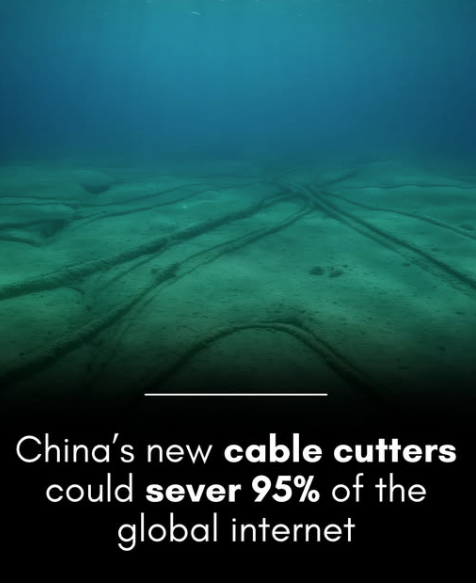
China just built a device that can cut the cables carrying 95% of the world’s internet. China has revealed a deep-sea cable-cutting system capable of severing the steel-reinforced undersea cables that handle more than 95% of the world’s internet traffic, sparking alarm across the global defense and cybersecurity communities.
Built by the state-run China Ship Scientific Research Centre, the device can descend to depths of 4,000 meters and slice through armored cables with a diamond-edged grinding wheel. While Beijing describes it as a tool for salvage operations and seabed resource recovery, its clear military potential, especially when deployed by quiet submersibles near key chokepoints such as Guam, has put analysts on high alert.
The technology’s stealthy deployment options make it both an engineering marvel and a potent instrument of strategic disruption. Although Chinese officials maintain it is purely civilian in purpose, the obvious dual-use capability has intensified worries about deliberate sabotage of the fragile underwater arteries that keep the global internet running.
As geopolitical rivalries deepen and countries scramble to safeguard their digital infrastructure, this breakthrough serves as a stark reminder: the same innovations that push technological boundaries can also expose—and dramatically alter—the balance of power in an increasingly connected world.
#US President #DonaldTrump will visit #China from May 13 to 15, marking his first visit to the country in nine years. According to Wu Xinbo, dean of Fudan University's Institute of International Studies, today's China is "more powerful, more confident, and more determined to… pic.twitter.com/r8ST1wUuwl
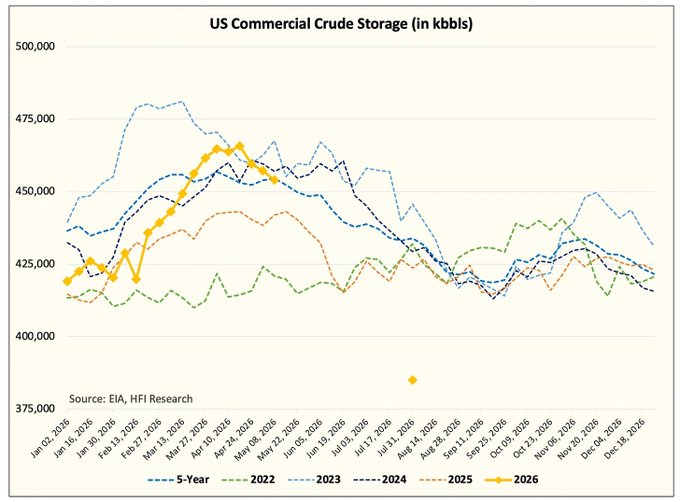
The oil market just crossed the breaking point and there’s no playbook for what comes next.
The Strait of Hormuz closure knocked out 11 to 13 million barrels a day, roughly 4 times larger than any supply outage in history, and analysts at HFI Research say we are already past the point of no return.
The sequence goes like this: refineries start running low on crude, they bid aggressively to secure whatever is left, prices stop moving in a straight line and go parabolic, and then at some point demand just… collapses on its own because people can’t afford it anymore.
Asia gets hit first and hardest since it depends most on Hormuz flows, and here’s the brutal part: even if the Strait reopened today, actual oil deliveries to Asia wouldn’t resume until mid-July.
The only thing that could offset a shortage this size would be COVID-style government lockdowns, and nobody is ordering those. Without lockdowns, the only mechanism left is prices rising until people simply can’t afford fuel anymore. At which point the economy breaks itself.
HFI’s honest conclusion: they have no idea where prices settle, and neither does anyone else There is simply no historical precedent for what is happening right now. Source: HFI Research
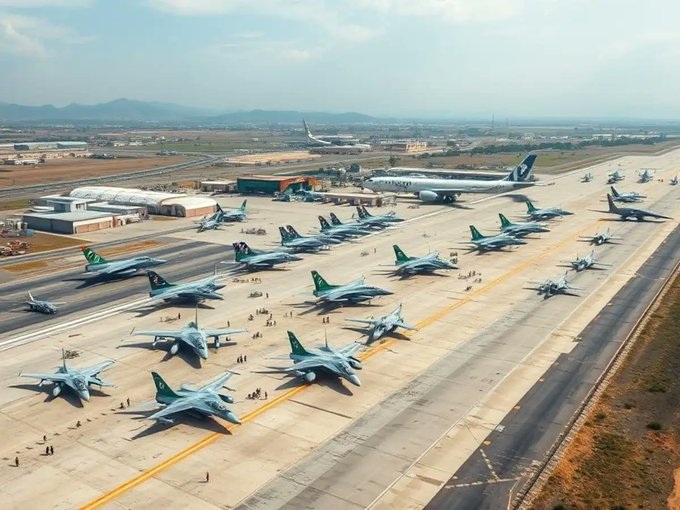
Pakistan to CBS: Stop the BS, we didn’t shelter any Iranian planes during the war
CBS claimed some of Iran’s military fleet was stationed at Pakistan’s Nur Khan Airbase, saying it was to shield them from U.S airstrikes.
Pakistan’s government said only non-military aircraft arrived for the peace talks, and some of them remained there because elements of Iran’s delegation stayed on, expecting further talks.
The planes “bear no linkage whatsoever to any military contingency or preservation arrangement.”

 Watch on YouTube
  Listen in your favorite podcast player
  Despite how enticing the promise of AI may seem, the tech remains incredibly nascent. With issues such as accuracy, hallucination and data security, it’s unclear whether this tech is actuallycapable of taking over jobs entirely — or if it just looks like it can. Either way, AI is likely not the sole reason for these cuts. Rather, it’s the excuse these companies can use. By claiming to reorganize around AI, these companies stand to make themselves appear to be riding the innovation curve. Plenty of tech firms overhired during the pandemic. The reality is that these cuts are more likely AI washing, using the tech as a scapegoat for the reductions rather than admitting they miscalculated.



 If you’re a CEO or on a CEO’s team: