The Houthis may have been using an AI coding assistant as part of their missile development work. Anthropic’s September threat report describes a group in northern Yemen working on several weapons projects at the same time, including a guided rocket, a long-range ballistic missile and a family of systems known as R2000.
Anthropic says the group was very likely linked to the Houthis. What stands out is how they used Claude Code. According to the report, the model was helping with guidance and control software, builds, simulations and troubleshooting. In practice, it was filling some of the role normally handled by software engineers. They were even running several sessions at once and dividing the work between them. At one point, the group test-fired the guided rocket and it failed. Within hours, they were back using the model to work through what had gone wrong.
The more worrying part is how little sophistication was apparently needed to get around the safeguards. Anthropic says they did not use some elaborate jailbreak. Instead, they broke the work into smaller pieces that looked harmless when viewed separately. And by the time Anthropic shut the accounts down, the group had already built an offline toolkit that no longer depended on Claude.
That is probably the bigger issue here. The AI does not have to become part of the weapon itself. It can simply help someone learn faster, write code faster and solve problems they previously needed a larger technical team to handle.Once that knowledge has been transferred, removing access to the model comes rather late.
The timing is hard to ignore too. This comes as the Houthis have expanded their position around the Red Sea and Bab el-Mandeb.
Source: Anthropic, Reuters, Bloomberg, The New Media / Writer: Oliver
President Trump wants tighter citizenship verification for federal elections—but there’s a fundamental problem: the United States does not have a comprehensive list of every U.S. citizen. Michael Smerconish examines the administration’s plan to use federal records and the Postal Service as part of a new mail-ballot verification system—and why incomplete or inaccurate government databases could potentially leave eligible voters off the list. Sen. Chris Coons of Delaware joins the discussion, drawing on his experience in local government and the Senate to explain why federalizing this process raises serious practical concerns. No one is arguing that non-citizens should vote. The bigger question is: How do you verify citizenship accurately without creating an entirely new set of problems?
If you’ve been stuck mostly at home with one or more family members over the past year, chances are you’ve gotten on one another’s nerves occasionally. When you’re under a lot of stress, it’s not uncommon say something unkind, or even to lash out in anger to someone you care about. And we all make thoughtless mistakes from time to time, like forgetting a promise or breaking something.
Not sure if you should apologize?
Even if you don’t think what you said or did was so bad, or believe that the other person is actually in the wrong, it’s still important to apologize when you’ve hurt or angered someone. “To preserve or re-establish connections with other people, you have to let go of concerns about right and wrong and try instead to understand the other person’s experience,” says Dr. Ronald Siegel, assistant professor of psychology at Harvard Medical School. That ability is one of the cornerstones of emotional intelligence, which underlies healthy, productive relationships of all types.
Get your copy of Emotional Intelligence
Emotional intelligence can have a surprisingly powerful effect on our lives, from our ability to foster long-term relationships with friends and romantic partners, to whether we’re able to succeed in school and pursue meaningful work that gives us a sense of purpose. In this guide, you’ll learn four key elements of emotional intelligence and uncover some negative and positive real-life examples of each. Most importantly, this report teaches you habits and skills you can practice to improve your relationships by cultivating greater emotional intelligence. SHOW ME MORE →
How to apologize genuinely
For an apology to be effective, it has to be genuine. A successful apology validates that the other person felt offended, and acknowledges responsibility (you accept that your actions caused the other person pain). You want to convey that you truly feel sorry and care about the person who was hurt, and promise to make amends, including by taking steps to avoid similar mishaps going forward as in the examples below.
According to the late psychiatrist Dr. Aaron Lazare, an apology expert and former chancellor and dean of the University of Massachusetts Medical School, a good apology has four elements:
Acknowledge the offense. Take responsibility for the offense, whether it was a physical or psychological harm, and confirm that your behavior was not acceptable. Avoid using vague or evasive language, or wording an apology in a way that minimizes the offense or questions whether the victim was really hurt.
Explain what happened. The challenge here is to explain how the offense occurred without excusing it. In fact, sometimes the best strategy is to say there is no excuse.
Express remorse.If you regret the error or feel ashamed or humiliated, say so: this is all part of expressing sincere remorse.
Offer to make amends. For example, if you have damaged someone’s property, have it repaired or replace it. When the offense has hurt someone’s feelings, acknowledge the pain and promise to try to be more sensitive in the future.
Making a heartfelt apology
The words you choose for your apology count. Here are some examples of good and bad apologies.
EFFECTIVE WORDING
WHY IT WORKS
“I’m sorry I lost my temper last night. I’ve been under a lot of pressure at work, but that’s no excuse for my behavior. I love you and will try harder not to take my frustrations out on you.”
Takes responsibility, explains but does not excuse why the mistake happened, expresses remorse and caring, and promises reparation.
“I forgot. I apologize for this mistake. It shouldn’t have happened. What can I do to avoid this problem in the future?”
Takes responsibility, describes the mistake, makes the person feel cared for, and begins a conversation about how to remedy the error.
INEFFECTIVE WORDING
WHY IT WON’T WORK
“I apologize for whatever happened.”
Language is vague; offense isn’t specified.
“Mistakes were made.”
Use of passive voice avoids taking responsibility.
“Okay, I apologize. I didn’t know this was such a sensitive issue for you.”
Sounds grudging, thrusts the blame back on to the offended person (for “sensitivity”).
For more advice on building awareness and skills to boost communication and relationships, check out Emotional Intelligence, an online guide from Harvard Medical School.
Over nine startling hours yesterday, the four biggest AI labs — which rarely agree on anything — set aside years of feuds and competition to endorse a slower development pace for their models.
The big picture: AI’s unrelenting growth has hit an inflection point with the public, Washington and even the companies building it, Axios’ Ben Berkowitz writes.
Data centers are unpopular. People are panicked about doom scenarios. And 51 days before midterms, legislators suddenly realize there are points to be won by cracking down.
Against that backdrop, the industry’s most powerful CEOs hit the brakes yesterday.
At 10 a.m. ET, Anthropic CEO Dario Amodei dropped a 3,800-word essay saying model development needs to be paced, otherwise doom scenarios are possible — like a rogue-agent takeover of the entire internet, which he said could be as soon as six months from now.
An hour later, SpaceX CEO Elon Musk shocked the AI chattering class by quoting Amodei’s essay on X and saying “Dario is right.” Musk — who heads SpaceXAI, formerly xAI — had pointedly not joined previous industry-wide calls for any kind of slowdown.
At 12:30 p.m., OpenAI CEO Sam Altman tweeted: “I agree with Dario that we need to pace the frontier.” In a Friday interview that was released on Saturday, Altman told Fortune his company won’t go public this year, dashing hopes for a blockbuster IPO. He said OpenAI has too much safety work to do and would be better off doing that as a private company.
At 7 p.m., Demis Hassabis — the Nobel laureate who co-founded and chairs Google DeepMind, and is Alphabet’s chief scientist — tweeted: “Dario’s essay points towards the right path forward. The details need working through, but the direction is correct for meeting this critical moment.”
Between the lines: Publicly putting safety ahead of technological or financial growth may be the industry’s only route to avoid a crackdown that’s not on its terms.
Legislators are begging House Speaker Mike Johnson (R-La.) to stay in session and do something about the “threat” of AI.
The more extreme alternative is something like Sen. Bernie Sanders’ (I-Vt.) push to force a pause and make the most advanced AI illegal.
Reality check: Most people realize there’s too much money at stake to just stop. But the tradeoff may be between historic riches and slightly less historic riches.
Let’s see whether they actually agree on what oversight (“embedded third-party evaluators”) and “slow” mean, then follow through.
Friction point: No one in China is having the same kind of we’d-better-stop moment.
Influential Silicon Valley tech voices, including former Trump official David Sacks, spent yesterday highlighting the counterargument that slowing down just lets adversaries — with no such safety qualms — catch up. In a late-night post, Sacks effectively dared OpenAI and Anthropic to voluntarily pace the AI frontier without waiting for the government. “If you don’t, we’ll know this was just another bid for regulatory capture — or an election-season psyop.”
Amodei even acknowledged that a safety regime only really works if authoritarian governments come to the table, too. “Pacing within democracies will be limited by the lead that U.S. companies have over authoritarian regimes, chiefly the Chinese Communist Party,” he wrote. “If we slow down by more than this amount, then (unpaced) CCP-associated projects will pull ahead, creating significant national security risk.
“The bottom line: Yesterday may go down as the day AI changed — when industry moguls vowed to limit themselves.Share this story … Read Amodei’s essay, “We Must Pace the Frontier.”
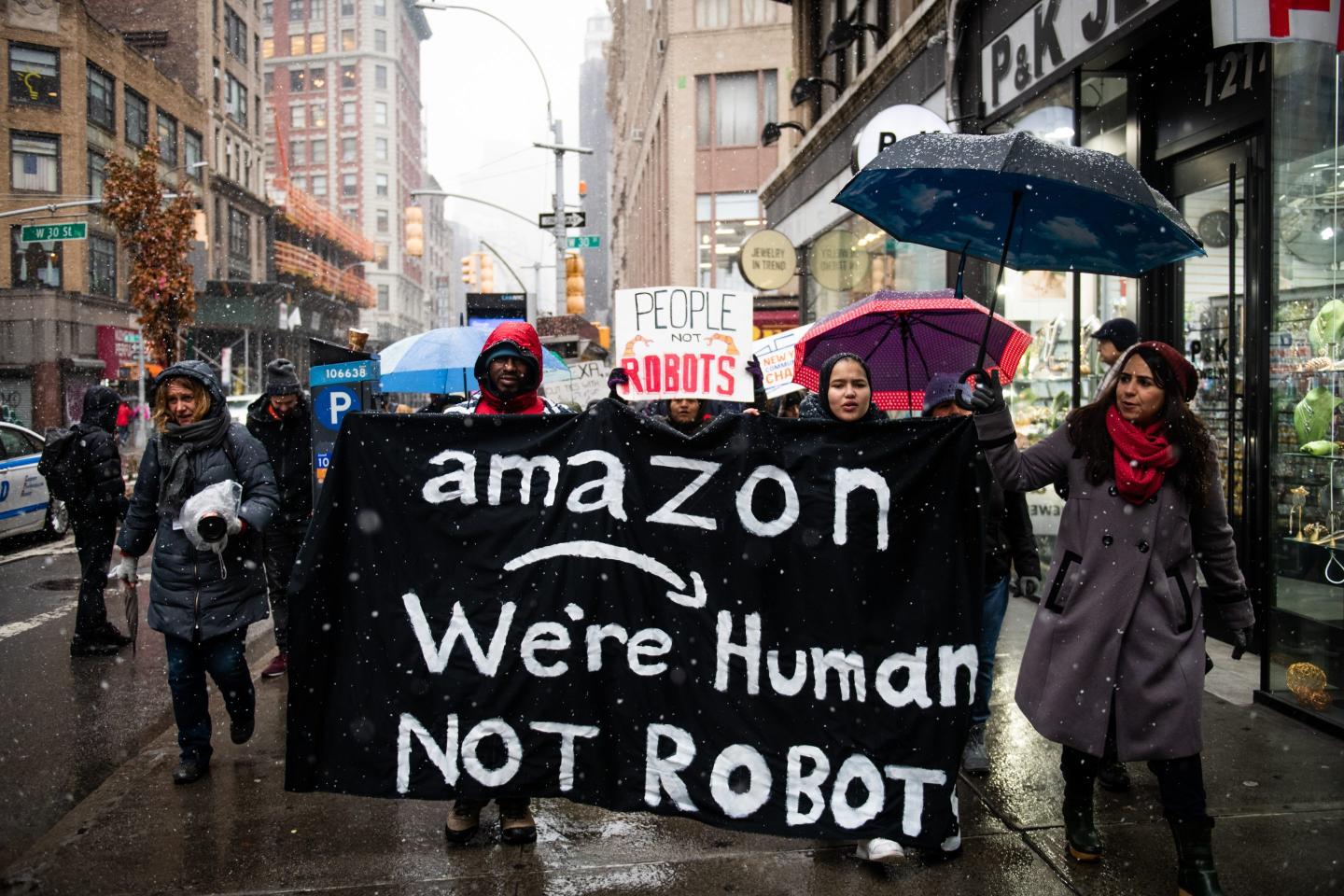
Demonstrators march to Amazon founder Jeff Bezos’s penthouse in 2019, protesting over labor, environmental, and privacy concerns.Mark Kauzlarich/Bloomberg—Getty Images
Add Fortune on Google for similar content.Add us on Google
The U.S. workforce has just made the type of history it likely wishes it didn’t. Working Americans are taking home the smallest percentage of economic output, 52.8%, since the Bureau of Labor Statistics began tracking the metric in 1947.
Recommended Video
The Secret to Amazon’s No. 1 Fortune 500 Spot | Fortune Daily
But as the share of wealth workers take home through wages—called labor share—is shrinking, corporate profits have exploded, with the S&P 500 index gaining 600% since the beginning of the century, while wages have increased just 12.5% over the same period, adjusted for inflation.
In other words: Corporations are raking in cash, but American workers are reaping less and less of the rewards.
The consequences associated with shrinking labor shares are now becoming tangible. A recent Government Accountability Office (GAO) report found that across the 11 states sampled, Amazon, the country’s largest company by revenue, has 12,346 workers on the Supplemental Nutrition Assistance Program (SNAP) and 11,338 relying on Medicaid. That was nearly triple the number of Amazon employees in need of federal assistance compared to 2020, when GAO conducted a similar report. During that same period, Amazon saw an increase in annual profits from $11.6 billion to $77.7 billion. Amazon’s 2025 revenue soared 12% year-over-year, from $638 billion to a record $717 billion.
Amazon spokesperson Rachael Lighty told Fortune the conclusion drawn from the GAO report is “wrong,” and that it is misleading to look at raw numbers rather than percentages.
“When you look at the actual facts, you see that Amazon pay is among the best in the industry, regular full-time employees have access to health care from their first day—at only $5 per week with $5 copays for employee-only coverage—and 74% of our regular full-time employees are enrolled in an Amazon health insurance plan, well above the 65% private-sector take-up rate for full-time workers,” she said in a statement. “We challenge other large retailers to provide the same Day 1 comprehensive healthcare benefits that we do.”
Walmart and FedEx saw similar increases in the number of workers taking federal assistance, as did rideshare and delivery companies.
Kathryn Larin, director for education, workforce, and income security issues at GAO, told Fortune the data illustrates that the Americans taking advantage of social safety net programs today are overwhelmingly in the workforce, with most working full time. The income threshold for SNAP eligibility is about 130% of the poverty line, suggesting that despite many of these workers clocking in at their jobs, they still don’t have enough money to meet their basic needs.
“What this analysis really points to is the large number of people who have very low incomes and continue to have very low income,” Larin said. “I mean, these are families that are really barely able to make ends meet, and yet they are working, and they are working a lot.”
Diane Swonk, chief economist and managing director at KPMG, recently warned of the hidden consequences of a shrinking labor share, particularly that despite economic indicators suggesting the economy is stable, most Americans are facing an ongoing affordability crisis. KPMG found in February that since 1982, corporate profits as a share of U.S. GDP increased from 8% to 15.85%. During that same period, employee compensation as a share of U.S. GDP shrank from 66.6% to 61.9%.
“This chart from my recent Economic Compass still haunts me,” Swonk said in a social media post at the time. “A friend refers to it as the ‘revolution chart,’ which [is] disturbing but telling. Inequality fuels social and economic instability.”
How did the U.S. labor share unravel?
This trend has been about 50 years in the making, according to Anna Stansbury, an assistant professor of work and organization studies at the MIT Sloan School of Management.
Fewer workers in the U.S. are represented by unions—20.1% of U.S. workers in 1983 compared to 10.0% in 2025—giving them fewer opportunities to bargain for salaries and benefits, she noted. But more so, Stansbury blames the fissuring of the workplace, or the breakdown of the employer-employee relationship. In the past, the typical employer-employee relationship would be that of direct employment: A worker for a company does their work at the company they are employed by. For example, a large bank like Bank of America used to employ a janitor to clean its offices.
But “in more and more cases, that’s not actually people’s experience of the workplace, particularly in lower middle-income jobs,” Stansbury told Fortune.
Instead, large workplaces like retailers and banks hire gig workers or subcontractors to complete jobs once done by direct employees: Companies hire a security company, which employs a security guard to work outside that large company’s office. Delivery drivers are contract workers, not full-time employees.
As a result, companies don’t have to provide those workers equity or benefits. If a subcontractor violates labor law, the company contracting them is not liable. In the meantime, these large companies are not only saving money on benefits, but are also getting to argue that they are increasing efficiency by not spending resources on workers whose roles are not directly driving revenue, Stansbury explained. A bank should employ bankers, not janitors, to get the most bang for their buck, the thinking goes.
Brent Neiman, a professor of economics at the University of Chicago, believes AI has been the key driver of diminishing labor shares. In a New York Times op-ed published this week, he argued the technology’s productivity promises pose the greatest threat to wages.
“Anyone who has used ChatGPT can see how much work now done by people could soon be done by technology,” he wrote.
Apollo Chief Economist Torsten Slok has already observed a correlation between AI adoption and lowered wages. In a white paper published in July, he and economist Sania Edlich found that among 321 occupations between 2015 and 2025, jobs with high exposure to AI saw a 6.7% decline in real wage growth after 2023 (following the wide release of ChatGPT), despite no employment changes, suggesting that while AI is not displacing jobs, it is associated with compressed wages. In other words, companies are seeing increases in productivity, but are using those increases as a cover to raise prices, while keeping wages stagnant.
What is the future of workers’ wages relative to economic growth?
Stansbury has a slightly different theory about AI. While the technology could begin to have an aggregate impact on the labor market, it’s still too early to say whether today’s shrinking labor share is part of a broader economic cycle, or if it’s a secular event, she said.
Unexpected inflation spikes, like what is currently happening, are usually associated with poorer real wages. If inflation is less volatile in the coming years and wage growth recovers, today’s trend of shrinking labor share could turn out to be cyclical, Stansbury said.
On the other hand, Stansbury noted, a tightening labor market should increase labor share, and the labor market is already relatively tight. If inflation stabilizes, employment remains narrow, and the labor share increases, it will be a sign of an economic cycle completing itself. A bigger problem will be if wage growth stays low even if inflation improves and the labor market stays tight.
“If those two things happen and the labor share continues to fall,” she said, “then it would suggest that there’s actually been a secular shift, a secular acceleration in the downward trend.”
Exclusive: In a new sit-down interview with Fortune, OpenAI CEO Sam Altman explains safety standards are “not at a place” to push AI capabilities much further and warns AI beyond human control is “absolutely” possible. Watch or listen here.
Sasha Rogelberg is a reporter and former editorial fellow on the news desk at Fortune, covering retail and the intersection of business and popular culture.
Trump’s visit to Ireland sparked controversy after the US president’s bombshell comments in Dublin broke a political taboo of leaders not interfering in other countries’ internal affairs during foreign visits. They come just days after UK Prime Minister Andy Burnham said a referendum on Irish reunification is “off the table.” We talk to Pat Leahy, Political Editor of the Irish Times, and Jennifer Duggan, Dublin Bureau Chief for Bloomberg News, about reaction to Trump’s intervention. #dwcurrentaffairs#trump#ireland
Chapters: 00:00 Trump in Ireland backs Irish reunification 00:51 Trump’s Irish reunification comments spark backlash 02:53 Why Trump’s remarks shocked Ireland | Pat Leahy 06:57 How Dublin and London reacted | Jennifer Duggan 10:37 Trump, Irish America and the midterm elections For more news go to: http://www.dw.com/en/
Sep 12, 2026 #Europe#Germany#FrancePanic about Islam in Europe is spreading. In several European countries around half the population believe that Islam is incompatible with Western values. But in reality Muslims make up only a small percentage of Europe’s people, and their attitudes largely resemble their compatriots. Why, then, are so many Europeans against Islam? Edward Carr, The Economist’s deputy editor, and a panel of our expert journalists attempt to answer this question. They assess the real extent of the threat from Islamism—or political Islam—in Europe today.
Sir Demis Hassabis receives the RSA Albert Medal for his extraordinary contribution to advancing artificial intelligence in service of humanity. Co-founder and Chair of Google DeepMind and Chief Scientist at Alphabet, Demis Hassabis is a leading figure in artificial intelligence and the development of AI for scientific discovery, including AlphaFold. With Professor Hannah Fry, he explores artificial intelligence, the future of AI and what comes next. The RSA Albert Medal recognises creativity and innovation for the benefit of society. This event was recorded at the Royal Society of Arts in London.
00:00 Introduction 00:17 David Joseph’s introduction 05:35 David Joseph on Demis Hassabis 09:14 Hannah Fry introduces Demis Hassabis 13:13 Demis Hassabis’ acceptance remarks 23:02 Hannah Fry interviews Demis Hassabis 46:00 AI and human storytelling 51:00 AI and architecture 58:00 AI and education #DemisHassabis#AlbertMedal#RSA#ArtificialIntelligence#RoyalSocietyOfArts Learn more about the Royal Society of Arts https://www.thersa.org/Sir Demis Hassabis, recipient of the RSA Albert Medal, explores the deep intersection of science, technology, and human ingenuity. In conversation with Professor Hannah Fry, they examine how early influences and a cross-disciplinary mindset have shaped the development of artificial intelligence as a profound tool for understanding the world and advancing human health.Summary


 Against that backdrop, the industry’s most powerful CEOs hit the brakes yesterday.
 Between the lines: Publicly putting safety ahead of technological or financial growth may be the industry’s only route to avoid a crackdown that’s not on its terms.
 Friction point: No one in China is having the same kind of we’d-better-stop moment.