The Harvard Gazette: A promising first for researchers probing mental illness

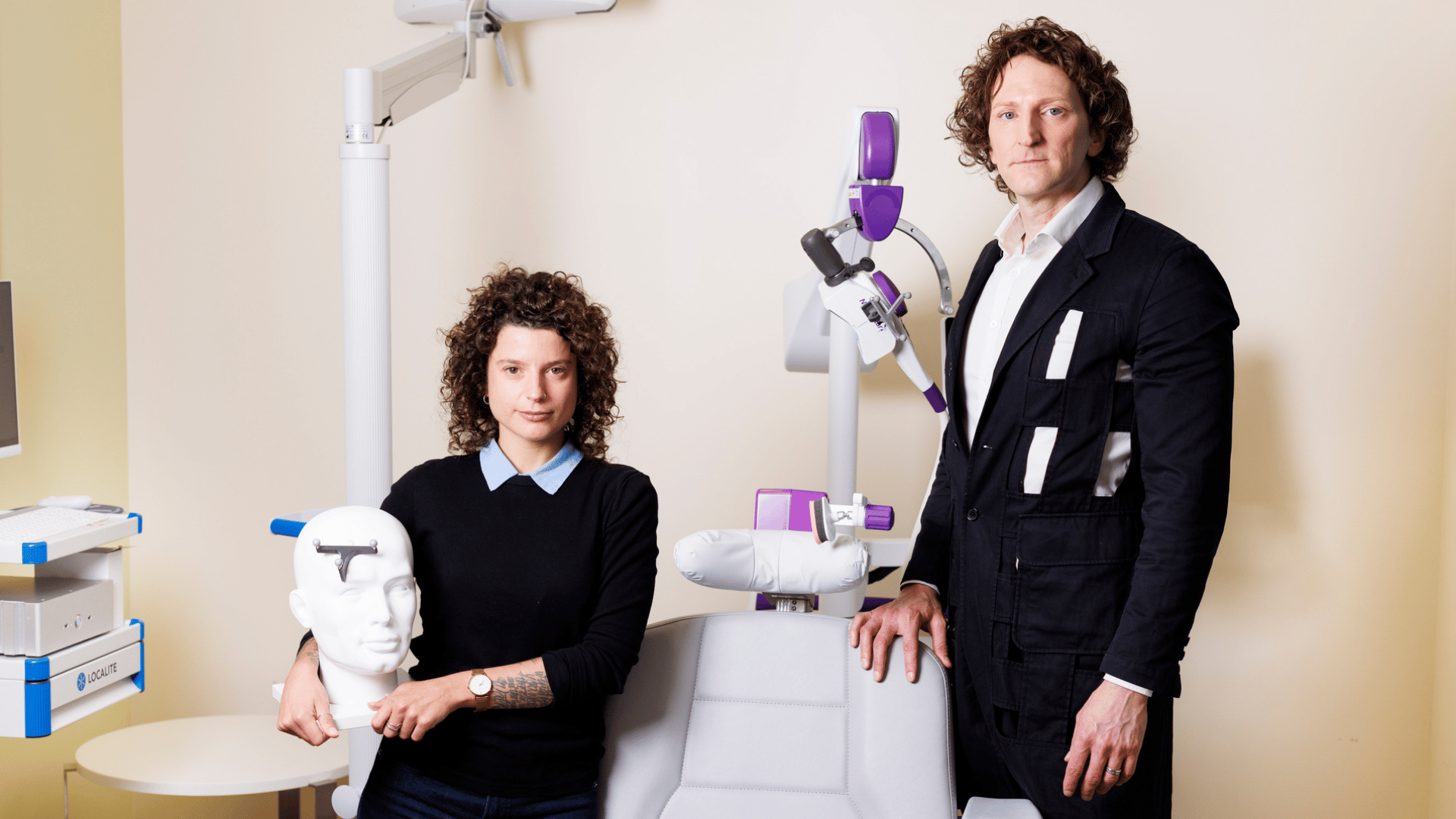
Samantha Baldi and Joseph Taylor.
Samantha Baldi and Joseph Taylor.Veasey Conway/Harvard Staff Photographer

Health

A promising first for researchers probing mental illness

Sy Boles

Harvard Staff Writer

June 10, 2026 4 min read

Anxiety finding a highlight as brain stimulation trial raises new hopes for precision care

Psychiatrists have long treated depression using transcranial magnetic stimulation — noninvasive magnetic pulses that stimulate neurons.

Now, new research is allowing them to fine-tune their approach, potentially targeting specific symptoms and opening new possibilities for precision care.

In a series of papers, including one in Nature Molecular Psychiatry, researchers stimulated two brain circuits — one widely targeted in TMS therapy, the other far more experimental — in people who had moderate to severe symptoms of both anxiety and depression. Both targets eased depression symptoms, but the novel target also led to significant improvements in symptoms of anxiety, suggesting that the new circuit may be a better treatment target for people with both conditions. It was the first time researchers selectively improved specific anxiety symptoms through targeted TMS. 

“This is important for the field because comorbidity is often the rule rather than the exception: Up to half of people who have one psychiatric illness also meet criteria for another,” said Joseph Taylor, lead author on the Molecular Psychiatry paper and a Harvard Medical School assistant professor of psychiatry at Brigham and Women’s Hospital. “That’s why we launched this trial: to take a little bit of a step toward precision medicine — to say, ‘OK, you have two different symptom clusters, we have two different circuits, let’s see if we can change selectively one symptom versus another.’”

TMS is a well-established treatment for major depressive disorder, especially when therapy and medication have failed. But delivery remains imprecise. Clinicians typically target brain regions by measuring the patient’s scalp, leading to incidental variation in where the brain is stimulated.

In previous research, BWH psychiatrists exploited that variation to link brain regions with symptom changes. They found that patients who received stimulation to the more traditional site — the dorsolateral prefrontal cortex — were more likely to see improvements in depressive symptoms: sadness, decreased interest in activities, and suicidality. But those stimulated at the dorsomedial prefrontal cortex, which is not a standard TMS target, were more likely to see improvements in a certain cluster of what they called “anxiosomatic” symptoms: irritability, sexual disinterest, insomnia. 

“These two circuits were derived in a data-driver manner, without going in with a predetermined idea of existing, recognized functional circuits in the brain,” explained Samantha Baldi, HMS postdoctoral fellow in psychiatry at Brigham and Women’s, who was not involved in the previous research but contributed to the latest findings. 

“Essentially, we found evidence that targeting different circuits may influence different symptoms, but we did not find evidence that larger changes in circuit connectivity led to larger symptom improvements.”Samantha Baldi

The new research shows that the two circuits can be targeted intentionally to drive symptom-specific results — though researchers noted that the findings should be taken cautiously, given the small sample size. 

Thirty-six patients who met FDA criteria for TMS treatment for depression and who also reported moderate to severe anxiety were randomized to receive targeting either at the standard stimulation site or the novel one. The patients received 30 daily treatments. As the researchers hypothesized, the relative change in depression versus anxiety was significantly different between the two groups. 

The findings are a promising sign that brain circuit imaging can eventually translate to clinical practice, ushering in a more personalized era of psychiatric treatment. But, the researchers said, major questions remain. Chief among them: Why does it work? 

“Clinical symptoms did change depending on which circuit was targeted, but those changes were not related to how much the brain circuits themselves changed with treatment,” Baldi said. “Essentially, we found evidence that targeting different circuits may influence different symptoms, but we did not find evidence that larger changes in circuit connectivity led to larger symptom improvements.”

In other words, the treatment worked, but there wasn’t a clear correlation between the symptom improvement and connectivity in the targeted brain circuit. 

In the field, Taylor said, that’s not surprising. “We have limited tools to understand how our treatments work, but we are starting to understand how to use our current tools, like functional magnetic resonance imaging, more effectively in terms of treatment planning.”

Still, he said, “Increasingly we’re recognizing brain stimulation as a new area of psychiatry, and the possibilities really are endless.”

Share this article

Posted in Uncategorized | Tagged , , , , | Leave a comment

Axios: China saved the oil market

China saved the oil market
 
Illustration of the flag of China as a chart with the stars creating a ripple effect
Illustration: Sarah Grillo/Axios
 
China apparently kept the oil market from imploding in the wake of the Iran war, Axios’ Emily Peck reports.

The world’s second-largest economy sharply cut the amount of oil it imports, taking the pressure off worldwide demand for the commodity and keeping a lid on prices.

💰 The big picture: Even as the conflict enters its fourth month, the price of a barrel of oil is still trading below $100 — defying predictions of $200 back in March when the war began.

The U.S. national average for a gallon of gas is $4.11 — down 10%+ from its late-May peak.

China reduced oil consumption using three key levers:

Ramped up usage of electric vehicles and electric-powered rails.

Used coal instead of oil to produce certain chemicals.
Stopped aggressively stockpiling oil — as it did in the year before the war.📈 

Reality check: Energy prices are still way up since February, and have driven up global inflation.Go deeper.
Share on Facebook Tweet this Story
Posted in Uncategorized | Leave a comment

Axios: What’s in the Iran Deal:

What’s in the Iran deal
 
Ships are anchored yesterday in the Strait of Hormuz, as seen from Musandam, Oman. Photo: ReutersAxios’ Barak Ravid unpacks the Iran deal President Trump says is so close that he’ll dispatch Vice President JD Vance to sign it in Europe as soon as this weekend:

The U.S.-Iran memorandum of understanding calls for the Strait of Hormuz to reopen immediately without tolls, and for Iran to receive sanctions relief based on compliance, according to a diplomat from one of the mediating countries and a U.S. official.

Why it matters: The MOU would extend the ceasefire for 60 days, including in Lebanon. Nuclear negotiations would be held during that time. The text includes a framework for addressing Iran’s enriched uranium stockpile, though any action on Iran’s nuclear program would depend on a second, more detailed accord.

State of play: The diplomat from one of the mediating countries, who walked Axios through the latest text, said the U.S. and Iran “have agreed on the text of a deal,” but acknowledged the deal still needed final sign-off.

As of last evening, the deal had been approved on the Iranian side at high levels but likely not by Supreme Leader Mojtaba Khamenei, two knowledgeable sources said.

Zoom in: The MOU calls for the strait to be reopened immediately without tolls, with a return to pre-war shipping volumes within 30 days. In return, the U.S. blockade would also be lifted.

🖊 The deal, mediated by Qatar and Pakistan, will be called the Islamabad Agreement — if both sides ultimately agree to sign. Read on.
Posted in Uncategorized | Leave a comment

Missing Woman from Germany Reappears in the Epstein Files. A young woman from Germany vanished without a trace 11 years ago. Now, her name makes several appearances in the Epstein files. Her family wants to finally learn what happened to her. DER SPIEGEL

DER SPIEGEL – The German View <derspiegel@substack.com> Unsubscribe10:44 AM (17 minutes ago)
to me
Forwarded this email? Subscribe here for moreA Missing Woman from Germany Reappears in the Epstein FilesA young woman from Germany vanished without a trace 11 years ago. Now, her name makes several appearances in the Epstein files. Her family wants to finally learn what happened to her.DER SPIEGELJun 12∙Preview READ IN APP Michele as a child in a family photo album. (Photo: Melina Mörsdorf / DER SPIEGEL)

By Nikolai Antoniadis, Sophia Baumann, Alexandra Berlin, Roman Höfner and Michael Suntinger

Jonas says he doesn’t remember exactly which day his sister disappeared. It was sometime in early September 2015, he says, when Michele grabbed her suitcase and left. She didn’t say where she was going or how long she’d be away, “but that was normal.” Michele, 22 at the time, was always on the move, and she rarely told her family where she was headed. “That’s why I didn’t think anything of it,” says Jonas, whose name has been changed for this story. Michele would turn up again – in a week, two at the most. That, he says, is always what happened when she left on a trip.

Not this time.DER SPIEGEL – The German View is a reader-supported publication. To receive new posts and support our work, consider becoming a free or paid subscriber…Upgrade to paid
Posted in Uncategorized | Leave a comment

Fortune: Well done to SpaceX employees who are set to become multimillionaires … Thanks to its IPO

Meet the SpaceX employees who are set to become multimillionaires thanks to its IPO: from execs to even welders

Preston Fore

By 

Preston Fore

Success Reporter

June 11, 2026, 10:24 AM ET

Add us on

SpaceX's IPO is expected to soar Elon Musk into trillionaire status—but blockbuster wealth increases could be in store for others, including welders who have built his rockets.

SpaceX’s IPO is expected to soar Elon Musk into trillionaire status—but blockbuster wealth increases could be in store for others, including welders who have built his rockets.Joe Raedle/Getty Images

As markets brace for what could become one of the most consequential public offerings in modern history, Elon Musk’s rocket giant SpaceX is preparing to generate staggering wealth—not only for its billionaire founder, but potentially for thousands of employees and investors.

Recommended Video


The biggest fortunes will flow to executives and early insiders. Chief Operating Officer Gwynne Shotwell and Chief Financial Officer Bret Johnsen each hold stakes that could reportedly be worth more than $1 billion, according to the Financial Times. Antonio Gracias, a SpaceX director and founder of Valor Equity Partners, owns shares that could ultimately be worth some $65 billion, while another director, Luke Nosek, has a stake estimated at roughly $5 billion.

But wealth creation won’t be confined to the C-suite. Some 400 current and former SpaceX employees could see their stake worth soar to more than $100 million, according to an analysis by Hill.com, a San Francisco-based investment platform, first reported by The New York Times. 

In total, more than 4,400 current and former SpaceX employees are expected to become millionaires in the IPO.

Unlike many recent IPOs—dominated by software startups and AI firms—SpaceX has constructed its empire in factories, launchpads, and manufacturing facilities as much as engineering labs. To become the world’s most dominant rocket company, Musk needed more than coders and executives. He needed welders, machinists, technicians, and manufacturing specialists by the thousands—many of whom were offered company stock as part of their compensation.

Juan Hernandez is one example. A former SpaceX welder who joined the company in 2015 earning $28 an hour, the Mexico-native is sitting on shares now worth roughly $880,000 at the anticipated IPO price of $135, according to The Wall Street Journal.

SpaceX’s IPO: a moment for the skilled trades, or a shift in financial risk?

SpaceX’s IPO comes at a pivot moment around the future of work.

As artificial intelligence reshapes white-collar jobs and raises fears of workplace disruption, skilled trade roles—from welding and industrial maintenance to electrical work—have increasingly been viewed as among the least vulnerable to automation. At the same time, shortages of skilled labor have left employers scrambling to fill manufacturing and infrastructure jobs critical to the U.S. economy.

For some, the wealth potentially unlocked for thousands of skilled workers through SpaceX’s IPO represents something larger: validation that hands-on careers deserve the same respect often reserved for white-collar work.

Ruchir Shah, CEO of Skillcat—an online skilled trades training start-up—said SpaceX is helping expose a broader truth about the future economy: some of the hardest jobs to automate—and hardest workers to hire—may increasingly sit in the physical world.

Paid Content

Why regenerative agriculture can help support global food supply

From General Mills

“If you think about it, these are some of the most critical people for SpaceX to grow,” Shah told Fortune. “It’s just as hard to find good welders and good machinists as it is a software developer—if not harder because if there’s a massive shortage—so it makes sense that they were given equity.”

Still, while equity in a company with ambitious growth plans might sound lucrative, Jason Schloetzer—an associate professor of accounting at Georgetown University’s McDonough School of Business—cautioned against viewing SpaceX as evidence of a broad-based wave of skilled tradespeople suddenly accessing Silicon Valley-style wealth.

“Nothing that I can see in the filing suggests a novel blue-collar equity model,” he told Fortune. “This is largely venture-backed compensation attached to a company that happens to build rockets.”

If anything, Schloetzer said, SpaceX illustrates how more financial risk is being shifted onto workers. Rather than receiving guaranteed compensation, many workers appear to participate through employee stock purchase plans—programs that allow employees to buy discounted shares using deductions from their own paychecks rather than stock simply handed to them.

“The traditional industrial model paid skilled labor through pensions, profit-sharing, and union-negotiated packages where employers carried much of the uncertainty,” Schloetzer said. “Equity changes that risk profile.”

And even for workers sitting on valuable equity, paper wealth does not always translate into immediate cash. Lockup periods can limit when employees are able to sell, stock prices can fluctuate sharply after an IPO, and taxes can eat into gains.

“Equity worth millions on paper is not millions in the bank,” Schloetzer said.

Elon Musk has the most to gain from SpaceX’s IPO—but trillionaire status is far from guaranteed

The biggest winner of the SpaceX IPO will be Musk. Already the world’s richest person with $700 billion to his name, Musk owns roughly 43% of SpaceX—which merged with xAi earlier this year—meaning a successful public debut could push his net worth beyond the $1 trillion mark.

For critics of rising inequality, that possibility represents something far larger than a blockbuster IPO. According to Nabil Ahmed, Oxfam America’s senior director of economic justice, any employee windfall would likely pale in comparison to the extraordinary gains expected to accrue to Musk, warning the offering could intensify already historic levels of wealth concentration.

“We’re running out of adjectives to describe the frightening scale of wealth concentration that we see in this moment,” Ahmed told Fortune, calling the potential accumulation of wealth “a shocking and frightening moment for our economy, for our society, for our democracy.”

The concern, Ahmed added, extends beyond Musk’s personal fortune to the increasingly intertwined role his companies play in American life. SpaceX has become a major contractor for both NASA and the U.S. Department of Defense, while xAI is positioning itself as a key player in the race to build advanced artificial intelligence infrastructure.

Still, the enormous wealth projects surrounding SpaceX are far from guaranteed. The IPO aims to raise $75 billion by selling 555.6 million shares at $135 per share, bringing the company’s total valuation to $1.75 trillion. And some financial analysts have argued the company’s anticipated valuation may already be priced in years of technological breakthroughs that have yet to materialize. Investment research firm Morningstar recently valued SpaceX at roughly $63 per share—more than 50% below its anticipated $135 IPO price.

“Even at $63 per share, we give SpaceX a lot of benefit of the doubt in two of the three scenarios, in which we assume the company can achieve a rapidly reusable Starship rocket enabling multiple launches per week and successfully commercialize data centers in space,” Mornstar equity analyst Nicolas Owens wrote. “Neither of these engineering problems has been solved, and we don’t expect them to be until at least 2028.”

Do you currently have a stake in SpaceX—or have plans to invest after its IPO? Fortune wants to hear from you. Email preston.fore@fortune.com.

The Fortune 500 Innovation Forum will convene Fortune 500 executives, U.S. policy officials, top founders, and thought leaders to help define what’s next for the American economy, Nov. 16-17 in Detroit. Apply here.

About the Author

Preston Fore

By Preston ForeSuccess Reporter

Preston Fore is a reporter on Fortune‘s Success team.

Posted in Uncategorized | Tagged , , , , | Leave a comment

The Donaldson Sex Abuse Trial: Episode 12. Jeffrey in the witness box

Posted in Uncategorized | Leave a comment

Neuroscience News: Social Anxiety Disorder – soaring numbers of people affected

This shows the outline of a young person.

Social Anxiety Disorder has surged by 71% since 2002, creating a profound generational mental health crisis that now impacts 24% of young Canadian adults. Credit: Neuroscience News

71% Explosion in Social Anxiety Disorder

Featured Neuroscience Psychology

·June 10, 2026

Summary: Researchers exposed a dramatic, generational surge in the prevalence of Social Anxiety Disorder (SAD) across Canada. The investigation revealed that social phobia now impacts nearly 1 in 7 Canadian adults, marking a staggering 71% increase in lifetime prevalence since 2002.

Analyzing extensive demographic and lifestyle data, investigators mapped a widening generational divide: while older populations remain relatively resilient, a profound crisis has emerged among young adults, with 24% of Canadians aged 20 to 24 meeting the lifetime diagnostic criteria for the condition.

Key Facts

  • The Generational Cliff: The study unmasked a massive, age-graded disparity in mental health vulnerability. Approximately 1 in 4 young adults (24%) between the ages of 20 and 24 have suffered from social anxiety, compared to a mere 6.2% of older Canadians aged 65 and above.
  • The Post-Pandemic Digital Hypothesis: While the data tracks the raw escalation from 8% of the population in 2002 up to nearly 14% today, researchers point to recent structural changes as primary drivers. The combination of intense social media curation pressures, increased political polarization, and profound isolation during formative developmental windows in the COVID-19 pandemic have rapidly accelerated youth vulnerability.
  • The Long Shadow of Childhood Adversity: Using a life-course epidemiological approach, the research team proved that early-life trauma heavily drives adult social phobia. Individuals with a history of witnessing domestic violence or surviving childhood sexual abuse exhibit significantly higher lifetime rates of SAD.
  • The Comorbidity Cluster: The study successfully linked social anxiety to broader, systemic physical and psychological strains. Individuals struggling with chronic pain, managing multiple concurrent physical health conditions, or battling substance use disorders showed an intense, statistically significant overlap with SAD.
  • The Insulation Power of Social and Spiritual Support: On the protective side, the data highlights that strong interpersonal assets drastically alter a person’s risk profile. Individuals lacking a reliable social support network are highly vulnerable, whereas those who report that spirituality plays an important, active role in their daily lives are significantly less likely to struggle with the disorder.
  • An Urgent Call for Evidence-Based Access: Given that a quarter of young adults are now impacted, Professor Esme Fuller-Thomson emphasizes that public health infrastructure must rapidly expand access to targeted Cognitive Behavioral Therapy (CBT), a highly effective, evidence-based psychological treatment that directly restructures the maladaptive fear and avoidance loops of social anxiety.

Source: University of Toronto

A new Canadian study has found that social anxiety disorder (SAD) now affects nearly 1 in 7 adults — a 71% increase since 2002 — making it one of the most common mental health challenges in the country.

Social anxiety disorder, sometimes referred to as social phobia, is a mental health condition characterized by an intense fear of being judged or embarrassed in social situations, often leading to significant distress, impaired relationships and work performance, reduced quality of life, and substantial economic costs to society. “Social anxiety is becoming more common in Canada, and understanding why this increase is happening is essential for improving mental health support,” said Tak-Lai Nellie Chau, recent MSW graduate of the Factor-Inwentash Faculty of Social Work (FIFSW), University of Toronto.

The research revealed that nearly 14% of Canadian adults have experienced social anxiety at some point in their lives, up from just over 8% in 2002.

While the study did not examine why social anxiety may have increased, the authors hypothesize that recent social changes, such as increased use of social media and the effects of the COVID-19 pandemic, may be contributing to this rise.

Young People Are Most at Risk

The research shows a strong pattern: younger Canadians are far more likely to experience social anxiety than older adults. About 1 in 4 or 24% of people aged 20 to 24 had a social anxiety disorder at some point in their life, compared to only 6.2% of those aged 65 and older.

Digital communication and reduced face-to-face interaction could be to blame.

“Young adulthood is a key life stage where social pressures are high, which may increase vulnerability to social anxiety,” said Stephen A. Oliver, recent MSW graduate of the FIFSW, University of Toronto. “Add to this the experience of increased isolation during the pandemic, growing pressures to achieve certain ideals on social media, and increased polarization and those pressures are bound to  intensify.”

Early Life Experiences and Childhood Trauma Play a Role

The study also found that early life experiences are strongly associated with social anxiety disorders.  Individuals who experienced childhood sexual abuse or witnessed domestic violence had significantly higher rates of social anxiety disorder.

The prevalence of lifetime social anxiety was also linked to chronic pain, multiple health conditions, and substance use disorders, showing that social anxiety often overlaps with other challenges.

“These findings highlight the importance of a life course approach to understanding mental health,” said Esme Fuller-Thomson, Director of the Institute for Life Course and Aging, and Professor at the FIFSW, University of Toronto. “Childhood experiences can cast a long shadow on adult mental health”.

Social Support Makes a Difference

The research showed that people with low social support — those who felt they didn’t have someone to rely on — were much more likely to have a social anxiety disorder.

At the same time, people who reported that spirituality was important in their lives were less likely to struggle with social anxiety.

“While our study did not test treatments directly, there is strong evidence from other research that cognitive behavioural therapy can be highly effective for social anxiety. Given that one in four young Canadians are affected, improving access to these evidence-based supports is essential,” said Fuller-Thomson.

Key Questions Answered:

Q: What is the difference between normal shyness and a clinical Social Anxiety Disorder?

A: The primary differences are the intensity of the fear and how severely it disrupts daily life. While many people experience occasional nervousness in public, Social Anxiety Disorder involves an intense, overwhelming fear of being judged, scrutinized, or humiliated by others. This chronic distress can lead to severe isolation, causing people to actively avoid job interviews, casual conversations, and relationships, which ultimately lowers their overall quality of life.

Q: Why are young adults suddenly experiencing such a massive surge in social anxiety compared to older generations?

A: Researchers point to a perfect storm of digital isolation and post-pandemic stress. Young adulthood is already a high-pressure phase for identity and career building. For today’s young adults, this stage was deeply disrupted by COVID-19 isolation, keeping them away from crucial face-to-face practice. Combined with the relentless pressure to maintain a perfect, hyper-curated image on social media, social interactions have become a major source of anxiety.

Q: Can people completely recover from severe social anxiety, and what is the best way to treat it?

A: Yes, social anxiety is highly treatable. The University of Toronto research team emphasizes that Cognitive Behavioral Therapy (CBT) is considered the gold standard treatment. CBT helps individuals recognize, challenge, and gradually change their negative thought patterns and avoidance behaviors. Given that 1 in 4 young Canadians are now struggling, expanding affordable access to these evidence-based therapies is a vital public health priority.

Editorial Notes:

  • This article was edited by a Neuroscience News editor.
  • Journal paper reviewed in full.
  • Additional context added by our staff.

About this social anxiety research news

Author: Dale Duncan
Source: University of Toronto
Contact: Dale Duncan – University of Toronto
Image: The image is credited to Neuroscience News

Original Research: Open access.
“Social Anxiety Disorder in Canada: Sociodemographic and Psychosocial Correlates” by Tak-Lai Nellie Chau, Stephen A. Oliver, and Esme Fuller-Thomson. Psychiatry Research
DOI:10.1016/j.psychres.2026.117252

Posted in Uncategorized | Tagged , , , , | Leave a comment

Chatham House: AI CAMS – A First World War lesson: innovate in aerial combat

Posted in Uncategorized | Leave a comment

Muslim Brotherhood “dispensaries” … Two forks in the road of our world Islam v Christianity Judaism … silently seeping into enemy cultures in the West to teach them what is in fact “The Right Way”. If you find this too long, explore with AI and get a synopsis. Knowledge is power

Posted in Uncategorized | Leave a comment

Heather Cox Richardson: Destroy the Rule of Law

Posted in Uncategorized | Leave a comment