Axios: Bulletin: At 3:54 a.m. ET, President Trump announced on Truth Social that he’s pausing the nomination of Jay Clayton to lead the intelligence community. Instead, he’ll keep Bill Pulte, a MAGA favorite, as acting head of the Office of the Director of National Intelligence (ODNI) until Congress confirms Clayton’s successor as top federal prosecutor in Manhattan. Also, MAGA hawk mutiny

Happy Wednesday! Smart Brevity™ count: 1,971 words … 7½ mins. Thanks to Noah Bressner for orchestrating. Edited by Bill Kole and Mickey Meece.

🏛️ Bulletin: At 3:54 a.m. ET, President Trump announced on Truth Social that he’s pausing the nomination of Jay Clayton to lead the intelligence community. Instead, he’ll keep Bill Pulte, a MAGA favorite, as acting head of the Office of the Director of National Intelligence (ODNI) until Congress confirms Clayton’s successor as top federal prosecutor in Manhattan.

Steve Bannon, top MAGA podcaster, immediately texted me: “President Trump just pulled the pin on a hand grenade named Bill Pulte and rolled it into the Tent called the Deep State.”
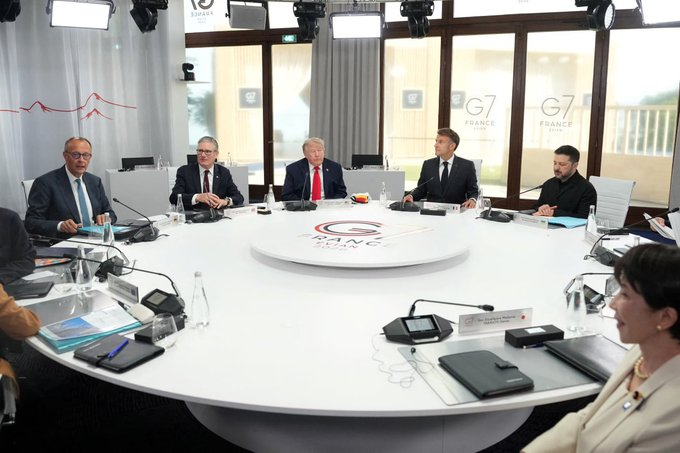
Clayton was to have his confirmation hearing today. But Trump — posting from France, where he’s attending the G7 Summit — said he’s “cancelling” that. The Senate had been expected to move fast to confirm Clayton as a way to shorten Pulte’s time as acting head
.

In what Trump called a “slight bit of intrigue,” he’s tying passage of his prized voter ID measure, the SAVE America Act, to this whole chain of events.

1 big thing: MAGA hawk mutiny

Photo illustration of Donald Trump, boxed in by two screens of red, white and green glitchy static on his left and right.
Photo illustration: Brendan Lynch/Axios. Photo: Saul Loeb/Getty Images

President Trump’s Iran deal has opened an explosive second front in MAGA’s civil war, waged by hawkish allies who view U.S. concessions as an existential betrayal of Israel, Axios’ Zachary Basu writes.

Why it matters: Across two terms and 11 years in the political spotlight, no issue has divided Trump’s base more than the Iran war.


When U.S. strikes began, leading isolationists — from Tucker Carlson to Marjorie Taylor Greene — were excommunicated for suggesting Trump had abandoned “America First” principles on behalf of Israel.

Three months later, with an interim deal in hand and peace potentially on the horizon, the Republican hawks who cheered Trump into battle are now leading their own furious rebellion.

🖼️ The big picture: Pro-Israel conservatives are demanding to see the text of Trump’s memorandum of understanding (MOU) with Iran, frustrated as much by the deal’s secrecy as by its reported substance.

The White House has given conflicting signals on timing: Senior officials said the text would be released yesterday or today. Trump said it may come Friday, after a formal signing ceremony in Geneva.
Republican leadership in Congress remains in the dark — and frustrated by the lack of detail.
So is Israel, which hasn’t seen the official MOU despite being a party to the ceasefire.
Trump inflamed the backlash yesterday by praising Iran’s negotiators in a bilateral meeting with Qatar’s emir, a key mediator distrusted by many pro-Israel Republicans.

“We’re dealing with people that I think are very rational people,” Trump said, adding that Iranian officials were “nice to deal with,” “not radicalized” and “looking to help their country.”
For hawks who view Iran’s government as a terrorist regime incapable of reform, the president’s language deepened their fear that the deal rewards Tehran for surviving the war.

President Trump meets with UAE President Sheikh Mohammed bin Zayed Al Nahyan yesterday at the G7 summit in Évian-les-Bains, France. Photo: Mandel Ngan/AFP via Getty Images

🔎 Zoom in: The objections from Trump’s pro-Israel allies fall largely into three buckets.

Money: The MOU would allow Iran to immediately begin selling oil while opening the door to sanctions relief, frozen funds and a $300 billion reconstruction fund during the next phase of nuclear talks. U.S. officials stress that financial relief would be tied to compliance, but hawks are apoplectic at the mere prospect of money flowing to Tehran.

Leverage: Months of overwhelming military force crippled Iran’s nuclear infrastructure and conventional military defenses. By entering a 60-day negotiation window and lifting the naval blockade now, hawks argue Trump is trading away unprecedented leverage. Some even claim the regime was on the brink of collapse, though there’s little evidence of that.

Trust: Critics reject the premise that Iran can be coaxed into moderation — a concern echoed inside Trump’s own government. Axios reported that CIA Director John Ratcliffe warned Trump that U.S. intelligence has serious doubts about Tehran’s willingness to make the nuclear concessions required for a final deal.

Between the lines: Vice President Vance may be more vulnerable to the deal’s political fallout than Trump, who can always pitch himself as the president who took on Iran when no one else dared.

Vance, the likely 2028 heir to the MAGA throne and a longtime skeptic of foreign entanglements, helped negotiate the MOU and is expected to sign it Friday in Geneva.

Defending the deal on Megyn Kelly’s show yesterday, Vance dismissed hawk critics as wanting “an endless conflict” that goes on “until every Iranian is dead” — then urged MAGA skeptics to stay inside the coalition.

Share this story.

Share on Facebook Tweet this Story Post to LinkedIn Email this Story Text this Story

Posted in Uncategorized | Tagged , , , , | Leave a comment

Futurism: Working From Home Has a Grim Effect on Your Brain, Surprise Research Finds. Comment: Not surprised, the workforce provides employment to all kinds of people but there are some who fall into the mental illness category, on prescribed medications that allow them to perform normally. I think these people need the support of the office environment.

Health & Medicine Brain Mental Health

Brain Drain

Working From Home Has a Grim Effect on Your Brain, Surprise Research Finds

Pros: no commute. Cons: mental anguish.

By Frank Landymore

Published Jun 13, 2026 12:00 PM EDT

Add Futurism(opens in a new tab)More information

A female employee sits at her home office in front of her laptop and rests her head on one hand looking forlorn.
Illustration by Tag Hartman-Simkins / Futurism. Source: Shutterstock

Sign up to see the future, today

Can’t-miss innovations from the bleeding edge of science and tech Email address Sign Up

Most people would kill for a work-from-home job, but it turns out it can have some grim effects on your mental health.

A new study published in the journal Science found that remote workers were more likely to report feeling anxious, depressed, and being socially isolated compared to people who worked in-office. No commute and having the comforts of home is undoubtedly an upside, but it seems there’s no substitute for genuine social connections.

https://06bfa8883a529b1079ab63f7b22996cb.safeframe.googlesyndication.com/safeframe/1-0-45/html/container.html

Nicholas Epley, a professor of behavioral science at the University of Chicago’s Booth School of Business who wasn’t involved in the study, told NPR that workers might be underestimating the value of being to “reach out to connect with other people,” and that “people might be choosing poorly” in terms of their well-being.

Until now, most studies have focused on remote work’s impact on productivity and job satisfaction, according to an editor’s summary, while there’s been little insight into its relationship to loneliness and mental health.

To fill that gap, lead author Natalia Emanuel, an economist at the Federal Reserve Bank of New York, and her colleagues conducted an analysis that drew on data from five national surveys on American workers, comparing “remotable jobs” that can be done remotely, like software engineering, and “non-remotable” jobs, like surgery.

It found that the hours that workers in remotable jobs spent working alone surged by 58 percent compared to workers in non-remotable jobs. That may not be surprising, since they’re staying at home, but the level of isolation could be extreme, as there was also a 72 percent rise in their chance of spending an entire day with no human contact whatsoever.

It was even worse for remote workers who lived alone, with an 83 percent chance of spending a whole day with no human contact. “Likewise, the increase in mental distress is almost twice as large for those living alone as for those living with their family,” Epley told NPR.

Given the connection between mental and physical wellbeing, this becomes a genuine health problem, as “being alone compromises your immune system functioning, your cardiovascular system functioning,” Epley said.

Of course, the findings “don’t suggest that every office should be forcing everybody to come in to work,” Epley told NPR — something that spiteful employers are trying to find any excuse to impose on their underlings. But it’s something else to consider for anyone looking to ditch the office, and a reminder that we may need to be a little bit more deliberate about our social lives if we’re not getting our daily dose of human interaction through work.

More on mental health: Psychiatrists Investigating People Who Get Trapped Inside Vivid Daydreams

Frank Landymore Avatar

Frank Landymore

Contributing Writer

I’m a tech and science correspondent for Futurism, where I’m particularly interested in astrophysics, the business and ethics of artificial intelligence and automation, and the environment.

Posted in Uncategorized | Tagged , , , , | Leave a comment

Mario Nawfal on X: The Rape Gang Inquiry

The Rape Gang Inquiry documents how police treated the victims. Fiona’s case is one of the worst. When Fiona’s mother reported her missing and named her abusers, the call handler told her: “You can’t describe them as Asian men because that’s racist. You should just be glad your child is being taught a different culture.” And it gets worse. The report says a police officer once returned Fiona to the house where the abuse was happening and told the men to “have fun with her.” On another occasion, it says police told the abusers that if they could get Fiona to sign herself out of care, they’d stop bothering them. The only formal action anyone took was a warning notice to the men. Nothing followed it. Source: http://bit.ly/4uE5odw / Writer: Julie

Posted in Uncategorized | Leave a comment

FT: Anthropic AI Mythos good guy … guardails

https://twitter.com/FT/status/2067166829911462247/video/1

Posted in Uncategorized | Leave a comment

Comments on MOU by Mike Pence. (Appeasement)

Mike Pence

@Mike_Pence

·

According to language that has been reported about MOU with Iran, there is:

NO mention of dismantling the nuclear program or the ballistic missile program.

NO commitment to ending support for Hamas, Hezbollah, or other terrorist organizations

But remarkably, the MOU with Iran reportedly includes:

Immediate sanctions relief from the moment the MOU is signed. This means $3 BILLION a month into the coffers of Iran.

A pledge of $100 billion in Iranian frozen assets being freed up based only on “progress” in negotiations

The U.S. & others to arrange for a $300 billion reconstruction fund for Iran.

The reported MOU with Iran smacks of the kind of appeasement that we saw during the Obama years, the kind of appeasement that Joe Biden tried to accomplish and was ignored by the Iranians, and the kind of appeasement we categorically rejected during the first Trump administration.

Posted in Uncategorized | Leave a comment

The Cradle: G7 backs Lebanon ceasefire, plans energy diversification amid US-Iran agreement —— Leaders of the G7 nations called for a ceasefire in Lebanon on Wednesday and announced plans to broaden energy supply routes to lessen reliance on the Strait of Hormuz.

The Cradle

@TheCradleMedia

·

G7 backs Lebanon ceasefire, plans energy diversification amid US-Iran agreement —— Leaders of the G7 nations called for a ceasefire in Lebanon on Wednesday and announced plans to broaden energy supply routes to lessen reliance on the Strait of Hormuz.

“We underline the need for the negotiation … to address the threats posed by Iran in the region and beyond and ensure that they never obtain a nuclear weapon,” the leaders said in a statement. The leaders also expressed their willingness to assist in carrying out the agreement, with a British- and French-led coalition expected to help safeguard maritime traffic once the Strait of Hormuz reopens, as anticipated on Friday.

Speaking at the summit, US President Trump expressed dissatisfaction with Israel’s conduct during the war, saying he was “not happy” with the way Israel had handled itself. “Without us, without the United States, there would be no Israel. Without me, there would be no ⁠Israel, because no other president was willing to do what I did,” Trump said. In their joint statement, G7 leaders urged an “immediate robust ceasefire” in Lebanon and called for Hezbollah to be disarmed

Posted in Uncategorized | Leave a comment

The Fourth Green Field … interesting video for nostalgia and a realisation of the sadness and futility of War. “The IRA Officer Who Took Down the Belfast Laundry – Brendan Hughes

May 20, 2026

On the morning of Monday, 2 October 1972, at a corner of Andersonstown in West Belfast, a man in a parka who had been the Officer Commanding of the Provisional IRA’s Belfast Brigade for fourteen months stood at the wall of a house with a radio that did not officially belong to him and waited. His name was Brendan Hughes. He was twenty-four years old. He was waiting for confirmation that three British Army intelligence operations had been simultaneously terminated within a six-mile radius of where he stood. Two miles to the west, a green van bearing the false signage of a civilian laundry was about to be ambushed on a housing-estate cul-de-sac. Four miles to the northeast, a Belfast brothel on the Antrim Road was about to be raided by a four-man IRA squad. One mile south of where Hughes stood, an MRF office on College Square East was about to be hit. All three had been compromised by the same counter-intelligence cell. All three were going down inside the same forty minutes. The man on the corner had given the order. That is one way to tell the story of the morning of 2 October 1972. It is the story Hughes himself told, on a series of tape reels recorded between 2001 and 2002, in a Belfast back room, to a former IRA prisoner named Anthony McIntyre, for an oral history project archived at Boston College and embargoed until the contributors were dead. Hughes died on 16 February 2008, in Belfast City Hospital, of a chest infection that progressed to coma. The embargo lifted. The tapes emerged. The journalist Ed Moloney published them, in 2010, in a book called Voices from the Grave. The Officer Commanding had finally given his version of the morning, and the morning had its inside narrator. This is that narrator’s morning. To understand the man on the corner, you have to start in the Lower Falls.

Posted in Uncategorized | Tagged , , , | Leave a comment

The Andrew Neil Report: ‘That’s not true’ Andrew Neil clashes with Trump ally over Iran

Jun 16, 2026 #andrewneil#andrewneilreport#podcast

On today’s clip from The Andrew Neil Report, the veteran broadcaster challenges Trump ally and chair of the Foreign Policy Initiative Carla Sands over the substance of any ‘deal’ with Tehran. Will it hold until Friday and beyond?

Posted in Uncategorized | Leave a comment

GZERO Ask Ian: What the rise of a trillionaire reveals about the American Dream?

Posted in Uncategorized | Leave a comment

Neuroscience News: Young People Turn to AI …

Young People Turn to AI for Mental Health Support

FeaturedNeurosciencePsychology

·June 15, 2026

Summary: New research revealed a critical safety and regulatory paradox within campus healthcare, proving that college students experiencing severe mental health crises are disproportionately turning to artificial intelligence for emotional support.

Analyzing data from the 2024–2025 Healthy Minds Study, the research team discovered that while 18% of the general college student population utilizes generative AI for mental health, students battling moderate-to-severe depression, intense anxiety, or active suicidality exhibit a two-fold higher likelihood of using these unregulated systems.

This creates an urgent clinical dilemma: the most vulnerable individuals are outsourcing critical emotional regulation and crisis management to automated, general-purpose algorithms that lack human oversight or institutional accountability.

Key Facts

  • The Vulnerability Inversion: Clinical data confirms that students facing the most acute mental health burdens are the ones most actively adopting conversational AI. Moderate depression, severe depression, severe anxiety, and active suicidality are each associated with an approximate two-fold increase in the likelihood of utilizing AI for psychological relief.
  • The Allure of the Mirror Relationship: Dr. Liu notes that generative AI presents a unique psychological risk precisely because of its constant availability. The algorithm acts as a dedicated relational partner that is accessible 24/7, never issues rejection, and offers unconditional validation, which may accidentally undermine a student’s capacity for real-world emotional regulation and perspective-taking.
  • A Substitute for Human Clinical Care: Investigators expressed severe concern that these completely unregulated digital tools are actively standing in for formal psychiatric counseling. This pattern is particularly pronounced among students with severe depression who face steep internal or structural barriers to traditional clinical access.
  • Cultural Nuance and Diagnostic Blinds: The trial unmasked a distinct demographic trend: Asian students displayed roughly twice the odds of using artificial intelligence for mental health compared to their peers. This highlights an immediate need to understand how cultural factors and systemic stigma drive specific minorities toward anonymous, digital alternatives.
  • A Call for Embedded Crisis Detection: The study authors issue a direct mandate to commercial AI developers. Because general-purpose AI platforms are operating as de facto therapy channels, they must embed mandatory, high-fidelity crisis detection protocols that automatically flag self-harm phrasing and trigger immediate human crisis interventions and referrals.
  • Robust Healthy Minds Analytics: The retrospective study analyzed a highly standardized, web-based dataset tracking a cohort of 675 students across two distinct academic institutions, creating a high-integrity profile of modern tech-driven coping mechanisms.
  • Reforming Campus Mental Health Policy: The research team emphasizes that universities cannot simply ignore or ban AI use. Instead, institutional health practices must proactively audit their student bodies to understand how these tools are being used alongside or in place of formal medical care, deploying targeted interventions where automated advice falls short.

Source: Brigham and Women’s Hospital

College students have rapidly adopted generative AI, but critical questions remain about its use for mental health support. In a study co-led by investigators at Mass General Brigham, 18% of surveyed college students reported using artificial intelligence (AI) for mental health. Students with more severe mental health symptoms were more likely to do so.

The findings are published in the Journal of Affective Disorders.

“College students who are most drawn to AI for mental health may also be the most vulnerable to its risks,” said lead author Cindy H. Liu, PhD, director of the Developmental Risk and Cultural Resilience Laboratory in the Mass General Brigham Departments of Pediatrics and Psychiatry. “College students who are struggling may seek out AI, and we worry that these unregulated tools could stand in for human support. At the same time, many students clearly find these tools useful, which is a reason to understand where they help and where they fall short.”

Liu and her colleagues analyzed data from the 2024–2025 Healthy Minds Study, an annual web-based survey on mental health and related experiences among U.S. college students. Among 675 students from two institutions, those with severe mental health symptoms reported AI use for mental health at rates higher than the 18% observed overall.

Moderate depression, severe depression, severe anxiety, and suicidality were each associated with an approximately two-fold higher likelihood of AI use for mental health. Asian students also had about twice the odds of using AI for mental health.

“Conversations with AI for mental health may pose a risk because of how appealing they are: AI can act as a relational partner that is always available, never rejects, and offers unconditional validation,” said Liu. “We don’t yet know whether using general-purpose AI for mental health is beneficial or whether it undermines critical capacities such as emotional regulation or perspective-taking.”

The investigators provide actionable guidance. They note that AI platforms should embed crisis detection and referral mechanisms, institutions should consider how to support students who may turn to AI when formal care may feel inaccessible—a pattern seen among students with severe depression and Asian students—and mental health practices should seek to understand how patients are using these tools alongside or in place of formal care.

Authorship: In addition to Liu, Mass General Brigham authors include Wenbo Zhang, Felix Lou, and Chang Zhao. Additional authors include Angela Chow and Tiffany Yip.

Disclosures: Liu serves as an advisor for youth mental health for Surgo Health, The Asian American Foundation, and a youth-oriented project funded by The Manton Foundation. All other authors declare that they have no known competing financial interests or personal relationships that could have appeared to influence the work reported in this paper.

Funding: None.

Key Questions Answered:

Q: Why are college students dealing with severe depression and anxiety turning to AI chatbots instead of seeing a real campus counselor?

A: Because generative AI removes all the immediate friction, scheduling delays, and social stigma associated with traditional mental health care. For a student suffering from severe depression or intense anxiety, making an appointment, walking into a clinic, and opening up to a stranger can feel completely insurmountable. An AI chatbot is instantly available on their phone at 2:00 AM, never judges them, never rejects them, and provides immediate, unconditional validation without requiring them to navigate a complicated university healthcare system.

Q: What are the primary psychological risks of using a general-purpose AI as a substitute for a human therapist?

A: The danger is that an AI is a mirror, not a real relationship partner. Human therapy works because it forces a patient to practice emotional regulation, process constructive criticism, and engage in perspective-taking with another human being. Because an AI chatbot is programmed to be endlessly agreeable and perfectly validating, it can create a false, hyper-isolated comfort zone. This can prevent vulnerable students from developing the vital real-world coping mechanisms needed to navigate complex human relationships and real-world stress.

Q: How should universities and AI developers respond to this sudden rise in digital therapy seeking?

A: They must cooperate to embed ironclad safety guardrails and crisis detection tools directly into these platforms. AI companies can no longer pretend their models are just text generators; they must install smart algorithms that recognize suicidal ideation or severe panic and instantly drop in human crisis hotline referrals. Concurrently, universities must realize that students, particularly Asian students and those with severe depression, are using AI to fill a gap in accessible care, meaning campus clinics must actively ask patients about their AI use and build low-barrier human alternatives.

Editorial Notes:

  • This article was edited by a Neuroscience News editor.
  • Journal paper reviewed in full.
  • Additional context added by our staff.

About this AI and mental health research news

Author: Cassandra Falone
Source: Mass General Brigham
Contact: Siyun Qin – Mass General Brigham
Image: The image is credited to Neuroscience News

Original Research: Open access.
“Clinical and sociodemographic predictors of AI use for mental health among college students” by Dongmei Deng, Chong Li, Ling Zhu, Yin Tian, Jie Wang, Chenshi Li, Mo Chen, Guoning Huang, Shaorong Gao, Shimeng Guo, and Jingyu Li. Journal of Affective Disorders
DOI:10.1016/j.jad.2026.122058

Posted in Uncategorized | Tagged , , , , | Leave a comment