
The U.S. stock market is becoming ‘too big to fail’

Research shows one in five CEOs exhibits clinically significant psychopathic traits.
It’s a rate nearly identical to that found in prison populations.
Recent findings presented at the Australian Psychological Society’s annual congress indicate a startling trend in the corporate world: approximately 21% of senior professionals possess clinically significant psychopathic traits. This figure mirrors the prevalence of psychopathy within prison populations and stands in stark contrast to the estimated 1% to 4% found in the general public. These individuals, often dubbed “successful psychopaths,” navigate their way into high-ranking positions by leveraging superficial charm and flamboyant personalities. However, these same traits—including a profound lack of empathy and a penchant for insincerity—can predispose leaders to unethical behaviors and long-term organizational failure.
Forensic psychologist Nathan Brooks, who led the study alongside researchers from Bond University and the University of San Diego, suggests that current recruitment strategies are partially to blame. Many firms focus exclusively on technical skills and professional history, inadvertently ignoring toxic personality features that can damage corporate culture. To combat the rise of psychopathy in the C-suite, the study advocates for more rigorous personality screening during the hiring process. By shifting the focus from mere competence to character, businesses can better protect themselves from the “short-term success” that psychopathic leaders often buy at the cost of the company’s future integrity.
source: Brooks, N., Fritzon, K., & Croom, S. Corporate Psychopathy: Highlighting the Importance of Personality Screening in the Recruitment Process. Australian Psychological Society Annual Congress.
Jul 11, 2026
Every month 14 ships leave a quiet port on the west coast of Ireland, carrying alumina towards St Petersburg. Alumina is a fine white powder. Once smelted, it becomes aluminium, a metal essential to modern industry and also to military production, including aircraft, armoured vehicles, missiles and other weapons systems.
I began investigating this supply chain after reading a report in The Irish Times earlier this year. I contacted the refinery with questions, but my calls and emails went unanswered. So I booked a flight home to Ireland and decided to investigate it myself. What I expected to be a short report about a single supply route became one of the largest and most difficult investigations I have ever undertaken.
It led me through the ownership of the refinery, its connections to Russia, the environmental damage experienced by people living nearby, the silence surrounding the operation and the political system that allowed it to continue largely unchallenged. I met local people who had been asking questions for years. Farmers who said their lives had been devastated. Workers who were frightened to speak publicly. Independent reporters who had tried to raise the alarm long before the rest of the country began paying attention.
As I started publishing reports from the ground, the story spread further than I could ever have expected. The videos received more than 11 million views across my platforms. Within days, the investigation moved from social media into local, national and international coverage. Ministers were questioned. European officials became involved. A refinery that very few people had heard of suddenly became the centre of a major argument about Ireland, Russia, sanctions and the war in Ukraine.
After weeks of filming, research and painstaking editing, this is the full story. It includes the investigation itself, the people we met, the political confrontations, the moments that happened behind the scenes and the extraordinary chain of events that followed once the public began paying attention.
This film was made entirely independently. Many major Irish media organisations receive substantial public funding. I have chosen to keep this channel independent of governments, corporations, sponsors, billionaires and private interests. There are no sponsorship deals behind this film and no wealthy backers deciding what I can or cannot investigate. The work is funded almost entirely by the people who watch it. Those who become members through Patreon are not simply supporting a channel. They are helping produce all my independent journalism and making investigations like this possible. You can join and support my work through the Patreon link below. https://linktr.ee/CaolanRobertson You can also contribute directly towards the cost of this investigation through PayPal. Producing the film required extensive travel, cameras, accommodation, research and weeks of editing. Every contribution helps me continue working independently. https://www.paypal.me/CaolanRobertson I am incredibly proud of this report, but I am also deeply grateful to everyone who trusted me with their story, shared the investigation and helped force these questions into the open. Please share the film with someone who needs to see it, and leave a comment telling me what stayed with you. I am now heading back to eastern Ukraine to begin work on the next frontline report. Thank you for watching, and thank you for making this work possible.
Transcript
Jul 9, 2026
Is the ceasefire between the U.S. and Iran over? Is the memorandum of understanding dead? On Wednesday, those questions were put to President Donald Trump at the NATO Summit in Ankara, Turkey, a gathering that came on the heels of renewed strikes between the U.S. and Iran over the Strait of Hormuz. Here, to make sense of the fragile state of the strait, the stalled negotiations in Iran, and the big ticket questions about the European alliance, Turkey, and China, is Free Press columnist Niall Ferguson. He breaks down how the ceasefire fell apart, why the pathway to managing the Strait of Hormuz is contingent on cooperation from the Gulf States, and what the new status quo looks like—plus: Will the U.S. let Turkey buy F-35 fighter jets, after it was previously barred from doing so? How have hostilities between Russia and Ukraine escalated? And what is China learning from the sidelines?
https://www.gzeromedia.com/video/gzero-world-clips/how-do-iranians-feel-about-their-future
July 08, 2026
The war may have shifted the geopolitical balance in Iran’s favor, but for many Iranians, it has brought little relief. In this clip from GZERO World with Ian Bremmer, New York Times Iran correspondent Yeganeh Torbati describes a country still living with the aftermath of mass protests, a brutal government crackdown, and an economy that continues to deteriorate.
Keep reading…
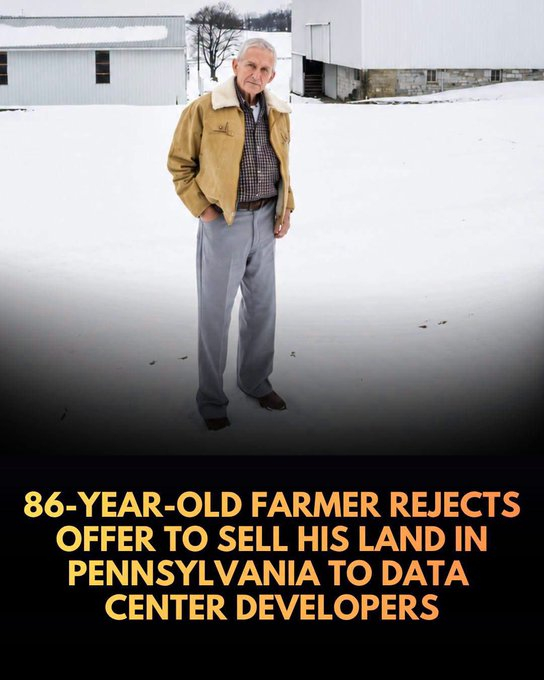
An 86-year-old Pennsylvania farmer chose preserving his land over a massive $15 million payday, turning down AI data center developers to protect his 261-acre family farm.
For over 60 years, Mervin Raudabaugh has farmed his 261-acre property in Cumberland County, Pennsylvania—the very land where he raised his family and nurtured a thriving wildlife habitat.
When AI developers targeted his rural area for a massive data center expansion, they offered him over $60,000 per acre, totaling more than $15 million. Rather than sell to developers, the 86-year-old farmer resolutely declined. “I was not interested in destroying my farms,” Raudabaugh explained, choosing instead to sell his development rights to a land preservation program for just under $1.9 million.
This selfless decision ensures the productive farmland, woodlands, and wetlands will never be built upon or dug up, protecting it in perpetuity. Raudabaugh’s stand highlights a growing national tension as tech companies rapidly expand energy-hungry, resource-intensive AI data centers across the rural United States.
These massive infrastructure developments require immense acreage and electricity, often sparking local opposition over lost agricultural land, water depletion, and environmental disruption. While the financial temptation for struggling farming families is immense, Raudabaugh hopes his conservation efforts inspire others to protect America’s agricultural heritage.
For him, safeguarding his lifelong home so that future generations could live there and experience its natural beauty was worth infinitely more than any tech-fueled windfall. source: Thompson, C. (2026). Why this Pennsylvania farmer said no to $15 million from A.I. data center developers. PennLive.
| Market mindset unravels |
 |
| Illustration: Sarah Grillo/Axios. Stock: Getty Images |
| American political leaders on the left and right are rebelling against the market-first consensus that dominated Washington for four decades. Why it matters: The result is one of the biggest shifts in U.S. economic policy since the Reagan revolution, overturning decades of orthodoxy on trade, manufacturing, housing, health care and corporate power, Axios’ Courtenay Brown and Neil Irwin write. Between the lines: The shared skepticism of the old economic consensus masks vastly different visions for what comes next.  On the right: “American economic policy on the right is now much more Alexander Hamilton than it is Milton Friedman,” Vice President Vance told right-wing political commentator Michael Knowles last month. On the right: “American economic policy on the right is now much more Alexander Hamilton than it is Milton Friedman,” Vice President Vance told right-wing political commentator Michael Knowles last month.Translation: Vance believes the GOP’s intellectual center of gravity is shifting away from free markets to a more interventionist government that promotes domestic industry. He joked that President Trump threatened to seize an AI company’s equity and “no one protested.” In practice, the pivot means that Trump has embraced tariffs and taken stakes in individual companies, among other policies. This week,the president celebrated Walmart’s decision to lower prices and urged other retailers to follow suit.  On the left: Democratic socialists, including New York Mayor Zohran Mamdani, argue that government, not markets, should guarantee affordable housing, health care and other basic necessities. On the left: Democratic socialists, including New York Mayor Zohran Mamdani, argue that government, not markets, should guarantee affordable housing, health care and other basic necessities.The movement is showing fresh political muscle following Mamdani’s rise in New York, and a wave of DSA-backed victories in New York and Colorado that have establishment Democrats increasingly on edge. The new socialist candidates oppose the idea that markets should decide who gets health care, housing, child care or power at work — a close left-wing mirror image of Vance’s belief that markets should serve broader social goals, not dictate them. The big picture: No single economic event explains the unraveling of the market-first consensus. Consider how slow-moving economic forces have built on each other: The China shock, the 2008 financial crisis, decades of soaring housing and health care costs, the pandemic and the inflation surge — all eroded confidence in the economic status quo. Social media amplified those shocks, giving Americans a window into how other people live, making wealth disparities, housing inequities and economic frustration feel more immediate and personal.  Reality check: The shift is far from universal. Trump paired tariffs and industrial policy with traditional Republican priorities — including corporate tax cuts, deregulation and a generally business-friendly agenda. Reality check: The shift is far from universal. Trump paired tariffs and industrial policy with traditional Republican priorities — including corporate tax cuts, deregulation and a generally business-friendly agenda.Even some democratic socialists have embraced supply-side ideas in housing, arguing that government should both build more homes and lower barriers to construction.Share this story. |

