1996/1997 Trinity Horizon project. Dr Peggy Fine-Davis Centre for Women Studies, Trinity College, Dublin and Professor McKeon from St Patrick’s hospital. 15 women were selected and over a four day week they had classes in computers, sport, writing, group therapy, women’s health, personal counselling. This was the first of its kind in Ireland and was based on re-integration of women with depression back into the work or study. It was the pilot project and is worth research to see how it contributed going forward? In the context of President Trump, this would be classified under DEI … and yes it was about helping people with depression. Have you any source of getting details
Yes, we can confirm the exact official record of this pioneering study! The source document you are looking for is titled “Trinity Horizon Project: Final Research and Evaluation Report to the Department of Enterprise and Employment,” published in July 1998. Trinity College Dublin
The project was led by the late Dr. Margret (Peggy) Fine-Davis (a pioneering social psychologist and co-founder of the Centre for Gender and Women’s Studies at Trinity College Dublin) alongside research partner A. Langheld. It was conducted in collaboration with Professor Patrick McKeon, a renowned consultant psychiatrist at St. Patrick’s Mental Health Services and founder of the depression support charity Aware. Trinity College Dublin +2
Document Details for Archival Retrieval
Because this was a non-peer-reviewed government policy report from 1998, the full text is not completely digitized as an open-access web article, but it is indexed in academic and national repositories: Trinity College Dublin
Authors: Fine-Davis, M. and Langheld, A.
Title:Trinity Horizon Project: Final Research and Evaluation Report to the Department of Enterprise and Employment
Date: July 1998
Sponsoring Bodies: Funded via the European Social Fund’s “HORIZON” initiative (a 1990s EU program dedicated to the labor market integration of marginalized groups and people with disabilities) and administered by the Irish Department of Enterprise, Trade and Employment. Trinity College Dublin +1
Where to Find the Physical or Digital Records
The Trinity College Dublin Library: You can request a search of Dr. Fine-Davis’s research archives or the Centre for Gender and Women’s Studies historical papers through the Trinity College Library Catalogue.
Lenus (The Irish Health Repository): Many historical papers involving St. Patrick’s Hospital and Irish mental health initiatives are digitized on Lenus.ie.
TARA (Trinity’s Access to Research Archive): Some of Dr. Fine-Davis’s subsequent work building on this pilot (such as the National Flexi-Work Partnership which also partnered with Aware) can be downloaded via the TARA Repository.
Historical and Modern Policy Context
The First of Its Kind: You are entirely accurate that this was a revolutionary pilot program for 1990s Ireland. At the time, clinical treatment for depression was highly medicalized and siloed. This program was unique because it treated recovery through a holistic, social-inclusion lens—combining cognitive/group therapy with practical tech skills, physical sport, creative writing, and occupational rehabilitation. Lenus.ie
The Evolution into “DEI” and Workplace Wellness: While modern political discourse (such as corporate diversity mandates or US political rhetoric) groups these initiatives under DEI (Diversity, Equity, and Inclusion), in 1990s Ireland and Europe, this framework was known as Social Inclusion and Employment Equity. This pilot project directly contributed to a shifting paradigm: proving that mental health support is an essential branch of workplace equality and labor retention. Trinity College Dublin +3
Dr. Margret Fine-Davis – TCD – People FinderMargret Fine-Davis was a member of the Department of Psychology from 1980-89. She was a co-founder of the Centre for Gender and Wo…Trinity College Dublin
Publications – Trinity Research in Childhood Centre (TRiCC)… Equality Bill 1998, Conference on Managing Diversity in the Workplace , Irish Management Institute, Dublin , 15 May , 1998. Co…Trinity College Dublin
The Effects of Flexible Working on Work-Life Balance … – TARA1.1 Background The National Flexi-Work Partnership, a collaborative venture between the Centre for Gender and Women’s Studies, Tri…Trinity College Dublin
Mental health and social inclusion – Lenus.ie Executive Summary. xi. The relationship between mental health and social inclusion is examined in the. report in terms of: strengt…Lenus.ie
Clinical Psychology Today21 Jun 2026 — Articles from past editions of Clinical Psychology Today are available through the links below and on the Irish
*Michael Barker-Caven is an award-winning theatre and opera director who has had a significant association with Trinity College Dublin and its resident performance spaces. He has taught classes, notably on the Principles of Directing, and has directed numerous productions at Trinity’s Samuel Beckett Theatre, including the acclaimed adaptation of Tales from Ovid. [1, 2, 3, 4, 5]
Throughout his extensive career in Irish theatre, Michael Barker-Caven has directed for major companies including The Abbey Theatre, The Gate Theatre, and Landmark Productions. He is also highly recognized in the local community for his previous tenure as the Artistic Director/CEO of The Civic in Tallaght. [1, 2, 3, 4]
Would you like to know more about his specific past productions at Trinity College, his work at The Civic, or details about his theatre directing career?
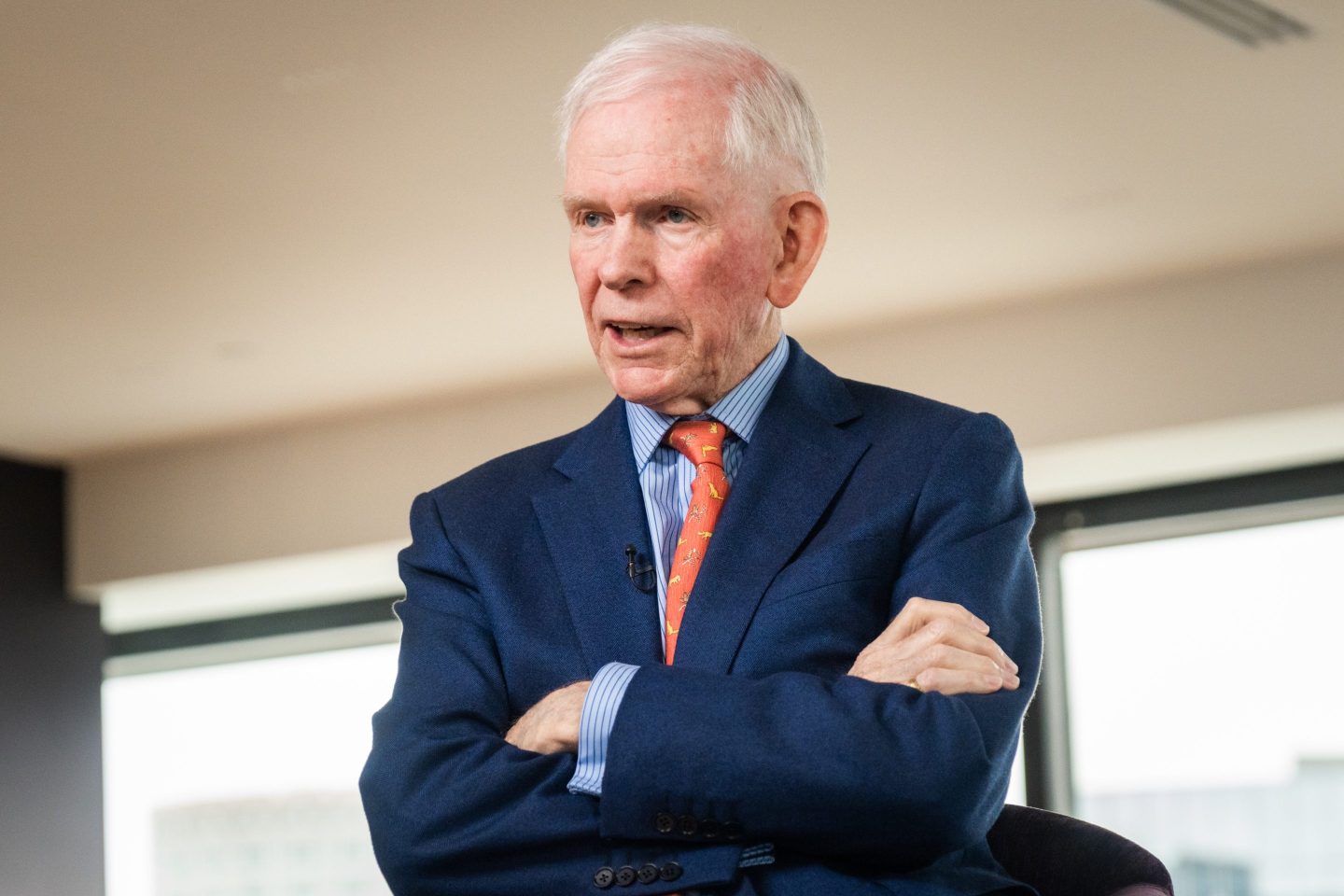
Jeremy Grantham, co-founder and chief investment strategist of GMO LLC, during an interview on an episode of Bloomberg Wealth with David Rubenstein in Boston, Massachusetts, US, on Thursday, Aug. 17, 2023.Vanessa Leroy/Bloomberg – Getty Images
With Elon Musk’s SpaceX now embedded in the Nasdaq 100, the prospects of the rocket company have–directly or indirectly–now slipped into the stock portfolios of millions of people around the globe.
But joining the Nasdaq index has done little to convince critics, who are dubious about the lofty aims of the company. In the prospectus ahead of its offering, SpaceX said its goal is “to build the systems and technologies necessary to make life multiplanetary, to understand the true nature of the universe, and to extend the light of consciousness to the stars.”
Such statements will be laughable to investors of the future, says Jeremy Grantham, co-founder of investment giant GMO. Admittedly, the billionaire British investor is known for his skepticism: He’s a self-professed “permabear” and has warned AI’s impact will result in “blood in the streets.”
Recommended Video
It is perhaps no surprise, then, that he is unimpressed by the (literally) out-of-this-world intentions of SpaceX. “Everyone’s lining up to tell you to buy the craziest IPO in the history of man,” Grantham told Morningstar’s The Long View podcast in an episode released this morning, “In 50 years, they’ll be telling and writing stories about SpaceX, and they’ll be quoting you paragraphs from the prospectus, and you will be laughing at it.”
Even the most bullish of investors might be feeling a reality check since SpaceX launched. At the time of writing, SpaceX is down 7% over the past month, hovering at around $150 a share—only slightly ahead of the $135 it targeted at launch.
Wall Street is split on how high SpaceX can fly, though they generally agree it will soar: Morgan Stanley, for example, has reportedly set the price target at $300, while Goldman Sachs’s Eric Sheridan and team wrote in a note seen by Fortune that they see it closer to $205.
Sentiments among analysts are, generally, positive. J.P. Morgan wrote that its target is $225 , adding it believes Elon Musk’s goal of reaching $1 trillion of revenue by 2031 is possible “but requires strong execution across an ambitious timeline.”
The note authored by Doug Anmuth, Seth Seifman, Sebastiano Petti, and Richard Choe highlighted some concerns, one of them being the fact that there’s “only one Elon.” They wrote that Musk’s “outsized influence and control (82% voting power) is central to SpaceX’s culture, vision, and operational strategy, and we believe his leadership has been a defining driver of the company’s success. At the same time, that concentration of control raises governance considerations and exposes the company to leadership-transition risk.”
Grantham said he was baffled by Wall Street banks’ recommendations to buy SpaceX for their clients. He added: “In the end, the reality will come out, and this will turn out to be, of course, one of the landmark historical events that I so value in history looking back. It will be amazing, by the way, if it doesn’t collapse, because it will need such massive developments on AI that our entire lives are totally different.”
Even if the justification for a higher price becomes a reality, the world will be a “strange one” and “we’ll be lucky not to be bossed around by our automaton friends.”
This “rather horrific” outlook is less likely than a crash, Grantham adds, “though both ways it will be historically notable.”
Fortune has contacted SpaceX for comment.
“There’ll be a lot of people who have to buy it for any index that is Nasdaq-y”
Last month, Nasdaq announced it was launching new fast-track rules for older companies to reflect the changing IPO market. “When large companies stay private for a decade or more before going public, indexes that wait months to add them have less than a full picture of the market they track,” the index said.
Fast-tracking large IPOs helps “indexes better represent all the public companies that matter to the economy and the stock market,” it said.
This has had a direct impact on SpaceX’s performance, insists Grantham: “What that means is there’ll be a lot of people who have to buy it for any index that is Nasdaq-y. So there’ll be much more demand than there are sellers.
“So supply and demand being what it is, it’s hard to imagine the price won’t go up, and perhaps it will go up a lot.”
The Fortune 500 Innovation Forum will convene Fortune 500 executives, U.S. policy officials, top founders, and thought leaders to help define what’s next for the American economy, Nov. 16-17 in Detroit. Apply here.
Eleanor Pringle is an award-winning senior reporter at Fortune covering news, the economy, and personal finance. Eleanor previously worked as a business correspondent and news editor in regional news in the U.K. She completed her journalism training with the Pre
Since millions of NSDAP membership cards have been made available online, many Germans have been surprised to discover that their ancestors weren’t always as innocent as family stories had led them to believe.
Many Germans repressed the fact that they had once cheered for HitlerImage: akg-images/picture-alliance
“I always thought of my grandfather as a left-wing unionist, and now he’s turned up in the NSDAP database,” Hanno Dannenfeldt told DW. It was always said in the family that his paternal grandfather had clean hands.
Now that the National Archives of the United States has published its collection of National Socialist German Workers’ Party (NSDAP) membership cards, Dannenfeldt is one of countless Germans eager to find out whether their relatives were members of the party that ruled Germany during the Nazi era from 1933 to 1945.
This has not been an easy task: The site is often inaccessible because of heavy traffic, and the user interface is difficult to navigate.
A German tool simplifies the search
The German weekly newspaper Die Zeit has developed a tool that simplifies the search.Users simply enter the name and perhaps the year and place of birth of a person — and the results appear immediately. These records are sure to be of interest to people in South America, as well: Many Nazis went into hiding there after World War II. However, a subscription is required to use the service.
What users find there can be painful. Often, it means suddenly looking at their families in a very different light. Memories of a loving grandfather who was always full of fun and energy can contrast sharply with evidence now presented in black and white that the very same grandfather was a member of the National Socialist Party.
After the war, few families spoke about the crimes of the Nazi era, let alone their own role in them. According to a study, more than two-thirds of Germans believe that their ancestors were not Nazis. Nearly 36% believe that their relatives were among the victims, and over 30% believe that their ancestors helped victims of the Nazis — for example, by hiding Jews.
Daily life in Nazi Germany: There was hardly any resistanceImage: teutopress/picture alliance
But this can’t possibly be true. Only about 1% of Germans actively resisted. In 1945, one in five adult Germans was a member of the Nazi Party — which had a total of 8.5 million members — thereby lending their support, at least on paper, to that unjust system.
‘These are good, honorable people’
After the war, Germans preferred to push this out of their minds. Germany lay in ruins, occupied by the Americans, British, French and Russians. Adolf Hitler had killed himself, thereby evading justice. The other major war criminals were indicted and convicted in the Nuremberg Trials. “There’s always been this notion: ‘Okay, they’re the ones responsible.’ But that leaves the rest of society off the hook,” cultural studies scholar Aleida Assmann told DW.
Aleida Assmann has engaged extensively with German memory cultureImage: Arnulf Hettrich/IMAGO
That changed when doctors, industrialists and civil servants also appeared in court and had to answer for their roles under the Nazis. “Then people said: ‘But now practically everyone is on trial. That can’t be right. These are good, honorable people,'” said Christian Staas, head of the history department at Die Zeit. “And the Germans began to push back against such trials. Most saw themselves as victims of National Socialism and not as the ones who were guilty.”
They also claimed to have known nothing about the mass murders of the Jews. As part of “re-education” efforts, the Allies pressured all Germans to watch documentary films in movie theaters about the liberated concentration camps; the aim was to combat the collective denial of an entire people.
Practically everyone got a ‘Persil certificate’
At the same time, the process of so-called denazification began. Every German had to fill out pages of questionnaires providing personal information, details about their career, and information regarding NSDAP membership.
Reichsmarschall Göring, Hitler’s closest confidant, on trial in 1945Image: imago images/ITAR-TASS
Naturally, everyone tried to present themselves as favorably as possible. Even a member of the Schutzstaffel (SS), the Nazi paramilitary organization, could have his party affiliation expunged if he could credibly demonstrate that he did not support the ideology.One common excuse was to claim that joining the party was necessary to continue one’s studies, and that people were otherwise opposed to the Nazis.
People mockingly referred to the denazification certificates as “Persil certificates” — named after the laundry detergent that “gets clothes extra white.”
“White is the color of purity and flawlessness and, of course, innocence,” Assmann said. People washed away their guilt with the “idea of Persil.”
Assmann said it was important to the Western Allies — above all the United States — to restore Germany to a functioning state. “Making a clean break and creating a fresh start was their goal,” Assmann said. “National Socialist society had to be transformed into a democratic society, but with the same people: How could this be achieved? By forgetting. People simply stopped talking about it.”
Germans filled out questionnaires on their roles during the Nazi eraImage: Arne Dedert/dpa/picture alliance
Konrad Adenauer, the first chancellor of the Federal Republic, took a pragmatic view of the matter. “You don’t pour out dirty water if you don’t have any clean water,” he said, justifying the inclusion of former Nazis in the new government.
A long-awaited reckoning
After the war, Germans were busy rebuilding their bombed-out country. Then came the economic miracle and new prosperity in the 1950s. It wasn’t until the next generation that people began asking their parents uncomfortable questions.
In 1968, the activist Beate Klarsfeld slapped Chancellor Kurt Georg Kiesinger, shouting: “Nazi, Nazi.” Kiesinger had once been a high-ranking member of the NSDAP, always served Hitler loyally and even headed the Reich Broadcasting Department.
Beate Klarsfeld in court. After the slap, she was sentenced to one year in prison. It was later reduced to a four-month suspended sentenceImage: Chris Hoffmann/dpa/picture alliance
“Another important milestone in coming to terms with the past was the television series ‘Holocaust‘ from the late 1970s,” Staas said. Everyone could follow the fate of the Jewish Weiss family on their screens. The US series sparked a lively debate about the guilt of everyone in German — after all, they had witnessed the deportation of the Jews.
Records triggered defensiveness
The tendency to downplay the past persists, often helped along by the sentiment that life must go on. This is true even in Hanno Dannenfeldt’s family: His maternal grandfather — as was well-known in the family — was a member of the Napola, an elite boarding school where the Nazis sought to train the next generation of military and political leaders.
The series ‘Holocaust’ had a massive impact across Germany: Young people questioned their parents’ role during the Nazi era — and received hardly any answersImage: American Pictorial/Cinema Publishers Collection/imago
“But, as soon as it concerns one’s own family, the willingness to dig deeper isn’t really that strong,” Dannenfeldt said. “When you confront people with this, a rationalizing rhetoric quickly emerges. In my grandfather’s case: ‘He was just so young; his father had sent him to the Napola. But afterward, he was a good husband, a good father, a good grandfather.'”
Too late to interview witnesses
Eighty-one years after the fall of the Nazi regime, it is becoming difficult to shed light on the motives of ancestors who joined the NSDAP, or even to answer the question: Was someone a diehard Nazi or just a follower?
Whether people joined the party early or later can provide some insight, Staas said. “If someone joined the party before 1933,” Staas said, referreing to the year the Nazis came to power, “it can be concluded that this person was a true believer in the ideology.”
Hanno Dannenfeldt confronts his family’s Nazi pastImage: Ulrike Bornhak/DW
“My great-grandfather, for example, was one of the first to join the party back in 1933,” Dannenfeldt said. “And then there were others who didn’t join until 1942 or 1943. Unfortunately, all we can do today is speculate: Maybe there was peer pressure. Or, as in the case of my other great-grandfather — who was a cattle dealer and a large landowner — he may have had business reasons for joining the party.”
No one was forced to join the party or was enrolled into it without their knowledge — as many families have claimed.
Dannenfeldt said it was unfortunate that the names of party members are only now coming to light. “I’m frustrated by all the conversations we’ve had that only touched lightly on the subject,” Dannenfeldt said. “But we didn’t have anything concrete to go on — nothing in black and white, like we suddenly have now with these membership cards. I mean, we’re talking about one of the greatest crimes against humanity.”
Even young children were to be raised in accordance with Nazi ideologyImage: teutopress/picture alliance
What Germany has learned from the Nazi era
Germany is now regarded abroad as a world leader in how to confront a country’s dark past. There are 100,000 Stolpersteine (“stumbling stones”) embedded in streets to commemorate the victims of National Socialism, a Holocaust memorial stands in the heart of Berlin, and schools place a particular focus on the Nazi era.
And yet, nationalism is on the rise in Germany again. The far-right Alternative for Germany (AfD) party is gaining influence. Dannenfeldt wonders whether Germans might again embrace the justifications of the Nazi era. “Some people might think, ‘I’ll join the AfD and make a career for myself,’ he said. “When you realize that your own family didn’t put up much of a fight back then, it makes you think about just how great the danger is today, as well.”
According to a woman interviewed by Die Zeit, the real question is no longer about the past, but about us: “How we act when the political landscape changes — and whether we then have the courage to take the necessary steps to protect our fundamental democratic values.”
This article was originally written in German.
Suzanne Cords Globetrotter with a passion for culture
Trump: I would often say in Speeches, and otherwise, America will never be a Socialist Country, and I was 100% correct, the Dumocrats skipped Socialism, and went all the way down to Communism. AMERICA WILL NEVER BE A COMMUNIST COUNTRY!


 Trinity College Dublin
 Trinity College Dublin +2
 Trinity College Dublin
 Trinity College Dublin +1
 Lenus.ie
 Trinity College Dublin +3
 Trinity College Dublin
 Trinity College Dublin
 Trinity College Dublin
 Lenus.ie