Personal tax rates soared to address a fiscal crisis 18 years ago. The crisis is long resolved, but taxes were never restored. It’s long past time to cut personal tax rates and end the injustice of people on average incomes having the government take more of their pay increases, overtime and bonuses than they get to keep for themselves. The top tax rates of 52% for employees and 55% for the self-employed disincentivise work and are plainly unfair.
Jul 21, 2026 #Inflation#stockmarket#deflation“Devastating Global Economic CRASH…” – Jeffrey Sachs Prof. Jeffrey Sachs discusses the crisis of the global economy and why Europe is especially vulnerable. Share this video with a friend if you find it useful! Consider subscribing to the channel for videos about investing, business, stock market, managing money, building wealth, passive income, and other finance-related content!
China openly challenges Trump. Trump: “We need two billion dollars a day to reopen the Strait of Hormuz.” Chinese Foreign Minister: “The Strait was open before the war. The root of the problem lies in your illegal actions against Iran; you have created a global crisis out of nothing.”
In his latest Quick Take, Ian Bremmer argues that the war between the United States and Iran has entered a more dangerous phase, with both sides demonstrating they can sustain military and economic pressure without forcing the other to back down. The question is, will this standoff bring them back to the table before the conflict escalates further?
“This is a much worse situation than we were in a couple of weeks ago,” Ian says, though he notes the fighting remains “considerably more restrained than both sides have the capacity to engage militarily.”
Ian compares the standoff to President Trump’s earlier trade confrontation with China, arguing that Tehran, like Beijing, has shown it can impose costs Washington underestimated. “Iran will continue to engage in strikes that will shut down at a minimum the Strait of Hormuz,” he says, warning that the US cannot quickly protect Gulf infrastructure or shipping.
Despite the escalation, Ian says neither side can achieve a lasting victory through military force. “There’s no useful outcome coming through more military strikes,” he says, arguing that both Washington and Tehran will ultimately need to return to negotiations.
They dive into the hidden war fought in the rural heartlands of Northern Ireland during the Troubles, spotlighting the extraordinary reach of IRA intelligence and the massive British surveillance effort in response. Toby shares the story behind the book’s unexpected reissue 25 years after its release, the shadowy figure of Tom “Slab” Murphy, and the dangerous tightrope journalists walked reporting from IRA strongholds. The conversation then pivots to the CIA, highlighting Harnden’s acclaimed book First Casualty and his upcoming work on the Distinguished Intelligence Cross, the CIA’s highest honor. Interview with Toby Harden author of Bandit Country Key Topics & Themes: Moral complexity of insurgency and counterinsurgency The reissue and enduring relevance of Bandit Country IRA intelligence structure and infiltration British military and surveillance operations in Northern Ireland The life and mythos of Tom “Slab” Murphy Journalistic risks during the Troubles CIA’s post-9/11 mission in Afghanistan Distinguished Intelligence Cross and CIA recognition Timestamps & Segments:
00:00 — Intro & Guest Welcome Adam Brookes introduces Toby Harnden and his career journey from Royal Navy officer to war correspondent. 01:38 — The Revival of Bandit Country Why and how Toby’s 1999 book returned to print 25 years later. 05:03 — Entering South Armagh: IRA Heartland A firsthand look at the rural guerrilla battlefield and IRA sniper teams. 08:34 — The Intelligence War How the IRA built an intelligence network using locals and public workers. 12:26 — The British Response Massive surveillance, SAS deployments, and the high-tech watchtowers. 15:56 — Reporting in Hostile Territory Toby recounts the dangers of reporting from Crossmaglen and Republican events. 20:15 — The Enigma of Tom “Slab” Murphy The pig farmer turned IRA chief of staff — smuggler, strategist, and shadow man. 24:24 — International Ties: Libya, PLO & FARC How the IRA networked globally and Murphy’s role in Libyan arms deals. 28:00 — Motivation & Identity What really drove South Armagh fighters like Murphy—ideology, identity, or revenge? 30:59 — A History of Resistance The inherited culture of rebellion in South Armagh, going back a century. 33:16 — How Many Were Fighting? A few dozen active fighters in South Armagh vs. the full force of the British state. 38:29 — Lessons for Intelligence Agencies The CIA, MI5 & MI6—what they learned (or didn’t) from the Troubles. 42:12 — Inside the CIA: First Casualty Toby’s work on CIA’s response to 9/11 and the birth of his next book project. 44:36 — The 39: CIA’s Silent Heroes The untold stories behind the Distinguished Intelligence Cross. 48:02 — Ordinary Lives, Extraordinary Work Why the CIA’s frontline operatives are some of the most remarkable unsung heroes. 51:22 — Closing Thoughts & What’s Next Final reflections and teasers for Toby’s upcoming book, The 39.
The U.S., Israel and Lebanon are exploring several options to disarm Hezbollah. One proposal would have the U.S. train, equip and vet elite Lebanese army units, which would gradually replace Israeli forces in southern Lebanon before eventually attempting to disarm Hezbollah if necessary. Other options include having Syria help cut off Hezbollah’s supply routes or relying on continued Israeli military operations to weaken the group. Source: WSJ
Global data reveals Gen Z is the first generation to underperform their parents in attention, memory, and literacy skills. For decades, global intelligence scores followed an upward trajectory known as the Flynn Effect.
However, new neuroscientific research suggests this trend has sharply reversed. According to data from over 80 countries presented by Dr. Jared Cooney Horvath, Generation Z is the first demographic to score lower on key cognitive measures—including IQ, memory, and numeracy—than the Millennials who preceded them. This downturn, which became noticeable around 2010, marks a significant shift in human cognitive development, raising concerns about the long-term impact of modern digital environments on brain function.
Researchers point toward the ubiquitous presence of digital technology as a primary driver for these changes. As screen time increases, it often replaces the deep, interactive learning experiences necessary for building complex neural pathways. Critics emphasize that the shift away from critical thinking toward passive consumption may be fundamentally altering how the younger generation processes information.
To combat this decline, experts are urging a return to balanced digital habits and richer, more immersive learning environments that challenge the mind beyond the digital interface. source: Horvath, J. C. (2026). Digital saturation and the reversal of the Flynn Effect in Generation Z. University of Melbourne Research Reports.
Summary: Moving past traditional models that view memory and computation as static synaptic states or isolated neuronal action potentials, the team modeled local functional circuits as parameterized digital neural ensembles within a multi-scale “neural sphere.”
Their findings reveal that information is encoded in collective spatio-temporal electrical patterns governed by nonlinear dynamics, chaos, and fractal theory. Crucially, the framework demonstrates that brain computation requires only about 1.26 times the Landauer limit, operating at up to 79% energy efficiency, while predicting a maximum memory storage capacity of 7.48 times 1018 bytes.
Key Facts
Near-Landauer Computational Efficiency: Energy consumption for neural computation and communication was calculated at approximately 1.26 times the Landauer limit (the theoretical minimum physical energy required to erase one bit of information), yielding an operational energy efficiency of 79%.
Dramatic Contrast with Silicon AI: While the human brain operates near thermodynamic physical limits, modern semiconductor AI hardware exceeds the Landauer limit by a factor of 10^9 (1,000,000,000 times), highlighting immense potential for neuromorphic chip optimization.
Revised Memory Bounds: The model estimates the human brain’s theoretical maximum storage capacity at $7.48 times 10^18 bytes, roughly three orders of magnitude higher than conventional estimates based on linear synaptic summations.
Massive Equivalent Compute: Brain computational throughput was modeled at up to 6.24 times 10^18 floating-point operations per second (FLOPS), equivalent to roughly 78,000 high-performance modern graphics processing units (GPUs).
Spatio-Temporal Pattern Encoding:Rather than storing information in isolated synapses or single neurons, the brain uses initial conditions of neural ensembles to generate periodic potential waveforms that serve as dynamic physical carriers of information.
Source: Science China Press
The human brain is one of the most energy-efficient intelligent systems in nature. With only about 20 watts of metabolic power, it supports perception, memory, learning, thinking and motor control. Yet how the brain performs such complex information handling at such low energy cost remains a fundamental question.
In a recent study published in National Science Review, Ma and Guo from Nanjing University of Aeronautics and Astronautics proposed a new theoretical framework called highly energy-efficient information-handling dynamics of the brain.
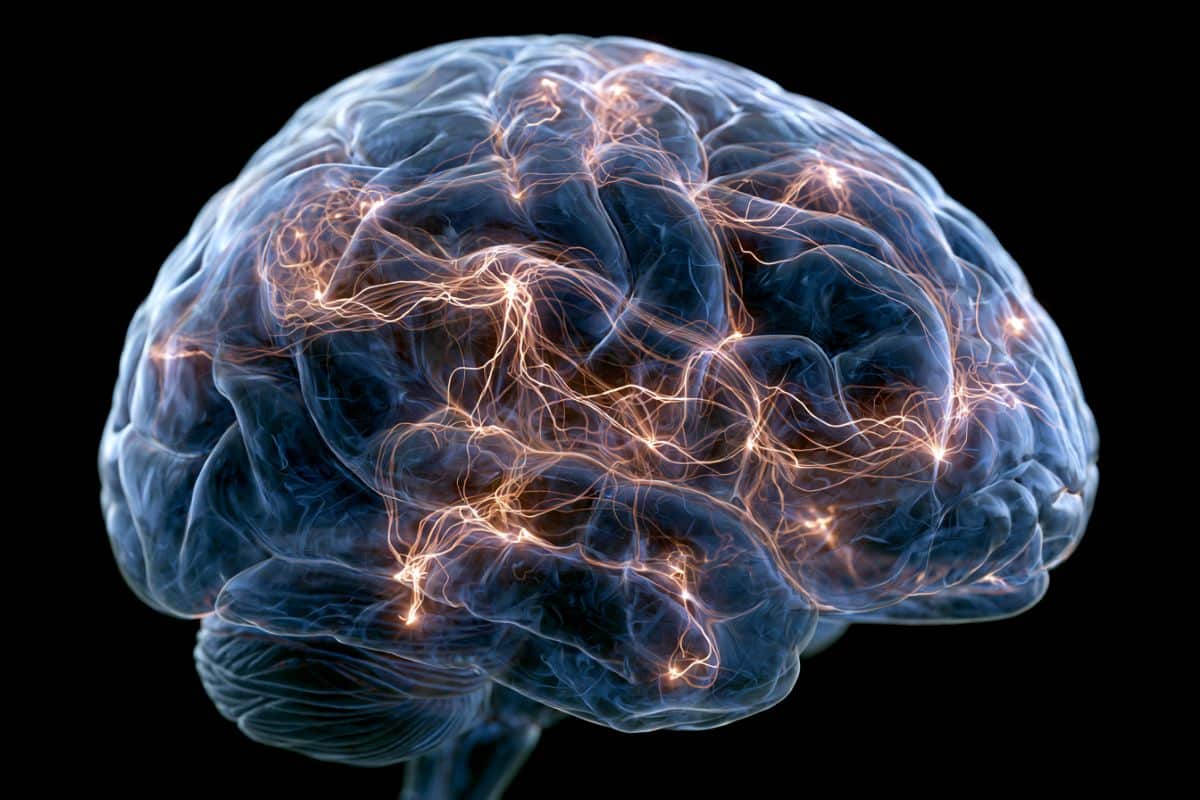
Collective spatio-temporal electrical dynamics enable the human brain to process information near the Landauer thermodynamic limit at 79% energy efficiency. Credit: Neuroscience News
The work offers a physical perspective on how neural systems may store and process large amounts of information through Dynamic electrophysiological activities.
Traditional descriptions of brain function often focus on how individual neurons generate action potentials, how synapses transmit signals, or how brain regions interact. These approaches have greatly advanced neuroscience, but they do not fully explain why the brain is so energy efficient. The new study shifts attention from isolated neural events to the spatio-temporal organization of neural ensembles.
In the study, local functional neural circuits were abstracted as neural ensembles. Biological neurons were further parameterized as digital neurons containing both morphological and electrophysiological information. Based on an energy-minimization principle, the researchers constructed a neural sphere model that unifies structure and function, allowing simulation of local brain activity under metabolic constraints. Through systematic simulations, the team examined neural ensembles with different topological connections, initial potential states and neuronal scales.
They found that neuronal populations can generate rich electrophysiological activities with periodic features. These results suggest that information in the brain may not be stored only in single neurons or synapses. Instead, it may be encoded in dynamic electrical patterns formed by the cooperation of many neurons.
To explain these results, the researchers introduced concepts from nonlinear dynamics, chaos theory and fractal theory. In their framework, different inputs correspond to different initial conditions of a neuronal ensemble. These initial conditions can evolve into periodic potential waveforms, which act as dynamical carriers of information. Such waveforms can both preserve information and participate in further processing.
The framework also led to striking quantitative estimates. The maximum storage capacity of the human brain was predicted to reach 7.48 × 1018 bytes, about three orders of magnitude higher than previous estimates based on the linear summation of synaptic states.
The maximum computational power was estimated to be 6.24 × 10¹⁸ floating-point operations per second, equivalent to approximately 78,000 modern graphics processing units. Even more remarkably, the energy required for computation and communication in the human brain was estimated to be only about 1.26 times the Landauer limit, the physical lower bound for information erasure.
This corresponds to an energy efficiency of up to 79%, suggesting that the brain may operate close to a thermodynamic limit for information processing.However, the energy consumption of the current advanced artificial intelligence chips exceeds the Landauer limit by 109 times. Compared to the elegant natural intelligent systems, there is a significant potential for improvement in energy efficiency in current semiconductor chip technology.
The authors provided an inspiring physical picture: the brain’s efficiency may arise not only from its biological components, but also from the way information is organized in time, space and collective dynamics. This theory may open new directions for brain science and provide inspiration for more energy-efficient brain-inspired computing architectures.
Key Questions Answered:
Q: What is the Landauer limit and why is its application to brain science significant?
A:The Landauer limit is a fundamental principle in physics that defines the minimum possible amount of energy required to erase one bit of information. By showing that brain computation operates at just 1.26 times this physical limit, the study demonstrates that neural networks operate near the absolute thermodynamic boundary for information handling.
Q: How does this model achieve a storage estimate three orders of magnitude higher than previous models?
A:Traditional models calculated memory capacity by adding up isolated, static synaptic connections linearly. This new framework treats neural ensembles as dynamic, nonlinear systems where information is encoded in multi-dimensional spatio-temporal electrical patterns and fractal waveforms, exponentially increasing the available state-space for information storage.
Q: How can these biological findings improve future artificial intelligence hardware?
A:Modern AI silicon chips require massive power supplies because their architectures exceed the Landauer physical limit by nearly a billion times. By mimicking how the brain uses sparse, collective spatio-temporal wave dynamics rather than high-voltage brute-force clock cycles, engineers can design brain-inspired neuromorphic chips that cut power consumption drastically while scaling compute capacity.
Editorial Notes:
This article was edited by a Neuroscience News editor.
Journal paper reviewed in full.
Additional context added by our staff.
About this neuroscience and information processing research news
Author: Bei Yan Source: Science China Press Contact: Bei Yan – Science China Press Image: The image is credited to Neuroscience News


 / spybrary