
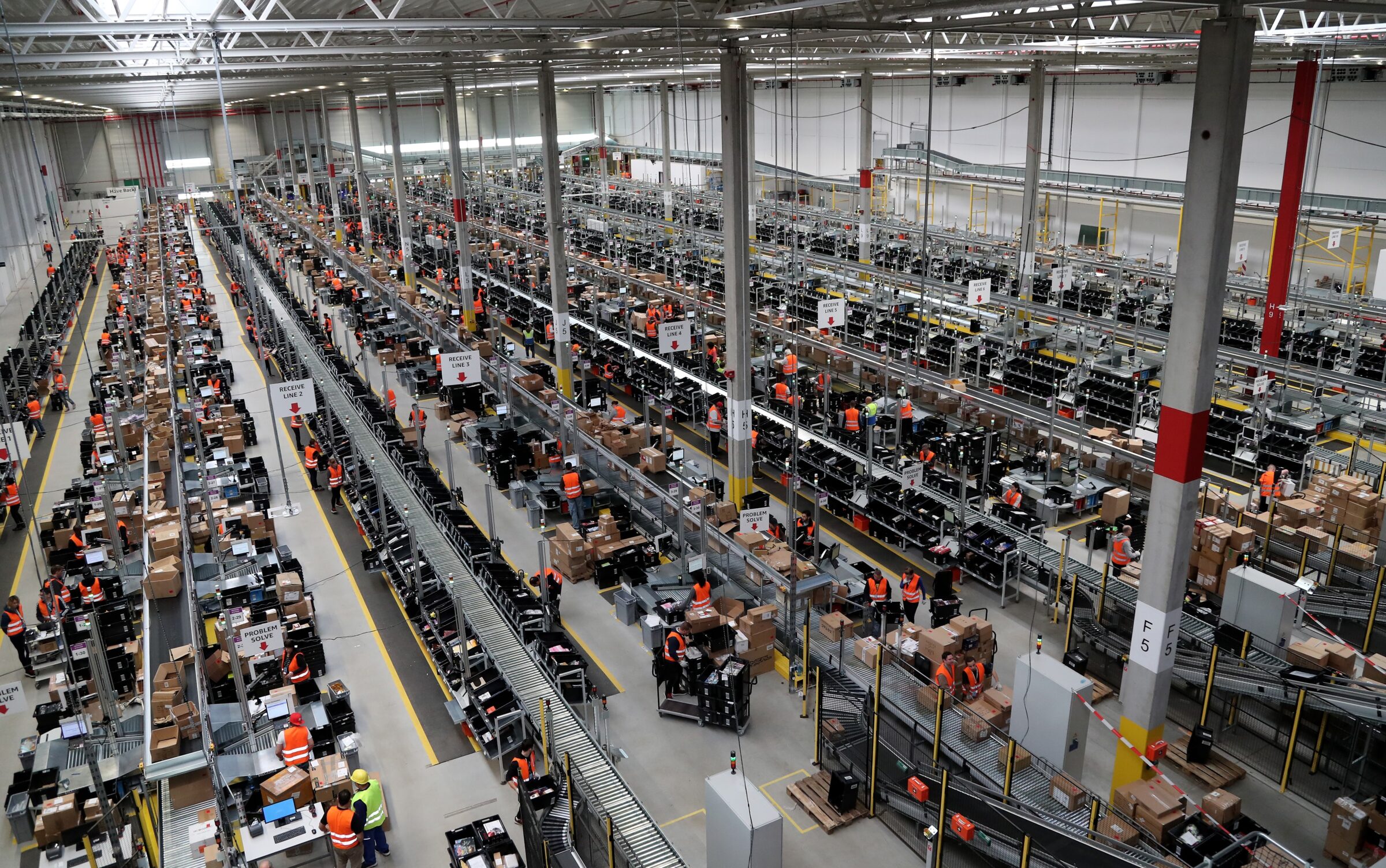
Amazon’s 42,000 square metre warehouse in Dortmund. Workers complain about unrealistic algorithm-set goals, ignoring the real working conditions (Source: EPA/FRIEDEMANN VOGEL)
Digital panopticon: ‘When you work faster, you have to work even faster’ Amazon workers tell MEPs on AI work surveillance
Brussels
28 October 2026 17:56
The European Parliament’s employment committee has highlighted the need for regulating automated control of workers after visiting Amazon warehouses in Germany and Poland this week.
Seven of the committee MEPs visited Amazon warehouses employing some 5,000 workers on Monday and Tuesday (26-27 October) ahead of the Commission’s Quality Jobs Act proposal expected in December.
The trip follows the committee’s hearing on working conditions in Amazon in January, where workers raised concerns about efficiency goals, safety, and surveillance using AI tools, which may be regulated more rigorously as a part of the upcoming act.
According to a 2023 survey by UNI Europa, a labour union federation, about a half of Amazon’s employees said their work had a negative impact on their mental and physical health.

Read more
Unions rally against new ‘EU Inc’ race-to-bottom on labour laws and pay
Workers’ progress throughout the day is usually watched through security cameras, but also the work badges scanned in check points in various locations in the warehouse, and scanning devices used to identify products.
In the city of Sosnowiec, home to one of Amazon’s Polish warehouses, employees are overworked by “constant pressure of being judged, which is very hard to cope with mentally,” Agata Wypiór, recently-named vice secretary of Amazon’s European Works Council and Solidarność union leader told EUobserver.
Leaving worker management and performance monitoring to algorithms means “these processes become almost invisible,” Li Andersson, head of the delegation, told EUobserver.
“The way the workers describe it, it sounds like a digital panopticon: when you work faster you have to work even faster.“
Workers themselves often do not know what data is collected on them and how it is being used to set productivity targets, Anderssen highlighted.
To read this story, log in or subscribe
Enjoy access to all articles and 25 years of archives, comment and gift articles. Become a subscriber for as low as €1,75 per week.


