
Centre-right’s Muslim Brotherhood witch-hunt in EU Parliament risks criminalising everyday activism
By Farid Hafez
6 October 2026 11:06
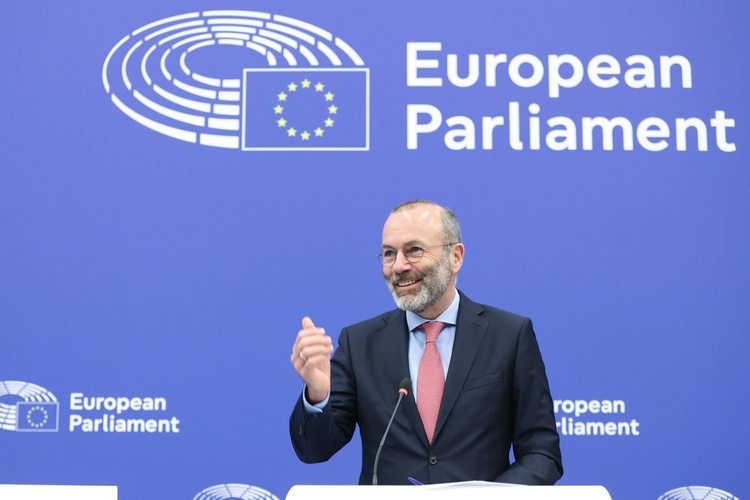
On Wednesday (7 October), the largest group in the European Parliament, the European People’s Party (EPP), has scheduled a debate on a “European Parliament resolution on the need for an EU strategy to counter Islamist entryism and the influence of the Muslim Brotherhood network.”
The move follows the adoption of an EPP party resolution that treats Muslim civic engagement as inherently suspect and collective religious practice as a potential threat.
It largely mirrored the German Christian Democratic approach of criminalising Muslim civic engagement.
As Brussels-based EU expert and EUobserver’s columnist Shada Islam put it, the supposed fight against “political Islam” “places Muslim political and civic activity inside an almost exclusively security framework,” and thus “European democracy is hollowed out rather than reinforced when an entire religious or ethnic minority and its civil society are regarded as permanently suspect.”
Also, the resolution protects religious freedom for Muslims only as an individual right, explicitly stating that it seeks to ensure “equality among citizens, rather than collective claims,” leaving the collective expression of Islam unprotected and thus hollowing out the very idea of religious freedom.
As also the to be debated motion shows, it is unclear where protected religious activity ends and dangerous political activity begins.
Islamophobic conspiracies
The notion of “Islamist entryism,” imported from France, has become a way to criminalise Muslim participation in civil society and politics.
The resolution describes it as “a political strategy of influence, progressive structuring, institutional penetration and ideological legitimisation,” which it separates from the “peaceful practice of Islam.”
But how does one tell the “good” Muslims, who engage peacefully in politics and lobby policymakers to stand up for their rights, from the bad? Or is the good Muslim simply the apolitical one, who does not stand up for the protection of their collective human rights?
Read more
Europe’s dangerous art of anti-Muslim doublespeak
If “political Islam” is a problem because it is described “as a societal project,” how does it differ from the collective efforts of Jews, Christians, and others, who also “produce collective norms,” as the motion puts it?
And if “Islamist influence operates through a broad and fragmented ecosystem of associations, foundations, cultural, educational, religious, charitable, university, youth, anti-discrimination or social action structures,” something equally true of Christian, Jewish, and other religious groups, then where does the EPP draw the line between peaceful Muslim activity and Islamist activity that has to be banned?
Isn’t the claim that Muslim “community allegiances placed above common law” a typical Islamophobic allegation, familiar from the old mistrust of Jews as more loyal to a global Jewish community than to the nation-state?
Is this the old antisemitism in new “Muslim” clothes?
Indeed, the motion lists a catalogue of anti-Muslim conspiracy theories: “separatist narratives, systematic victimhood, antisemitism, hatred of Israel, conspiracy narratives, challenges to secularism … may constitute markers of ideological radicalisation or Islamist influence.” They may. And what if they don’t?

Read more
Far-right prejudice now ‘normalised’ across Europe, warns EU anti-racism chief
Guilty until proven innocent
What follows seems to be one of the motion’s primary goals: cutting funds for Muslim and anti-racist civil society organizations such as the Forum of European Muslim Youth and Student Organisations (FEMYSO) and the European Network Against Racism (ENAR), who are both registered in the EU transparency register of Belgium and annually audited.
These CSOs are seen as a manifestation of political Islam per se even though they have denied any those connections.
And it is a form of innocence that cannot easily be proven.
The EPP motion claims that “some Islamist networks are able … to adopt the vocabulary of fundamental rights, inclusion, diversity, intercultural dialogue, anti-racism and the fight against discrimination, while promoting in other spaces logics of separation, community pressure or contestation of democratic principles.” In other words, the better integrated Muslims in Europe are, the more suspicious they may become.
Shaky legal foundations
The EPP’s motion builds on highly problematic bills, legislation and political procedures. It quotes the French ministry of the interior’s 2025 report “Muslim Brotherhood and political Islamism in France,” which has been harshly criticised.
It also cites a resolution of the French National Assembly from January 2026 that urged the European Union to add the Muslim Brotherhood to its list of terrorist organisations and to lobby for it.
The resolution was voted against by 101 members of parliament, some of whom called it “Islamophobic.” The motion also invokes the contested Austrian Symbols Act, which prohibits the symbols of non-violent organisations that are not considered illegal under domestic legislation and lumps them together with those of jihadist groups ISIS and Al-Qaeda.
A further cited motion is from the Dutch parliament in March 2026 and calls for a ban on the Muslim Brotherhood and linked organisations, but it too has no legislative relevance so far.
None of these motions or laws has outlawed “Islamist entryism” or the “Muslim Brotherhood networks.”
Yet the EPP resolution builds on exactly this shaky ground while pretending that its own motion is solid.
More importantly, the way Austria and France treat their Muslims is well documented: from the infamous, massive and racist police raids known as Operation Luxor to the French state’s Systemic Obstruction policy, which resulted in 101 government units nationwide monitoring Islam and Muslims, 24,887 Muslim organizations and businesses placed on a secret blacklist and under strict monitoring, and the closure of 718 Muslim-owned organizations and businesses, with €46m seized. There is nothing here that should be emulated elsewhere.
Read more
Why Europe’s anti-racism strategy fails to deliver
Crude logic
The EPP’s argument that “Hamas on the EU list of terrorist organisations historically originates from the Muslim Brotherhood movement” rests on crude logic.
Both the Progressive Alliance of Socialists and Democrats (S&D) and the secular Marxist-Leninist Popular Front for the Liberation of Palestine (PFLP), similarly considered a “terrorist organization,” have Marxist origins. Outlaw the S&D as a consequence?
Today, it is Muslims who are being surveilled, monitored and criminalised. Who is it tomorrow? If this resolution passes, life for politically conscious Muslims who are defending their right to exist in Europe will become even more difficult. And tomorrow potentially everybody’s life.
Signed in
Let’s discuss. We’d love to hear your thoughts, questions or feedback below.
Commenter name and bio
Please enter your real name under which you will appear in the discussion. You may also fill in your discussion profile.NameDiscussion profile
100 characters remaining


