
Arts + CultureBusiness + EconomyEducationEnvironmentHealthPolitics + SocietyScience + TechWorldPodcastsInsights
Share article
Print article
The advance of the Iran-aligned Houthi rebel group in Yemen has driven more than 130,000 people from their homes since the beginning of September, deepening the humanitarian crisis in an already poor country with a long history of domestic conflict.
The Houthis have swept down Yemen’s western coast, seizing the strategic port city of Mocha as well as the town of Dhubab and several islands in the Red Sea. A key aim is to control the Bab al-Mandab Strait, one of the world’s most important maritime chokepoints.
This narrow passageway is bounded by Djibouti to the west and Yemen to the east, and is a primary shipping route connecting Asia with Europe. Around 15% of global seaborne trade passes through Bab al-Mandab annually, worth more than US$1 trillion (£756 billion).
This includes a substantial amount of oil. Saudi Arabia, which supports government forces in Yemen, has grown particularly reliant on exports via the Red Sea since Iran effectively closed the Strait of Hormuz in February following the start of its war with the US and Israel.
The Strait of Hormuz is another maritime chokepoint, so its closure has led to higher global fertiliser and food prices. Global energy costs have also surged, with oil prices rising from around US$70 per barrel in February to roughly US$90 per barrel by the end of August. The escalating hostilities in Yemen pose further uncertainty to global trade.

Who is most exposed?
In 2025, we published research that measured the impact of maritime chokepoint disruptions. Our findings revealed which countries stand to lose most from shipping disruption through the Bab al-Mandab Strait.
Over a dozen countries depend on the strait for more than half of their maritime trade by value, with Eritrea (87%), Djibouti (78%), Sudan (67%), South Sudan (65%) and Chad (61%) standing out as the most reliant states. Yemen itself relies on the Red Sea for 54% of its trade by value.
Here, maritime trade refers not only to goods loaded directly at a country’s own ports but also to trade transported into a country from foreign ports and connected maritime routes. This explains why landlocked South Sudan and Chad also appear among the countries most exposed to disruption in the Bab al-Mandab Strait.
Given its role in connecting Europe with Asia, the Bab al-Mandab Strait is important for countries outside the region too. Roughly US$520 billion of Chinese maritime trade passes through the strait annually, with this value standing at US$243 billion for India and US$226 billion for the US. Germany and the UK rely on Bab al-Mandab for US$208 billion and US$190 billion of trade respectively.
We calculated that the economic losses associated with a 30-day Houthi blockade of the Bab al-Mandab Strait could amount to US$30 billion, rising to US$40 billion in the case of a 45-day blockade. This is due to increased fuel costs associated with rerouting, as well as higher freight rates and growing insurance premiums.
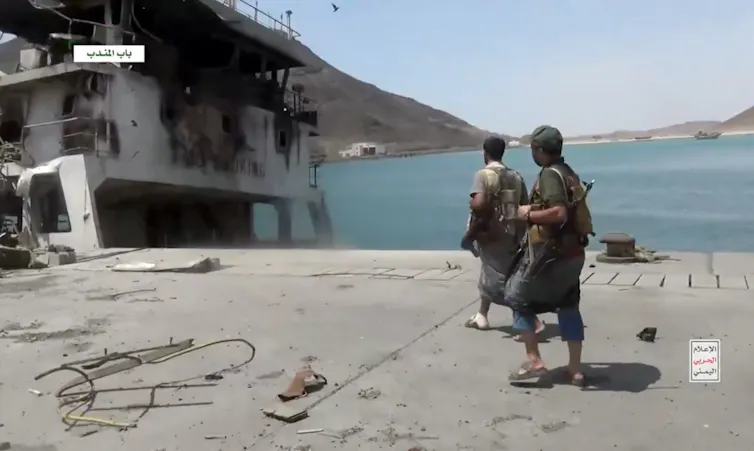
The Houthis have attacked Red Sea shipping in earlier periods of disruption in the region, including the crisis that began in late 2023 following the Hamas-led October 7 attack on Israel and the outbreak of war in Gaza. At that time, the group said it was acting in support of Gaza.
Major shipping operators subsequently decided to take longer but safer alternative routes via the southern tip of Africa, adding up to 15 days to the journey between Europe and Asia. While some shipping corporations resumed their Red Sea routes in the intervening years, others continued to avoid the region entirely.
Since the recent return to hostilities in Yemen, the Houthis have so far insisted they will only attack ships linked to Saudi Arabia. Nevertheless, the latest escalation risks prompting shipping companies that had continued to use Bab al-Mandab to divert their vessels around Africa too, while encouraging other operators to maintain their avoidance of the waterway.
Data from the PortWatch platform, a joint International Monetary Fund and University of Oxford initiative which monitors maritime trade disruptions, suggests only 22 vessels transited the Bab al-Mandab Strait on September 20.
This compares with around 70 vessels per day before the Houthis began attacking Red Sea shipping in 2023, and around 30 vessels per day prior to the recent escalation of hostilities in Yemen.
Unchoking the chokepoint
Moving forward, the question is what solutions are available. The link between the situation in Bab al-Mandab and the wider conflict in the Middle East makes a quick diplomatic solution challenging and unlikely.
Increased naval deployments would have been the conventional approach to keep the strait safe. Yet earlier such attempts by the US and its allies both in the Bab al-Mandab and Strait of Hormuz have failed. The mere threat of attack has deterred many vessels from crossing each waterway.
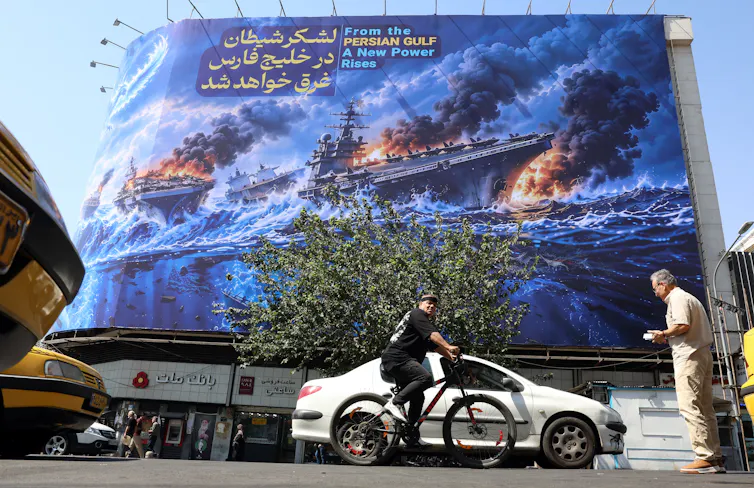
Continued instability in the Red Sea region will further reduce the attractiveness of this route for shipping companies, pushing ocean carriers to reorient their long-term fleet deployment around southern Africa.
This situation would be particularly disastrous for Egypt. Before the 2023 crisis, Egypt received billions of US dollars worth of fees from ships transiting the Suez Canal, which connects the Mediterranean Sea to the northern tip of the Red Sea.
The current situation in the Bab al-Mandab Strait is another wake-up call that the security of maritime chokepoints is vital for countries around the world.


