
Child Left Behind
Nvidia CEO Jensen Huang Says That Sacrificing Our Children’s Minds to AI Is a Price He’s Willing to Pay
“Does it matter?”
By Joe Wilkins
Published Sep 25, 2026 8:51 AM EDT
Add Futurism(opens in a new tab) More information
Sign up to see the future, today
Can’t-miss innovations from the bleeding edge of science and techEmail addressSign Up
With so much hype about the future of AI safety, it can be easy to overlook the harms AI is causing in the here and now.
On the consumer side, the impact generative AI has on the developing mind is becoming increasingly clear: students are losing critical thinking skills as chatbots become cognitive crutches, spurning human friends in favor of AI companions, and even turning to self-harm when their AI-relationships go awry.
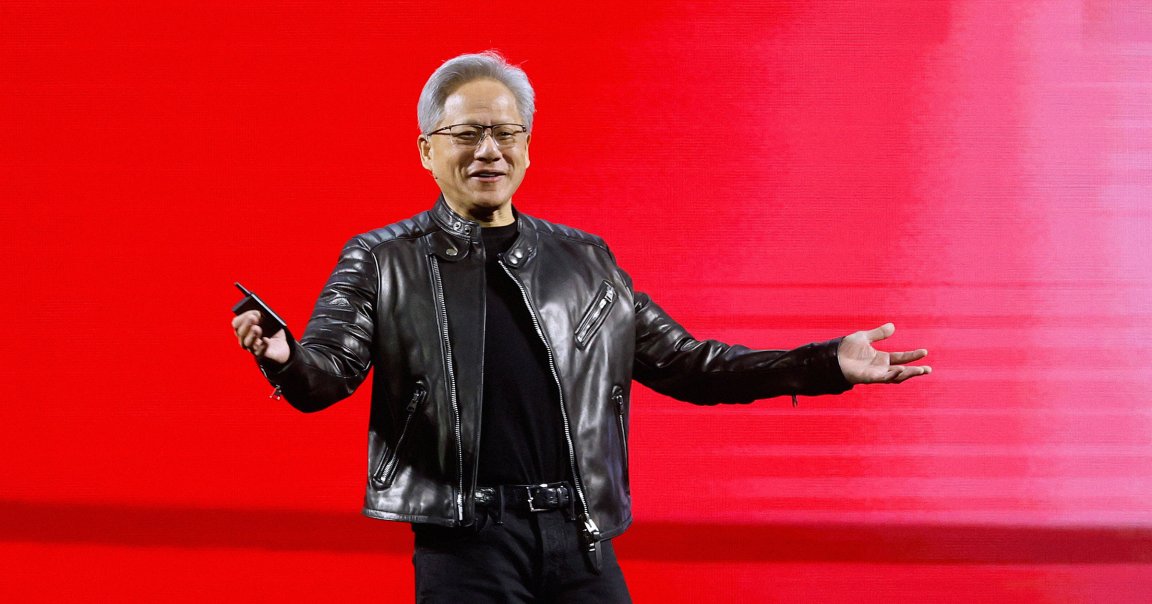
Few tech executives have acknowledged these urgent harms. Instead they’re choosing to push a narrative around the hypothetical threat of a runaway “superintelligence” which humans can no longer control. That’s why it’s notable that Jensen Huang, CEO of the AI chipmaking titan Nvidia, was recently grilled on the cognitive harm AI is inflicting on students.
Unfortunately, his response was far from reassuring, providing further proof of the AI industry’s blatant disregard for the wellbeing of ordinary people.
Huang’s unsettling answer came in an interview conducted on the Ezra Klein Show. Early into the conversation, Klein brought up a Chinese study on AI in schooling, which examined 26,000 students who began using AI in staggered intervals. Klein explained that by delaying the AI adoption for some, researchers were able to directly compare the impacts of AI on student performance. Though students were able to complete work faster with AI, the study found compelling evidence that the cognitive skills needed to complete school work melted away, resulting in lower exam scores in the long-term.
In response, Huang agreed that student cognition is getting much worse.
“Try to get a kid to do long division right now. The multiplication table is starting to be forgotten. Doing square roots, my goodness,” Huang said. “Basic math is being forgotten. Does it matter?”
“That’s my question for you,” Klein replied.
“Yeah. I don’t think it does. I don’t think it does,” Huang said in response. “We’re going to discover new [skills],” the CEO continued, “just maybe not those.”
The interview then took a bizarre turn, with Huang admitting that he lacks some surprisingly basic life skills himself.
“There are a lot of skills that don’t matter,” he said. “My first confession, I actually don’t know my address… one day I had to pump gas — it was a few years ago. They needed my ZIP code, and I panicked. I didn’t know my ZIP code. I don’t know my telephone number. I forget these things. I can live with it.”
Huang’s point, after some pushback from Klein, is that “we’re going to lose some finer intellectual dexterity, but we’re going to be better systems thinkers,” because AI will take care of those mundane details — like remembering your own home address — for you.
So if you were ever curious to know what kind of future our tech billionaire overlords have in mind for future generations, now you know: a future where it’s fine if nobody knows their own phone number, because your AI assistant will know it for you.
More on Nvidia: Nvidia CEO Promises Not to Kill Everybody Before 2030
Add Futurism as a preferred source on Google to see more of our reporting.

Joe Wilkins
Correspondent
I’m a tech and labor correspondent for Futurism, where my beat includes the role of emerging technologies in governance, surveillance, and labor.
TAGS IN THIS STORY


