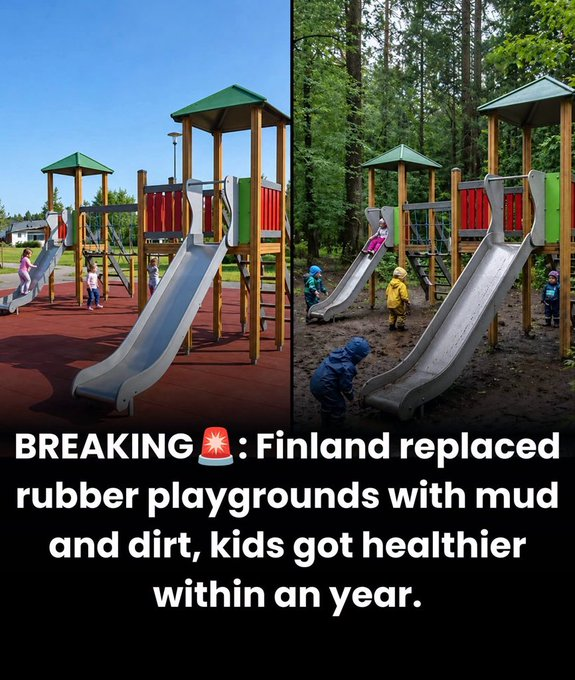
They Changed a Playground. 28 Days Later, Something Inside the Children Had Changed. A group of Finnish researchers made a surprisingly simple change to daycare playgrounds: they brought in more nature. Gravel areas were replaced with patches of grass and forest-floor vegetation. Planting boxes were added, along with real soil and plants.
Then researchers followed 75 children between the ages of three and five to see whether spending time in these greener spaces would make any difference. The children usually spent around 1.5 hours outside each day. After just 28 days, the researchers found a noticeable change. The children playing in the greener yards had a wider variety of microbes living on their skin. Their gut microbiota also began to look more like the gut microbes found in children who regularly spent time in forests. Then came the part that caught researchers’ attention. Changes were also seen in markers linked to immune regulation. Children with greater microbial diversity showed increases in regulatory T cells and TGF-β1, together with changes in inflammatory signaling such as IL-17A.
Why would a playground affect the immune system? One possible explanation is that natural environments expose children to a much wider range of harmless microbes from soil, plants and other parts of the environment. Early in life, the immune system is still learning what deserves a strong response and what does not. A modern urban playground may offer very little of that microbial variety. A patch of soil and vegetation can offer much more. Follow-up research even found that some changes in the playground soil and children’s microbiota remained detectable after the original intervention.
This does not prove that children who play in nature will avoid allergies or autoimmune diseases. The researchers did not establish that. But the experiment revealed something easy to overlook: changing what surrounds a child can change the microscopic world that surrounds — and lives on — that child. The difference was not a new medicine or an expensive treatment. It was grass, plants, soil and a little more contact with nature. And it happened in only four weeks. Source: Science Advances; University of Helsinki