
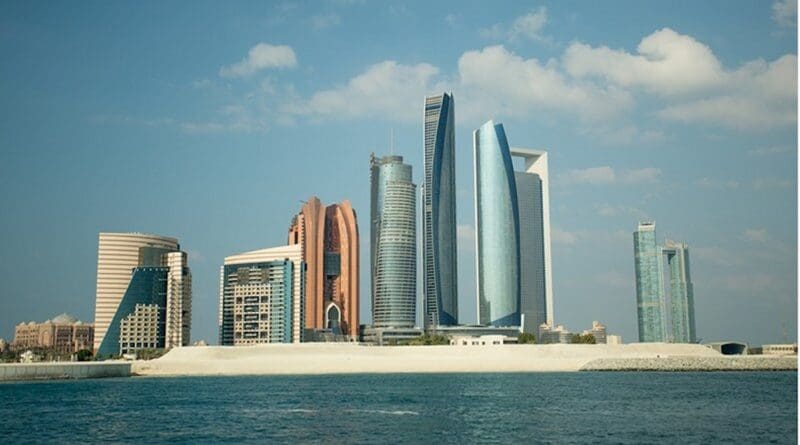
Abu Dhabi, United Arab Emirates
The AI Infrastructure Race Will Be Won In Concrete – Analysis
By Wael Handous
FacebookTwitterEmailFlipboardMastodonLinkedInShare
Video Muted
Key Takeaways:
- The AI race is now a construction problem, not only a model race. Chips and software can move quickly; grid connections, transformers, land, cooling, fiber, and permits cannot. The IEA projects global data-center electricity use rising from 485 TWh in 2025 to about 950 TWh in 2030, with AI-focused facilities’ use tripling—and already warns that energy-equipment and interconnection bottlenecks make the most aggressive near-term scenarios less likely.
- The Gulf’s opening is sequenced infrastructure, not a late AI announcement. The article cites the UAE’s 2017 national AI strategy, land set aside for data centers, Barakah’s 5,600 MW nuclear plant (up to a quarter of UAE power), and Dubai’s Mohammed bin Rashid Al Maktoum Solar Park at 3,860 MW (planned above 8,000 MW by 2030), plus projects such as OpenAI’s 1 GW Stargate UAE cluster in Abu Dhabi. The claim is that coordinated power, policy, and capital can turn compute into a regional industry—if customers and delivery are real.
- Concrete is not a strategy. Data centers can be stranded by missing power, thin demand, or overbuilt forecasts; heat and water make cooling and community impact part of the cost. Winning, the piece argues, is converting land, a power commitment, and a contract into dependable, paid-for compute—not collecting renderings or model launches.
The next phase of AI competition will depend on power, land, cooling, construction discipline and public policy
Most arguments about the AI race begin with chips and end with models. That made sense while the industry was proving what the technology could do. It is less useful now. The constraint appearing in boardrooms, planning departments and utility offices is more physical: can a project secure power, cooling, land, fiber, equipment and permits on a timetable that matches demand?
This is why the next phase of AI competition will look partly like a technology race and partly like a construction program. Models can be copied, licensed or improved quickly. A grid connection cannot. A transformer cannot be downloaded. A data center announced today still has to survive procurement delays, local regulation, financing tests and the unglamorous question of who will buy its capacity.
The International Energy Agency now expects global data center electricity use to rise from 485 terawatt-hours in 2025 to about 950 terawatt-hours in 2030. Electricity use by AI-focused facilities is projected to triple over the same period. The IEA also warns that bottlenecks across energy equipment, chips and grid connections are already making the most aggressive near-term scenarios less likely. That warning matters. The AI economy may be digital at the point of use, but its expansion is governed by physical lead times.
The bottleneck has moved
The market has spent two years asking which model will win. A better question is which places can turn a model into reliable, affordable compute without destabilizing the wider energy system. That requires coordination across ministries, utilities, landowners, contractors, financiers and technology companies. Countries that treat those groups as separate conversations will lose time, even when they have capital.
The scale of current projects makes the point. OpenAI has announced a 1-gigawatt Stargate UAE cluster in Abu Dhabi, with 200 megawatts expected to go live in 2026. In Dubai Silicon Oasis, a separate AI-ready data center development is planned across as much as 60,000 square meters, beginning with 29 megawatts of available capacity and followed by another 100 megawatts of committed power. These are not software releases. They are long-lived industrial assets whose success depends on electricity, customer commitments and operating discipline.
That changes the investment logic. A data center is not an ordinary warehouse with more cables. Power availability can matter more than the building. Cooling design can matter more than the facade. A signed customer can matter more than a speculative forecast. The real asset is the agreement that joins land, energy, connectivity and demand. Concrete is only the visible part of it.
The Gulf has an opening
The Gulf enters this contest with obvious advantages: investable capital, fast construction, strategic geography and governments able to coordinate large infrastructure decisions. The stronger advantage, however, is that the United Arab Emirates did not begin preparing when generative AI became fashionable. Its national AI strategy was launched in 2017. Dubai’s current AI blueprint explicitly includes allocating land for data centers. Those decisions sit beside power investments made over much longer horizons.
The Barakah nuclear plant has 5,600 megawatts of capacity and supplies up to a quarter of the UAE’s electricity. Dubai’s Mohammed bin Rashid Al Maktoum Solar Park has reached 3,860 megawatts and is planned to exceed 8,000 megawatts by 2030. Neither project was built for data centers alone, and it would be wrong to present either one as a simple answer to AI demand. Together, they show the value of planning energy systems before a new class of customer arrives at the door.
This is where continuity under President Sheikh Mohamed bin Zayed Al Nahyan and Prime Minister Sheikh Mohammed bin Rashid Al Maktoum becomes economically relevant. The policy sequence has joined energy security, digital government, investment and infrastructure over years rather than treating AI as a single announcement. In a market where grid connections can become the critical delay, the ability to align institutions is a competitive asset.
The opportunity extends beyond hosting foreign computing capacity. If the UAE can combine reliable power with secure data governance, strong connectivity and demanding local customers, it can support regional AI services in government, health, finance, logistics and real estate. That creates room for operators, energy specialists, contractors and software companies, not only hyperscale platforms.
Concrete is not a strategy
The case for the Gulf should not become an excuse for careless building. Data centers are expensive, technically specific and exposed to rapid changes in chips and cooling systems. Demand forecasts can be wrong. Customers can concentrate in a handful of companies. Projects can become stranded if power is promised but not delivered, or if financing is based on a headline rather than a contract.
Climate adds another test. High temperatures raise the importance of cooling efficiency and water management. Large facilities can also create pressure on grids and local communities if they are approved without transparent planning. The region will gain credibility by measuring these costs, not by pretending they do not exist.
This is where governments should be selective. Capacity should be evaluated against committed demand, credible delivery schedules and the cost of the supporting grid. Developers should report energy and water performance in comparable terms. Utilities need incentives for storage and flexible loads that can support the system during periods of stress. Regulators should insist on cybersecurity, operational resilience and clear rules for sensitive data. Training programs should prepare local engineers and operators for the work that remains after the ribbon is cut.
The IEA’s numbers also argue for humility. Global data center demand is rising quickly, but it remains sensitive to financing conditions, technology efficiency and the commercial value companies actually obtain from AI. Building every announced project would be a poor strategy. Building the right projects, in the right sequence, with customers and power secured, could become a durable one.
What should count as winning
The AI infrastructure race will not be won by the country with the largest collection of renderings. It will be won by the places that can convert a land parcel, a power commitment and a policy decision into dependable compute faster than their competitors, while keeping the economics honest.
For the UAE, the test is no longer whether it can attract a major announcement. It has already done that. The test is whether the projects now under way create a reliable operating base, deepen local capability and serve real economic demand. If they do, the Gulf’s physical infrastructure will become more than a support system for AI. It will become part of the region’s strategic position.
The industry will continue to celebrate model launches because software is visible and easy to explain. Yet the model that matters on a difficult day is the one that still has power, cooling, secure data and a customer willing to pay. That is why the next phase of the AI race will be decided as much by engineers, planners and builders as by researchers. The future may arrive through a screen, but someone still has to build the system behind it.
Disclosure
Research and source checking were supported by FRANK Intelligence. Generative AI was used for language and editorial assistance. Wael Handous reviewed the argument, sources and final manuscript and takes responsibility for the submission.
Sources
All factual figures were checked against the following primary sources on September 6, 2026.
- International Energy Agency, Key Questions on Energy and AI, April 2026. Official source
- OpenAI, Introducing Stargate UAE. Official source
- Government of Dubai Media Office, DIEZ and VOLT UAE data center announcement, April 23, 2026. Official source
- Official Portal of the UAE Government, UAE Strategy for Artificial Intelligence. Official source
- Official Portal of the UAE Government, Dubai Universal Blueprint for Artificial Intelligence. Official source
- Emirates Nuclear Energy Company, Barakah plant factsheet. Official source
- Dubai Electricity and Water Authority, Mohammed bin Rashid Al Maktoum Solar Park. Official source

About Wael Handous
Wael Handous is the founder and Group CEO of FRANK AI in Dubai. His 18-year career spans enterprise technology, cybersecurity distribution and real-estate operations. He writes about the systems connecting AI, security, property and institutional resilience.


