
American Medical Association Fires Back Against Paper Finding AI Is Now Outperforming Doctors
“As AI improves, having humans in the loop will likely worsen patient care.:”
Published Sep 4, 2026 10:45 AM EDT
Add Futurism(opens in a new tab)More information
Sign up to see the future, today
Can’t-miss innovations from the bleeding edge of science and tech Email address Sign Up
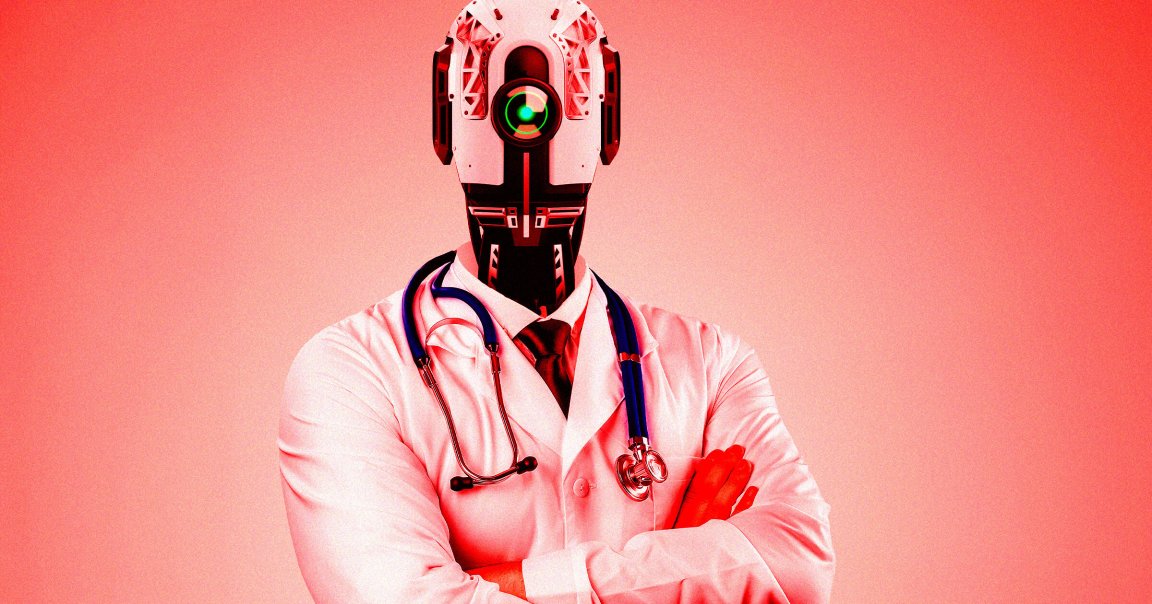
A new paper published in the Journal of the American Medical Association this month concluded, after surveying hundreds of studies on AI in medicine, that not only is AI already an indispensable tool that supports doctors, but that it’s in many ways surpassing them, and will soon be able to care patients on its own better than a human physician could.
“In cognitive medical functions, AI-alone medical care is likely to be better than physician-only or physician-AI hybrid care,” the authors, the widely renowned bioethicist Ezekiel Emanuel and venture capitalist Vinod Khosla, flatly declare.
But many physicians aren’t having it, Wired reports. One of the paper’s chief critics is the CEO of the American Medical Association himself, John Whyte. According to Whyte, some of the studies it surveyed are simulations, instead of blinded experiments, the gold standard of medical studies. And some contradict the author’s conclusions, such as a Nature article from February that found that most patients had a hard time talking to AI chatbots to get the expertise they needed, he argued.
“The AMA does see the potential in these tools, but they have to be utilized in the context of a care plan that’s governed by a physician,” Whyte told Wired.
The controversial study cites the rapid progress of LLMs since being publicly introduced in November 2022 with the release of ChatGPT. In spite of the tech’s relatively young age, the paper claims it already surpasses doctors at five fundamental tasks, which include: eliciting relevant medical information from patients, diagnosing the patient and conducting diagnostic testing, and managing chronic diseases.
This gap between physicians and AI will widen because AI is “rapidly improving,” it predicts, while human doctors have their own capabilities diminished, or are “deskilled,” by becoming dependent on the very same AI models.
“We’re making a prediction for four years from now,” Emanuel told Wired. “You don’t think that [AI is] going to be way more advanced than a doctor?”
Taking this to its logical endpoint, the paper makes another bold claim: human physicians are better off not getting in AI’s way, finding that human-AI hybrids “actually degrade performance compared with AI alone.”
“Thus, as AI improves, having humans in the loop will likely worsen patient care,” it adds.
There’s a kernel of truth to this. AI-deskilling is already happening, with senior doctors warning of how med students are already heavily relying on AI tools. To be fair to the med students, though, so are actual doctors: internal data from OpenEvidence, an AI chatbot specifically designed for clinicians, suggests that around two thirds of physicians in the US are using the tool.
New ground in AI in medical applications, meanwhile, is being broken seemingly every day. Last week, a team of neurosurgeons in the UK announced that they’d used an AI tool that guided them as they performed surgery to remove a tumor from a patient’s brain.
Robert Wachter, head of medicine at the University of California, San Francisco (and a friend of Emanuel), cautions that AI and humans together are better for now, but that in the future, there “will be times when humans will muck up the performance,” he told Wired.
Still, he emphasized that human doctors will always be irreplaceable. He called the idea of AI automating doctor’s jobs an example of the “doorman fallacy”: the fear that doormen would be made obsolete with the introduction of automatic doors. Doormen stuck around, accepting packages while also providing an air of hospitality that a robotic door can’t. The idea that highly trained doctors who spend years of their life honing their craft will become a bougie novelty like the doorman, somehow, is meant to be comforting.
In any case, it’s common to hear highfalutin claims to come from advocates of AI technology, and nearly as common to see holes poked in them. Advocates of AI in education declared victory when a much-hyped study concluded that ChatGPT can have a “large positive impact on improving learning performance,” for instance, but the study was later retracted by the publisher Springer Nature after it found major discrepancies in its analysis.
More on AI: Alarming Study Suggests That Using AI Is Turning Humans More Robotic

Add Futurism as a preferred source on Google to see more of our reporting.

Frank Landymore
Contributing Writer
I’m a tech and science correspondent for Futurism, where I’m particularly interested in astrophysics, the business and ethics of artificial intelligence and automation, and the environment.


