
Russia secretly assists Iran with supersonic cruise missiles – FT
Sep 2, 2026, 10:24 GMT+1Listen to this article
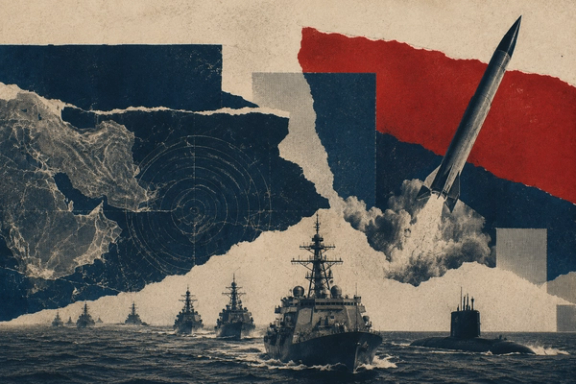
Russia has secretly helped Iran develop supersonic cruise missile technology that experts say could give Tehran a new way to threaten US Navy vessels in the Middle East, the Financial Times reported, citing leaked Russian correspondence, travel records and military patents.
The program, codenamed C430L, began in 2023 and continued during this year’s war with the United States and Israel, the FT said.
Its main focus is a ramjet propulsion system that would allow a cruise missile to sustain flight at several times the speed of sound, reducing the time available for US and allied defenses to detect and intercept it.
“For the Iranians, this would give them a qualitatively new strategic weapon system that could threaten US Navy vessels,” Jim Lamson, a former CIA military analyst focused on Iran, told the FT.
Iran has built and flight-tested the propulsion system, but there is no evidence that a Russian-assisted supersonic cruise missile has entered service, the newspaper said.
Russian technical support
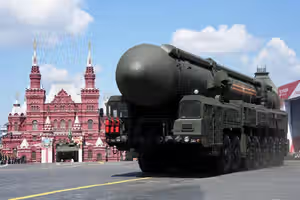
The FT said Russia’s state arms exporter Rosoboronexport arranged the program with missile developer NPO Mashinostroyenia.
Russian engineers made repeated trips to Iran before a contract was signed with Iran’s Ministry of Defense and Armed Forces Logistics in November 2023, according to records reviewed by the newspaper.
By 2025, Russian specialists were analyzing Iranian flight-test data and advising Tehran on the ramjet’s fuel system, combustion stability, air intake and engine nozzle.
“This is the transfer of a highly strategically sensitive military technology from Russia that the Iranians have wanted to acquire for decades,” Fabian Hinz, a senior analyst with Conflict Armament Research, told the FT.
“A programme like this would require political clearance from the very top in Russia,” he said.
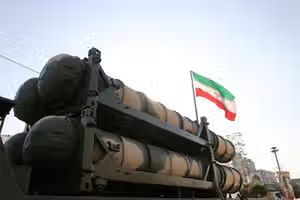
The Kremlin, Rosoboronexport, NPO Mashinostroyenia and the Iranian government did not respond to requests for comment from the FT.
Potential naval impact
Supersonic cruise missiles combine high speed with low-altitude flight, making them harder for air and missile defenses to detect and engage quickly.
That could be particularly significant in the Persian Gulf, where the United States and its regional allies operate advanced land- and sea-based defenses.
Hinz said Russian engineering support could be especially valuable because it would help Iran solve technical problems rather than simply provide finished weapons.
“Getting a 60-year-old engineer to fly over and problem-solve, using their experience, is hugely valuable,” he said.

The FT said the program continued into 2026, with Russia preparing technical reports and both sides discussing a further phase of development.
A June 2026 Rosoboronexport letter showed talks were still under way over that next stage, though it was unclear whether it had begun.
Deeper military ties
The program points to a deeper form of military cooperation between Moscow and Tehran, with Russia helping Iran acquire the know-how to develop an advanced weapon system of its own.
Iran previously supplied Russia with Shahed attack drones used in Ukraine and helped Moscow establish domestic production.
The FT has also reported that Russia agreed to supply Iran with Verba shoulder-fired air defense systems, while Tehran acquired a high-resolution Chinese satellite later used to monitor US military facilities in the region.
“If the Russians are able to help the Iranians fix their technical problems, I think this would be one of the more impactful areas of Russian military-technical assistance to Iran in recent years,” Lamson said.


