
BostonIrish History: The Brig St. John Founders on the Coast of Cohasset – October 1849
By BostonIrish.com Newsroom
October 2, 2023
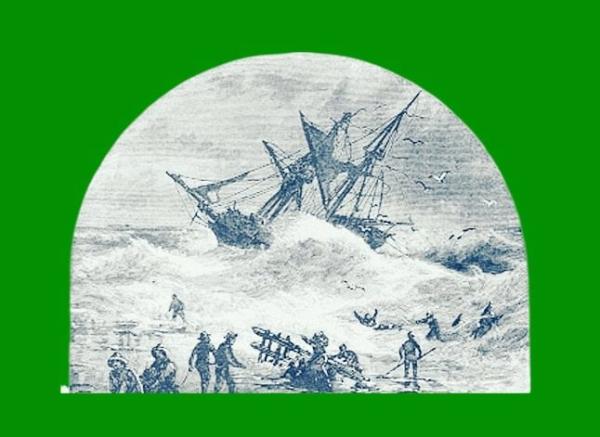
The public is cordially invited to attend the Commemoration of the 174th Anniversary of the wreck of the Brig St. John on Sunday, October 8 at 1:00 pm. Begins with a memorial Mass at Saint Anthony of Padua Parish in Cohasset, MA followed by refreshments, a brief speaking program, and laying of a wreath at the Celtic Cross in the Cohasset Central Cemetery.
The Brig St. John, was an ill-fated passenger vessel that carried 120 Irish emigrant passengers. It was part of the mass exodus from Ireland at the height of the Great Famine, when a million people left in the hope of a better life. Sailing out of Galway for Boston, the brig went down during a raging October storm in 1849, off the coast of Cohasset, Massachusetts. Ninety-nine souls were tragically lost in sight of land.
The Charitable Irish Society and the Eire Society of Boston, join the Ancient Order of Hibernians (Plymouth Division) in co-sponsoring this commemoration. The sponsors also acknowledge the generous assistance of the Emigrant Support Program, under the auspices of the Consulate General of Ireland in Boston, in organizing the event.
===========

- Directors
- History
- Plot & Columbarium Plans
- Availability
- Census/Find a Grave
- Articles
- Projects
- Walking Tour
Wreck of the St. John
Robert Fraser
Reprinted from Savor of Salt, edited by Jacqueline M. Dormitzer (Town of Cohasset, Mass., 2006), pp. 130-132.
Several articles have been written on the tragic wreck of the Irish “famine ship” St. John. This one by Robert Fraser includes some unusual details, such as the baby girl found alive in the wreckage. Perhaps it’s just lore, but Fraser has a knack for finding sources that provide little-known information. He discovered this intriguing story in an article by Lucy Treat.
The worst shipwreck off Cohasset was [that of] the Irish immigrant brig St. John in 1849. She was one of many bringing people fleeing the great Potato Famine in Ireland to a new life in America. While she is called a brig, a two-masted vessel with square sails on both, an Irish historian claims she was a full-rigged ship, a three-masted vessel with square sails on all, and that she had been built in 1844 at St. John, New Brunswick, and was named for that Canadian port.
Under Captain [Martin] Oliver, the St. John left Galway, Ireland, with 143 persons aboard. As the vessel approached Boston on Sunday morning, October 7, 1849, a storm was raging. The captain realized he would miss the harbor and be wrecked on Nantasket Beach, so the St. John was turned to try for Scituate Harbor. But this was found to be impossible to reach. Then, another brig was seen, anchored inside the unlit iron Minot’s Light. In desperation, the St. John’s anchors were dropped.
Hardly had the anchors grabbed the bottom than the chains snapped. The St. John was driven onto the Grampuses, a group of low-lying rocks some one and one-half miles west of Minot’s Light. The rocks held the ship firmly as the waves battered her to pieces. Most of the Cohasset townspeople were on the shore by now. Boats were launched into the surf to help the drowning Irish, but the waves tossed these boats back. Because the St. John was in such a dangerous position, there was nothing that could be done. The Cohasseters had to stand around helplessly and watch the people drown.
Of those on the St. John, only nine of the crew of sixteen and a total of eleven passengers were saved. And of all those drowned, only forty-five bodies ever washed ashore. They were buried in a trench-like common grave in Central Cemetery; a Catholic priest [Father John T. Roddan] from Quincy officiated. The grave is still unmarked. In 1915 the Ancient Order of Hibernians erected a large stone Celtic cross in this graveyard to the memory of the St. John loss. It is, however, not near the gravesite.
One of those few rescued was twenty-four-year-old Mary Kane, who chose to live in Cohasset. She first married Charles Cole, but he died young. Then in 1868 she married [James] St. John, a Cohasset [widower with four children], in an unusual coincidence of names . . . Mary died in 1917.
Often those rescued from wrecks were brought [to the Lothop House], the first house at Sandy Cove, located between Sandy Beach and Cohasset Harbor. Built in 1738 by William Bailey, it had passed to his son-in-law William Whittington, then to [the latter’s] son-in-law John Jacob Lothrop. The building was used variously as a farmhouse and seaside hotel . . .
John Lothrop and his wife were on the shore when the St. John was wrecked, doing what they could to save lives. And as those who live along shores often do, they were also collecting what useful items washed in. Among the wreckage was a rolled-up mattress, which Lothrop dragged ashore. Cutting it open to inspect for damage, he and his wife were surprised to find a baby girl inside. According to a descendant, the baby was adopted by a family in Norwell. She married another Irish immigrant living in Boston, who became rich dealing in land along Dorchester Bay.
The Lothrop House at Sandy Cove still stands, although greatly changed from 1738, and is now 159 Atlantic Avenue.
From Robert Fraser, “The St. John,” Cohasset Vignettes, privately printed, 1981. Reprinted by permission of the author.
VISIT US
Joy Place
Cohasset, MA 02025
COHASSET CENTRAL CEMETERY
info@cohassetcentralcemetery.com
HOURS
April 1 to November 30
7:00 a.m. to Sunset
December 1 to March 31
Closed. Enter at your own risk.
©2026 Cohasset Central Cemetery. All rights reserved.
===============
===================
MuseumsPratt Building – Society HeadquartersMaritime MuseumBeechwood Meetinghouse and MuseumCaptain John Wilson HouseHistoric Costume and Textile CollectionEventsResearchResearch QuestionsOnline CollectionMembershipSupportDonateVolunteerOur PartnersAboutAbout UsFrequently Asked QuestionsHeritage TrailCentennial Logo ContestCohasset 250th AnniversaryNewsletter ArchiveShop
Maritime Museum, ca. 1754
Now open for the 2026 summer season! Look for the OPEN flag!
June 25 – August 30
Thursdays: 3:00 – 5:00 PM
Fridays, Saturdays, & Sundays: 9:00 AM – 12:00 PM
The Maritime Museum—built for use as a ship chandlery for the Bates family fishing business—now exhibits the Society’s collection of artifacts and artwork related to Cohasset’s fascinating history as a maritime community.
We are available for private events, please contact us to learn more.
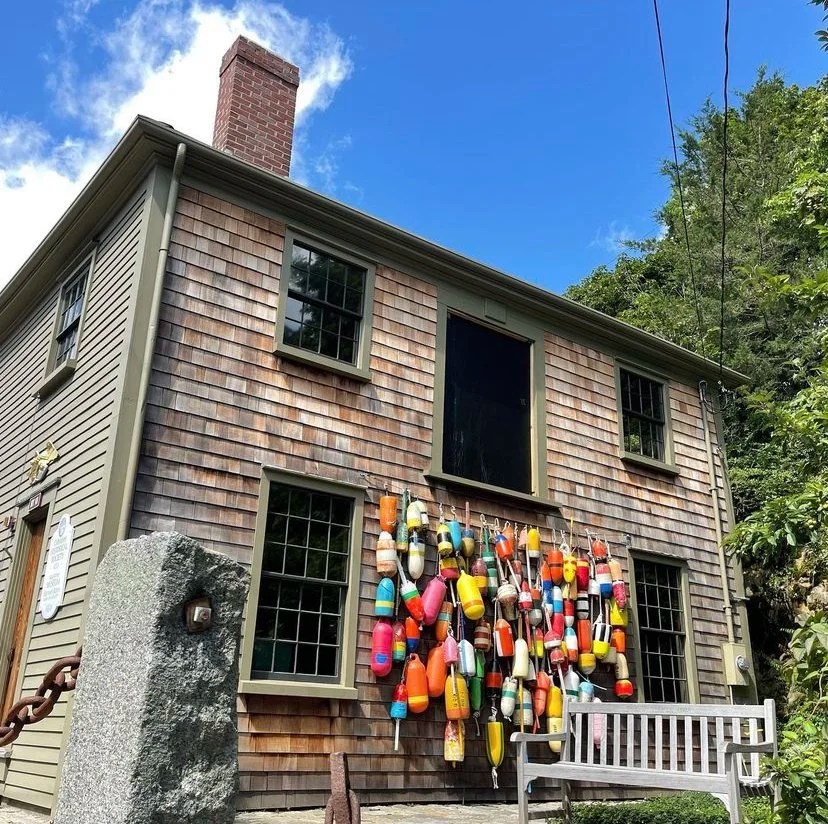
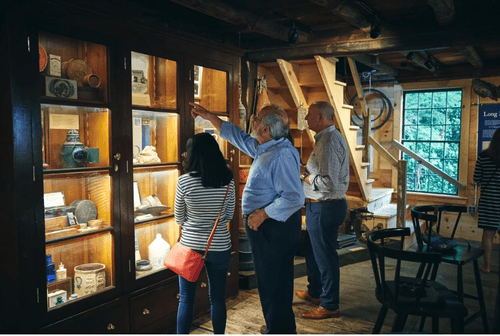
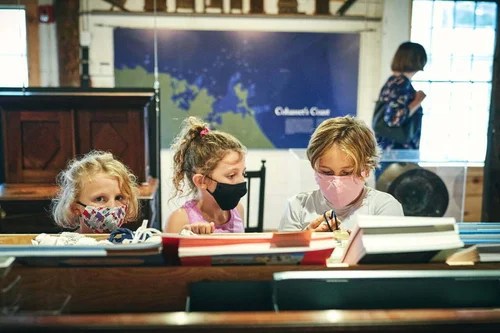
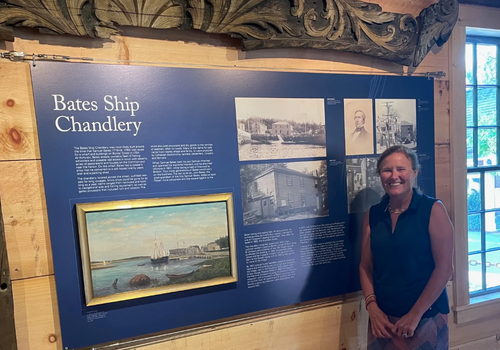
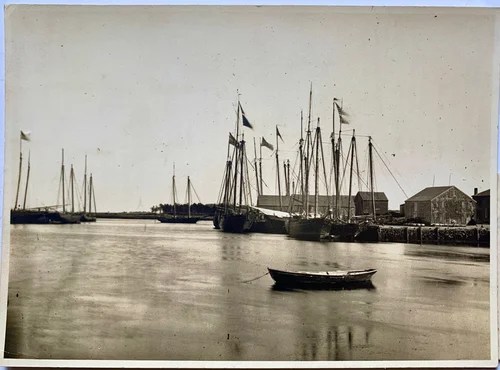
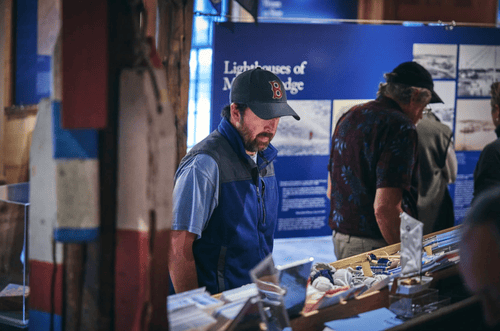
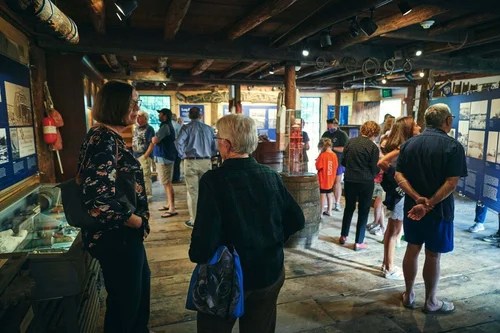
“Cohasset: In Port” (first floor) features the maritime history of Cohasset, from the earliest Indigenous people to the 19th-century community that supported shipbuilding and the fishing industry to today’s recreational boaters.
Recently reinterpreted, the second floor, “Cohasset: At Sea,” explores both the challenges of life at sea for deep sea captains and crew and the women who sometimes accompanied them; chronicles the many shipwrecks off the Cohasset rocks; and showcases the Society’s ship models and navigational instruments.
See us featured on WCVB Chronicle!
The Maritime Museum remains one of the earliest commercial maritime structures in the state. Samuel Bates, a deep sea captain and businessman, built the chandlery to outfit his own schooners as well as other local vessels.
In 1905, Clarence Walker Barron, a summer resident and the owner of the Wall Street Journal, Dow Jones, and Barron’s Magazine, saved the chandlery (originally located on Border Street) from certain demolition by the town (an early effort to clean up the harbor) and used it as a boathouse and as an art studio.
Later, his granddaughter Jessie Bancroft Cox gave the two-story frame structure to the Society. In 1957, it was moved to its present location on Elm Street, to the east of the Society’s Captain John Wilson House, home of another seafarer.
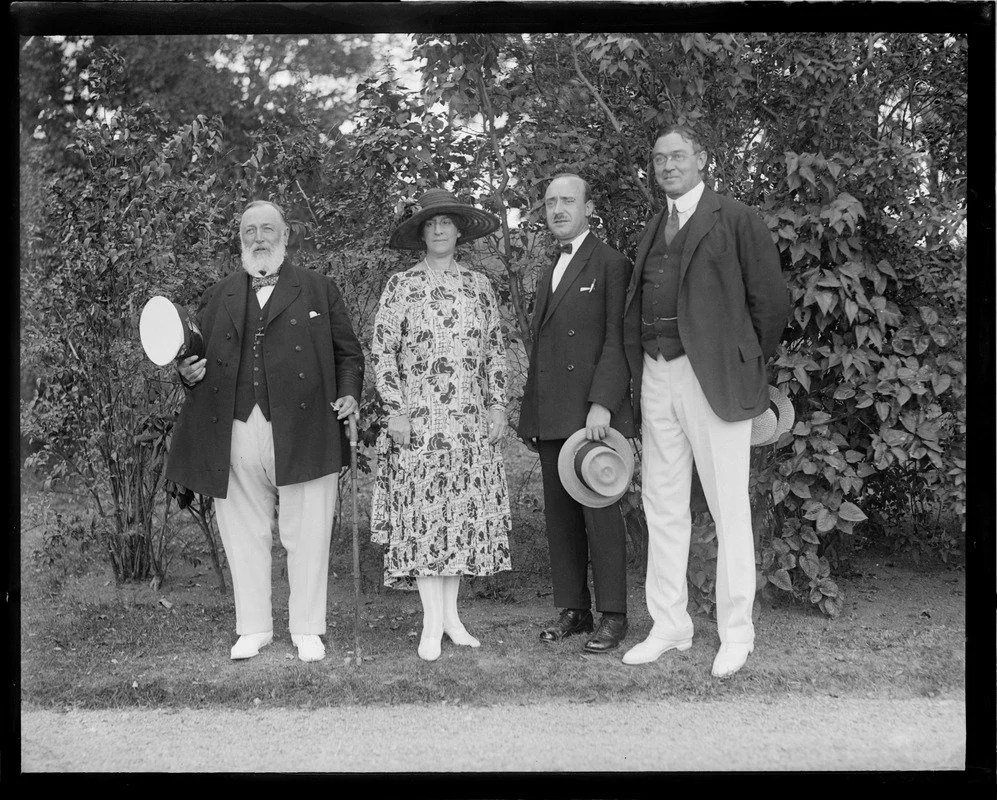
View some of the museum’s collection
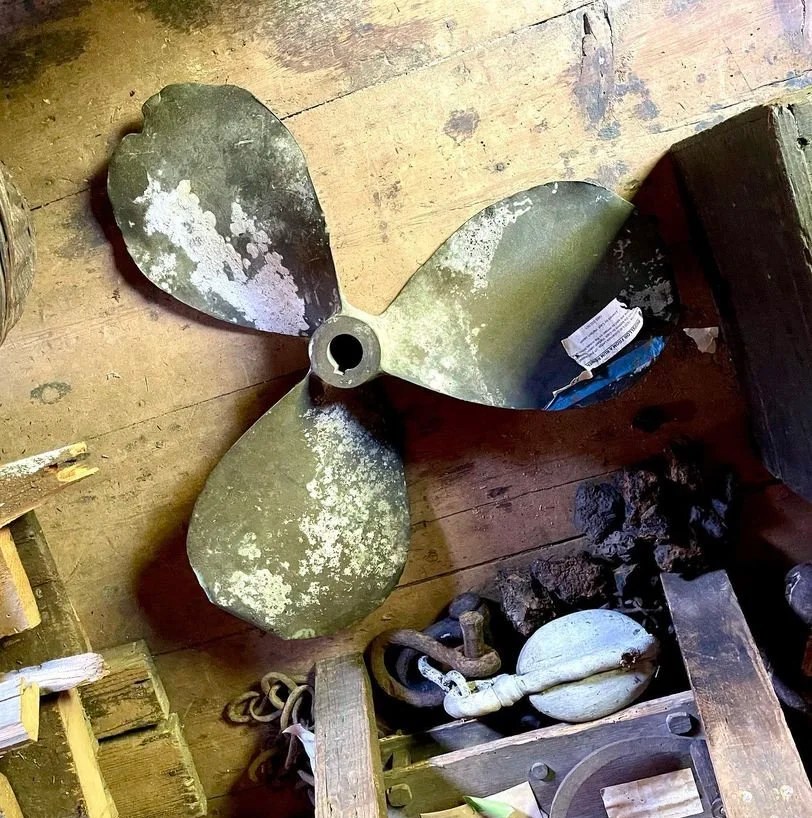
This ship propeller is from a rum runner wrecked off of Cohasset in the 1930s.
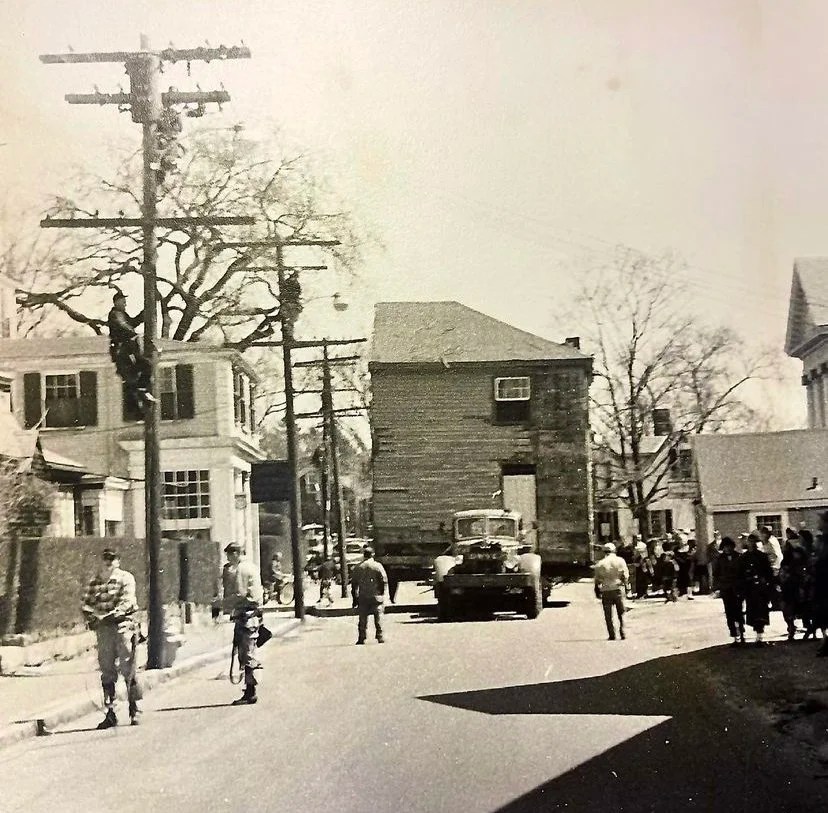
The Maritime Museum being moved from Boarder Street to the current location at 6 Elm street in 1957.
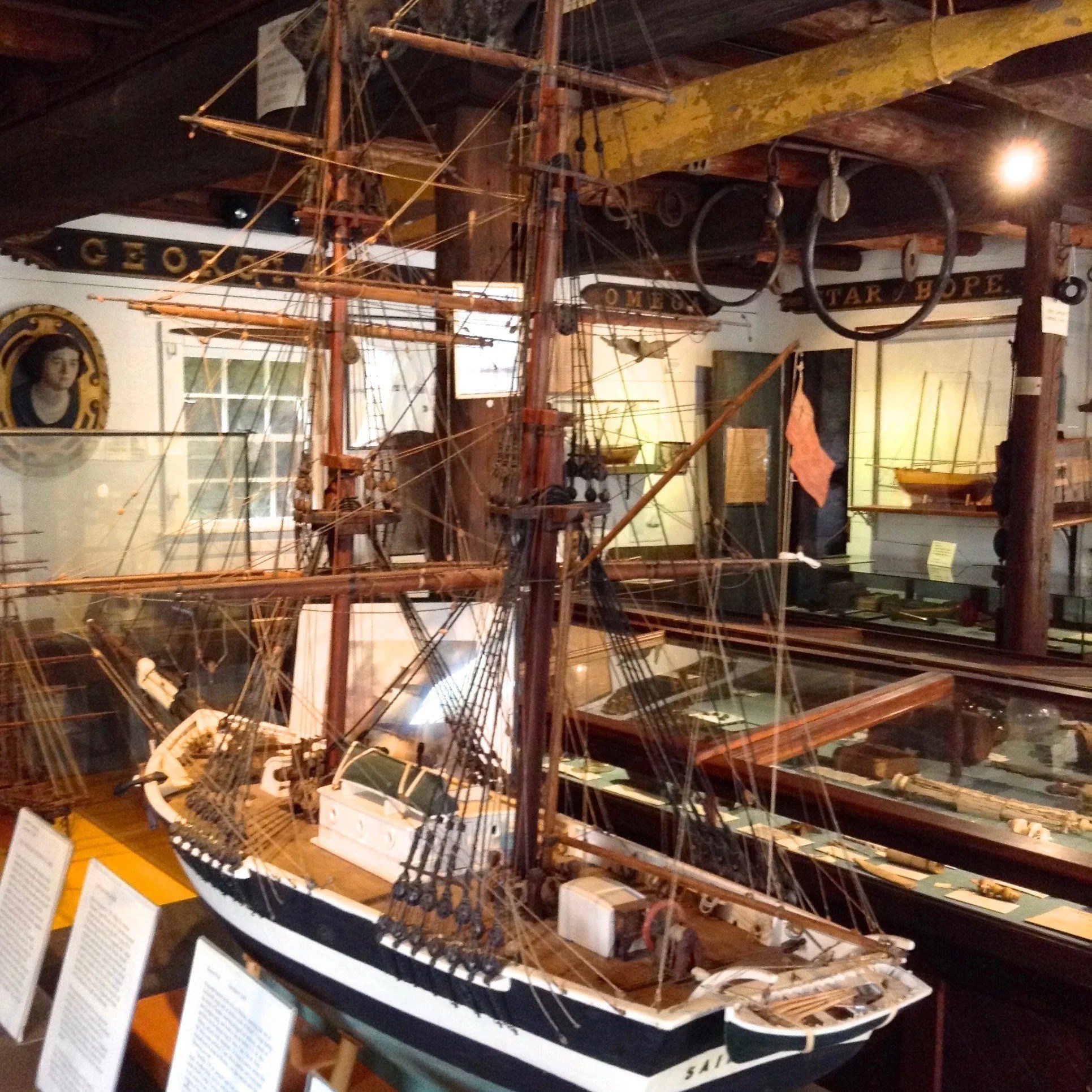
Model of the Brig St. John wrecked off the coast of Cohasset in 1849.
===============
Coffin Ship: The Wreck of the Brig St. John by William Henry
The Great Famine drove huge numbers to leave Ireland and pursue new lives in foreign lands. In 1847 some 200,000 people sailed for Boston alone. Of this number, around 2,000 people never made it to their destination, killed by disease and hunger during their voyages. Others survived the crossing, only to be lost within sight of the New World.
€16.00
3 in stock Coffin Ship: The Wreck of the Brig St. John by William Henry quantity
=============

On This Day: 99 Great Hunger refugees died off the coast of Massachusetts in 1849
A total of 99 Galway emigrants perished in sight of the land where they hoped to start their new lives.
IrishCentral Staff
Oct 07, 2021
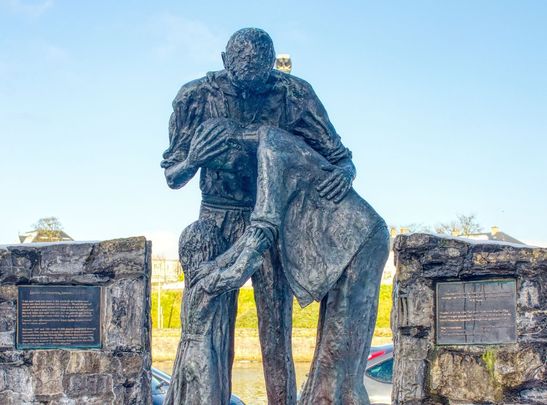
A statue in memorial of those lost in the Great Hunger, in Sligo town. Tourism Ireland
After escaping the devastation of the Great Hunger, leaving Galway on a coffin ship, the St. John, 99 emigrants lost their lives in a shipwreck on the shores of Cohasset, Massachusetts, on Sunday, October 7, 1849.
The 99 men, women and children were en route to start their new lives in America and tragically died within sight of the land they hoped to make their new home. The wreck was the worst in Cohasset’s history.
The ship weighing 200 tons was Irish owned and onboard were nine crew members as well as their passengers from North Clare and Connemara.
On that fateful Sunday morning, the brig St. John encountered a severe storm. The ship’s captain, Martin Oliver, dropped anchor two and a half miles off the coast in the hope that they could ride out the storm. The anchors failed to hold that the ship was washed onto submerged rocks, known as the Grampus Rock.
Read more
- Great Hunger Museum officially closed, Attorney General asked to investigate
- How Irish Famine immigrants created a new life in Boston
The ship’s hull was torn apart by the rocks and the emigrants flung from the hull into the sea. The crew cut away the masts and sails in an attempt to lighten the ship and escape from the rocks but to no avail. Within an hour the ship’s hull was in pieces and bodies began to wash ashore.
There were only an estimated 20 survivors from the St. John tragedy, Captain Oliver among them. Entire families were wiped out including emigrant Patrick McSweeney who died attempting to save his wife and nine children. None survived.
Days later the author Henry David Thoreau and his friend, the poet Ellery Channing, visited the area on an excursion to Cape Cod. He wrote of the devastation he witnessed in the June 1855 issue of Putnam’s Magazine. In Boston, he saw fliers reading “Death! 145 lives lost at Cohasset!” and so they decided that they would travel to witness the tragic aftermath.
When he arrived, Thoreau observed the town still in a state of confusion and the waves from the storm still breaking on the rocks. On the way to the site of the wreck, he noted a graveyard with a “large hole, like a cellar, freshly dug there” and seeing several wagons coming from the beach loaded with roughly made boxes. On the hillside near the water, he saw the bodies “marble feet and matted heads” all around him with “wide-open and staring eyes.” By this time days later it’s believed that only 28 bodies had been removed from the water.
Fifty-nine years after the shipwrecked the fraternal society, the Ancient Order of the Hibernians and the Ladies Auxiliary (now known as the Ladies Ancient Order of Hibernians) erected a 20-foot high Celtic Cross in Cohasset to honor the dead. At the memorial’s dedication ceremony in 1914 dignitaries of the time along with 15,000 brother and sister Hibernians were in attendance.
Source: Thoreau.eserver.org.
* Originally published in 2014.
Love Irish history? Share your favorite stories with other history buffs in the IrishCentral History Facebook group.
===========
Another Irish emigration sailing disaster
I have previously recounted the sorry tale of the plight of dozens of poor Sligo natives who were attempting to escape famine conditions in 1848 by sailing to the Port of Liverpool for onward connections to other far-flung destinations. Half of the passengers never made it beyond Londonderry. Read more here: Sligo sailing disaster. Below is an account of another tragedy at sea, less than 12 months later, this time involving over a hundred souls fleeing from the north-west of County Clare and Connemara in County Galway.
On 7th September 1849, the St John, a brig of about 200 tons, sailed out of Galway harbour bound for Boston. She was owned by Henry Comerford of Galway and Ballykeale House, Kilfenora, and Captain Oliver from Bohermore in County Galway was in command. Aboard were nine crew members and about a hundred passengers in two main parties from Clare and Connemara, although later investigations asserted that the captain might have been illegally carrying another 30 emigres not entered on to the official manifest. On Saturday 6th October, the ship came close to land near Cape Cod almost at the end of her journey to Massachusetts Bay. The voyage had been a good one and so the captain issued a ration of grog to the crew in celebration. Captain Oliver suggested to the passengers that they too might celebrate their last night aboard the St John. The Irish human cargo had every reason for merriment; they had left far behind them a country of starvation, disease and death. The voyage had been less of a trial then they had expected and they were in sight of the shores of the Promised Land. They hurried to decorate the rigging and decks with candles and passed the night with traditional Irish songs and dance.
At five o’clock in the evening the brig passed Cape Cod Light and by one o’clock in the morning the First Mate guided the St John around Scituate Light. All of a sudden, the ship caught the wind of a fierce north-easterly gale and was soon being driven towards the shore. The rigging was hurriedly adjusted and a new, safer course was set. By daylight, the gale had become a full storm and the ship was being blown southwards along the Massachusetts coast. An hour later, on a mountainous sea, the St John was sighted at the mouth of Cohasset Bay. Inexorably the wind drove the little ship closer and closer towards the shore, with all hands on deck fighting to regain control of the St John over insurmountable elements. It was to no avail; the sails were now in shreds and the storm too powerful to fight. Both anchors were dropped but they dragged. As a last resort, Captain Oliver had both masts cut away but the wind and seas were relentless and the brig was helplessly forced onto Grampus Ledge. It was then about seven o’clock on Sunday morning.
Enormous waves lifted the stricken vessel and smashed her again and again on the rocks. The impact broke her back and opened her seams. A hole was quickly broken in her hull and those below decks were drowned within minutes. Pounded against the rocks, the brig began to break up. Horrified spectators saw people being “swept in their dozens” into the boiling surf from the crowded decks. Even though they were deafened by the howling of the wind and the thunder of the seas, the watchers were convinced that they could hear the screams of the unfortunates as they were dragged to their deaths. Sickeningly, there was nothing any bystander could do to help.
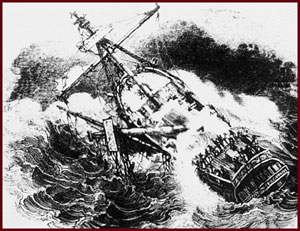
The jolly boat (or tender) had been hanging by its tackle alongside the brig. Suddenly, the stern rigging bolt broke and the small jolly boat fell into the water, in danger of being swept away. The captain, the second mate, two of the crewmen and two apprentice boys jumped into the maelstrom and managed to secure her, but immediately about twenty-five frenzied passengers attempted to board the little boat and it was swamped. Of the people in or around the jolly boat, only one survived – Captain Oliver, who managed to grab a rope which was hanging from the main deck and was pulled aboard the ship by the first mate, Henry Comerford (believed to be a nephew of the ship’s owner of the same name).
Another group of passengers jumped into the water in an attempt to reach the overturned jolly boat, but they all perished in the cruel sea. By now the main ship was rapidly disintegrating. The water around her was strewn with wreckage to which people clung desperately even though they were again and again buried beneath tons of water as the colossal waves broke over them. The captain, the first mate and the remaining seven members of the crew eventually succeeded in re-securing the jolly boat using grappling hooks and all safely swam to and (shamefully) boarded the makeshift lifeboat and headed off to shore; only one stranded passenger was collected en route.
By eight a.m. the ship had completely broken up and the worst horror was over. In total, eight women and four men had made their own way to the shore, semi-conscious through exhaustion. Two passed away on the beach and the remainder had to have their hands prised from the wreckage which had saved their lives. News of the disaster spread along the American coastline and by early afternoon the shore was lined with people who worked unsparingly to resuscitate the living and retrieve the dead. The survivors had many stories to tell. Two of the women who had fought their way ashore had each lost three children. The human loss was horrendous. A man called Patrick Sweeney of Galway perished with his wife and nine children. Many of the recovered bodies were badly mutilated by the jagged rocks, yet Sally Sweeney’s features were reportedly “calm and placid as if she were enjoying a quiet and pleasant slumber.” There was one tiny miracle: Mr Lathrop, in whose house the survivors found shelter, waded into the surf to retrieve a parcel of clothing and discovered that he had an infant in his arms. Some days later the baby was said to be in excellent health.
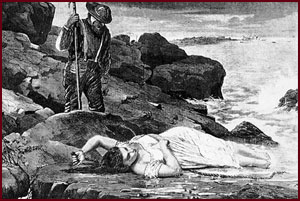
A newspaper report of the time says that forty-six bodies had been taken from the sea by nightfall, and that they were coffined in rough deal wood boxes on the beach. The storm raged on at sea for two more days as religious ceremonies on the shore and in the local cemetery took place. Immigrant family relatives rushed from waiting rooms at Boston Harbor to the scene upon hearing news of the disaster. Irish women howled each time a loved one was recognized in the lines of wooden boxes. Many unclaimed victims were buried in a common grave on Tuesday. The funeral party was headed by the captain and the survivors.
Sixty-five years later a huge granite Celtic Cross was raised over the mass grave, sited on the highest point of Cohasset Central Cemetery so as to command a view of the bay. The cross bears the inscription: “This cross was erected and dedicated May 30, 1914, by the A.O.H. and the I.A.A.O.H. of Massachusetts to mark the final resting place of about forty-five Irish immigrants from a total company of ninety-nine who lost their lives on Grampus Ledge off Cohasset October 7, 1849, in the wreck of the brig St John from Galway, Ireland. R.I.P.“
If you can stomach an even more harrowing version of events, here’s a link to newspaper reports of the time: 1849 St John disaster
List of Survivors and Drowned (complete with spelling errors)
Crew saved (9)
Captain . . . Oliver; Henry Cummerford, 1st Mate;
Sailors: Henry O’Hern, Michael Kennelly, William Larkin, Isaac Cummerford, Thomas Walker, James
Flathery, Andrew Frost:
Crew lost (sailors (7) ):
Antonio McDonough, William Thompson, Michael Conners, William Angiers, Edward Kennelly, 2
apprentice boys.
Passengers saved (with ages) : (11)
Austin Kearin – 20, Betsy Higgins – 21, Michael Fitzpatrick – 26, Barbara Kennelly – 20, Michael
Redding – 24, Mary or Honor Burke – 27 (lost 3 children), Catherine Flannagan – 20, Mary Kane – 24,
Michael Gibbon – 26, Mary Slattery – 20, Hanora Cullen – 28 (lost 3 children), and Mrs Quinlan.
Cabin passengers lost (5)
of KILNARE, COUNTY CLARE: Mary Flannigan, Nancy Hannagan, Margaret Hannagan.
of INISTIVAN, COUNTY CLARE; Bridget Quinn, Eliza O’Brien
Steerage passengers lost (90)
of INISTIVAN, COUNTY CLARE: Ann Slattery, Bridget Slattery, Hugh Madigan, Margaret Keenan
of KUNNANMAR, COUNTY GALWAY: Bridget Connelly, Patrick Sweeney, wife, 9 children
of GALWAY; Patrick Corman, Miles Sweeney, Thomas Burke, Eliza Burke, Mary McDermott, Joyce
McDermott & child, Catharine Fitzpartick, Bridget Burke, Peggy Purkey.
of LALINEN, COUNTY CLARE: Michael Hannagan.
of KILLANARA, COUNTY CLARE: Patrick Lahiff, John Lahiff, Thomas Riley, Bridget Maddigan
of INNISTIVAN, COUNTY CLARE: Hugh Glynn
of GALWAY: John Belton, Mary Dolan, Thomas Fahey, Bridget Fahey, Martha Fahey, Honora
Donnelly, Honora Mullen, sisters Catherine Henniff and . . . . Henniff, Mary Cahill, Patrick Noonan,
Mary Landsky. Meggy Mullen & sister’s child, John Butler
of ROAN, COUNTY CLARE: Bridget McMahan, Patrick McMahan, Catherine McMahan, Mary Nalon,
Mary Frowley & child
of INNES, COUNTY CLARE: Mary Freeman & child, Mr. Egan, wife & daughter
of DYANT, COUNTY CLARE: Martin Sexton, Jeremiah Murphy, James Moran
of ISSISTIVAN, COUNTY CLARE: Margaret Keenan, Miss Brooks
of ANCH, COUNTY CLARE: Daniel Byrnes, Michael Griffen, Catherine Burnes, Peggy Molloy, Ellen
Hassett
of KILMARY: Patrick McGrath, James McGrath, Winny Galvin, Mary Galvin, Margaret Kane, Mary
McNamara
of CLARE: Honora Lahiff or Rohan, John Lahiff or Rohan, Mary Curtis, Honora Mulkenan, Mary
Mulkenan, Margaret Mulkenan.
=============
Clare Libraries Local Studies
MenuSearch
- Home
- History
- Shipwrecks
- The Shipwreck of the St. John
- Shipwreck of St John – Awful Shipwreck at Minot’s Ledge
Shipwreck of St John – Awful Shipwreck at Minot’s Ledge
The Shipwreck of the St. John
Report from the Galway Vindicator:
About One Hundred Drowned – Men, Women And Children
We are indebted to our much respected friends from the Messrs Train & Co., the extensive Shipping and Emigration Agents of Liverpool, for the following melancholy intelligence, as also to our valued friend, John Moore, Esq., Post Office Pack-inspector of Boston, and formerly a citizen of Galway: –
The brig St. John, Capt. Oliver, from Galway, the property of Mr. H. Comerford, of this town [Galway], anchored inside of Minot’s Ledge, Saturday, Sept. 5th. At about 7 o’clock a.m., on Sunday morning, she dragged her anchors and struck the rocks.
The following particulars of her loss, together with that of 99 of her passengers and crew, is gleaned from the various persons who witnessed the disaster: –
The vessel struck at about 7 a m. yesterday. The scene was witnessed from Glade House, and is represented to have been terrible. The sea ran mountains high, and as soon as she touched, the waves swept the unfortunate human beings upon her crowded decks by dozens into the sea. The spectators of this awful sight imagined that they could hear the cries of the victims as they were swept away, but as no boat, save the life-boat, could have lived in the gale, it was found impossible to render aid.
The life-boat left Cohasset early in the morning, and went to the aid of a British brig which was in danger at the mouth of the harbour, and carried her to a place of safety. They did not however visit the wreck, supposing that the long boat which they met going towards the shore, contained all that belonged to her.
When the St. John struck, her small boat was got ready, but was swamped at the side by the large number jumping into her. Shortly after the long boat broke her fastening, and floated off from the vessel. The captain and several others swam to and got on board of her, and landed in safety near Glade House. The second mate, two men and two boys of the crew were drowned.
After the ship struck the rocks, she thumped awhile, but shortly went to pieces, holding together not more than fifty or sixty minutes. Seven women and three men came ashore on pieces of the wreck, alive, but some very much exhausted. Two dead bodies were also taken from pieces of the wreck.
Early in the forenoon, the news of the wreck began to spread, and in the afternoon, the shore was lined with people who were active in getting bodies from the surf. Mr. Holmes, railroad conductor, was busy during the entire day in aiding the living and rescuing the dead bodies from the waves. One man, whose name we did not learn, came near losing his life in rescuing a body from the surf.
Towards nightfall the bodies began to come ashore and quite a number were taken from the surf, all, however, dead. Dead bodies were thrown upon the rocks, but before they could be rescued, the sea would carry them back again.
Quite a number of her passengers, especially women and children, were below when she struck, and were probably drowned there, as a hole was almost instantly thumped in her bottom. The long boat that reached the shore in safety contained, in addition to the captain and crew, only one passenger. Of the 7 first class passengers, who were all lost were three girls, nieces of the owner of the vessel. Great difficulty was experienced in saving those who came ashore on the pieces of the wreck, on account of the surf, which would throw them upon the rocks and then carry them to sea again. The poor creatures would cling with a death-grasp to the clothes of those who came to rescue them, and were with difficulty made to release their hold, even after having reached a place of safety.
One woman saved was very badly bruised upon the rocks, and it was thought last night that she would die, but she is this morning most comfortable.
It is stated that one passenger, clinging to a piece of a wreck, floated to the rocks, but was so far gone as to be unable to unclench his hand. Finally someone jumped on the fragment, made fast a rope to him, and he was got ashore. His face of a deep purple, his open mouth, fixed teeth, and deathly eyes, formed a sight long to be remembered.
So far only 26 dead bodies have been recovered, but the surf which yet runs very high is full of them. Before nightfall many more will doubtless be taken out. The shore is strewed with the baggage of the passengers all stove to pieces.
LATER ACCOUNTS
Capt. Oliver and his surviving mate reached this city at twelve o’clock. He states he made Cape Cod Light about 5 o’clock on Saturday evening, Scituate Light near 1 o’clock on Sunday morning; then stood away to the northward, to clear the land, for about three hours; then, it being about daylight, tacked ship and stood S.S.W., weather very thick; he came inside of Minot’s Light House, and there saw a brig lying at anchor just inside of breakers, at a place called Hocksett Rock; tried to wear away up to the brig, but found he could not fetch up, and threw over both anchors, which dragged; he then cut away her masts, and she drifted on to Grampus Ledge, where she went to pieces.
Previous to breaking up, the jolly-boat was hanging by the tackle, alongside, when the stern rigging bolt broke and the boat fell into the water. The captain, second mate, and two boys jumped in to get her clear, when about 25 passengers jumped in and swamped her. The twenty-five, together with second mate and two boys perished; the captain caught a rope hanging over the quarter, and was drawn on board by the first mate.
When the long boat was got clear a number of passengers jumped over to swim to her, but all perished. The captain, first mate (Mr. Crawford), and seven of the crew swam to and reached the boat.
The names of the drowned are probably unknown to the captain. He reports 120 souls on board, 21 of whom were saved, leaving 99 lost. The brig was in ballast.
All of the survivors were taken to Mr. Lathrop’s house. They were chilled, bruised, and many of them senseless. Dr. Foster, the able and philanthropic physician of the village, attended them professionally, and it required untiring perseverance and skill to restore them. All but two of them are in a fair way of recovery. Mrs. Quinlan was struck upon the head with a very heavy piece of timber, which inflicted a severe wound, and she was otherwise both internally and externally injured. She will, however, speedily recover. Honora Burke is in a more critical situation. She was severely injured, and the struggle between life and death in her case has been a severe one. She appears much better this morning, and were it not that she is likely to become a mother in a short time, the Doctor could speak confidentially in her case.
A watch was set all night on the beach, to rescue what bodies from the water that might be cast ashore. Mr. Lathrop, at whose house the survivors were taken, relates an incident that is at once touching and affecting. The waves were dashing high before him, and upon their crested tops, as they were breaking upon him, he saw what he thought was a small package of goods. While watching to save even this small relic from the doomed vessel, it fell upon him striking upon his face. He reached forth his arm and grasped it – when, lo, he held an infant yet alive. He placed it in safety and that infant is now doing well in the family of a Mr. Gove, in this town.
From further conversation with the passengers and people of the town, it is certain to our mind, that Captain Oliver is liable to severe censure for some parts of his conduct. We would be the last to say one word the would add to the poignancy of his feelings in view of his great disaster; but, in a question involving the lives of more than one hundred fellow beings, we are bound to speak faithfully, the truth, as it has been presented to us.
It seems that on the afternoon of Saturday 6th inst., he numbered his passengers. Upwards of one hundred names were borne upon the manifest, or list, as two passengers called it who answered to the call. A line was then drawn across the deck, and between twenty and thirty other names were borne upon a small memorandum book. If the consignee has a duplicate list of passengers he or they should produce it. Unless a complete list can be produced we can never fully ascertain the exact number who perished on board this vessel on the fatal morning of October 9.
It is stated by three of the passengers that, on the afternoon of Saturday after they had made Provincetown Light, the Captain mustered his passengers on deck and joyfully assured them that the last night of their confinement on board had arrived. A sad truth and most fearfully realised. His passage had been a good one and he felt elated. The simple and light-hearted passengers in the exuberance of their feelings prepared for an illumination; the deck and rigging were decorated with candles and dance and song wore away the evening of their LAST NIGHT ON BOARD THE ST. JOHN. The Captain dealt out his crew a treat of ardent spirits, and all on board participated in the joys and hopes incident to the termination of an Atlantic passage. Sad, sad, finale to their journey.
The following are the names of the few passengers who were saved: – Austin Kearin, Catherine Flanagan, Betsy Higgins, Mary Keane Michael Fitzpatrick, Michael Gibbon, Barbara Kennelly, Mary Slattery, Michael Redding, Honor Cullen, Honor Burke, and Mrs. Quinlan.
From The Galway Vindicator
Clare County Library wishes to thank Clare Local Studies Project
for preparation of text for this publication.
- Home
- History
- Shipwrecks
- The Shipwreck of the St. John
- Shipwreck of St John – Awful Shipwreck at Minot’s Ledge
- Shipwreck of St John – The Burial of the Victims
- Brig St. John of Galway – List of Survivors and Drowned
- The Shipwreck of the St. John
- Shipwrecks
- History
==============
*** the world of Gearóid O’Neary ***
Search
Main menu
Post navigation
Another Irish emigration sailing disaster
I have previously recounted the sorry tale of the plight of dozens of poor Sligo natives who were attempting to escape famine conditions in 1848 by sailing to the Port of Liverpool for onward connections to other far-flung destinations. Half of the passengers never made it beyond Londonderry. Read more here: Sligo sailing disaster. Below is an account of another tragedy at sea, less than 12 months later, this time involving over a hundred souls fleeing from the north-west of County Clare and Connemara in County Galway.
On 7th September 1849, the St John, a brig of about 200 tons, sailed out of Galway harbour bound for Boston. She was owned by Henry Comerford of Galway and Ballykeale House, Kilfenora, and Captain Oliver from Bohermore in County Galway was in command. Aboard were nine crew members and about a hundred passengers in two main parties from Clare and Connemara, although later investigations asserted that the captain might have been illegally carrying another 30 emigres not entered on to the official manifest. On Saturday 6th October, the ship came close to land near Cape Cod almost at the end of her journey to Massachusetts Bay. The voyage had been a good one and so the captain issued a ration of grog to the crew in celebration. Captain Oliver suggested to the passengers that they too might celebrate their last night aboard the St John. The Irish human cargo had every reason for merriment; they had left far behind them a country of starvation, disease and death. The voyage had been less of a trial then they had expected and they were in sight of the shores of the Promised Land. They hurried to decorate the rigging and decks with candles and passed the night with traditional Irish songs and dance.
At five o’clock in the evening the brig passed Cape Cod Light and by one o’clock in the morning the First Mate guided the St John around Scituate Light. All of a sudden, the ship caught the wind of a fierce north-easterly gale and was soon being driven towards the shore. The rigging was hurriedly adjusted and a new, safer course was set. By daylight, the gale had become a full storm and the ship was being blown southwards along the Massachusetts coast. An hour later, on a mountainous sea, the St John was sighted at the mouth of Cohasset Bay. Inexorably the wind drove the little ship closer and closer towards the shore, with all hands on deck fighting to regain control of the St John over insurmountable elements. It was to no avail; the sails were now in shreds and the storm too powerful to fight. Both anchors were dropped but they dragged. As a last resort, Captain Oliver had both masts cut away but the wind and seas were relentless and the brig was helplessly forced onto Grampus Ledge. It was then about seven o’clock on Sunday morning.
Enormous waves lifted the stricken vessel and smashed her again and again on the rocks. The impact broke her back and opened her seams. A hole was quickly broken in her hull and those below decks were drowned within minutes. Pounded against the rocks, the brig began to break up. Horrified spectators saw people being “swept in their dozens” into the boiling surf from the crowded decks. Even though they were deafened by the howling of the wind and the thunder of the seas, the watchers were convinced that they could hear the screams of the unfortunates as they were dragged to their deaths. Sickeningly, there was nothing any bystander could do to help.
Privacy Settings
The jolly boat (or tender) had been hanging by its tackle alongside the brig. Suddenly, the stern rigging bolt broke and the small jolly boat fell into the water, in danger of being swept away. The captain, the second mate, two of the crewmen and two apprentice boys jumped into the maelstrom and managed to secure her, but immediately about twenty-five frenzied passengers attempted to board the little boat and it was swamped. Of the people in or around the jolly boat, only one survived – Captain Oliver, who managed to grab a rope which was hanging from the main deck and was pulled aboard the ship by the first mate, Henry Comerford (believed to be a nephew of the ship’s owner of the same name).
Another group of passengers jumped into the water in an attempt to reach the overturned jolly boat, but they all perished in the cruel sea. By now the main ship was rapidly disintegrating. The water around her was strewn with wreckage to which people clung desperately even though they were again and again buried beneath tons of water as the colossal waves broke over them. The captain, the first mate and the remaining seven members of the crew eventually succeeded in re-securing the jolly boat using grappling hooks and all safely swam to and (shamefully) boarded the makeshift lifeboat and headed off to shore; only one stranded passenger was collected en route.
By eight a.m. the ship had completely broken up and the worst horror was over. In total, eight women and four men had made their own way to the shore, semi-conscious through exhaustion. Two passed away on the beach and the remainder had to have their hands prised from the wreckage which had saved their lives. News of the disaster spread along the American coastline and by early afternoon the shore was lined with people who worked unsparingly to resuscitate the living and retrieve the dead. The survivors had many stories to tell. Two of the women who had fought their way ashore had each lost three children. The human loss was horrendous. A man called Patrick Sweeney of Galway perished with his wife and nine children. Many of the recovered bodies were badly mutilated by the jagged rocks, yet Sally Sweeney’s features were reportedly “calm and placid as if she were enjoying a quiet and pleasant slumber.” There was one tiny miracle: Mr Lathrop, in whose house the survivors found shelter, waded into the surf to retrieve a parcel of clothing and discovered that he had an infant in his arms. Some days later the baby was said to be in excellent health.
Privacy Settings
A newspaper report of the time says that forty-six bodies had been taken from the sea by nightfall, and that they were coffined in rough deal wood boxes on the beach. The storm raged on at sea for two more days as religious ceremonies on the shore and in the local cemetery took place. Immigrant family relatives rushed from waiting rooms at Boston Harbor to the scene upon hearing news of the disaster. Irish women howled each time a loved one was recognized in the lines of wooden boxes. Many unclaimed victims were buried in a common grave on Tuesday. The funeral party was headed by the captain and the survivors.
Sixty-five years later a huge granite Celtic Cross was raised over the mass grave, sited on the highest point of Cohasset Central Cemetery so as to command a view of the bay. The cross bears the inscription: “This cross was erected and dedicated May 30, 1914, by the A.O.H. and the I.A.A.O.H. of Massachusetts to mark the final resting place of about forty-five Irish immigrants from a total company of ninety-nine who lost their lives on Grampus Ledge off Cohasset October 7, 1849, in the wreck of the brig St John from Galway, Ireland. R.I.P.“
If you can stomach an even more harrowing version of events, here’s a link to newspaper reports of the time: 1849 St John disaster
==============
Brig St. John

On the 6th. September 1849 the Brig St. John departed Galway bound for Boston. She dropped anchor at Lettermullen, Connemara, to take on additional passengers. The Master was Martin Oliver from Galway. She had a crew of sixteen. Due to incomplete documentation, the total number of passengers remains disputed and unknown. They came from Galway, Connemara, and Co. Clare. She arrived off Cape Cod lighthouse at 5 pm. on the evening of the 6th. October, having crossed the Atlantic in good time under favorable conditions. In the early hours of Sunday, the 7th, off Scituate light, a sudden and unexpected violent storm erupted. St. John changed course a number of times to counteract the shifting wind and maintain her course. The masts had to be cut to maintain stability. The anchors were dropped but failed to hold. St. John was driven, out of control, before the storm. She was wedged firmly between the rocks at Grampus Ledge, Cohasset (42-15-57N. 70-46-48W). where she was pummelled to destruction. The steamer ‘R B Forbes’ from Boston sailed to her rescue but had to abandon the attempt. The Cohasset lifeboat also tried but due to bad communication with Martin Oliver, poor visibility, and confusion with another ship, the Kathleen, the attempt failed. The death toll was estimated to be between one hundred and forty-four and one hundred and sixty-four passengers and crew. (Source: The Northern Maritime Research, Canada) Forty-five bodies were washed ashore in Cohasset. The remainder were never recovered. There were twenty-two survivors.
St. John was a two hundred-ton cargo ship with two masts. Her design was classed as a Brig. The shipyard of construction is unknown. On Thursday, July 30, 1840, The Connaught Journal reported that the Brig John of Youghal went aground off Mutton Island, Galway, the previous Saturday. She was floated and towed to Nimmos Pier where she sank. This may well be St. John that Henry Comerford of Merchants Rd., Galway, and Ballykeale House, Kilfenora, Co. Clare, used to transport the unfortunate emigrants to America on the 6th September 1849. The writer Henry David Thoreau wrote afterward that some of the wreckage of St. John on the beach of Cohasset was “so rotten that I could almost thrust my umbrella through them.”


