·
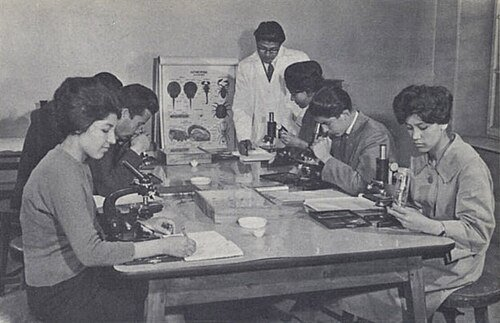
Female students attending a biology laboratory class at Kabul University during the late 1950s or early 1960s… One of the most persistent misconceptions about Afghan women is that their exclusion from public life is somehow an ancient and unbroken tradition.
Afghanistan’s own history tells a far more complicated story. Afghan women were granted voting rights in 1919, a year before the United States ratified the 19th Amendment guaranteeing women the vote nationwide. The reform came during the reign of Amanullah Khan, whose government pursued an ambitious program of modernization.
Afghanistan’s first girls’ school followed in the early 1920s. Progress was neither smooth nor universal. Amanullah’s reforms provoked fierce resistance, particularly outside Kabul, and some were reversed after he was forced from power in 1929. For decades, the lives of urban, educated women could look dramatically different from those of women in conservative rural communities.
Still, another major shift arrived in the 1960s. Afghanistan’s 1964 constitution introduced a more democratic political system and expanded women’s political rights. Women could vote and stand for office, and four women entered parliament after the 1965 elections. The period also brought greater numbers of women into universities, government offices and professional careers.
UN Women describes the 1964 constitution as an important step toward civil and women’s rights. It would be misleading to describe Afghanistan in the 1960s as a country where women enjoyed complete equality in everyday life.
Legal reform did not erase deeply rooted inequalities, and its benefits were especially concentrated in cities. But the photographs of Afghan female students, doctors, teachers and government workers from this period are not evidence of some foreign fantasy imposed on the country. They document a real chapter of Afghan history.
That history makes the present situation particularly stark. Since returning to power in 2021, the Taliban has systematically restricted women’s access to education, employment and political and public life. Afghan women did not begin asking for rights in the twenty-first century. They had already been exercising many of them generations ago.