
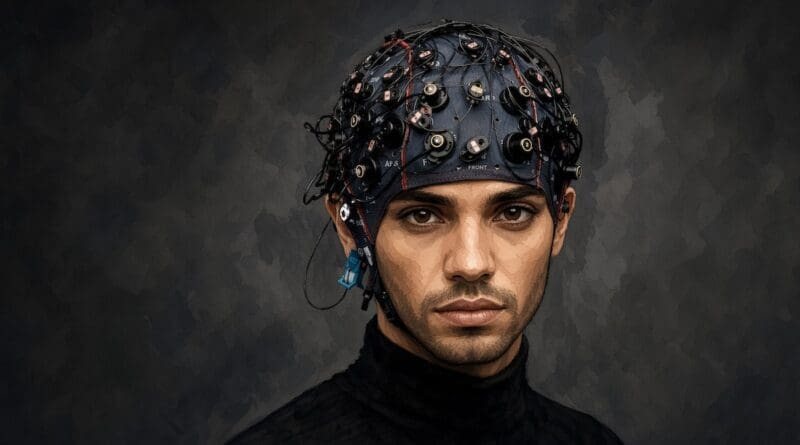
Image: Grok
Shaping The Future Of Neurotechnology: India’s Brain-Computer Interface Ecosystem – Analysis
FacebookTwitterEmailFlipboardMastodonLinkedInShare
Playlist advancing in 5 seconds
Video Unpaused
Key Takeaways
- Brain-Computer Interfaces are rapidly advancing from science fiction to practical medical tools that enable thought-controlled devices, restore communication and mobility for people with paralysis, and improve treatment of neurological conditions, with the global market expected to reach approximately US$6.2 billion by 2030.
- India has focused primarily on affordable, non-invasive wearable BCIs (such as hybrid EEG-fNIRS systems developed at IIT Delhi) for assistive communication, neurorehabilitation and cognitive enhancement, aligning research with domestic healthcare needs amid a sharply rising national burden of neurological disorders.
- Translating laboratory advances into clinical products remains limited by funding, clinical-trial infrastructure and industry collaboration, while specialised governance is needed for neural privacy, data ownership and safety; a National Neurotechnology Task Force is proposed to coordinate standards, trials, regulation and ethical oversight.
The idea of controlling a computer, wheelchair, or robotic limb using only human thought has rapidly moved from the realm of science fiction to real-world medical innovation. Brain-Computer Interfaces (BCIs) are emerging as one of the most transformative technologies of the twenty-first century. These systems establish a direct communication pathway between the human brain and external devices by translating neural activity into digital commands. Their applications are already transforming healthcare by enabling individuals with paralysis to communicate, restoring mobility through robotic prosthetics, and improving treatment options for neurological conditions such as Parkinson’s disease, epilepsy, and age-related vision impairment.
The significance of BCIs continues to grow as neurological disorders become one of the world’s largest public health challenges. Today, these disorders affect more than 3.4 billion people globally, making them the leading cause of disability and poor health. At the same time, advances in artificial intelligence have dramatically improved scientists’ ability to interpret complex brain signals, accelerating the development of increasingly sophisticated neural interface technologies. Together, neuroscience and AI are driving a technological revolution that promises to redefine healthcare, rehabilitation, and even human-machine interaction.
Recognising this immense potential, governments and private companies worldwide are investing heavily in neurotechnology. China has already implanted its Beinao No. 1 brain-computer interface in patients, marking a significant milestone in clinical neurotechnology. Similarly, companies such as Synchron have demonstrated the practical capabilities of BCIs through their COMMAND trial, where participants successfully controlled Apple’s Vision Pro headset using only their brain signals. These technological breakthroughs have contributed to rapid market expansion, with the global BCI industry expected to reach approximately US$6.2 billion by 2030. India, however, has followed a different developmental path.
Rather than concentrating primarily on expensive implantable BCIs, Indian researchers have largely focused on affordable, non-invasive technologies designed to address domestic healthcare needs. Most research has centred on assistive communication systems, neurorehabilitation, and cognitive enhancement using wearable devices. This approach reflects India’s emphasis on accessible healthcare solutions while simultaneously establishing a solid academic foundation in neurotechnology research.
The growing importance of neurotechnology is particularly relevant for India because neurological disorders are becoming an increasingly significant healthcare burden. Between 1990 and 2019, neurological diseases more than doubled their contribution to India’s overall disease burden. This increase has been driven largely by an ageing population, longer life expectancy, and the rising prevalence of non-communicable diseases. Stroke continues to remain the largest neurological health challenge, while dementia cases are increasing steadily. With projections indicating that more than 230 million Indians will be over the age of 60 by 2036, the demand for rehabilitation services, assistive technologies, and long-term neurological care is expected to grow substantially. Recognising these emerging healthcare needs, India has gradually built significant expertise in neurotechnology research. Several premier institutions have made notable contributions to the field. Researchers at the Indian Institute of Technology (IIT) Delhi are developing advanced hybrid wearable BCIs that combine electroencephalography (EEG) with functional near-infrared spectroscopy (fNIRS), thereby improving the accuracy of brain signal interpretation.
Another emerging dimension of implantable BCIs is their contribution to artificial intelligence. High-quality neural recordings are becoming increasingly valuable as training data for AI systems. For example, Precision Neuroscience’s Layer 7 cortical interface is capable of collecting billions of neural data points from a single patient every minute. Such massive datasets allow researchers to develop advanced neural foundation models that continuously improve AI’s ability to interpret human intentions. These models could eventually support personalised neurotechnologies while also accelerating the development of safer, less invasive brain-computer interfaces in the future.
Although India’s research capabilities continue to expand, one of its greatest challenges lies in translating laboratory discoveries into technologies that benefit patients. Many promising research projects fail to progress beyond experimental stages due to limited funding, insufficient clinical trial infrastructure, and weak collaboration between researchers, hospitals, and industry. International collaborators also remain cautious about conducting early-stage clinical trials in India, reducing opportunities for technological advancement. Consequently, only a small proportion of academic innovations successfully evolve into commercially approved medical devices or successful biotechnology companies.
Equally important is the establishment of effective governance mechanisms. Since implantable BCIs are medical devices that directly interact with the human brain, patient safety must remain the highest priority. India already possesses strong regulatory institutions, including the Central Drugs Standard Control Organisation (CDSCO), the Indian Council of Medical Research (ICMR), the Department of Health Research (DHR), and the Bureau of Indian Standards (BIS). These organisations provide an important regulatory foundation for medical technologies. However, brain-computer interfaces raise several unique ethical and technical concerns that extend beyond conventional medical regulation. Questions relating to neural privacy, cybersecurity, informed consent, ownership of neural data, AI integration, and long-term patient monitoring require specialised expertise. Addressing these issues will demand greater coordination among regulators, neuroscientists, AI specialists, cybersecurity experts, clinicians, and ethicists to develop comprehensive governance frameworks that keep pace with technological progress.
Beyond regulation, India must adopt a broader vision for frontier innovation. Building a globally competitive neurotechnology ecosystem requires more than scientific excellence alone. It also demands institutions that encourage interdisciplinary collaboration, facilitate responsible experimentation, and provide innovators with clear pathways for product development, clinical validation, regulatory approval, and commercialisation.
One promising proposal is the creation of a National Neurotechnology Task Force. Such a body could bring together experts from neuroscience, artificial intelligence, medicine, engineering, ethics, cybersecurity, and public policy under a single institutional framework. Its responsibilities could include developing indigenous technical standards, supporting clinical trials, coordinating regulatory oversight, evaluating emerging technological risks, collaborating with AI safety initiatives, and preparing ethical guidelines for future neurotechnologies. More importantly, it would strengthen India’s institutional capacity to govern rapidly evolving technologies before regulatory challenges become overwhelming.

About Dr. Sharanpreet Kaur
Dr. Sharanpreet Kaur is an Assistant Professor of International Relations at School of Social Sciences, Guru Nanak Dev University, Amritsar (Punjab) and her thrust area of research is India’s Foreign Policy with specialisation in Indo-US Nuclear and Defence Cooperation. She is the author of the book “India’s Soft Power Diplomacy: Prospects, Challenges and Way Forward”. She is also a columnist for The Daily Guardian and has written on issues related to India’s Foreign Policy. She has also been the Subject Expert for 5 Social Impact Assessment projects for Land acquisition under Punjab Government and has contributed chapters for Reports regarding the same. She has been actively involved with the Observer Research Foundation (ORF) and Institute for Defence Studies and Analysis (IDSA) and think tanks like Centre for Civil Society and Students for Liberty. Dr. Kaur’s research and writing modules include Diplomacy, India’s Foreign Policy, Politics of South Asia, Central Asia and West Asia. She has been awarded the Young Researcher Award 2023 by Institute of Scholars (InSc), an ISO certified and registered body under Ministry of MSME and Corporate Affairs. She has also been awarded for her Contribution to Education Community by Women Leaders Forum. She has also been featured among 100 Inspiring Women 2023 by Fox Story India.
View all posts by Dr. Sharanpreet Kaur →
Get the Eurasia Review newsletter
Selected analysis, news, and opinion delivered by email.First name or full nameEmail By continuing, you accept the privacy policy
Like what you read?
Please consider supporting Eurasia Review. Thank you for your consideration!
Leave a Reply
Your email address will not be published. Required fields are marked *
Comment *
Name *
Email *
Website

Russia Sustains Missile And Drone Pressure On Ukraine As North Korea Prepares Troop Deployments – Analysis
By Can Kasapoğlu Key Takeaways 1. Battlefield Assessment Last week, long-range drone and missile warfare continued to shape the war’s

US Navy’s MQ-25 Stingray: Background And Issues For Congress – Analysis

The US–Saudi Nuclear Deal And The Politics Of Strategic Exceptions – Analysis

China’s Trillion-Dollar Problem: Why China Fears Its Own Trade Surplus – Analysis
 Patial RC on The Dangerous Logic Of Adding More Vetoes – OpEdAugust 12, 2026majority for and against Vetoes will decide the issue .Single veto power to be done away.
Priyanka A on Reimagining India After Modi – OpEdAugust 11, 2026″On the economic front, India must restore a radical welfare state and pursue distributive economic policies to uphold the interests…
Stan Alfred Squires on Bab Al-Mandab: Another Pressure Point In The Middle East Energy War – AnalysisAugust 11, 2026I am from Vancouver,Canada and i want to say : The US Gov’t attacked Iran and it is continuing to…
C J Woo on Making ASEAN’s Five-Point Consensus Work: Thailand As A Bridge Or A Bypass? – OpEdAugust 10, 2026Is Thailand not thinking of second and third order consequences? Is it actually enabling the PRC to surround and control…
Subscribe to Eurasia Review
Get selected analysis, news, and opinion by email. By continuing, you accept the privacy policy
Copyright Eurasia Review. (ISSN 2330-717X) All rights are reserved.Privacy Policy And Terms Of Use


