

Academic rigour, journalistic flair
Arts + CultureBusiness + EconomyEducationEnvironmentHealthPolitics + SocietyScience + TechWorldPodcastsInsights
Share article
Print article
A fall from an electric scooter (e-scooter) can look deceptively minor. The rider is standing only a short distance above the road and, unlike a motorcycle, most e-scooters are limited to relatively modest speeds.
Yet trauma surgeons are seeing injuries that tell a different story. E-scooter crashes can cause serious head injuries, damage to internal organs, and complex fractures – sometimes after what appears to have been a simple fall.
This matters as e-scooters become an increasingly common form of transport in cities around the world. New research from England and Wales offers one of the clearest pictures yet of the injuries involved.
The study examined more than 15,000 people with moderate or severe injuries recorded in a national trauma database. This included 580 e-scooter riders, more than 7,000 motorcyclists, and more than 7,000 cyclists.
The clearest difference was what happened to riders’ heads.
Among seriously injured adults, traumatic brain injuries were around three and a half times as common among e-scooter riders as among motorcyclists, and around 1.7 times more common than in cyclists. More than a third of the injuries recorded among adult e-scooter riders involved traumatic brain injury.
Our mission is to share knowledge and inform decisions.
About us
Damage to internal organs and blood vessels was also proportionally more common. Fractures, however, were actually less common among e-scooter riders than among motorcyclists or cyclists.
There is an important qualification. These figures do not mean that taking an e-scooter journey makes someone three and a half times more likely to suffer a brain injury than riding a motorcycle. The researchers did not have comparable information on the number of journeys or distance travelled by motorcyclists and cyclists.
Instead, the results tell us that when people sustain moderate or severe injuries, the pattern of injuries sustained on an e-scooter is different. Head and internal injuries make up a much greater proportion of the resulting trauma.
That distinction matters when headlines describe e-scooters as “three times riskier” than motorcycles. The study cannot tell us whether an e-scooter journey is three times more likely to result in serious injury than a motorcycle journey, because the researchers did not have comparable data on how far people travelled on each.
Why e-scooters can cause serious injuries
One explanation for this injury pattern lies in how e-scooters are designed and ridden. Riders stand upright, giving them a relatively high centre of gravity. Their wheels are much smaller than those on most bicycles, while the handlebars provide a narrow point through which the rider controls the vehicle.
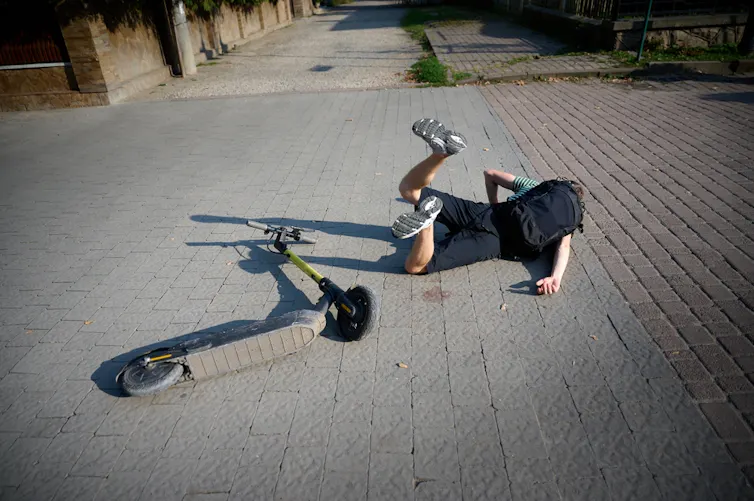
Hit a pothole, kerb or piece of debris and the small front wheel can stop suddenly. The rider keeps moving forwards and can be thrown over the handlebars towards the road, with very little protection between their head and the ground.
This makes helmet use particularly important. Among seriously injured e-scooter riders in the study, only about 6% were recorded as wearing helmets, compared with 45% of cyclists and 76% of motorcyclists.
Children also featured disproportionately. Around 16% of injured e-scooter riders in the trauma database were under 18 – substantially higher than the proportion among injured cyclists or motorcyclists.
A second part of the research examined more than 23,000 incidents involving rental e-scooters across more than 33 million journeys and almost 78 million kilometres. Collision rates varied considerably between cities, suggesting that where people ride may matter as well as what they ride.
Official figures give some indication of the wider burden. In Great Britain, police recorded 1,312 collisions involving e-scooters in 2024, resulting in 1,390 casualties: six people died and an estimated 444 were seriously injured.
How e-scooter injuries are treated
Treatment depends on what has been damaged. Minor fractures may need a cast or brace. More complicated fractures can require surgery involving plates, screws or metal rods. Serious head injuries may need intensive care, brain surgery, or prolonged rehabilitation, while internal bleeding may require emergency surgery.
The consequences can therefore extend far beyond the initial crash. A few seconds on an e-scooter can lead to months away from work, rehabilitation and, in the most severe cases, permanent disability.
Many of the factors contributing to these injuries can be reduced. A helmet cannot prevent a fall, but it can protect the part of the body that appears particularly vulnerable.
Riders should also become familiar with the acceleration, braking and steering before entering heavy traffic. Speed matters, particularly on wet or uneven roads. Using a phone, carrying another passenger or riding after drinking alcohol adds further risk to a vehicle that already demands balance and concentration.
E-scooters have clear advantages: they are convenient, relatively cheap and can replace short car journeys. Millions of rides take place without serious injury.
But their appearance can be misleading. An e-scooter may look more like a child’s scooter than a motorcycle, yet the injuries seen in trauma centres show that falling from one is not necessarily a trivial event.


