

Search Form
Meet the Bulletin‘s new editor-in-chief, Sharon Weinberger
Poster from “The War Game.” Via BBC.
A film about nuclear war “too horrifying for the medium of broadcasting”
By Rebecca Fons | July 8, 2026Share
Oh, where are you coming from, soldier, gaunt soldier,
With weapons beyond any reach of my mind,
With weapons so deadly the world must grow older
And die in its tracks, if it does not turn kind?
—Song for Three Soldiers, Stephen Vincent Benét
The 1990s were foundational movie-watching years for me. I was in my teens, and the films I consumed filled out my world, which at the time was narrow. I grew up in the small town of Winterset, Iowa (pop. 5,000) and it was through cinema that I first saw the gritty streets of New York City; witnessed a passionate kiss between lovers; heard Arabic, French, and Japanese; and experienced what has become my favorite activity: being told a story on a big screen in a room full of strangers.
That decade was a golden age for disaster movies: Twister (1996, man vs. nature), Independence Day (1996, man vs. alien), and Armageddon (1998, man vs. meteor). I logged countless hours in movie theaters watching beautiful people scream, run, drive, scream, shoot, cleverly quip despite certain death, kiss, scream, and always (even if a few characters had shuffled off the mortal movie coil gracefully and cinematically along the way) the heroes triumph against The Big Bad Thing that has come to destroy them—be it tornado, extraterrestrial, or killer rock from space.
Watching these films was a thrilling experience: cramming into the back row of a theater with my nerdy friends, big, buttery popcorn and enormous Diet Coke in hand as we screeched in terror, clutching one another tightly while the ubiquitous James Horner or John Williams score soared, blubbering when Bruce Willis sacrificed himself for the greater good, and holding our breath, praying that our favorite characters would make it out alive. It was exhilarating. These films were glorious and glossy products that Hollywood reliably churned out and that we would happily watch over and over again.
As I’ve gotten older, my palette has matured. I gravitate toward arguably more intellectual fare, but out of a sense of nostalgia—or maybe duty—I buy tickets and go to the sequels, prequels and remakes of the films of my youth; showing up to the theater for each reboot, franchise installment, and sequel. And each time, I sit in my seat, decidedly disconnected. I do not clutch the arm of my husband in the seat next to me, I do not hold my breath and pray. These new films are glossier than ever, but something has changed for me. Maybe the scripts have gotten worse, maybe there have just been one too many sequels.
Or perhaps it’s a third thing. Perhaps it’s that I don’t particularly want to pay $20 to see the screaming, the running, the driving, the shooting, the clever quipping. I neither seek out nor shy away from escapism in my cinema (I’m a film curator, my profession requires an open mind. But when footage of bombs dropping, genocide, and the loss of life is livestreamed every day on the small screen in our pockets, I realize I have become tired—exhausted, in fact—by the endless parade of CGI disasters released every Friday at a movie theater near you.
What’s more, my standard of cinematic terror has been so raised by Peter Watkins’ 1965 pseudo-documentary The War Game that every other big screen cataclysmic storyline feels like folly, other disaster movies come across as distraction.
Watkins, a Brit, was commissioned by the BBC to make The War Game. Most people knew nothing about the arms race, and Watkins planned to make an informational film about the effect of a nuclear strike on Britain.
Boy, did he.
The finished film—a 47-minute, uncompromising nightmare—was immediately suppressed by the BBC, who refused to release it, declaring it “too horrifying for the medium of broadcasting.” (The National Archives 1965). Though they denied it, saying the decision to pull The War Game from television was their own, there is evidence that the BBC screened the film for members of the British Ministry of Defence, who pressured them to ban the film. The War Game was eventually given limited release in cinemas, won an Academy Award for Best Documentary Feature, and finally aired on the BBC in 1985, twenty years later.
Watkins was staunchly anti-war, and throughout his career he used his medium to faithfully communicate his message. Culloden, the feature he made prior to The War Game, portrayed the brutality and futility of the battlefield; and with The War Game, he set out to detail the ultimate disaster: man vs. nuclear catastrophe; man vs. extinction. At a steady clip, Watkins, using a cast of non-actors, matter-of-factly dramatizes September 18 to Christmas Day—the 99 days of terror that follow the dropping of a Soviet nuclear bomb on the outskirts of Kent, England.
Shot in the style of a dry news report, Watkins steadies his camera dispassionately at his subjects, forcing the audience to bear witness as a narrator, without an ounce of sentiment or dramatic soundtrack, explains how little time the citizens of Kent have to take shelter (approximately three minutes, maybe fewer) at the drop of the bomb; how—because he was struck by the bomb’s thermal radiation—this little boy’s eyeballs melted; how 12 seconds later this building collapses due to the subsequent shockwave; or how 10 miles away in Rochester, an airburst has caused the firestorm you see here. And here we see, horrified viewers, Britain is striking back—dropping a bomb on the Soviets. Nuclear war has begun.
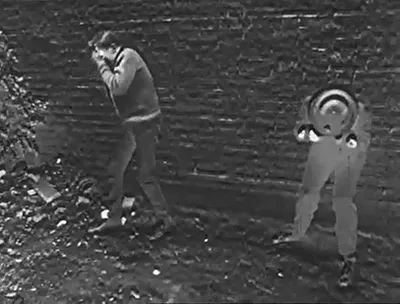
As the medical professionals interviewed in the film tell us: those who live, who make it past the initial blast, the chaos, and the overwhelmed emergency rooms (for every 800 injured, there is one doctor) will succumb to their wounds, to radiation poisoning, or simply to the mental toll of what they have seen.
Those who endure beyond these atrocities live to face the awful truth: After the bomb drops, there are no heroic gestures—this isn’t that kind of disaster movie. No single man or woman rises up from the ashes to lead the weak to victory against armed men guarding the caches of food—the hungry are shot on the spot. A sick child does not miraculously overcome his ailments thanks to the power of love—no, the narrator impassively tells us that he has seven bedridden years to come, and then will die from an unknown illness, likely caused by highly enriched uranium.
Throughout the film Watkins weaves in “man on the street” interviews with the people of Kent, those not involved in the dramatization. The narrator asks them what they know about nuclear war, or the threat of nuclear-armed states. “Very little.” “I’m afraid I don’t know much about atomic radiation at all.” “There won’t be a war, no.” A resident is seen showing off his bomb shelter—a shallow hole in the ground, covered by sandbags.
You can imagine the film concluding in a 1965 screening room, the lights turning on to reveal BBC executives and UK government officials with ashen faces, all immediately agreeing that it would never see the light of day, if they had anything to say about it. You might even agree with them, to a degree: It is a hard film to watch. The Guardian’s Peter Bradshaw said that after he saw The War Game, “It seemed as if I had entered a new era of disillusioned adulthood” (Bradshaw 2025). You can choose, then, to not watch it. Like the Choose Your Own Adventure books of my childhood, you too can choose your own movie disaster when you go to the cinema. Or sit on the couch or pick up your phone: man vs. fill in the blank.
As I write this, we’re a month into another war with Iran, which the White House and its newly retitled Department of War has named “Operation Epic Fury.” White House spokespeople are struggling to define the goal of the operation, or the action itself: It’s a war, or definitely not a war; the goal is to disarm Iran’s nuclear capabilities; or Iran has no nuclear capabilities because we already obliterated those.
Since the operation began, the White House has been posting stylized videos on its TikTok account to promote the war. In one, Nintendo Wii games are intercut with clips of “unclassified” infrared footage of bombs dropping on Iran military sites; a Wii golf game declares “Hole in one!” before cutting to the annihilation of a jet; a bowling ball hits all the pins, followed by grainy black-and-white footage of an artillery site ablaze: “Strike!”
The video that has gotten the most attention is one featuring clips of Hollywood blockbusters. Titled “Justice the American Way,” followed by the fire and American flag emojis, and set to music from the video game Halo, the TikTok begins with Robert Downey Jr. as Ironman’s Tony Stark, at a bay of computers. “Wake up, Daddy’s home,” he announces. In quick succession we see: Russell Crowe in Gladiator (“Strength and honor”), Mel Gibson in Braveheart (“What will you do without freedom?”), Tom Cruise in Top Gun: Maverick (“Maverick’s inbound”) before the screen fills with infrared footage of an enormous explosion. Scenes from John Wick, Superman (“I’m here to fight for truth, justice, and the American way.”), Star Wars, and Transformers follow, alongside half-a-dozen shots of bombs dropping. It is not possible for viewers to know if in the strike footage there is loss of life, or to know what is left when the dust clears, but there is no question that they will recognize Mel Gibson, and everyone certainly knows that is Tom Cruise.
The United States military has a long, healthy relationship with Hollywood. Newsreels from wartime, movies romanticizing war; the military-entertainment complex is strong.
But these TikTok videos…there is something especially dangerous happening here. What associations do the average person have with Top Gun: Maverick? Big, buttery popcorn, Diet Coke, a sweeping Hans Zimmer score, Alpha masculinity. By connecting scenes of Capt. Pete “Maverick” Mitchell to shots of bomb impacts in Iran, a message is being sent loud and clear: Real war is just like the movies. Dropping bombs makes you feel like a Hollywood movie star, like an Avenger, like Tom Cruise.
With The War Game, Watkins’ message was clear: When a bomb drops, the destruction is so complete, there can be no heroes. When you see the horrors that come from the pushing of the button, do you still think the man who pushes the button is brave? Sixty years later, the official White House TikTok account is publishing videos of military footage set to Los Del Río’s The Macarena, and the audience loves it: Comments on these videos are rapturous in their praise. “Whoever runs this account deserves a raise and is a legend.” “Iconic.”
I am nostalgic about those silly disaster movies of my youth and the thrill they gave me—who doesn’t like being entertained? Cinema has been thrilling audiences since 1896, when brothers Louis and Auguste Lumière showed an audience footage of a train arriving at a station and they fled, thinking the train was coming straight for them. When they realized there was no danger, they returned to their seats and an industry was born. The War Game was dangerous because it told the truth about the horrors of nuclear war; these TikTok videos are dangerous because they tell a lie—that war is a game and it’s as easy as getting a hole in one.
Editor’s note: Like many of the older films that are mentioned in this article, “The War Game” can be seen by doing a search for it on YouTube. More recent movies can be viewed by paying the usual subscription services online, buying a DVD, or renting via the local library—or even [shocking] going in-person to a revival at the local cinema. And if one looks hard enough, there are still a few summertime drive-in movie theaters around, as the July issue of the Bulletin goes to press.
References
Bradshaw, P. 2025. “Peter Watkins: an English film-making revolutionary from a tradition of uncompromising radicalism.” The Guardian. https://www.theguardian.com/film/2025/nov/03/peter-watkins-film-making-revolutionary-war-game-culloden-punishment-park
The National Archives. 1965. “BBC film censored?” Sixties Britain, transcript of Parliamentary question asked in the House of Commons by William Hamilton MP to the Secretary of State for the Home Department. December 2. The National Archives. https://www.nationalarchives.gov.uk/education/resources/sixties-britain/bbc-film-censored/
Together, we make the world safer.
The Bulletin elevates expert voices above the noise. But as an independent nonprofit organization, our operations depend on the support of readers like you. Help us continue to deliver quality journalism that holds leaders accountable. Your support of our work at any level is important. In return, we promise our coverage will be understandable, influential, vigilant, solution-oriented, and fair-minded. Together we can make a difference.


