
Fruit Flies Use Memory to Track Smells
·July 22, 2026
Summary: Researchers revealed that fruit flies (Drosophila melanogaster) navigate odor plumes using a sophisticated directional memory system rather than basic sensory reflexes.
Using a virtual-reality treadmill coupled with real-time neural imaging, researchers discovered that flies consistently navigate along the outer boundary of a scent plume, a strategy termed “edge tracking.” Every time a fly crosses into and out of the plume, a specialized set of neurons (FC2 neurons) within the brain’s central complex stores an angular directional memory pointing back toward the plume edge.
This internal compass allows the insect to dynamically re-orient toward the scent source even when wind conditions shift or the odor wafts away.
Key Facts
- Edge Tracking Strategy: Rather than walking down the center of an odor plume or blindly heading upwind, fruit flies weave along the boundary of the scent, using the edge as a spatial guidepost.
- Central Complex Neural Compass: Directional navigation is driven by FC2 neurons in the central complex, an ancient brain region responsible for spatial orientation in insects like bees and ants.
- Dynamic Angular Memory: Inside an odor plume, FC2 neurons reflect the fly’s current heading. The moment the fly exits the plume, these neurons pivot to encode an angular memory pointing back to the plume boundary.
- Robustness to Wind Shifts: Edge tracking allows flies to successfully reach an odor source even if the plume is angled perpendicular to the wind or rapidly shifting position.
- Essential Circuitry: Silencing FC2 neurons completely abolishes the fly’s ability to turn back toward the plume after exiting, confirming that plume recovery relies on stored spatial memory rather than simple reflexes.

Source: Rockefeller University
When a fruit fly catches a whiff of a ripe peach, it quickly heads toward it. Time after time, it finds the fruit—even from many feet away and even if the scent arrives only as a few drifting, disconnected puffs.
How do they home in with such unerring accuracy? Scientists have long assumed that all insects track smells with simple reflexes, turning straight upwind when they smell something appetizing.
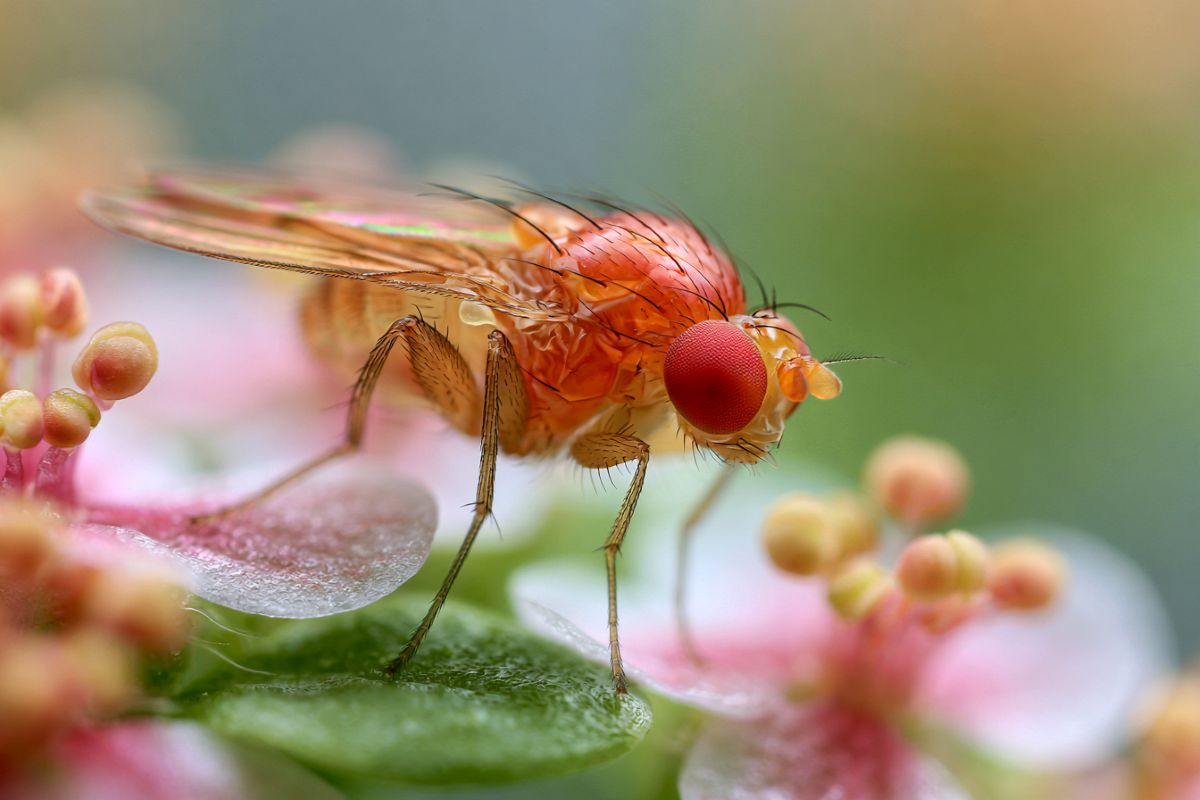
Now, researchers in Vanessa Ruta’s lab at Rockefeller University have found that flies use a more complex navigational strategy, which relies on a sophisticated memory system.
As flies track an odor, they weave along the edge of the odor’s plume. Each time they cross into and out of the plume, they store a directional memory that points back toward the scent plume, transforming a fleeting odor encounter into a spatial memory. This stored memory is what allows them to keep navigating towards the odor source even if the plume is not aligned with the wind or wafts away.
The findings, published in Nature, show that odor tracking is not just a reflexive response but instead, flies use brain circuitry for spatial navigation to remember where a plume boundary lies and steer back to it.
“Odors are some of the richest cues animals use to navigate, but they are also some of the most difficult to navigate and to study, because they are invisible and constantly shifting,” says Ruta, head of the Laboratory of Neurophysiology and Behavior. “We wanted to understand how an animal builds a working picture of a chemical world it can’t actually see.”
Following the edge
Ruta’s team built a virtual-reality system in which a fly walks on an air-supported ball, able to turn and move forward or backward in place, like a rotating treadmill. As the fly turns, a nozzle delivering a steady air stream rotates to match, mimicking wind from a fixed direction. When the fly reaches set points on a virtual map, the researchers pipe in precise amounts of apple cider vinegar scent, allowing them to create defined odor landscapes.
“The advantage of this kind of very controlled environment is that we know exactly what the fly is smelling at every moment,” says Charles Dowell, a postdoctoral associate in the Ruta lab and an author on the study. “That is something that is very hard to pin down with real, physical plumes of odor in the natural environment.”
The team expected flies to steer upwind and track within the center of an odor plume. Instead, flies consistently tracked along just one edge of a plume, darting into the odor, quickly turning out of the plume, then walking in clean air before returning. The researchers call this pattern “edge tracking.”
To test how well this strategy worked, Ruta’s group changed the conditions that flies had to contend with—angling the plume relative to the wind or shifting the plume’s position every time a fly left it. They showed that flies could efficiently track a plume even if was perpendicular to the wind direction, underscoring edge tracking is a remarkably flexible and robust strategy.
The team also exposed flies to a recording of how a real, physical odor plume drifts and breaks apart in moving air. In the most turbulent regions of the plume, where odor encounters were too fragmented for angular memories to be reliable, flies appeared to rely on other search strategies. But closer to the odor source, where the plume became more coherent and predictable, flies transitioned to memory-guided edge tracking.
“A turbulent plume is fragmented and very complicated; flies could be facing any particular direction,” says Silas Busch, a postdoctoral fellow in the lab. “But remarkably, the flies still found their way to the region where the plume was likely to be, and tracked its edge in the same way. That was a really exciting moment for me, realizing this behavior scales across very different kinds of odor structures.”
A compass in the brain
By monitoring activity in the flies’ brain cells at the same time the insects were immersed in the virtual reality environment, the team were able to home in on the importance of the brain’s central complex—an ancient insect brain region that supports spatial navigation. They found that a set of cells called FC2 neurons that encode a fly’s navigational goals didn’t always remain fixed in one direction. While a fly was inside an odor plume, the FC2 neurons pointed in the fly’s current direction.
Once the fly left the plume, however, the cells pointed back toward its edge, suggesting that these neurons reflect the angular memory to return to the plume. Silencing FC2 neurons left flies unable to return to the scent. The results reaffirmed that the flies weren’t simply following sensory cues back to the plume, but using a form of directional memory.
“It took us a while to convince ourselves that this really relies on an angular memory,” Ruta says. Unlike a bee returning to its nest, a fly tracking a plume has no single location to aim for, since the scent itself drifts.
“The plume isn’t found in a specific location, so tracking it does not require flies to store the exact position of the plume. Instead we found they use a directional memory that allows the fly to use each odor encounter at the plume’s boundary as a chemical signpost to help them track to the source.”
The new findings reframe odor tracking as a sophisticated form of spatial memory rather than a simple reflex. The reliance on the central complex suggests that tracking a fleeting drifting plume relies on the same brain architecture that ants and bees use to find their nests. More broadly, the work highlights how flexibly the circuitry of the central complex can be used in different sensory contexts, allowing animals to use odors as dynamic spatial cues.
“When people think about fruit flies, they imagine they are simple, reflexive little creatures,” Ruta says. “But when you consider what they have to contend with in their natural environment, you find they are using strategies that are adaptive, flexible, and surprisingly sophisticated—mechanisms we might have expected only in animals with much bigger brains. The power of the fly is that we can now begin to understand how those computations are built by the brain.”
Key Questions Answered:
Q: Why was it previously assumed that insects only use reflexes to follow smells?
A: Traditional models suggested that insects use simple anemotaxis, a reflex where an animal senses a smell and automatically turns directly upwind. Because odor plumes in nature are invisible and turbulent, it was difficult to observe the precise moment-by-moment corrections insects make at the plume boundary.
Q: How do FC2 neurons act as an internal compass for the fly?
A: FC2 neurons in the brain’s central complex keep track of heading directions. While inside a scent plume, they track the fly’s real-time movement. When the fly steps out of the scent, these neurons maintain an “angular memory” vector pointing back toward where the scent was last detected, serving as a chemical signpost to steer the fly back on course.
Q: Why is “edge tracking” better than walking straight down the middle of a scent?
A: Wind constantly breaks odor plumes into disjointed puffs. By weaving along the outer edge of a plume, the fly continuously updates its spatial memory at the boundary, ensuring it can relocate the scent pathway even if the plume moves perpendicular to the wind or breaks apart.
Editorial Notes:
- This article was edited by a Neuroscience News editor.
- Journal paper reviewed in full.
- Additional context added by our staff.
About this olfaction and memory research news
Author: Katherine Fenz
Source: Rockefeller University
Contact: Katherine Fenz – Rockefeller University
Image: The image is credited to Neuroscience News
Original Research: Open access.
“A vector-based strategy for olfactory navigation in Drosophila” by Andrew F. Siliciano, Sun Minni, Chad Morton, Charles K. Dowell, Noelle B. Eghbali, Silas E. Busch, Juliana Y. Rhee, L. F. Abbott & Vanessa Ruta. Nature
DOI:10.1038/s41586-026-10827-7
A


